Archive | Adventures in Chow City RSS feed for this section

BBQ in the ‘Burbs

14 Dec

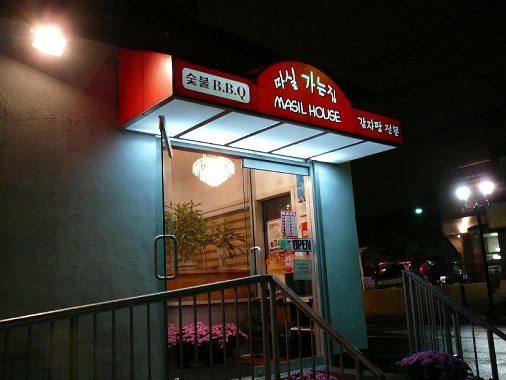
Our first out-of-town odyssey with Gerry was our venture just across the bridge to Fort Lee and the Korean, Masil House (see archives for November 9). When his turn to pick came up again, he took us further, a continuing theme for Gerry, when we traveled to Westchester for the not very exotic, though maybe it is for Westchester, barbecue. Here is what we experienced in the in Valhalla, New York in the fall of 2003.

Southbound Bar-B-Que

R.I.P.
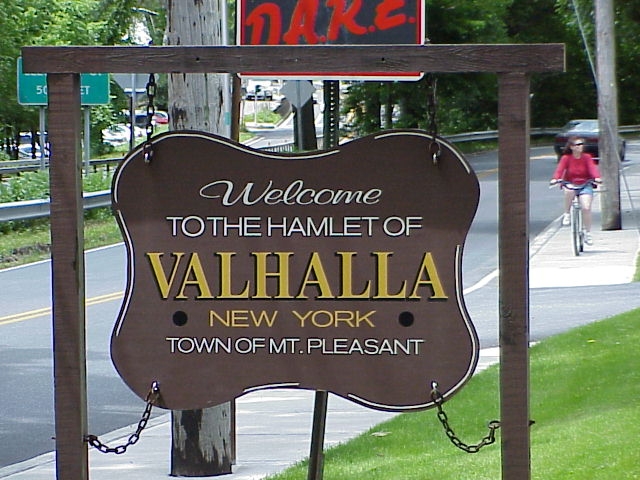


It was a bit confusing to begin with. We were heading north looking for the Southbound Barb-B-Que. And north, in this case wasn’t the Bronx, it was Westchester, Valhalla to be precise, conveniently Gerry’s hometown as well as the final resting place of Babe Ruth. Rick had obliged to haul those of us who lived in the city in his all-wheel turbo Ram out of the bright lights and into the dark roads of Westchester. Gerry is a bit of a barbecue aficionado, so we all very much anticipated his choice despite the schlep out of New York City’s environs. Using my increasingly fading memory of Westchester and the vague directions Gerry gave me, we were able to find the restaurant without too much trouble. Stepping out of the “Ram,” I sniffed. There was nothing yet. . .nothing to indicate that we were in very close proximity to a self-proclaimed “butt kickin’ rib joint.”  But as we got closer two huge exhaust ventilators were spewing the reassuringly familiar perfume of smoking meat.

The restaurant was painfully bright especially after navigating the black streets of Westchester. Gerry and Eugene were already present and so was our table for six. All of the other tables were occupied making Southbound Bar-B-Que one of the most popular of places we have experienced. Could there have been a little blurb in the New Yorker? Or was it that this was the real deal? Service started off slow, but the delay was more than compensated by very cold mugs of beer, endless baskets of freshly-made potato chips that kept arriving on our table, and recollections by Eugene about his first experience watching ESPN at the former incarnation of Southbound Bar-B-Que, a German restaurant named Franzl’s.
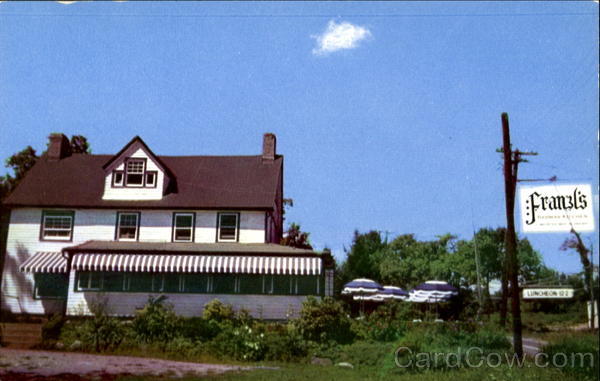
Southbound Bar-B-Que’s former incarnation.

As is the case with most barbecue joints, the menu was not very extensive. Ribs were the advertised specialty and available in a half or  full rack. The other typical barbecue items were pulled pork, smoked chicken, sausage, and beef brisket. With the exception of the chicken, we ordered everything, including two full racks of ribs. Then there were the sides; corn bread, baked beans, macaroni and cheese, corn, and “freedom” fries because the place would have been empty if they used the other F* word to define their fries.
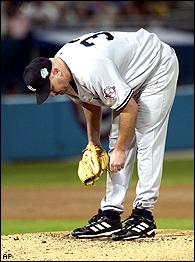
David Wells and his bad back was not good for the Yankees or my appetite.

Our food began to arrive around the first pitch of Game 5 of the World Series. And by the time David Wells left the game because of a bad back, the Valhalla chapter of the Hells Angels had entered the restaurant and took seats directly behind us. But neither the intimidating presence of the Angels nor the unwelcome David Wells’ situation deterred us from devouring the variety of smoked meats placed in front of us. The ribs, though spiced a bit blandly, were cooked perfectly, and the pulled pork was a true winner as was the beef brisket. The sides were nothing more than adequate; the corn bread a bit sweet and the macaroni and cheese unmemorable. The sauces were also a disappointment; all were overly sweet for my palate and the desserts good but indistinguishable. But I guess, despite the shortcomings, ribs cooked very closely to perfection in, of all places, Westchester, is a triumph in itself. I just hope the close proximity to barbecue doesn’t make Gerry complacent and limit his excellent efforts in that very same department.

I’m not sure when Southbound Barb-B-Que closed, but Gerry assures me it’s been gone a long time and that the food, after several visits following ours, went downhill very quickly. So, according to Gerry, its demise was no loss to him. The Yankees lost the World Series a few days later; David Wells’ injury pretty much doomed them and it wasn’t until six years later when they got back to the Series.

*The F word in the fall of 2003 was “French” for French fries. This was during the ridiculous hysteria during the lead up to the Iraq invasion when the French and their anti-invasion stance was vilified by Rupert Murdoch’s minions.

Across 125th Street

7 Dec

For years I would drive past the M&G Diner on 125th Street and wonder at the restaurant’s flamboyant signs “Soul Food” and “Southern Fried Chicken.” The signage looked authentically from the 1960’s and 70’s and I was curious if the food was, as another one of its signs said, “Old Fashion’, But Good!” Yet I continued to just “drive by;” never getting out of the car to check it out. When it was my turn to pick our destination in September of 2003, the time had finally come. Below is our M&G Diner experience.

M&G Diner: Circa 1974

M&G Diner
R.I.P

If it weren’t for the small poster tacked onto the entrance to the 125th St. subway station announcing an upcoming rally for “Reparations: It’s Time They Pay,” I would have thought I had just stepped onto the set of a 1970’s blaxploitation movie. There was the West African Hair Groomers just a few doors down from Showman’s Café, est. 1942 and on the corner of 125th and Morningside, the big neon “soul food” sign at the M&G Diner. Gerry and Eugene were waiting outside when I arrived. Eugene had arrived first and was marveling at the contrasts found on 125th street where in one store an NBA jacket sold for almost $800 while in another pants were selling for $1 each.

Peering into the spectacularly unadorned diner, I noticed only a few tables; this Harlem legend which I had never experienced was much smaller than I had thought. I suggested we take one of the tables before they disappeared. Rick had already bowed out of this trip due to an attack of either too much drink the night before, some tainted food, or the combination of both. That made five of us—the capacity for one of the tables at the M &G.

“What they do!…they smile in your face…”

“Back Stabbers,” by the O ‘Jays was playing when we entered. We were off to an excellent start.

It had been almost two months since our last venture and judging by Zio’s trim appearance a few minutes later, the layoff had been very good for his waistline. But we were now in a self proclaimed soul food restaurant and we couldn’t worry about our waistlines.  While we waited for Charlie, we perused the succinct menu: fried chicken (leg or breast), short ribs of beef, meat loaf, shell steak, chopped steak, chitterlings, smothered pork chops, ham hocks, fish and grits. With each dinner you were to choose two sides including soul food standards like lima beans, green beans, macaroni and cheese, collard greens, black eyed peas, and yams. Even though the options were not foreign to us, deciding what to order, as it always does, requires deep clear thinking. While looking at the menu, Eugene mentioned jokingly about ordering eggs and despite the music playing loudly from the jukebox, the lone woman behind the counter heard him and barked: “No breakfast served now!” The hand-written signs on the walls announced that the M&G was open 24 hours and that breakfast was served daily but only between 12:00 am until 1:00 pm. You obviously don’t joke about defying the one written rule of the M&G Diner.

We had given Charlie a half hour grace period and he still hadn’t arrived; it was time to begin the ordering process. The woman came from behind the counter equipped with pad in hand. She was running the show; handling all the tables, the counter service and the outgoing orders with brisk, yet good natured efficiency. Now she had moved to our table; she wanted decisive answers—waffling would not be tolerated. After each of us recited our dinner orders, she barked out “Sides?” We were ready for her with our responses and then: “Dinner roll or corn muffin?” Despite her formidable presence and our novice status at the M&G, we handled the drill reasonably well. Zio and Eugene went for the fried chicken, Gerry the smothered pork chops.

“Short ribs,” I said to her when it was my turn to order, but then the pressure got to me and my response of macaroni and cheese and collard greens came out with a slight stammer. I could tell she sensed weakness in me so, in response to the bread query, I rallied with a strong, definitive “corn muffin.”

Charlie walked in soon after we ordered with the lame excuse of being stuck in the office as an alibi for his tardiness. There was no way we were going to risk the wrath of the M&G Queen by summoning her to our table again, so we sent Charlie to the counter to put in his own order.


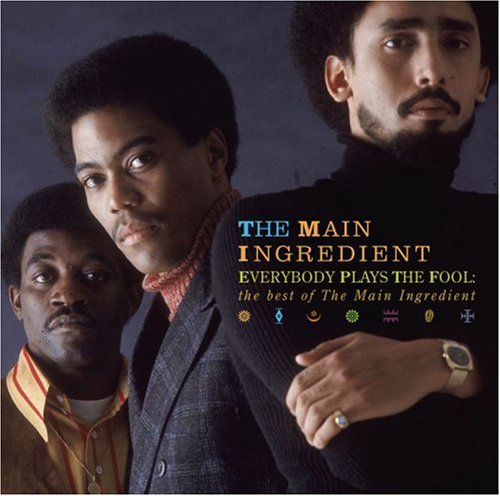
With nothing to munch on and the beverage choices being soda or overly sweet lemonade, all we could do while waiting for our food was listen to the Main Ingredient remind us that “Everybody Plays the Fool.” And then the M&G Queen arrived with our orders, carrying a few plates at a time without, as far as I could tell, even breaking a sweat.

The chicken had been proclaimed in our research as a highlight, and judging from what I saw and sampled, that assessment was accurate; tender and lightly pan-fried the way fried chicken was meant to be prepared as opposed to deep fried in a heavy batter. My short ribs were perfectly cooked, the meat separating cleanly from the fat and bones; the brown sauce, however, a bit thick and bland for my taste. The corn muffins were warm and not overly sweet and Gerry’s pork chops, tender and seasoned perfectly.

Despite the gargantuan portions, almost all of us were willing to sample the cakes and pies for dessert. I was the lone dissenter instead choosing an extra fork in which to pick at all the others. I tried a bit of Zio’s coconut cake, a bit more of Gerry’s sweet potato pie and almost all of Charlie’s chocolate cake and immediately regretted my decision in not ordering a slice of cake for myself. So impressed were we by the desserts, we asked if they were made at the diner. The M&G Queen said no and held out for a minute in revealing where they were from. Without too much coaxing, she gave in and, finally, offering us a smile as well, said they came from the H&H Bakery in Brooklyn as if that meant anything to any of us.

Our tab came in well under the $20 limit and as we were leaving, I heard O.V. Wright on the jukebox moaning something about “A Nickel and a Nail.”  We went our separate ways at 125th St, and as I walked toward the subway,  I noticed that the velvet rope was already out in front of Showman’s Café.


The M&G closed in 2008. A new condo tower had been proposed to be built on the corner where it was located. That project fell through; a casualty of the recession, but the damage was done. M&G was gone and I guess it gave an already struggling business an early out. It’s not easy for something “old fashion’ But Good” to compete with “DD,” “BK,’ “MickeyDs” and the other fast food joints that are now, unfortunately a permanent part of the 125th Street landscape.

Literary Tacos

30 Nov

We visited El Paso Taqueria, which is chronicled below, in the summer of 2003. It was the first Mexican restaurant we had been to since forming our group. I remember being very surprised as well as upset that soon after Charlie circulated his choice with the other members, the New Yorker magazine came out with one of their restaurant blurbs on, coincidentally, El Paso Taqueria.

El Paso Taqueria
1643 Lexington Ave
East Harlem

Charlie didn’t know that the New Yorker magazine would scoop him on El Paso Taqueria. If he did, he surely would have looked elsewhere to take the group. Once a restaurant is written up by the New Yorker, the kiss of death has been delivered at least for our purposes. A cheap “ethnic” restaurant mentioned by the New Yorker pretty much guarantees that there will be a major change in both clientele and attitude at the restaurant and that was, apparently, the case the night we visited. As a result, our sense of adventure was immediately deflated. But there are other problems: the influx of bluebloods from the neighborhood a few blocks to the south called “Carnegie Hill”, and their incessant questions about what’s on the menu, what to order, how spicy is it, etc., can also breed resentment on a suddenly overworked staff; and  resentment can lead to petulance and impatience. Unfortunately, at El Paso Taqueria, that scenario was playing out for us.


Our listless waitress asked if we wanted guacamole to start, as if we had a choice. Guacamole? Now if she asked us if we wanted the “corn fungus,” that was described in the New Yorker or a “flor de calabaza” quesadilla we would have been seriously impressed. Instead, we got guacamole which turned out to be her final suggestion for us. We were on our own, but maybe, in this case, that was okay. Zio wasted no time and actually restrained himself here and only ordered a mere six varieties of tacos, including tripe and tongue. The mention of tongue prompted Eugene, as if he had rehearsed it, to repeatedly state that he only had one preference for “tongue.” His sniggering comment got a minimal chuckle the first time we heard it, but he persisted with his sad routine until it soon became background noise. I delved in with an order of sopes; a thick tortilla covered with various meats and topped with soft cheese. Of the “platos tipicos” or typical plates, we all were interested in the mole poblano, and the “famous puebla stew.” Could we go wrong if it was so famous? Charlie suggested the “adobo de puerco,” spare ribs in a hot and spicy sauce, and Gerry opted for the exotic “cecina asada” salted beef with cactus jalapenos and onion. Was it enough, we asked the waitress? She shrugged.

It was enough. Everything came at once making the table look like one giant open-faced taco. Most of the dishes, certainly the tacos and sopes looked alike, with the meat simmered in a tomato and pepper sauce and sprinkled with cotija cheese. Only by sampling the meats, could you tell the difference between the tongue and the salted beef or the tripe and the spicy pork. The mole poblano was dark and rich with chocolate while Gerry’s salted beef was extremely high on the spice meter. Charlie’s spare ribs were an interesting variation, but at least from this experience, ribs are not what they do best in Mexico. The stew, with chicken, tomatillos, peppers, and potatoes, was hearty and comforting, but we still wondered what made it famous. Dessert was strawberries in whip cream or bananas in whip cream. We tried both. And, though nothing very exciting, they were a refreshing end to the meal.


From the New Yorker blurb, we learned that El Paso Taqueria began as a lunch truck feeding the Mexican immigrants that were new to the neighborhood of East Harlem, offering a quick, inexpensive and authentic taco or two before getting back to work. The lunch truck became so popular it sprouted the restaurant on 104th and Lexington where we were and a new one on 97th between Madison and Park. But after eating in the restaurant, I think the lunch truck, where you can savor one, two, or maybe three or four tacos at a time, is probably the best and most authentic way to enjoy the food and flavors of El Paso Taqueria. And you don’t even have to order the guacamole.

Looking back on what I wrote, I see how I let being scooped by the New Yorker cloud my summary of our El Paso Taqueria experience. I was hard on the restaurant though it was no fault of theirs. All I could do was complain that the guacamole was pushed on us and that the tacos looked alike. I’ve since reformed my ways and even have an El Paso Taqueria take out menu in my possession which my family uses as our first option when it comes to having Mexican delivered to our home.

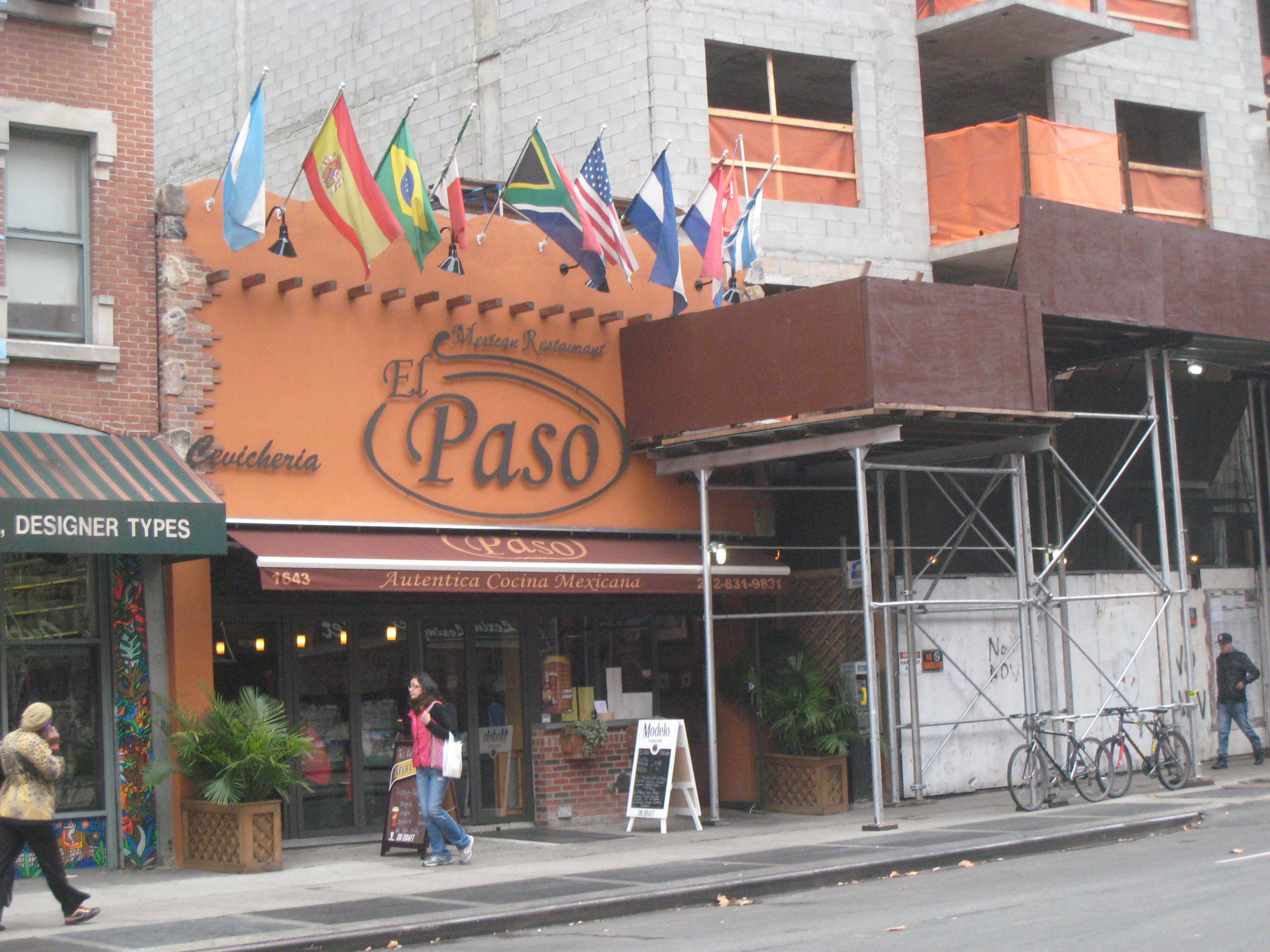
The newest El Paso Taqueria complete with cevicheria and scaffolding.

Like the growing Mexican population in East Harlem—they now are the largest immigrant group in that community surpassing Puerto Ricans and Dominicans—El Paso Taqueria has grown as well. There are now three El Paso Taqueria outlets, including one on 116th Street and another across the street from the original that advertises a “cocktail list” and a “cevicheria.” For the record, there was no ceviche or cockails on the menu when we visited. The original location where we dined has been turned into a take-out taqueria (see photo above).  They also have a colorful website www.elpasotaqueria.com and a new, flashy lunch truck proving that, along with a pretty good taco, there’s nothing like what a little publicity from a renowned literary magazine will do for business.

Cooked in Corona

23 Nov

A few weeks before our trip to La Pollada De Laura, we visited a Thai restaurant in Woodside called Arunee. At the time in 2003, the legend of Sripraphai, the most famous Thai restaurant in Queens, was already cemented. Arunee, on the other hand, in Jackson Heights, was still comparatively undiscovered until Eugene steered us in its direction.  The meal, I recall was spectacular, but, unfortunately it was one of the few, due to a family emergency at home, I never reported on. Queens was our destination again, and what follows is our experience at a Peruvian restaurant called La Pollada de Laura.

La Pollada de Laura
(R.I.P)

Zio’s misadventures driving around Jackson Heights searching feebly for Arunee, the Thai restaurant we last visited, convinced him to take the subway from his love nest in Astoria to our next destination, La Pollada de Laura in Corona.  I also planned on the subway, the 7 train, and before leaving we tried to coordinate it that we would meet at the 103rd St Corona station. To help we came equipped with cell phones.

The Peruvian restaurant Rick chose was located on Northern Boulevard. Having been in Corona only once, when my car broke down on the Long Island Expressway many years ago, I was clueless as to how to get to Northern Boulevard. The Colombians, Mexicans, Dominicans, and others Latin American immigrants were out in large numbers around Roosevelt Avenue on this pleasant Spring night, but getting an answer to my question; which direction was Northern Boulevard, spoken in English, did not produce immediate results. I tried calling Zio’s cell phone but another 7 train had rumbled into the station above muffling any chance I had of communicating with him. Finally, using sign language, I was pointed in the direction of Northern Boulevard. Once clear of the elevated tracks, I was able to make phone contact with Zio who had already found the restaurant. As I made my way the very long five blocks to Northern Boulevard, Zio and I had a running commentary on the bustling neighborhood where even the music from the ice cream trucks had a Latin tinge to it.

Gerry and Eugene were seated and the music was blasting as I entered La Pollada de Laura. Rick soon joined us and after Eugene regaled us with stories of his Times Square Madame Tussaud’s experience, as if we were interested, we were just about ready to order. The menu featured numerous ceviches, a Peruvian staple. Eugene, without elaborating, was determined to sample leche de tigre, otherwise known as “Peruvian Viagra.” The very friendly waitress happily explained the lore of the dish; that among its health benefits was an enhancement of male virility. Not that anyone of us, with the possible exception of Eugene, believed her, but it was the sweetly innocent way she explained it that made us order not one, but two leche de tigres.

Rick had mentioned that the owner of the restaurant, Manny, would help us decide what to order from the menu. But Manny had not arrived, so it was up to the ever-helpful waitress to recommend how we should proceed. Instead of a few different ceviches, she suggested we go with the ceviche mixto, which had a little of everything; fish, octopus, squid, shrimp and conch. I’ve had the famous Peruvian pollo a la brasa (roast chicken) at other Spanish restaurants, but wanted to try it here. We also ordered a jalea grande, a mix of fried fish, shellfish, potatoes accompanied with a salsa criolla, and with a nod from our waitress, lomo saltado de carne; beef with slices of onions, tomatoes and French fries.

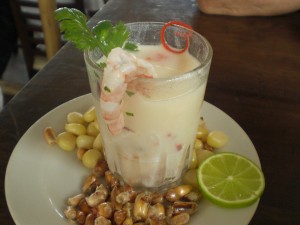
While we waited, we were brought a pre-meal snack; tiny pieces of purple, salted corn kernels. They went well with our Peruvian beer, Cusquena. The leche de tigre was first to arrive at our table. Large shrimp and half a blue crab hanging over a tall glass filled with a milky liquid; the “tigers’ milk.” I immediately tasted a spoonful of the liquid—the “leche”—was the juice used to marinate, or “cook” the fish with lemon, lime, cilantro and peppers. And there was only so much of that juice you could actually drink without “cooking” the inside of your own mouth. Virility, male or female, was most definitely needed to down a big glass of leche de tigre.

At most of our food adventures, once the food begins to arrive, there is little room on our table. But we eat quickly not only because we can’t help ourselves, but because the quicker we eat and dispose of a platter, the more room will be found at our table for another entrée.  This night was no exception.  The delicious lomo saltado was devoured before the ceviche mixto even arrived, but still, our table was crammed with a whole pollo a la brasa and a monumental-sized mound of jalea, fried mixed seafood cooked to perfection.  When the ceviche arrived, we found room on the table for the equally large portion; the squid, octopus, fish and other seafood tenderly marinated, smothered in red onions and swimming in the lemon juice.

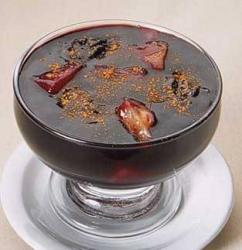
Manny eventually showed up and brought us his homemade hot sauce. Ignoring Manny’s warning of its intensity, Rick smothered his ceviche with the sauce and soon the sweat was flowing alarmingly from his forehead. Finishing what was on the table seemed impossible, but given time we did not disappoint. We even had room for dessert, trying Manny’s recommendation, mazamorra morada, a crimson-colored gelatinous mess that prompted Zio to make a comment about blood, brains, and shotguns. Though collectively not to our liking, Eugene could not resist mentioning that it was better than the infamous beans of halo halo from Ihawan, the Filipino restaurant we visited a year ago.

Amazingly, all of what we ate came under our budget and then some. As Zio and I tried to walk off the meal in the four blocks to the subway, we wondered how, with prices like that, La Pollada de Laura could actually stay in business. Before either of us could respond, the sound of the number 7 train drowned out any hope of further conversation.

In the book I write about New York City, I recommended pairing a meal at La Pollada de Laura with a visit to the nearby Louis Armstrong House Museum, where the jazz great lived from the 1940’s until his death in 1971. Unfortunately, several years ago, La Pollada de Laura closed thus answering our 2003 question wondering how they could stay in business considering the prices they were charging.

Fire on Grand Street

16 Nov

When we visited Nyonya in early 2003, before the internet food site explosion, the Malaysian restaurant, though located in Little Italy a few doors from the great Di Palo Fine Foods, was still somewhat under the radar. At the time, it had a following, but nothing like it does now. It was our group’s first experience with Malaysian food and the unadulterated heat that distinguishes it.  We like unadulterated—heat or otherwise—so Malaysian food became one of our most repeated cuisines.

Nyonya
199 Grand Street
Little Italy

Zio confided that he had many options for our upcoming food destination, but the thought of crispy pork intestines, beef tripe noodle soup, fresh fish head cooked with lemon grass, and sooi pooi (sour plum) drink which Nyonya, the place he ultimately chose, offered, was too enticing for him to pass on. So all of us, Eugene excepted, who was on a Caribbean cruise and most likely at work on the unlimited buffet line, assembled in the bustling tiki-hut like restaurant in Chinatown. We were the few non-Asians in the restaurant; a very promising sign.

The menu was extensive and when not entranced by the bloated fish swimming in the tank behind our table, we had to concentrate on the task ahead: what to order. Crunch time came and all Zio could come up with after the promise of a variety of organ meats in coconut milk was the relatively conventional mango chicken. Eugene was probably experiencing more exotic fare on his cruise.  Zio’s selection was vociferously vetoed and after much urging switched to the more adventurous, kari ayam, described in the menu as chicken cooked over low heat with lemongrass and chili paste and simmered in thick rich coconut curry. Charlie stuck with chicken as well and gambled on the Hainanese chicken, steamed (room temperature) with a chef’s soy sauce. Gerry ordered the kang kung belacan, which translated meant sautéed “convolus” with spicy Malaysian shrimp paste sauce. We had to ask one of the dozen or so waitresses who were attending to our table for the translation of “convolus,” and were told that it was Malaysian string beans. Rick showed his fortitude by ordering cheng-lai stingray while I went with the comparatively mundane curry spareribs.


It wasn’t that the promise of gargantuan main courses was not enough for us. It was that Nyona’s appetizers looked much too good on paper to pass up. So we started with the so-called “Malaysian national dish,” roti canai, an Indian pancake with a curry chicken dipping sauce. Chicken satay and Poh Piah, a Malaysian spring roll stuffed with jicama and minced shrimp rounded out our first courses. To drink there was Chinese beer for most of us while Zio insisted instead on the fresh coconut juice. When his drink arrived in half a real coconut and a big straw, we wondered why the pink umbrella was missing.  Zio, oblivious as always, cradled the coconut in his hands and sucked the juice from the straw. We looked at him for a moment, savoring the absurd sight, and then went back to our beer.

The parade of waitresses began piling the food on our table almost immediately and just as quickly we began to devour it, eating the roti canai with our hands, dipping it into the murky, but very tasty curry, pulling at the tender satay, and wondering over the jicama in the spring roll. Rick’s sting ray (a.k.a. skate) was the first entrée to arrive and we picked at the perfectly cooked flesh, dipping it into a fiery sauce. At Nyonya, fiery was the theme; the curry spareribs particularly sinus-clearing while Zio’s chicken, also very spicy and falling off the bone. In fact, all of the food, including the sautéed “convolus” which tasted nothing like string beans, wax beans, green beans or anything else we had previously encountered, was hot with the one exception of Charlie’s wan-looking “room temperature” chicken, which many at the table found unappealing; though Gerry and I thought it’s blandness was the perfect antidote to the heat in the other dishes.


We worked through all the food at the table with only a few pieces of the above-mentioned Hainanese chicken remaining—and no volunteers to take it home. Our stomachs bloated, no one even mentioned dessert…not even the usually insatiable Zio. In Eugene’s absence, I was left to do the math and after tip and including drinks, we came in one dollar over our $20 budget—meaning, excluding the drinks, that we actually came under budget.


A few years ago Nyonya moved across Grand Street to a shiny new space. It also branched out to Brooklyn with two locations. I’m not sure if now Nyonya would qualify for our group. Too popular. Really almost a chain with three branches in the city. But that is now, and the above was then and none of us had any complaints about what we experienced in 2003.

The Seoul of Jersey

9 Nov

The following trip to New Jersey for Korean food was our first expedition outside of New York City. Gerry, who lives in the suburbs, has been the boldest of us all in finding places beyond New York, often to the major chagrin of the others, myself included. But after our trip to Masil House, no one was complaining. Here is what we experienced in the Korean enclave of Fort Lee.

Masil House
400 Main Street
Fort Lee, New Jersey


Gerry was bold and brave in his choice for our most recent food adventure. Not only did he gamble by summoning us across the Hudson River to the shores of Fort Lee, New Jersey, he also chose a place that we discovered upon our arrival, had velvet-covered menus. More used to grease-smeared paper menus, the velvet-covered menus immediately sent up warning signs.  But his was no brash act by someone irresponsibly leading the group astray. No, Gerry deliberated long on the subject taking his assignment extremely seriously. He even committed a first in our year-long gatherings. He, as Rick aptly put it, “called an audible,” switching the destination almost at the last moment from a tofu-laden, seemingly all-vegetarian Korean restaurant  to another Korean restaurant, this one with a barbecue grill in the middle of our table. The barbecue brought with it the promise of an abundance of meats and, though we have nothing against tofu and all the health-benefits it contains, Gerry’s audible was quietly endorsed by all.


While we waited for Rick’s arrival, we sipped barley tea and studied the thick menus. Gerry suggested we skip the appetizers and stay for the most part with the entrees; that as part of the Korean meal, many side dishes are included with the entrees. After making a few suggestions of our own, we turned over the ordering to Gerry. This was his show. The only exception came from Eugene who insisted we include an order of the stewed baby chicken with ginseng. Eugene’s insistence was based on the claim that we all needed some of the attributes that supposedly are contained in the fabled ancient Asian root.  “Speak for yourself,” Zio barked back to Eugene. And really, where was Eugene when he had the opportunity for “Johnny to get up and stand up” by trying some of the Jamaican Irish Moss drink and some of the other  “health” tonics that were available at Toyamadel, our last get together?

As soon as Gerry completed the order with the patient waiter, the side dishes he had told us about began arriving; aromatic and spicy kimchi, salted anchovies, sugared seaweed, pickled turnips, sesame-seeded soy sauce, vinegar peppers, and other items unidentifiable to me. We began picking at  the condiments as the waiter prepared the barbecue. It was a cold night in New Jersey and the extra warmth from the barbecue as well as from the spicy food was welcome.

Once the coals and grate were hot, pieces of marinated beef short ribs, Bul Gol Bi, removed from the rib were put on the grill. While the beef cooked, we tasted the ginseng chicken, a pancake filled with assorted seafood including shrimp and squid, and a very spicy stew of octopus and noodles. All were flavorful and immense in portion, but it was the barbecue that was the highlight. Like a taco, we wrapped the cooked meat in a lettuce leaf stuffed with condiments such as raw garlic, hot pepper, a garlicky bean paste, and whatever else you wanted to add and ate lustily. Along with the two orders of short ribs, there was one order of sliced marinated pork with peppers and onions.


As we have been trained to do, we devoured just about everything on the crowded table with only a few small overly-charred pieces of meat remaining on the grill.  It didn’t take long for all the fragrant accompaniments; garlic, cabbage, salted, cured fish, and spices to begin oozing from our pores.  And at the time, sated and satisfied, none of us really cared how truly “aromatic” our Korean feast had made us.

Dessert, apparently, was not an option. We were, however, brought complimentary slices of orange. The oranges had a cleansing effect—a clearing of the palette from the strong redolent assault we had just experienced. The bill came and adding in a very generous tip due to the fact that actual cooking was done by the waiters at our table, it came to $20 each–exactly our prescribed limit.  As it was coming over, crossing the river via the George Washington Bridge back to New York, the traffic was light. Gerry’s Jersey gamble was a success.

I haven’t been back to Fort Lee for Korean food or any other reason since that night in early 2003. Gerry’s success in getting us out of our comfortable New York City environs on this night apparently led him to take even more gambles, with, in many cases, much more mixed results. You will read of them as these adventures continue.

Cool Jerk

2 Nov

I had been to Jamaica many times for both business and for vacations and was very familiar with the food. I knew it would be hard to replicate my island experiences, but I was curious to see how this one compared when we visited in December of 2002.

Toyamadel
(Now Known As The Food Hut)
1709 Amsterdam Avenue
Hamilton Heights

The place formerly known as Toyamadel

The wind was howling down the northern fringes of Amsterdam Avenue on a frigid early December night. I was waiting for a transfer to the M101 bus from 135th Street to take me ten blocks up to my destination: Toyamadel, the Jamaican eatery I chose for our stouthearted group of diners. But on this night, the stouthearted were diminished in numbers. Charlie took an early exit by having a tennis match (indoors we hope) scheduled on the evening of our meet while Gerry, due to a family commitment was also absent. So when that 101 finally and thankfully arrived and shuttled me the ten blocks north to Toyamadel, only poor Eugene was waiting, cell phone in hand thinking he would be left deserted on that desolate night in the brightly-lit restaurant dining room surrounded by root tonics and coco bread.

Soon Zio appeared, layered in his favorite arctic gear, and then Rick, more urbane in his noir-New York threads. Whatever your attire, you had to keep the coats on here—the heat from the restaurant’s radiator was feeble at best. Toyamadel was not like our other experiences. With a miniscule dining area, the restaurant was mostly take-out. We didn’t waste time making small talk before ordering from the somewhat beleaguered woman behind the sturdy plexiglass shield.

By 7:30 the menu had been remarkably paired down. Many of the desired items typical of Jamaican cuisine had a blue star next to them. This blue star, we were told, signified they were out of that item. The curry goat was gone. The ital vegetable stew was history. The brown stewed chicken, a memory. The red and the blue snapper: finis.  And to Zio’s dismay, they were even out of the stewed cow foot. But that did not mean we didn’t have anything to choose from. There were still both vegetable and chicken patties available and we tried two of each. The jerk chicken was without a blue star so Eugene and Phil quickly ordered it. I went for the stewed codfish, an item from the breakfast menu that had remarkably survived until dinner while Rick decided on the oxtails. The next major decision was the size of our dinner. Behind the shield and near the menu there were displays of the $6, $8, or $10 portions. The empty $10 portion plate just didn’t look like much up there on the display, so, without really any hesitation, we went for the biggest portion.


The drink menu, though non-alcoholic, was extensive. None of us were courageous enough to sample any of the pricey herbal tonics on the menu such as “Doctor Bird Bitters,” “Sun Dial Wood Root,” “Groundation Root,” “Root Force,”  “Rage Roots,” “SSS Tonic,” and “Irish Moss” that promised, among other things, to help get “Johnny” in the words of Bob Marley, to “get up, and stand up.” The prospect that presented was, considering our motley group, just too frightening to even consider, so we stuck to more familiar fare; lemonade, ginger beer and the Caribbean Christmas specialty, Sorrel, which Eugene sampled and immediately approved of. Months after the sweet bean dessert experience at the Filipino restaurant in Queens, Eugene, it seems, was still having difficulties coming to terms with the fact that what was supposed to be a sweet fruit dessert had cannellini beans in it. Something about those beans had, evidently, struck a primal chord in his subconscious memory. But Eugene’s subconscious was an area we really did not want to explore.

The patties were slipped to us in a brown paper bag under the plastic shield. Topped with Pickapeppa sauce, both the chicken and vegetable varieties were quickly devoured. The $10 dinners came next; the tins in which they were served weighed down with meat, rice and peas, plantains and salad. My stewed codfish was tender and not overly salty. But the combination of rice and peas, yams and plantains—a serious starch overload—was doing me in.

Being the jerk aficionado I am, I had to sample Zio’s chicken. With the possible exception of what I’ve prepared on a Weber grill, back in the days when I had a Weber grill, I’ve not had jerk chicken replicated anywhere near what you can get in Jamaica. Toyamadel, I’m afraid, was no exception. The chicken was tender and the sauce flavorful, though not too fiery. But it just didn’t have that smoky, earthy flavor you get when ordering from an open air jerk stand on the island.

As usual, we over-ordered, the $8 plates would have been more than enough. But that didn’t stop Zio and I from consuming slices of a freshly made carrot cake. By the time we paid, $14 per person, well under our allotted $20, there were even more blue stars next to items. But the customers kept coming. And the door kept opening and closing with freezing regularity.

Toyamadel closed soon after we visited and reopened as “The Food Hut.”  I returned recently and noted that the menu was exactly the same as I remembered nor were any alterations made to the bare bones interior. Even the prices had remarkably held with plates ranging from $6 to $10 dollars.  I tried a veggie and beef patty; ordering at the steam table and then paying and receiving my order under the plexiglass shield just as I had eight years earlier.  Grateful that some things just don’t change, I found a seat at one of the tiny restaurant’s tables and ate the patties.


Pupusa Love

26 Oct

Still in our first year, but now on our second round of picks, Charlie found La Cabana Salvadorena “in the heights”…several years before the musical of the same name opened. I remember driving up and around the hills past the George Washington Bridge trying to find parking. I also remember how glad the owners and chef were to have us at his restaurant. Something that happened quite often throughout our years doing this.

La Cabana Salvadoreña
4384 Broadway
Washington Heights

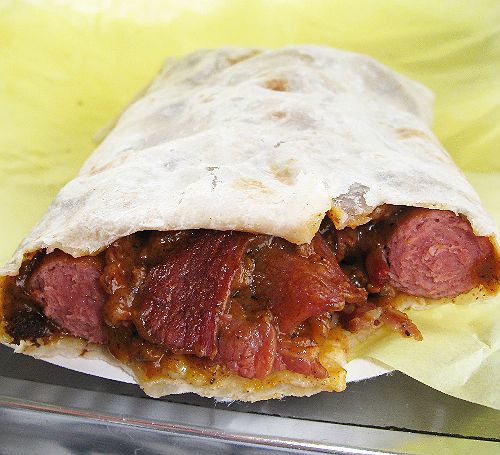
Having gone full circle; everyone fulfilling their responsibility and picking a restaurant within our still vague guidelines, it was back to Charlie, who led off last February with the Puerto Rican restaurant in El Barrio, La Fonda Boricua. Keeping in that Latin vein and also keeping us in Manhattan, Charlie chose La Cabana Salvadorena, on 187th street and Broadway, the northern fringe of Washington Heights. The food promised was not just Latin, but Salvadoran, a cuisine none of us had the pleasure of previously experiencing. I admit having come close while living in Los Angeles in the 1980’s. During my seemingly endless time behind the wheel of my wreck of a car, I would pass establishments advertising pupusas. These establishments were called pupuserias. Though always somewhat adventurous about food, I never had the nerve to pull up to a pupuseria in Los Angeles. Hot dogs were a big part of my subsistence while I struggled in Los Angeles and I ate all kinds there including a very memorable one called an Oki Dog, two hot dogs

wrapped in a big burrito-sized flour tortilla and stuffed with pastrami, cheese, chili and onions. The Oki Dog experience I still remember fondly as a youthful indulgence akin to experimenting with a hallucinogenic drug. I had no limits when it came to hot dogs, but I could not get myself to try a pupusa. There was the connotation with something cuddly that just turned me off.  So here, many years later on a cold damp autumn evening in Washington Heights, I think I was ready to try a pupusa.

Zio and I were the first to arrive at the brightly-lit restaurant. We choose the big round table next to the “Real Women Have Curves” poster. Our waitress came up immediately to begin taking our orders. I held out my fingers in the right manner to alert the waitress that there would be six of us and ordered a Presidente beer. The waitress obviously knew little or no English and Zio and I pointed to the menu helping her to understand. And looking at the menus, which were under the glass on the table, we noticed different variations of the same menus. One item on all the different menus, however, was consistent: pupusas.

After struggling to find parking, the others soon all arrived. I warned them that getting help on what to order from the exotic menu might be difficult considering the language barrier with our waitress. No sooner had I said that than Raul came to our rescue. Raul, it turned out, had no financial attachment to La Cabana Salvadorena; he was an electrician and a friend of the owners. He offered his bilingual services to us along with his expertise in choosing the best items on the menu. We gave Raul free reign as what to order for us. We trusted him implicitly. And Raul, despite being from Honduras rather than Salvador, delivered. He came back with pupusas, rice and corn flour patties, stuffed with beans, pork, and cheese. He picked a mixed seafood ceviche for us, a few platters of “Plato Tipico” a combination plate of typical Salvadoran food; thinly pounded steak, steamed chicken tamale in the husk, a cheese pupusa with “loroco” a grated cheese, sweet plantains, and a “tortilla;” an omelet with chorizo and onions. We engulfed it. Consumed it. Devoured it all including the tasteless cabbage salad that came in a jar and was on every table. While we were eating, the chef, who also spoke little or no English came out to check on our progress. Looking somewhat like the actor, Edward James Olmos, the chef was impressed with our work, though upset that Raul had neglected to order us the boiled beef, also a Salvadoran specialty. Next time, we promised. He went away smiling and satisfied the gringos were pleased.

As with most of our experiences, dessert was limited here as well. We all sampled a piece of what seemed like fried dough in sugar syrup. Eugene immediately proclaimed the meal as his favorite of the seven we had experienced. And it certainly fulfilled our original aim; even with beers and other drinks, our bill came under $20 per person. We were getting pretty good at this.

I returned to La Cabana Salvadorena recently.  I was glad to see that pretty much nothing had changed in the eight years since I’d last visited. They had no website and there were no stickers from Zagat, Yelp, Citysearch or anywhere else on their windows. The awning, small front counter, and dining room, with the exception of the “Real Women Have Curves” poster being gone, was exactly as I remembered it. But best of all were the prices—still frozen at 2002 levels.

Spleen on a Bun

19 Oct

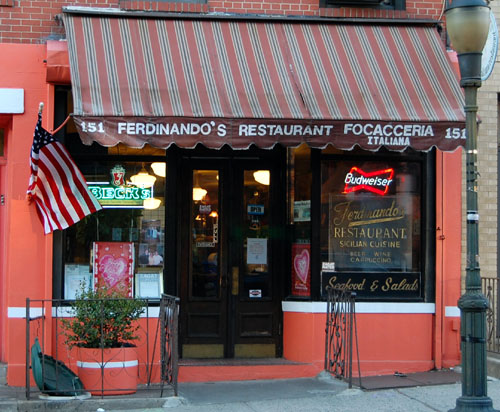
Rick was the last of us to make a pick during our first go round in this still experimental food group. His choice was a convenient restaurant close to his then apartment in Carroll Gardens called Ferdinando’s Focacceria. This was in 2002 and at the time I had no idea of the burgeoning gentrification and real estate boom that was happening in that neighborhood. I’m not sure Rick was even aware of it even while he was living in the midst of the boom. Looking back, the changing clientele in the restaurant at the time was a tip off though it was really just the start. Within a few years, townhouses that were owned for generations of mostly Italian Americans were being gobbled up for astronomical sums…and still are. The upward creeping prices at the ancient restaurant should have also been an indication. My recording of that meal in the fall of 2002 follows:

Ferdinando’s Focacceria
151 Union Street
Brooklyn

The red flags went up soon after I sat down at Ferdinando’s Focacceria Ristorante on Union Street in the Carroll Gardens section of Brooklyn. Just a short walk from Rick’s apartment, Ferdinando’s was his pick, the last of our first go-round at this food adventure thing. The red flags were up because of what I noticed on the restaurant’s ancient (circa 1904) brick walls; plaques with a commendation from Zagat and another with a printed review by Eric Asimov of the New York Times in the $25 and under column he used to write. His review of Ferdinando’s appeared in 1993 when $25 and under went a longer way than $25 and under does now. And anyway, our aim wasn’t $25 and under, it was $20 and under. And commendations from popular guides like Zagat and of course from the Newspaper of Record meant that this was far from an “under the radar” establishment. Okay, so every place we go to can’t be a discovery, but could we at least be not too far off? I guess if you’ve been around since 1904 that’s pretty hard to do.

I’m mainly familiar with Carroll Gardens through Rick and the abundant barbecues he holds in his backyard. Whenever I visited, I’d see the old school Italian-Americans sitting in their rickety lawn chairs in front of their brownstones. These were the people, Rick claimed, who were the clientele of Ferdinando’s and that’s how he sold it. But on this Friday evening, the restaurant was inhabited not by those I used to see sitting on those lawn chairs on summer evenings. The diners at Ferdinando’s were more like the six (myself included) who waddled in from somewhere else. In other words, Ferdinando’s, like the neighborhood, was getting seriously gentrified. So because it had already been discovered by the New York Times and Zagat, and despite what looked like an intriguing menu, I was wary that Ferdinando’s might not pass the somewhat stringent and purposely vague criteria we had set for ourselves.

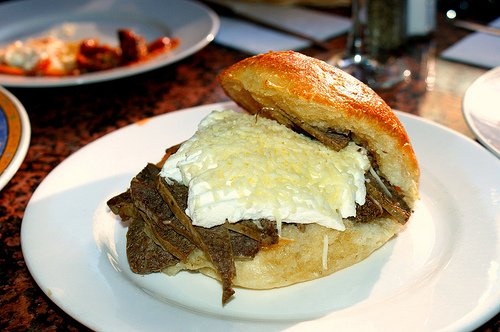
I confess as never having visited a focacceria and was unsure of what it was. I knew of foccacia and assumed Ferdinando’s specialized in typical focaccia, maybe with a brush of fresh tomato on top, or a sprinkling of olive oil and herbs. Ferdinando’s focaccia wasn’t quite typical. Rick recommended the “panelle” special so we had a few brought to the table. These “focaccia” were more like buns, made with chick pea flour and deep fried; the special was topped with ricotta and grated cheese. We also indulged on other of the smaller Sicilian specialties such as the “arancina,” a rice ball deep fried with chopped meat, peas and sauce, and an incredible “caponatina,” the famed Sicilian eggplant salad. No one, not even the adventurous Zio tried the “vastedda,” a sandwich made with calf’s spleen, ricotta and grated cheese. Zio, however, did not disappoint by quickly and decisively ordering his entrée of “trippa,” tripe stewed in tomato sauce with peas. Eugene was also very resolute when he ordered another Sicilian specialty, pasta con sarde, pasta with sardines, fennel, and pine nuts. Rounding out the orders were Rick with the pedestrian pasta con vongole, Gerry with linguini con seppia (squid in its ink), Charlie with the downright lame, chicken parmigiana and rigatoni, and myself with one of the specials of the day, pasta with baby polpo (octopus). As if that were not quite enough, Rick thought we should also try the calamari ripieni, stuffed calamari with mussels. The beverage of choice for most of us was the Italian beer, Peroni.


We soon finished off our appetizers and, while waiting for our entrees, devoured the endless baskets of fresh unadorned focaccia. Rick had noticed the diners as I had and a bit nervously assured me that whenever he had visited Ferdinando’s in the past, usually for lunch—the restaurant is only open until 9 on Fridays and Saturdays—that the locals; specifically, the old timers, were the only diners, not the gentrified groups we were seeing on this night. By then, though, I was no longer aware of the diners, only the food in front of me. The baby polpo on my linguini was perfectly tender, the sauce, sort of a sweet and sour sauce, maybe a bit too sweet for me. Zio’s “trippa” appeared hearty; the white lining of cow’s intestine swimming in tomato sauce.  And for some reason, with the exception of the courageous Gerry, he had no volunteers for samples. I was curious about Eugene’s pasta con sarde, but by the time I got around to asking for a taste, it was gone; Eugene enthusiastically proclaiming its virtues. Finally came the stuffed calamari and though Zio had previously and rancorously announced that he never ate anything “stuffed,” he relented and tried the calamari, which, filled with bread crumbs, garlic and herbs, he grudgingly acknowledged that it was “damn good for something stuffed.”

With the dry focaccia we cleaned the sauces on all our dishes reserving, incredibly, a bit of room for a cannoli sampling. This simple, classic Italian pastry was also worth noting for its perfection; the shell fresh, the cheese spectacular. Finally finished, our check was brought to the table. In the scrawl on a tiny piece of paper, Rick knew we had gone over our “budget.” Eugene did the math and the damage was $36 per person. It wasn’t as bad as it seemed at first glance. There were empty bottles of Peroni littering our table and drinks do not factor into our price limit, so that reduced the total somewhat. Add in the stuffed calamari extra and we were really only about three or four dollars over the $20 allowance. Rick did not meet the criteria. Not only did he not factor in our gluttony, had he read the Zagat review, he would have known that the total figured within that book was $22. Asimov’s $25 and Under review was another tip. Rick obviously just did not do his research. Not that I, or any of us were complaining

Looking back on our experience at Ferdinando’s, I’m very surprised no one had the courage to try the spleen. I think we were all a little raw at this and did not want to test our limits too much. That changed as the group evolved.  I  did revisit Ferdinando’s. It was probably in 2007 at the height of the real estate boom in Brooklyn. My experience was not as positive; the food not as good as I remembered from the above visit and prices had climbed so much that it was hard to imagine any of the old timers from the neighborhood (if any still remained) spending much time at Ferdinandos…even for lunch. Carroll Gardens was a much different place. Even Rick had fled.

Kvass and Vodka

12 Oct

Soon after we started this food group, we learned that Eugene had friends of many different nationalities. We don’t really know why or how he happened to befriend so many from other lands, but he made it clear that he had them. At our dinners he would often refer to a friend from India, or China, or Peru, to name just a few. Eugene would then pick the brain of that friend asking for a recommendation; a place where we could find an authentic replication of the food of that person’s particular homeland. For his first pick, Eugene called on a Russian friend who suggested Café Glechik. Below is what we experienced on a warm summer’s night in 2002.

Café Glechik
3159 Coney Island Avenue
Brooklyn

There was a slight delay in getting started on the trek to Brighton Beach, to the Ukrainian restaurant suggested by Eugene called Café Glechik. The delay was due to the sudden emergence of cockroaches and other less unsightly bugs in my kitchen. I needed expert help and there was no one else to call than Zio. For those not aware of it, Zio is a man of many talents. Not only can he make a first rate beef braciole,  he is also a talented illustrator. But it is his ability to kill termites, cockroaches, carpenter ants, the many variations of rodents, and all those other pests that is his true gift. I needed that gift and Zio delivered with a few well-placed shots of an extremely deadly, though not odorous concoction that the cockroaches, he claimed, just cannot resist. The other problem was the little bugs I had been seeing on the kitchen counter. We spent time shaking a few items in my cupboards seeking the source of these bugs, but were having no luck until we found a few lounging in a box of Festival mix I had brought back from Jamaica. Festival being the equivalent of fried dough and served usually with jerk pork and chicken. The bug Zio identified as a flour beetle. The Festival had to go. With it, I hoped also would go the flour beetles.

Finally we headed out, with Charlie in tow. Over the Triboro Bridge. Crawling through the BQE. Heading down Ocean Parkway. Finally, Coney Island was in sight and after an hour of driving, we made it to Café Glechik in the Russian/Ukrainian enclave of Brighton Beach.

The others were seated and waiting in the small, busy café when we arrived. The Café did not have a liquor license and Gerry had gone out in search of vodka. He was told there was a liquor store on a street called “Brighton 10.” He returned empty-handed. “Too many Brighton 10s,” he said shaking his head.  Apparently there was more than one. In the meantime, a young man called Vlad began to explain the items on the menu. He was helpful and patient though inexperienced. After a few really tough questions such as what would he suggest we eat to sample a true Russian meal at Café Glechik, he gave up and handed us over to another waiter, this one not as patient, nor as helpful. He wouldn’t even tell us his name he just wanted our orders—we were on our own here.

After my contact lenses cleared from glancing at the Russian language side of the menu, I was able to discern what we might be eating, starting with herring with potato, smoked mackerel and “vareniki,” the Russian version of a pierogi. We ordered one stuffed with potato and another with meat. After Rick, Eugene, and Charlie made the mistake of asking Waiter Number Two a few questions about some of the items on the menu, his glare flustered them so much they ordered whatever blurted from their tongues; in this case it was chicken stroganoff, beef stroganoff and grilled chicken breast respectively. Zio, aware of the wrath of Waiter Number Two, wasted no time ordering the rabbit stew.

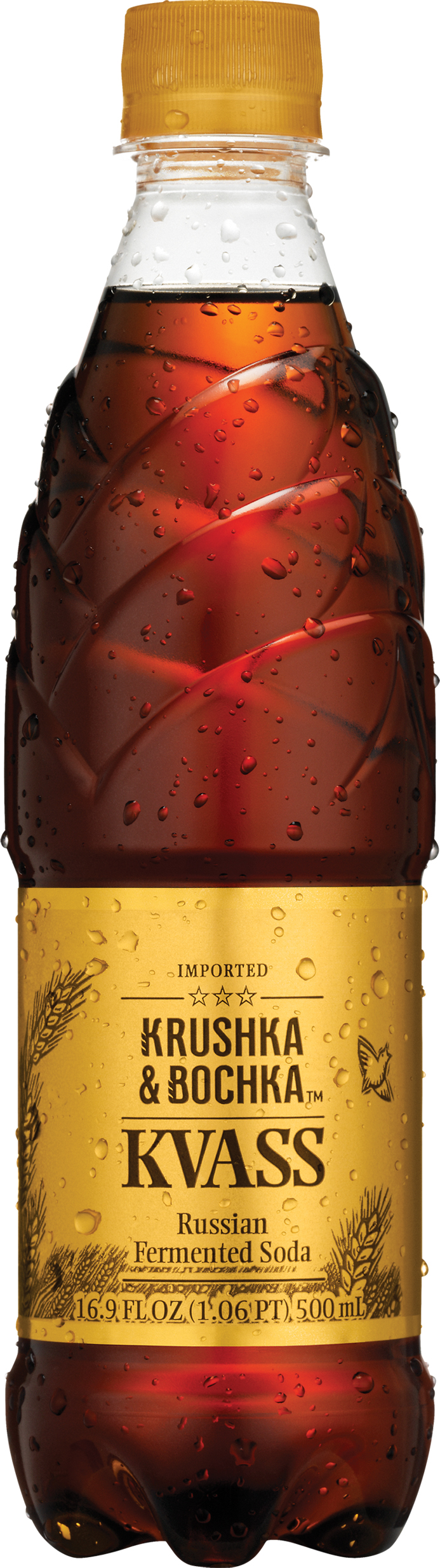
One of the few things my Ukrainian-born Grandmother was able to cook competently was stuffed cabbage. It had been well over 30 years since I last tasted that stuffed cabbage, but it was a distinct taste and I was curious to see how this would compare, so my choice seemed easy. Under the pressure of the moment created by the gruff waiter, we didn’t realize until our main courses had arrived and that Gerry forgot to order one so, to the mix, and to Waiter Number Two’s rolling eyes, he quickly added stewed “Odessa” in a pot, a Russian variation on beef stew.  For our beverage, we all ordered the local carbonated, non-alcoholic drink called Kvass. It was said, though I don’t know who said it, to be a very good chaser for vodka.

To calm our nerves, we needed more than Kvass and this time Vlad gave us clearer directions to a liquor store. Gerry and I took a walk while the others waited for our food and drinks. The Russian-owned liquor store which shared a storefront with a video store had many Russian vodkas I was unfamiliar with. They were cheap and seemed like worthy companions to a Russian meal. But the store owner steered us away from the Russian stuff instead urging us to buy Absolut, proclaiming that it was much better. It was also much more expensive which might have been why he was pushing it.


The Kvass and the herring and mackerel were waiting for us when we returned. The Kvass, like the cantaloupe drink at Ihawan, turned out to be another unfortunate beverage choice. Made with water, yeast, sugar and raisins, it tasted like a sweetened version of the malta drinks popular with Hispanics. I’ve washed down rum with coconut water, ginger beer, and a grapefruit soda called Ting, but chasing the Absolut with Kvass just wasn’t working for me. It did not, however, dampen mine or anyone else’s appetite once the food began piling on our table. The vareniki, freshly made and as light as something so dense could possibly be, still began to weigh us down. That didn’t mean there were any leftovers. Everything was scraped clean. Soon the clay pots, in which all the entrees were served, began to arrive. We slowly cleared through them, picking at the meats, scooping up the sauces, not leaving anything. The meats were tender, the sauces heavy and bland. The stuffed cabbage still had that distinctive taste but was better than I remembered it. This was good hearty fare for a brisk night in the Ukraine. But it was summer in Coney Island and now our meal was weighing on us a bit uncomfortably.

When Waiter Number Two came to take our dessert order we were hesitant. We made the mistake of asking what was on the dessert menu. He responded brusquely with “fancy cake and cherry vareniki.” We shrugged; we would try one of each for the table. Apparently he took that to mean we all wanted to try a piece of the “fancy cake,” so he returned with six pieces of a non-descript cream-filled cake along with a huge platter covered with 100 pieces of vareniki dripping with sour cherries and their syrup. To Zio’s failing eyes the platter looking like what he called “cherriolies,” or cherry ravioli. I tried a few but almost lost a front tooth when biting into the so-called pitted cherries.


Despite the dessert oversight, and not factoring in the kvass or vodka, the meal came in just under $20 each. That was the good news. The not so good news was that it took the hour ride back, and then some, for the dead weight that had amassed in my belly after the feast at Café Gelchick to dissipate. It was dark when I got back. I turned on the lights in the kitchen. There were no bugs scurrying. The roaches were gone. And for that I was happy.

I’ve never been back to Café Glechik, but from what I can tell it’s been a very good eight years. The restaurant, much bigger now has the prerequisite website; www.glechik.com. And on that website I noticed that scary word I see much too often at ethnic restaurants: “fusion.” In this case it’s called “Ukrainian Fusion,” whatever that might mean. In 2006 the New York Times reviewed the restaurant in the paper’s “$25 and Under” column. Anthony Bourdain featured it on his program “No Reservations” on the Travel Channel. You can, of course, follow Glechik on Twitter and Facebook. They even opened another Café Glechik; this one in Sheepshead Bay. There’s also a full bar at the restaurant now and I’m sure kvass is available.  That funky beverage has prospered as well. Earlier this year, the Coca Cola company made a deal to import Kvass to the United States and a few weeks ago, at a nearby Whole Foods Store, I noticed that samples of the drink were being given out.  A server smiled and asked if I wanted to try some. I politely passed.