Archive | Adventures in Chow City RSS feed for this section

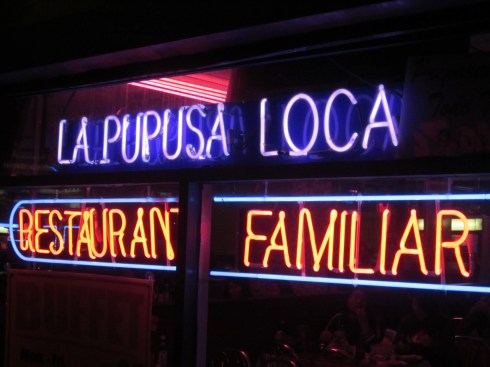
Living La Pupusa Loca

18 Dec

pupusa loca 050

Sometimes the third time is the charm. At least that was the case for Mike from Yonkers who had to go to plan C for our latest outing.

Plan A was a “hot tip” on a place in Bloomfield, New Jersey. He kept the tip to himself, but we nixed schlepping to Bloomfield during the “gridlock alert days” we were currently experiencing.

“I’ll save that one for next time,” he slyly added, still keeping us under wraps on what we might encounter in Bloomfield.

Plan B illustrated that Mike from Yonkers was experiencing much holiday duress. Under pressure to select a destination, he mistakenly consulted New York Magazine and choose the wildly popular Brooklyn Thai  restaurant, Pok Pok. That he didn’t realize that a place given multiple stars (whatever they mean) by New York Magazine wouldn’t be mobbed by voracious foodies can only be excused by a combination of work and holiday stress. To make it clear to him, we sent him links with actual photos of some of the long and legendary lines waiting to dine at Pok Pok.

One thing Mike from Yonkers did know, at least we hoped he did after almost eight years as a member of our group, was that we never wait on line to dine. The options are too many for that. So one look at the links and he knew he had to go to Plan C.

Now, under immediate pressure, he went to his own backyard.  His pick: a Salvadorian place just over the Bronx border in Yonkers called La Pupusa Loca.

Welcome to Yonkers

And despite it not being in the five boroughs, La Pupusa Loca fit right into our criteria. A brightly-lit cafeteria where English was very foreign and Spanish novelas blared from multiple televisions, La Pupusa Loca featured large tables offering our group of five—Rick being absent after the very recent birth of his first child—plenty of room for food and flesh overflow.
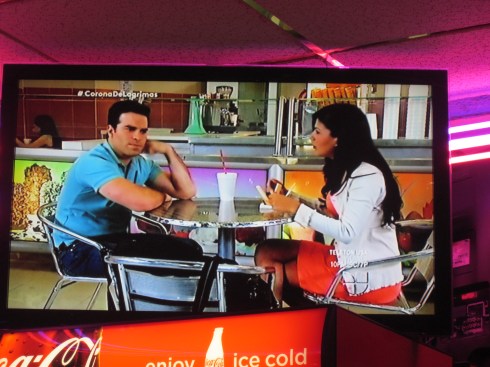
Serious happenings on the tube.

Serious happenings on the tube.

Mike from Yonkers and I were the first to arrive, followed soon after by Zio and at that time, the lone waitress was ready to take our order. I started with a Pilsener, a Salvadorian beer, but waited on ordering food until the others arrived. By the time Gerry and Eugene arrived, however, the waitress was occupied with others and the wait seemed interminable.

“Is this the longest we’ve had to wait,” Eugene asked.

“I’m hungry,” Gerry bellowed. “I haven’t eaten since lunch.”

Finally, visibly harried, the waitress came to our table and took our orders. I needed to discover what the restaurant’s namesake, the pupusa, tasted like and ordered a bean and cheese.  Foolishly thinking it would be too much for me, I passed on what I saw someone else in the restaurant getting: the “mariscada especial;” an enormous bowl of fish soup where, lobster, shrimp with the heads on, and crab claws overflowed from. Instead I went with a seafood combination of shrimp and fried fish, casamiento, a mash of beans, rice, garlic and other herbs, and chimol, a Salvadorian salsa.

Gerry and Eugene both also ordered fish; Eugene the whole red snapper with onions and Gerry the fried porgy.

“Where does porgy come from?” I asked.

“Long Island Sound,” Zio answered.

“Yeah and that’s why I ordered it. To support our local fishermen,” Gerry cracked.

An enormous platter of pork chops passed our table and Zio’s weary eyes were immediately drawn to them. “I’ll have what they’re having,” he said repeating the oft-used line.

After studiously perusing the menu, Mike from Yonkers went with the steak combination which included an egg, scrambled according to the waitress.

“Can I have it fried,” Mike from Yonkers pleaded, giving her a look she could not refuse.

The pupusas arrived first, which came with a tomato sauce on the side and a big container of homemade pickled cabbage. Our waitress said the cabbage was eaten as an accompaniment to the pupusa.

“Its Salvadorian sauerkraut,” Zio announced after trying the cabbage. And so it was, but not really needed, in my opinion to enhance the already deliciously crazy pupusa.
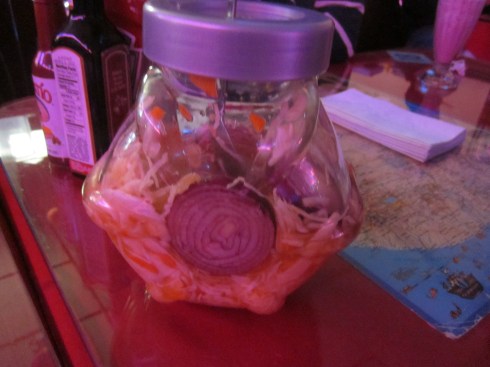
Salvadorian sauerkraut

Salvadorian sauerkraut

The platters began to arrive. First were Gerry’s and Eugene’s whole, fried fish, both smothered in onions. Next were the super-sized pork chops. After inspecting their enormity, Zio groaned realizing what he was in for.

Only Mike from Yonkers’ family-sized combination platter exceeded Zio’s. On the platter was a selection of beef cuts, two long “maduros,” sweet bananas, a wedge of salty hard white cheese, and a mound of rice and beans; all of it topped with the requested fried egg.
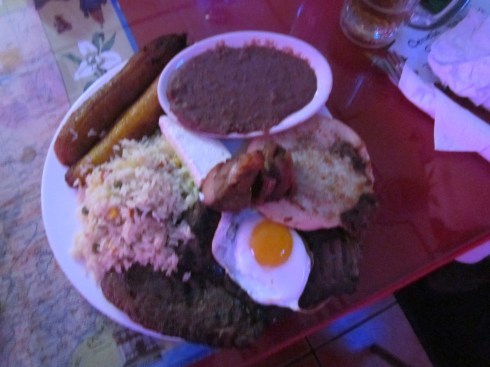
Meat combo with fried egg.

Meat combo with fried egg.

When my comparably miniscule plate arrived, the discrepancy was noticed by all. On it was just a small wedge of fish filet and a few “medium” shrimp, along with the casamiento and chimol. It was as if I ordered from the kids’ menu, if there was such a thing at La Pupusa Loca.

“Don’t worry, you can have some of mine,” Mike from Yonkers generously offered.

But I had my pride. I figured I would finish what was on my plate first before I began scavenging for more. It didn’t take long; only the dense casamiento slowed me down.
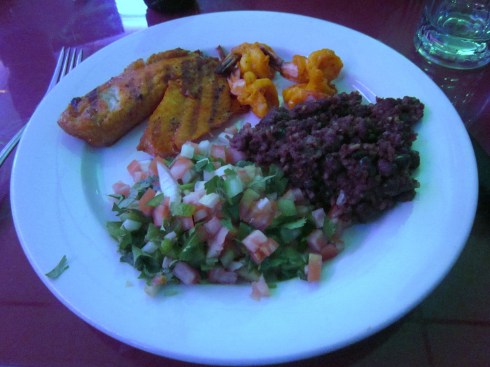
The kids' platter; fish and shrimp.

The kids’ platter; fish and shrimp.

Mike from Yonkers had hardly made a dent in his platter by the time I finished. In fact,  Zio polished off the monstrous pork chops before Mike from Yonkers even touched the cheese.

Finally, I conceded. “I guess I’ll take you up on your offer,” I said to him. It wasn’t really that I was still very hungry, it was more as a prod to get him to work with a little more purpose on his platter.

He cut me a sizable wedge of “bistec,”  thinly pounded grilled steak, but by the time I got to it, the meat was cold and tough as a hockey puck.

I wasn’t the only one to notice how long it was taking him to finish the gargantuan platter “Geez, we’ll be here all night,” Gerry barked.

Sensing pressure from the group, Mike from Yonkers pushed the platter away from him. “Okay, that’s it. I’m done,” he announced.
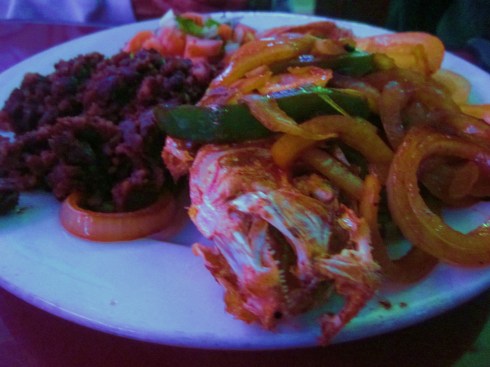
A snapper drowning in onions.

A snapper drowning in onions.

While we waited for the check, I walked around the restaurant and noticed that the placemats under the glass tabletops all had maps of Honduras. This was a Salvadorian place, wasn’t it? Was there a difference between a pupusa from Honduras and one from Salvador? Frankly, I didn’t care.

La Pupusa Loca

297 S. Broadway

Yonkers
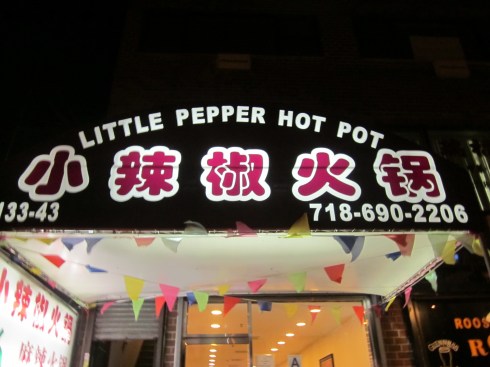
The Ring of Fire on Roosevelt Avenue

4 Dec

Little Pepper Hot Pot

Little Pepper Hot Pot
133-43 Roosevelt Avenue
Flushing, Queens

“I don’t think I like hot pots,” Gerry wrote in an email after I told him Zio and I were going to spend a Chow City interlude at the Little Pepper Hot Pot in Flushing.

Despite his hasty judgment based on one hot pot experience (Minni’s Shabu Shabu), Gerry agreed to meet the two of us there.

After reading blurbs about the restaurant, I learned that I could park in the garage of the nearby Sky View Center for free for up to three hours. I didn’t think it would take us longer than that to make quick work of Little Pepper’s hot pot so I pulled into the multi-level parking garage and walked through the gleaming, glass enclosed, Taipei City-like mall, passing such culinary stalwarts as Applebee’s and Chucky Cheese on my out to Roosevelt Avenue.

Where am I?

Where am I?

I found Little Pepper Hot Pot across the street from a 1960’s housing development and then recognized it as the location of the great and original Little Pepper (A Cold Sweat in Flushing), which has since relocated to  College Point Avenue.

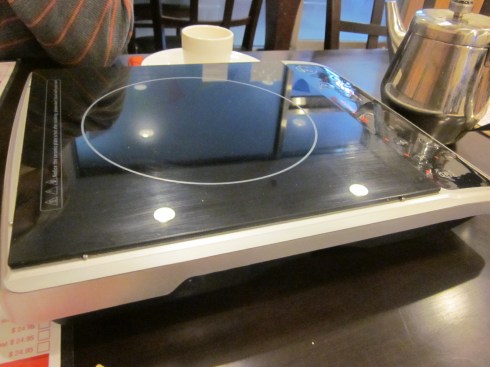
The tables of the narrow restaurant were all adorned with an electric stove top heater. The menu was attached to a clipboard. What turned Gerry, and most of us off about the other hot pot experience was the chaos for first timers. We had no clue what to do and the servers at Shabu Shabu were just too busy to deal with our hot pot virginity.

The hot pot heating device.

The hot pot heating device.

At Little Pepper Hot Pot our waiter spoke perfect English and was patient with our ignorance of things hot pot related. Still, the three of us, sadly, are not quick studies and at first it was a struggle, especially for the menu-challenged Zio.

“I just have no clue,” Zio said, shaking his head and tossing the clipboard.

I took the menu and studied it. It reminded me a little of the SAT tests where you need to blacken little circles next to the correct answers. Where was Mike from Yonkers, the SAT specialist, when we needed him?

Finally, I think I figured it out and explained to Gerry and Zio that for the table we needed to order one hot pot for $25, which would serve as our cooking device. From there we could choose other meat and vegetable items from the menu to toss into the boiling cauldron.

There were three hot pot options: Szechuan (all spicy), half Szechuan and half “Original” (mild), or all Original. We like to think that we are very brave when it comes to spice. No one can tell us something is too hot for us. And there have been instances when condescending waiters, assuming because of our vanilla visages (speaking about my own only) that we cannot tolerate the same heat as those born with the spice resistance gene.

This was, however, an offspring of the original Little Pepper where they definitely did not pull any punches when it came to spice. So in this instance we decided to take the safe route and go with the option number two: the combination pot.

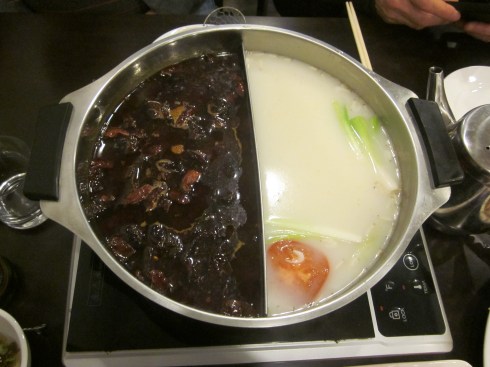
The pot was brought to the table, placed on the portable stove top and turned on. On one side was the chili pepper red Szechuan while on the other was the clear, milky Original—the two separated by a divider. It wasn’t long before both broths were bubbling furiously.

The yin and the yang of hot pots.

The yin and the yang of hot pots.

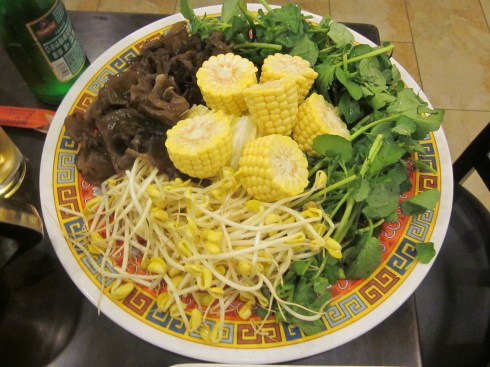
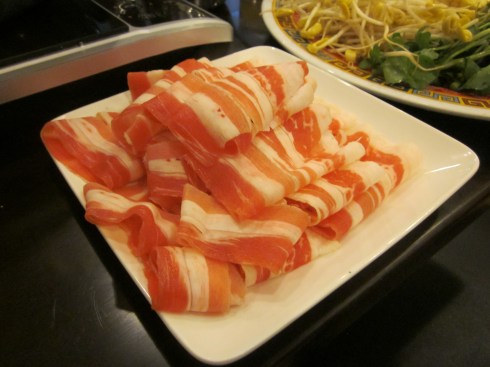
A gigantic tray of vegetables came with the pot: watercress, wood ear mushrooms, corn, bean sprouts, cabbage and a plate of “fatty beef.”

The veggies ready for the pot.

The veggies ready for the pot.

Fatty beef

Fatty beef

Using chopsticks, I started to drop the meat and vegetables into the hot pot.

“Use your hands,” Gerry barked. “You’re taking too long.”

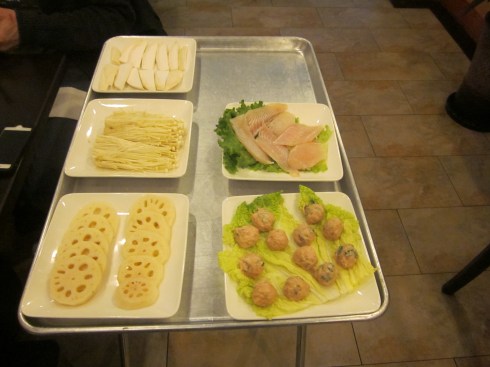
I did as commanded and then the waiter appeared with the other items we ordered: fish, parsley meatballs, king oyster mushrooms, lotus root, cabbage, and enoki mushrooms.

More to go into the pot

More to go into the pot

“Now what the hell are we supposed to do with these?” Zio wondered, holding up one of the slotted, net-like spoons that came with the hot pot.

“Fish out the fish,” Gerry said.

I tried to fish out the fish from the Szechuan side of the pot and came up with something—maybe the wood ear mushrooms and some of that fatty beef. I shoved whatever it was into my mouth and almost immediately my eyes watered and nose ran and I quickly spat it all out. I examined what had flown out of my mouth and was now on my plate. In my insatiable haste, I almost ingested countless pieces of dried hot chilies.

“Next time maybe you’ll be more careful,” Gerry scolded.

And the next time I was able to fish out the fish and the other ingredients that were now all cooked through and deliciously infused with the accumulation of flavors the multiple ingredients gave the broth.

A bubbling cauldron

A bubbling cauldron

The piles of napkins on our table were dwindling at the same rate as the honking noise from our collective noses was increasing. Scooping the meats and vegetables from the “Original” side of the hot pot did little to ease the self inflicted pain from the heat of the Szechuan side. But no one was complaining. It was what we wanted. What we came here for.

Soon, with the exception of the dried chilies and a few enoki mushrooms, there was nothing much left in either side of the pot.

“I’ll be back,” Gerry, who was originally skeptical, said inferring that another trip to Little Pepper Hot Pot was needed.

“Yeah, me too, but not with the Colonel,” Zio said. The Colonel, who was Zio’s partner, had, as Zio made it known many times, a zero tolerance policy when it came to spice. “One sip of this stuff and her tongue would be fried. She wouldn’t be able to talk for a week. Though that’s not a bad idea.”

As I made my way through the enormous mall to try to locate the car somewhere in the bowels of the indoor parking garage, I could feel a burn in my gullet. It made me think of the song “Ring of Fire,” by Johnny Cash. I hummed it in the car driving back home.

The next morning the tune was still in my head, but it was no longer the Johnny Cash version I was humming. The burn had lingered overnight and the effects I was feeling the next morning were closer to how Ray Charles handled it: slow and deliberate and with a raw blast of the blues (see below). The burn and the accompanying pain, I knew, would fade but it wouldn’t be long before I, like Gerry and Zio, would eagerly go back for more of the same.

Cuban Chuletas in a Casa in Chelsea

20 Nov

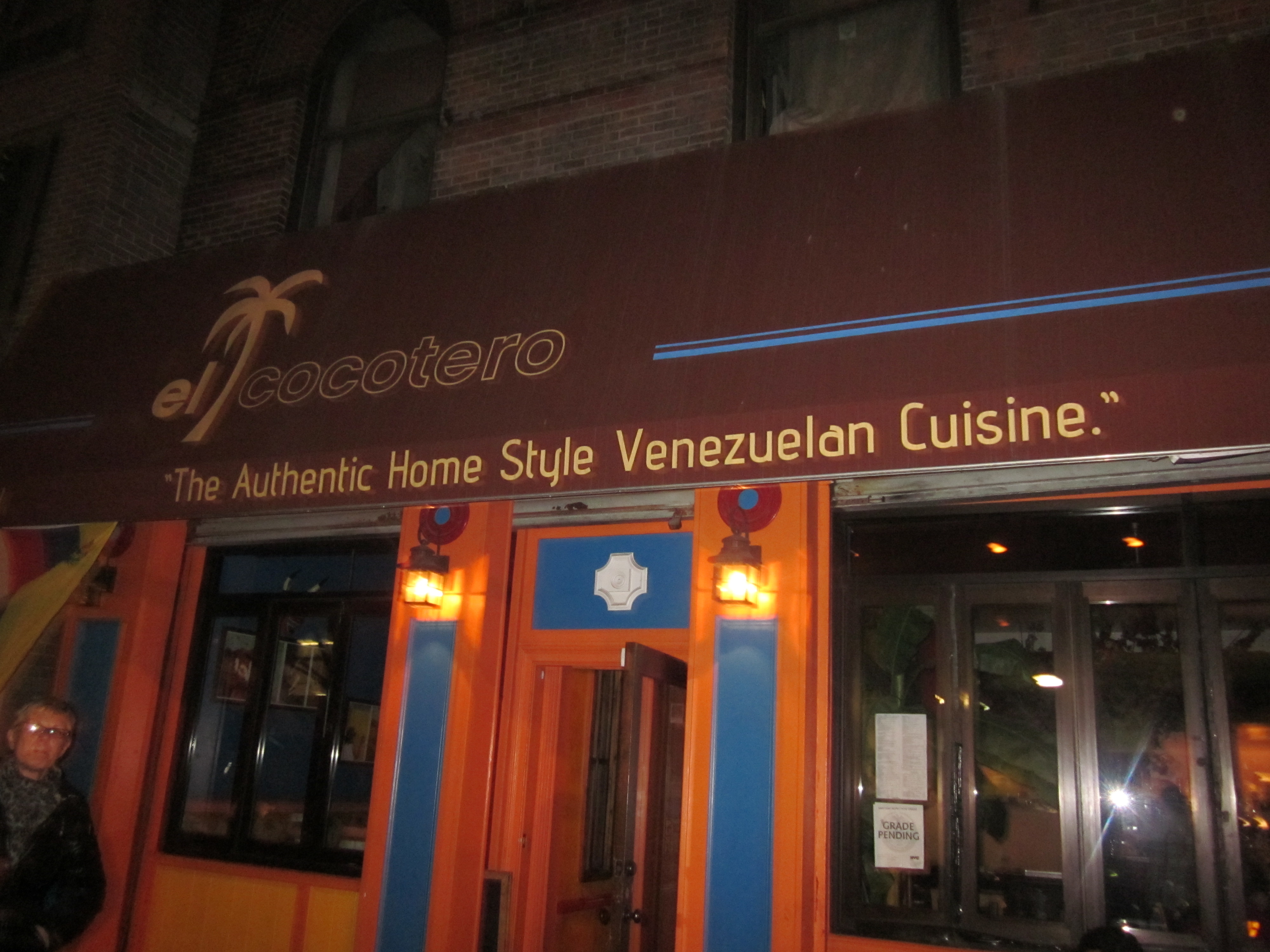
Rick’s choice of a Venezuelan place in Chelsea quickly raised some eyebrows amongst our group when we were notified. A few months earlier, we traipsed to Inwood for Venezuelan cachapas on Dyckman Street Stalking Corn on Dyckman Street.  It wasn’t only the relatively quick repeat of a cuisine that was odd, it was also the location. Chelsea, in its present incarnation, is not a neighborhood where we would think to find our kind of restaurant; meaning one suited more for our penny pinching tastes.

Still, we gave Rick the benefit of the doubt and to El Cocotero we all planned to meet. But a couple of hours before our meeting time, Rick sent an email that read as follows:  “Guys. Just got a call from the wife and we have to go to the hospital! It may be a false alarm, but please go enjoy Venezuelan food without me.”

The false alarm was a reference to the impending birth of his first child; the due date set for early December. We all wished the best for Rick, but his pronouncement was just too sudden and late in the day to stop us from heading to Chelsea.

Before anyone else had arrived at El Cocotero, Zio had scouted it out. “It’s so dark in there, you won’t be able to find your mouth with your fork,” he wrote in a text.

You couldn’t tell that power had been restored weeks ago in Chelsea judging by the lack of light in El Cocotero.

When I entered, I immediately thought Zio was exaggerating. It was dim, for sure, but the flickering candlelight wouldn’t stop me from stuffing my face. Reading the menu, however, was a more challenging issue. Without my reading glasses, the menu print seemed as insurmountable as trying to read a Russian novel without a magnifying glass.    Thankfully, Eugene’s eyes were stronger than mine and he informed all of us that the cachapas were ten dollars—almost $4 more than what we paid at Cachapas y Mas on Dyckman Street.

To make matters worse, the table we were given was so cramped that there was the very frightening prospect of rubbing thighs with Mike from Yonkers while trying to get the food from fork to mouth.

“This is a date place,” Eugene blurted out.

Indeed it was, and Mike from Yonkers was not my date. Since Rick was not going to be joining us, there was no reason to endure eating at a romantic restaurant with the likes of Eugene, Gerry, Mike from Yonkers and Zio—and I’m sure the feeling was mutual.

Our group slunk out of El Cocotero, lamely apologizing to the manager as we exited.

The prospects of finding something Chow City like in Chelsea, we knew, were not good, but we had to try. I knew of a nearby Szechuan place that I liked, though it was probably as expensive as the Venezuelan we just left.

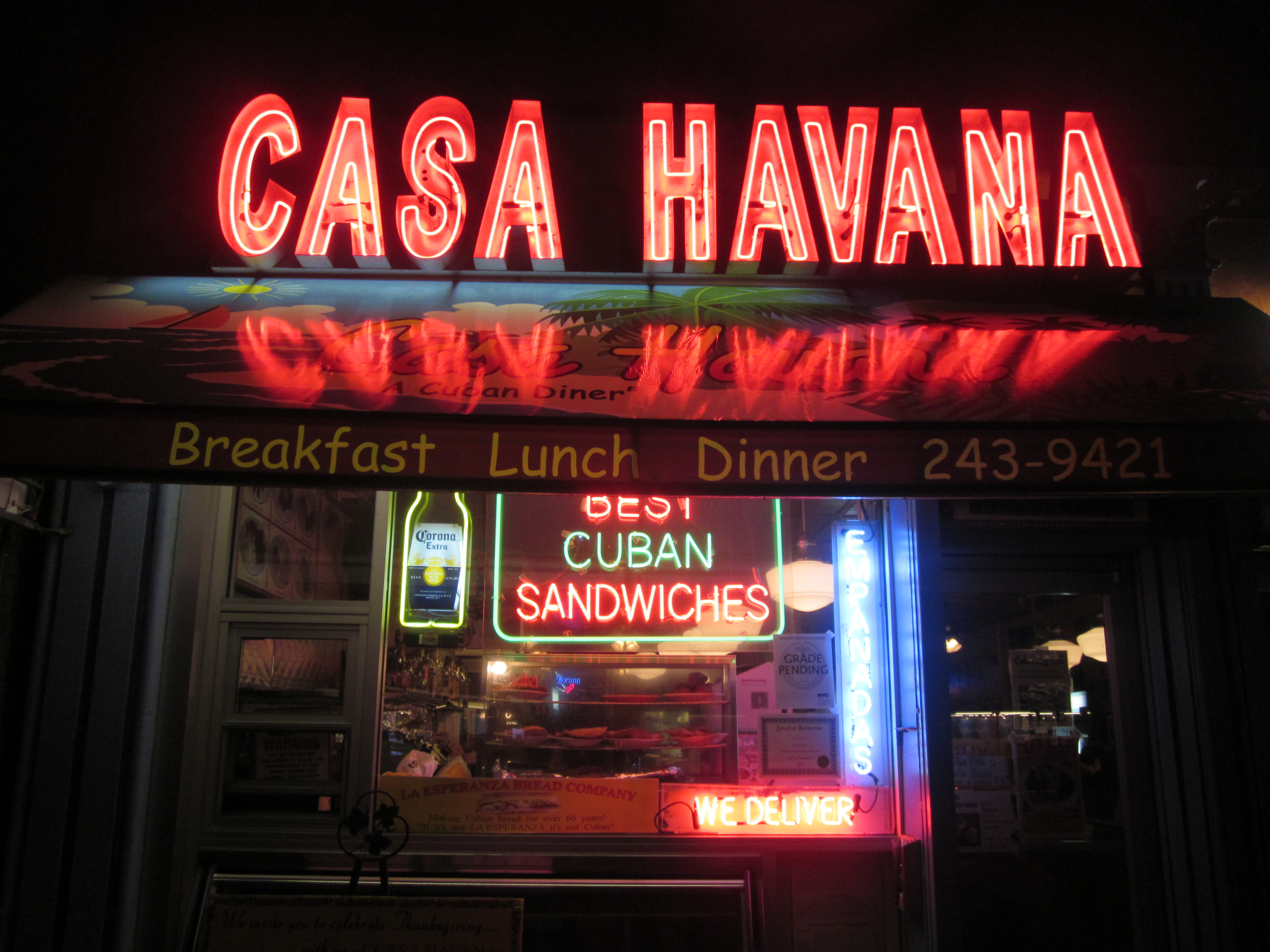
And then I remembered passing a Cuban diner on 8th Avenue on my way to El Cocotero that looked like something closer to our criteria. I mentioned it and our ensemble headed in that direction.

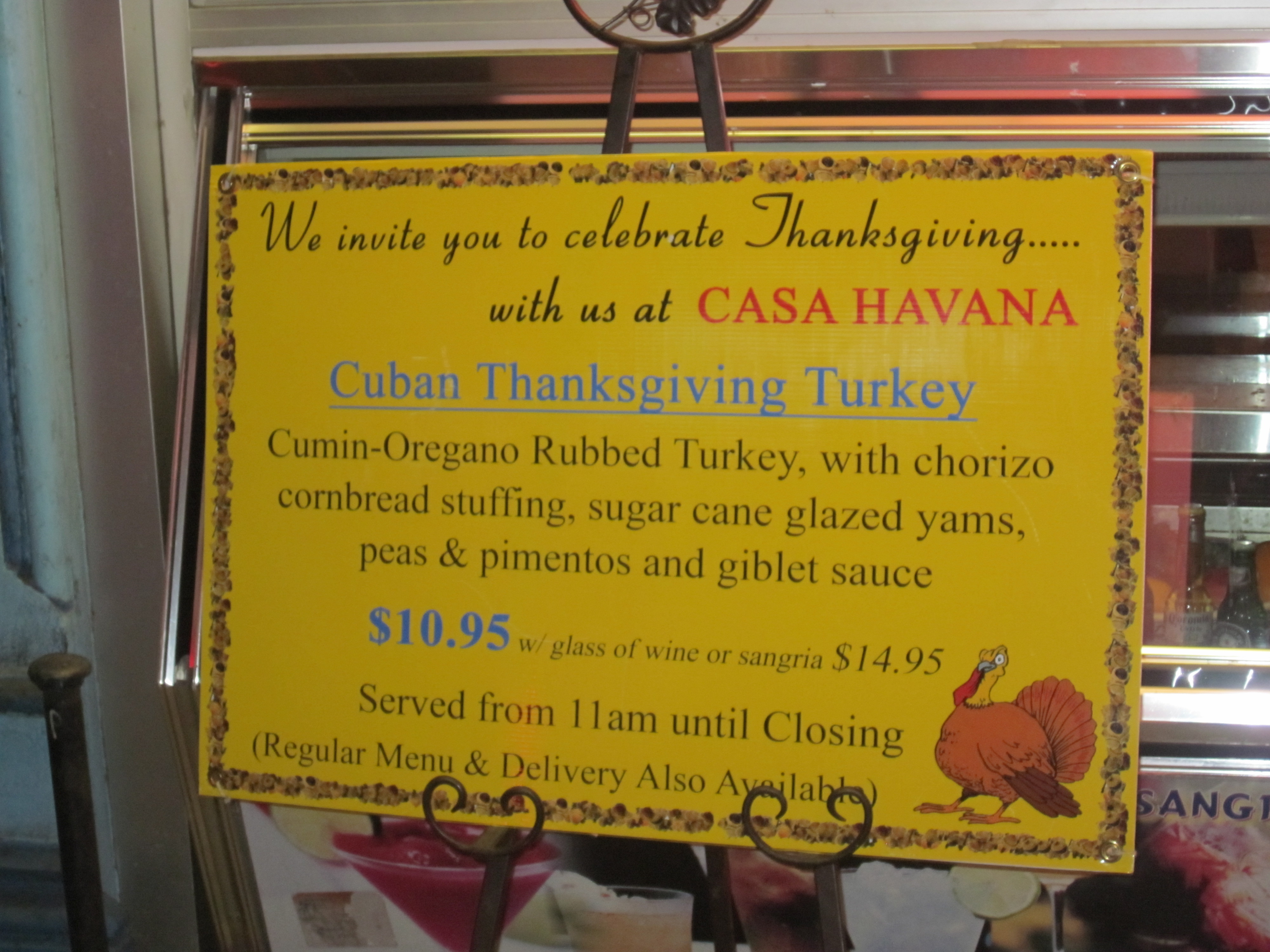
In front of Casa Havana was a placard advertising Thanksgiving dinner for $10.95 and another displaying a glistening suckling pig for $12.95. Eugene didn’t have to see anymore to be convinced. He was halfway to a table when Gerry, still out on the street, whined that he had eaten Cuban food the previous day.

We looked at him. You could never tell whether Gerry was joking or serious.

“Really, I did—in Montclair,” he said.

We all hesitated. Eugene came back out of the restaurant. “What now?” he barked.

This was becoming a fiasco and Gerry knew it.

“All right, let’s just go here,” he gamely conceded.

While our Mexican waitress brought the Cuban menus to our ample table, Dominican meringue played over the restaurant’s loudspeakers. Glancing at it, I noticed that the prices were lower than what we would have experienced at the Venezuelan place around the corner, but more than we would have paid for similar food uptown.

There was nothing out of the ordinary on the menu; rice and beans, fried pork, fried fish, roast pork, shrimp in garlic sauce, beef stew, etc.

“Do you have the turkey?” Eugene asked our waitress, referring to what was advertised outside the restaurant.

She shook her head. “No, we just have that for that other day,” she said, meaning Thanksgiving.

Instead, he settled on shrimp criolla while Zio, keeping to his fishy pattern whenever we gather,  ordered the “lubina frita,” fried bass.

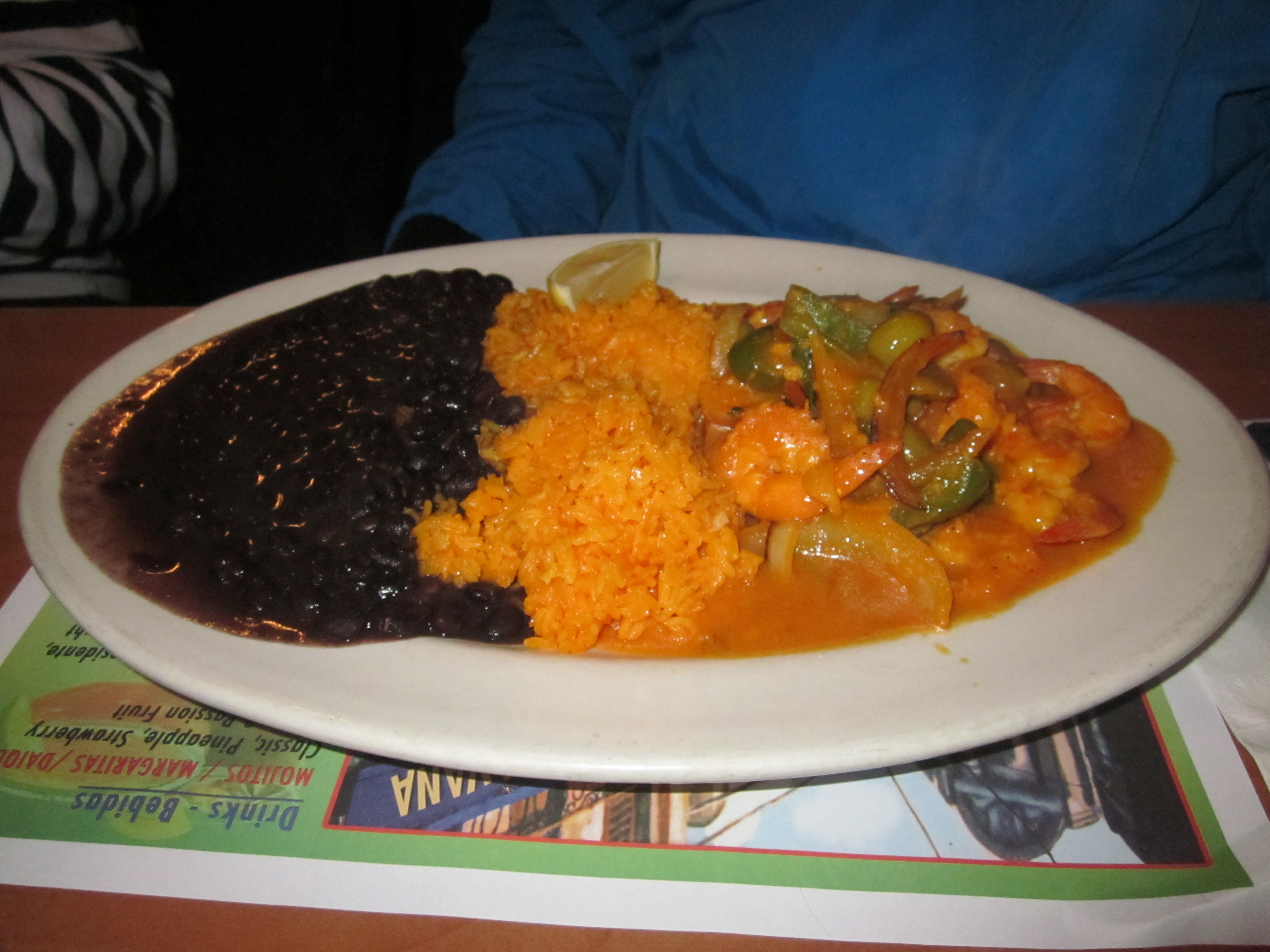
After his Cuban meal in Montclair, Gerry eschewed the entrees and instead chose a Cuban sandwich with a small bowl of black bean soup. Mike from Yonkers was rebuffed by his first choice of fried snapper and had to go to plan B: the baked chicken. I decided on the “chuletas,” (pork chops) in red sauce with yellow rice and black beans.
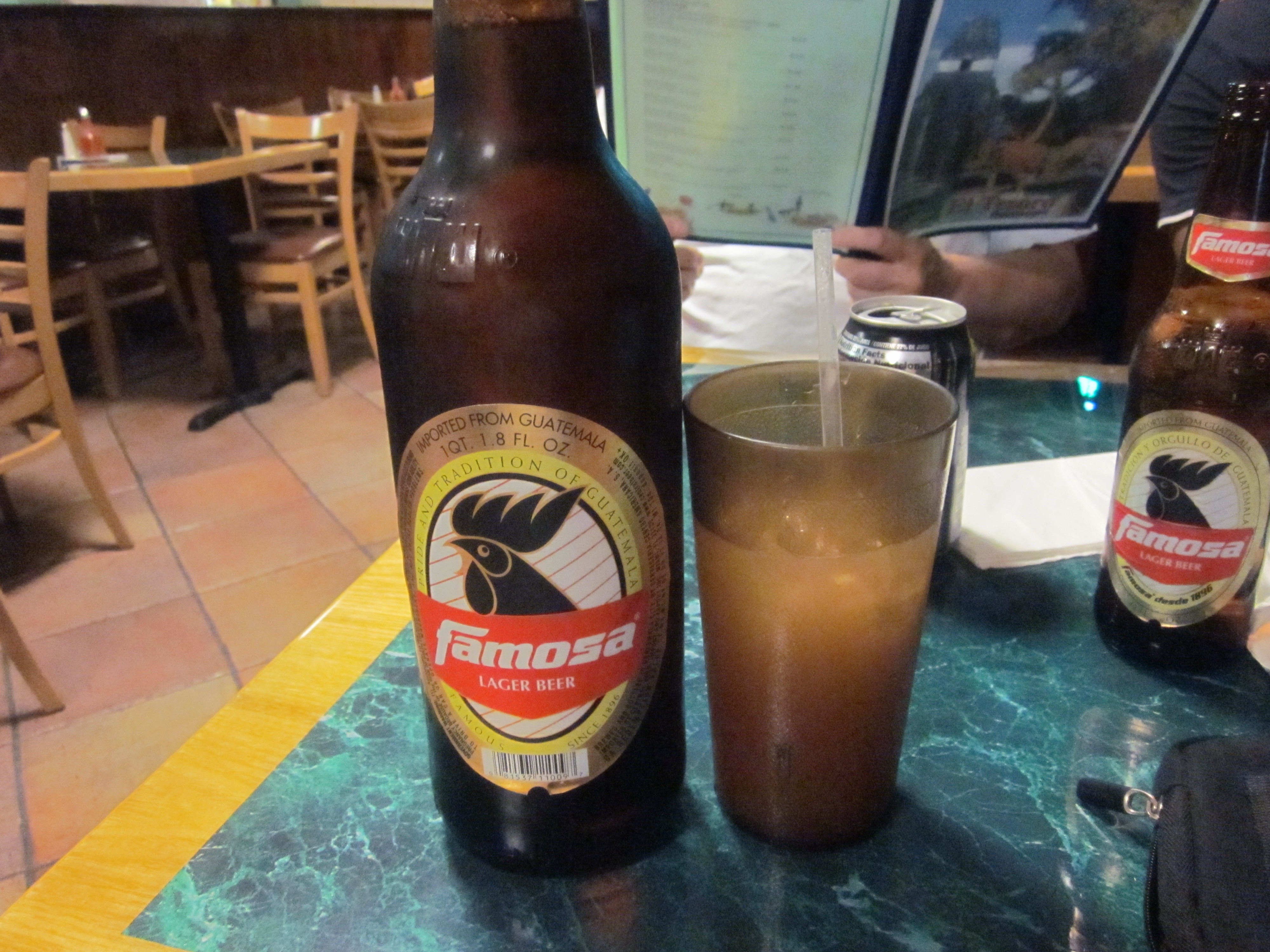
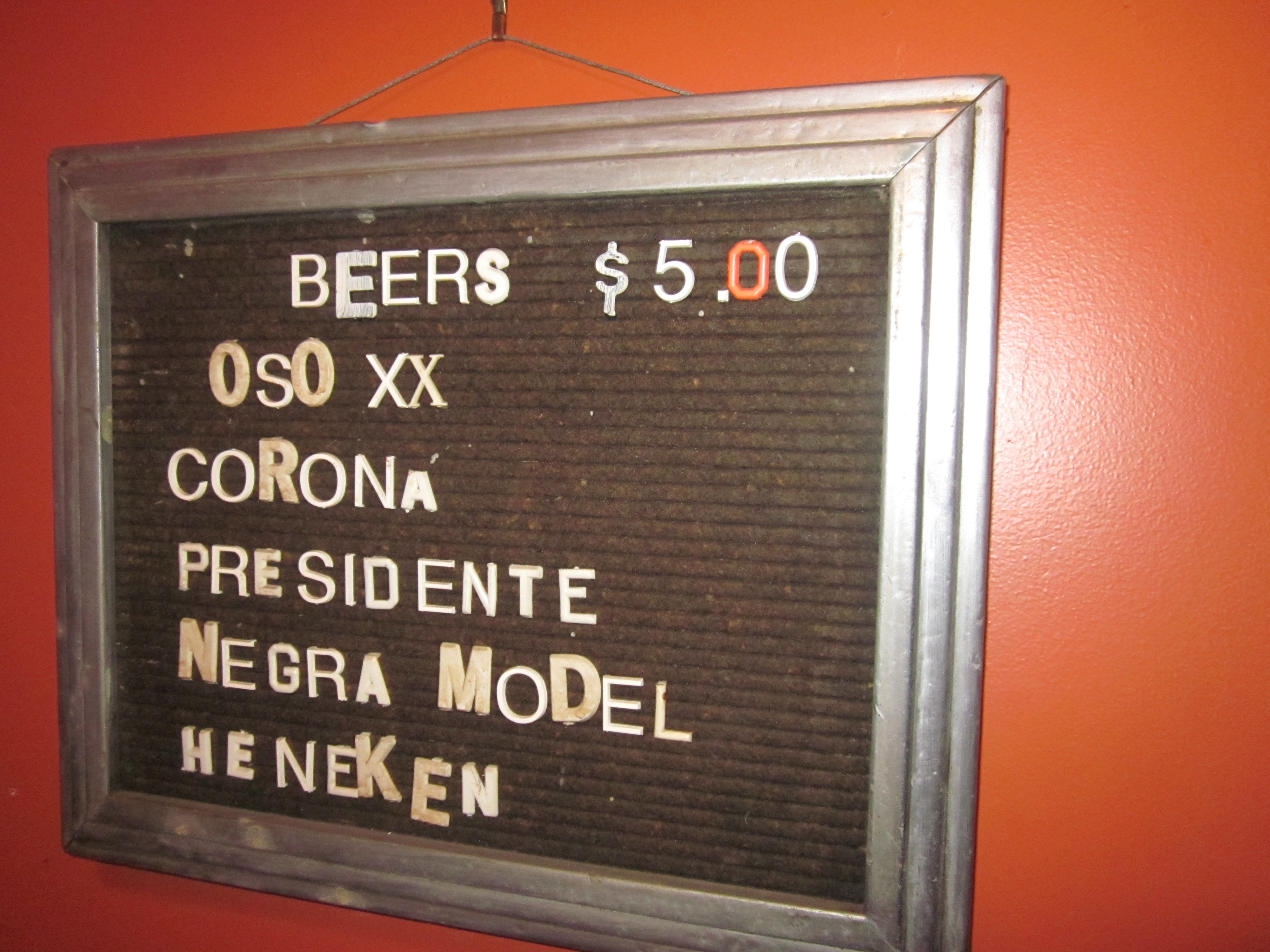
While we waited for the platters to decorate our table, all of us except Zio, who sipped a mango “batido,” had $5 Mexican beers.

Embargo beer options at a Cuban Restaurant.

The food came and we plowed through it without many exclamations. No one complained. No one praised. The chuletas were skimpily thin and swimming in a non-descript tomato sauce that benefited greatly by a large dousing of the house hot sauce.

Shrimp Criolla, yellow rice and black beans

Because the food did not inspire discussion, we had no choice but to listen to Eugene describe the annual Christmas party he attends—the one with the Viennese dessert buffet—as well as the many meals he eats at the all-inclusive resort he frequents in the Dominican Republic.

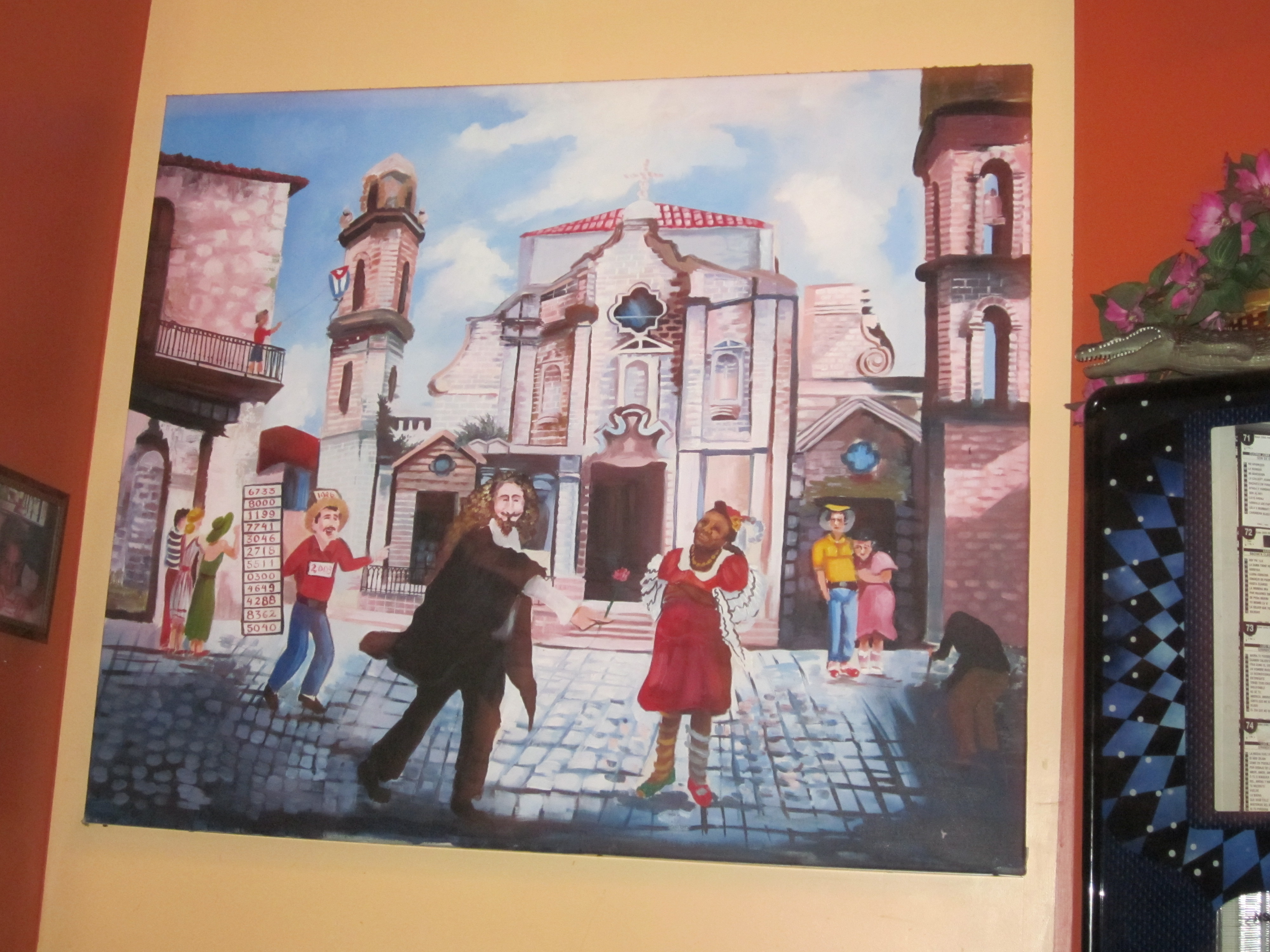
Who knew Shakespeare vacationed in old Havana?

Gluttons for punishment, to name just one of the things we are gluttons for, we could have just called it a night in Chelsea. Instead, hoping we would find something to praise, we all had dessert. Sadly, even the desserts; coconut pudding, coconut cake, tres leches cake, and chocolate cake, did not surpass uptown standards.

And, as he suspected it would be, Rick informed all of us that indeed the trip to the hospital was a false alarm. If only we could have said the same thing about our trip to Chelsea.

Injera Ingestion

14 Nov

“In all our time as a group, how have we missed eating at an Ethiopian place?” I asked Gerry, who was with me at an Ethiopian place in Harlem called Abyssinia.

“Too expensive usually,” Gerry responded, referring to our group’s tight $20 per person budget.

I looked at Abyssinia’s menu. Nothing was over $16. “Not here,” I said.

“No, definitely not here,” Gerry concurred.

It was a day after a nor’easter left a few inches of wet snow on the already soggy city streets and a little over a week after the big storm. Our group was scheduled to meet the previous day, but we were currently on hurricane hiatus. Though the group could not gather, Gerry decided to leave his still heatless Westchester home where he claimed there were no lines for gas, to drive into the city for what he hoped would be much needed spicy food.

His hopes were quickly realized. Not only was the small restaurant deliciously fragrant, it had heat—lots of it. And adding to the warmth from the clanking radiators was the heat from the meat “sambusas” brought to us by our pleasantly quiet waiter.

Similar to the Indian “samosa,” the sambusa was fiery and though berbere sauce, Ethiopian hot sauce,  accompanied it, the added spice was not needed.

Sambusas with Ethiopian hot sauce.

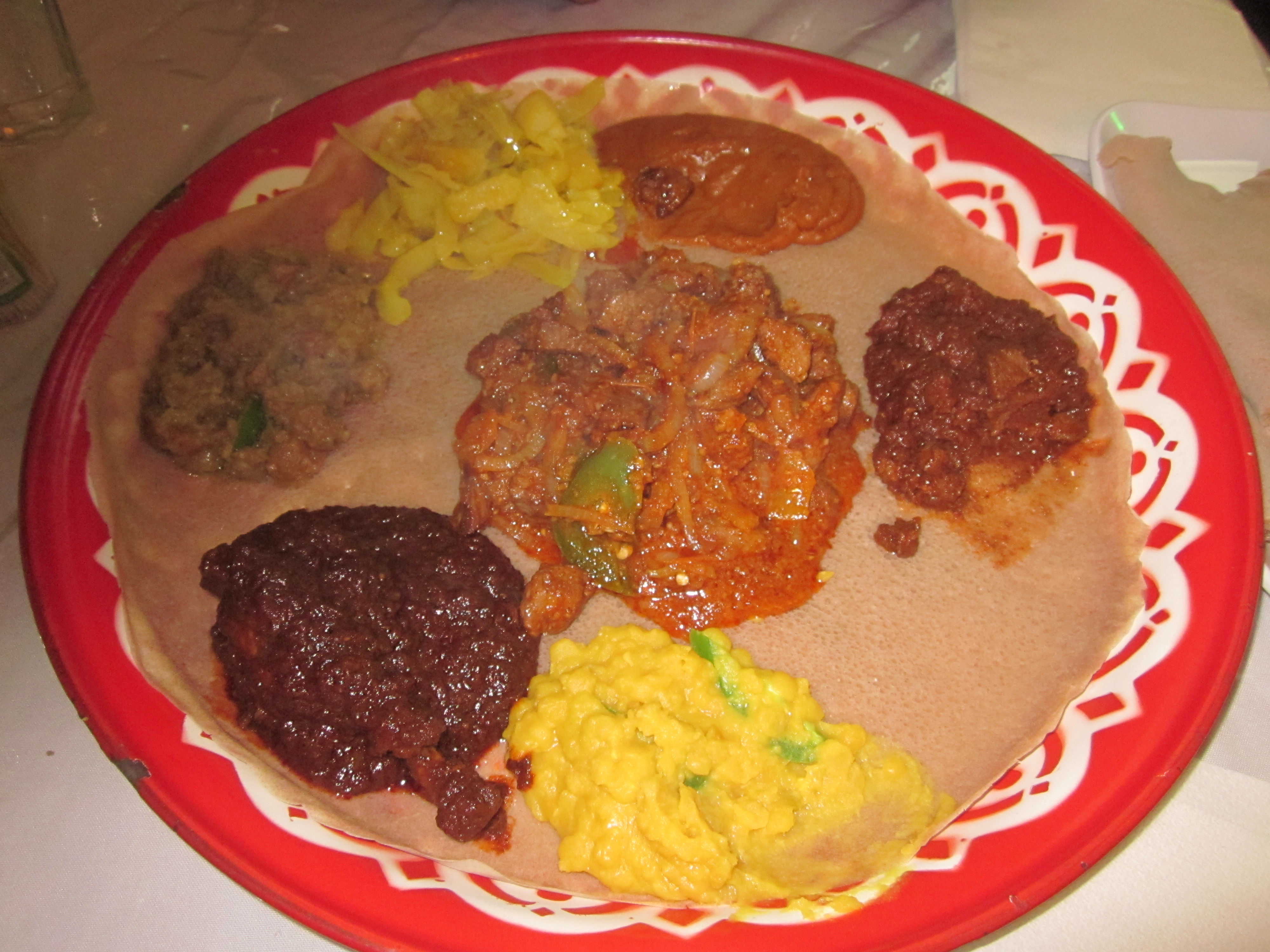
To get a good sampling of the meats, we ordered the “meat combo,” featuring three meat options along with a separate order of yebeg awaze tibs, cubes of lamb sautéed with onions and jalapeno in an awaze (berbere) sauce.

The meats came assembled on a colorful platter with each individual meat dish in a small mound along with a few vegetable sides and layered on top of the spongy Ethiopian bread known as injera.

The Abyssinia meat combo platter.

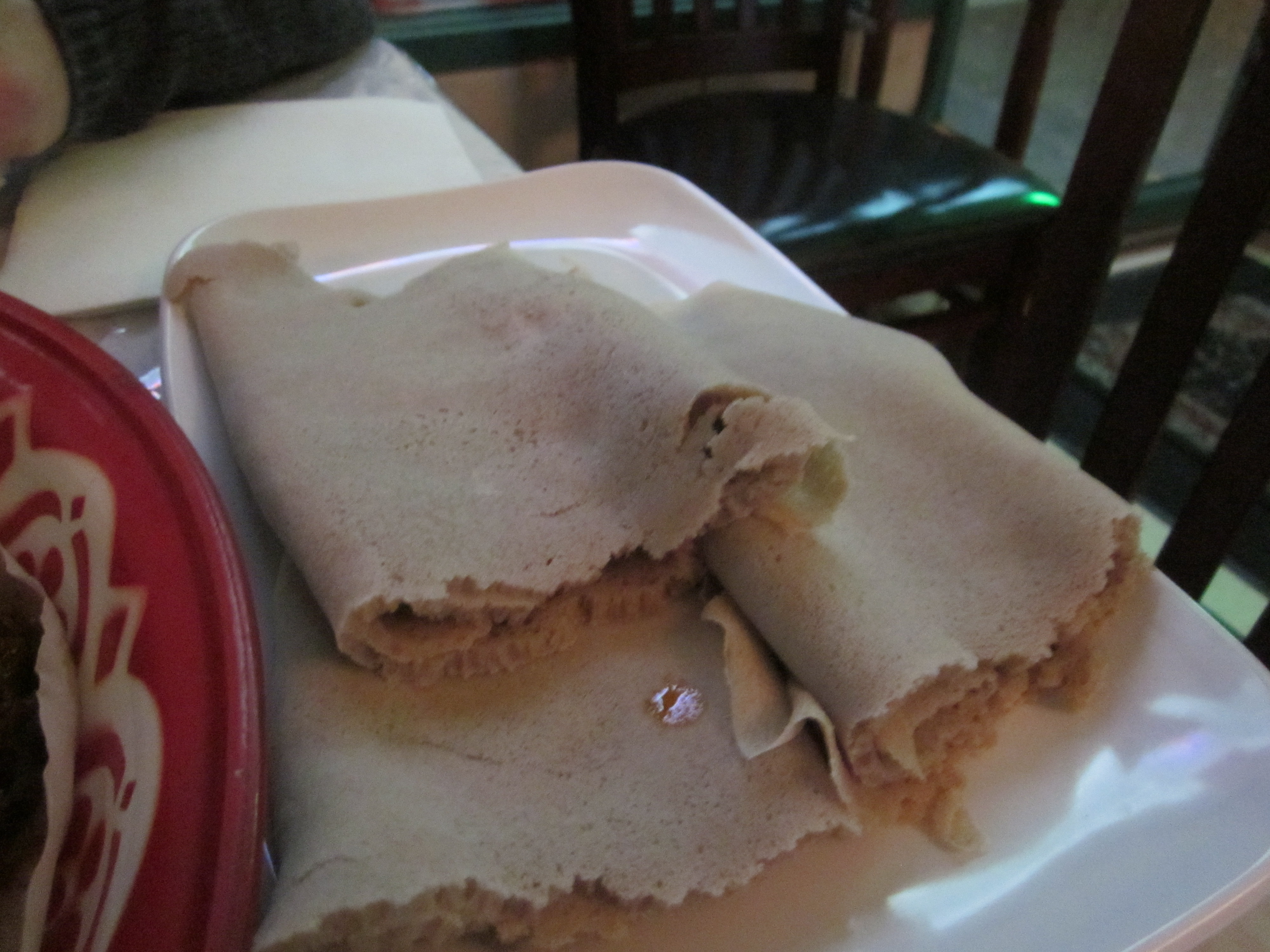
Along with the platter, we were given an additional plate of injera. There were no forks, spoons or knives on the table. With bread like this, who needed utensils? We scooped up the meat and veggies with the accompanying injera and shoved it into our mouths, doing our best not to let anything fall our already food-stained clothes.

These meats were not on the day’s menu at Abyssinia.

The doro wat, a chicken leg in a rich berbere sauce was tender, falling off the bone, the sauce identical to what coated the beef in the ye siga wat. The lamb, though not as tender as the beef or chicken, was aromatically addictive. Soon our “utensils” were gone and our waiter returned with another fresh plate of the injera for us.

We went through that plate as well and still much of the meat remained. We were not ones to waste anything, but we just could not continue. It was as if the injera had expanded in our gullets.

We ate all the “utensils.”

The waiter came to our table. He smiled slyly and examined what was left and then shook his head. “This is the best part,” he said, indicating the injera that the meats were layered and now saturated with their juices.

What was left did look delicious, but regrettably, any attempt to taste it might have resulted in a not very pleasant finale to what had been a much needed most comforting, post-hurricane meal.

As he took away the platter, I stared at it longingly. We both knew we erred, but if you do not learn from your mistakes, you are destined to repeat them…or something like that.  It would not happen again.

Abyssinia Restaurant
268 W. 135th
Harlem

One Tale From a Thousand and One Falafel Tales

9 Oct

“I was going to pick a Bolivian place,” Eugene said, “but I thought you guys didn’t want me to.”

We had been to Latin restaurants the past three outings,  so when Eugene mentioned the unnamed Bolivian place as a potential destination, we gently suggested another cuisine. Eugene took our suggestion to heart and came up with an alternate pick.

“Why, out of the thousands of falafel joints in this town, did you decide on Amir’s?” I asked wondering about the logic of Eugene’s choice of Amir’s where, on this night, just four of us were assembled. I should have known, however, that logic never factors into Eugene’s decisions. This is a man, a native of the New York suburb of White Plains, who always goes out of his way to root against all New York teams; a man who claims allegiance to other teams, most from Boston, but really gets his sports’ jollies more from a New York team’s defeat than one of his own teams’ victory.

That there were only four of us at Amir’s was probably a good thing. The small, eat in/take out place would have been a challenge for our usual brawny six. And it was probably better that Zio spend his wedding anniversary with The Colonel rather than dining on something he could get at a street cart closer to his love nest in Astoria. The question was, would what he could get at the street cart in Astoria, or at any of the other countless falafel places in the city compare to Amir’s?

Amir’s falafel

After our brief outing; ordering from the typically middle eastern falafel menu; falafel, hummus, babaganoush, along with what now are called “proteins” on many menus meaning meats; shawarma beef, chicken, and kebabs, the verdict, sadly, was yes. Though Amir’s falafels were relatively light, not drenched with oil, slightly sweet, and above average on the unofficial falafel meter, they were no more distinguishable than Mahoud’s, Ahmad’s, or any other above average falafel joint in the city, of which there are hundreds.

There’s protein somewhere in there.

The “protein” that Rick tried, a shawarma beef sandwich in pita, was not worthy of veering from the falafel while the “popeye,” a spinach pie Gerry bravely ordered, had an outer shell that to penetrate required the muscles of the cartoon character of the same name.

The “popeye.”

After our falafel experience, we strolled down Broadway, congested heavily with Columbia students. We again pressed Eugene on his choice. “I don’t know. I pick a neighborhood that I’ve never been to and then I find a place there. What’s the name of this neighborhood anyway?”

“I think it’s Morningside Heights,” Rick offered.

“The Upper West Side,” I said.

“It’s nice here,” Eugene added, successful in veering the conversation  to real estate and away from falafel.

We muttered collectively and though the meal was not as satisfying as we are used too, took solace in knowing that there was Bolivian food sometime in our future.

Amir’s
2911-A Broadway

The Poor Man’s Pupusas of Port Chester

11 Sep

El Tesoro II

14 South Main St.
Port Chester

When Gerry sent out the email revealing his choice for our most recent adventure, there were doubts among us of its authenticity. His first obviously mock pick, for some reason known only to Gerry, was a fictional restaurant in Brewster, Massachusetts. Even Zio, who has been slow, as he is on most things, in recognizing Gerry’s much too subtle sense of humor, knew that we weren’t schlepping five hours to Cape Cod for dinner.

A few days later, Gerry came up with another destination. This one, El Tesoro II, in Port Chester, New York, I knew was genuine. Zio, however, had his doubts. He responded in an email writing the following: “I take it this is one of Gerry’s confusing attempts at humor. If I can’t get there with my senior metro card I will be relaxed about sitting this one out.”

Port Chester is approximately 24 miles from Manhattan. Gerry has had us put on the mileage before; taking us to Yonkers, Valhalla, White Plains, Fort Lee, Jersey City, and, worst of all, Sheepshead Bay, Brooklyn. When it’s Gerry’s pick, we come to expect to battle the rush hour traffic leaving the city. Apparently, Zio wasn’t going to take it anymore, yet when the day arrived, his attitude changed and he not only agreed to travel to Port Chester, but to chauffeur me up there with him.

Rick, however, who lives roughly 77 miles from Port Chester, was a game day drop out. Attributing his cancellation to a late work-related meeting, Rick needed no excuse. He was more than justified in bowing out—Gerry’s cruel joke could be taken only so far.

Zio and I expected a long haul up to Port Chester but as it turned out during this rush hour, there was no rush. The roads were surprisingly clear and we made it to the stark streets of Port Chester several minutes before the scheduled meeting time.

Those few minutes gave Zio and I time to take a look at the nearby eating offerings of Port Chester. Besides El Tesoro II, which claimed two Central American countries; Guatemala and Salvador as the cuisines featured, there were a couple of Peruvian diners, a chili dog dive, and, across the street where a monstrous, correctional facility-like mall stood, there was an Applebee’s and a Buffalo Wild Wings.

Two of Port Chester’s inviting eateries.

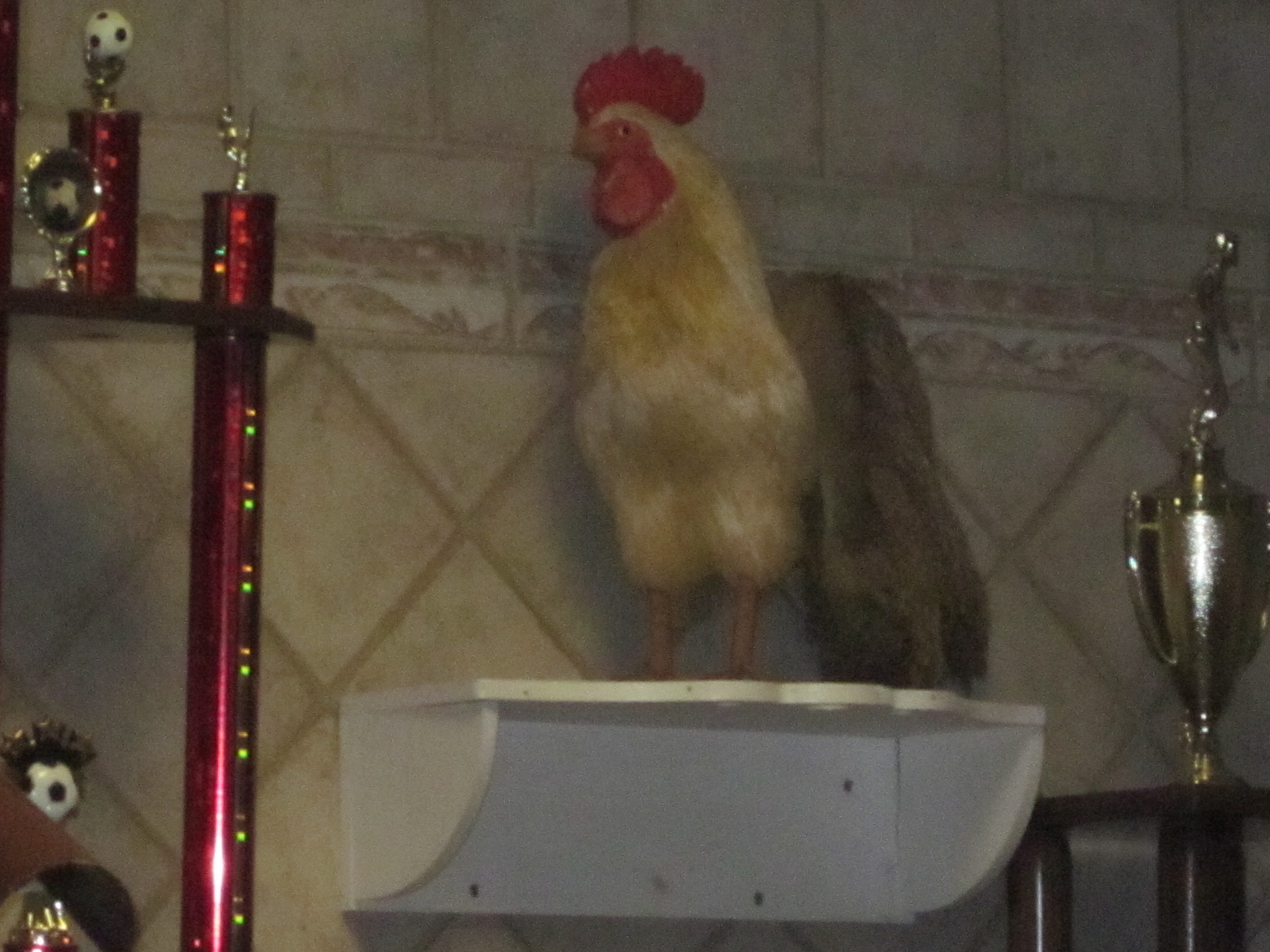
We passed a window where numerous colorful parrots frolicked at the Bird House of Westchester, and then entered El Tesoro. There were birds inside the tropically adorned restaurant as well, but these were chickens and they were stuffed.

One of the several stuffed hens at El Tesoro.

Our waitress, who Eugene, executing one of his lamer lines, asked if she claimed Italian heritage, revealed that she was, in fact, not from Guatemala or Salvador, but that she was from Honduras. And if there was a difference in the cuisines of the three Central American countries, she wasn’t telling us.

Guatemala or Salvador? Which is it?

From the Salvador-labeled section of the menu were the well-known pupusas which we celebrated many years ago at a restaurant in Washington Heights that still survives called: La Cabana Salvadorena.  (See Pupusa Love). As I vaguely recall, the pupusas were worth loving there and we had to try a few at El Tesoro.

No love for the pupusas of El Tesoro.

Also from the Salvador starters section were the tamales while, representing Guatemala, were the rellenitos, which Gerry bravely ordered. Our waitress described them as platanos (plantains) stuffed with beans. What she didn’t say what that the rellenito was of the sweet variety, deep fried and then sprinkled with granulated sugar? Even with the presence of the beans, you really just wanted to take the thing and dunk it in your coffee; it was that sweet.

Maybe Dunkin Donuts should consider adding the rellenito to their doughnut menu?

Eugene ordered the garanchas; tiny tortillas topped with beef, cheese and the Guatemalan version of pico de gallo, which, after sampling one, did not live up to the more familiar Mexican version.

Garanchas

As we proceeded to sample the food, what we tasted, unfortunately were mediocre replicas of the major influences from the north (Mexico) and the south (South America).

The carne guisada I ordered, familiar to me at other Latin restaurants as beef stew, was, here, more like ropa vieja; shredded beef in a very bland tomato sauce.

“It’s mushy,” Zio commented about the tamale. “I like Mexican tamales better.” The tamale was dense with corn masa and stuffed with pork but Zio’s description was accurate. It was mushy.

Salvadorian tamale

Mike from Yonkers did not expect potatoes added to the rice in his pollo saltado, the Guatemalan attempt at the Peruvian specialty. “Too much starch,” he said and, in a rare display, put his fork down well before his usual meticulous cleaning his plate.

Pollo Saltado

Zio had ordered the pollo frito in what the menu described as “our secret seasoning.” He offered a wing and/or leg of the chicken to any takers, but there were none. “The fried chicken was really dry,” he confessed to me on the way back to the city.

I’m not sure what was expected of the chile relleno Gerry ordered, but again, what I tasted of it was a poor man’s version of the Mexican dish. The flavor, or lack therof, just not what any of us were accustomed to.

Things weren’t all lackluster at El Tesoro. The Famosa beers were cold and delicious. The service was cheery. Even the incessant screeching of a toddler added life to the otherwise drab Port Chester experience and, not that it was what I was seeking, made me feel right at home.

Stalking Corn on Dyckman Street

31 Jul

Cachapas y Mas
107 Dyckman Street
Inwood

There was a small booth on Dyckman street where corn along with other farm fresh goods were being sold. Across the street a vendor was selling roasted corn and batata (sweet potato) cooked on a gas grill. Further down the block another vendor had homemade empanadas hanging on hooks inside his makeshift cart. This was the scene I encountered on Dyckman Street on a humid summer evening on the way to Cachapas y Mas, the Veneuzuelan fast food place Zio had chosen for our group.

Roasted corn for sale on Dyckman Street.

Besides the abundance of corn, Dyckman Street, in the Inwood section of upper Manhattan was bustling; teeming with urban humanity—the street congested and loud with honking livery drivers. On the sidewalks, microscopic shorts for women hugged tightly over curvy female mannequins, while for men there were flamboyant, colorful dress shirts on racks. Wedged between the retail stores were an assortment of fast food fried chicken places, Dominican bakeries, and a number of Latin-style steakhouses; in other words, my kind of street.

Cachapas y Mas was clean, with a row of wooden picnic tables along with a few smaller, plastic-topped tables and chairs. A slick, flat screen television broadcast soccer from a Spanish language station. The menu was displayed on a digital screen above the cashier that electronically would shift from a picture of “cachapas,” to one of “patacones,” to one of “arepas,” and finally to “yoyos;”

Yoyos, patacones and empanadas.

I did scant research once Zio announced his pick, but enough to learn that the food was Venezuelan and that the specialty were meats sandwiched between either griddle toasted corn cakes (arepas and cachapas) or fried green plantains, also known as tostones (patacones) or yellow plantain, i.e. maduros (yoyos).

Our group of five, soon to be six once Rick arrived, grabbed one of the picnic tables and added two of the plastic chairs at either end to accommodate all of us. From where I sat, my eyes were just not up to the task of reading anything from the digital screen so I got up for a closer look.

The “man in charge,” either the owner or manager, noticed my curiosity—and my trusty camera—and offered advice. He suggested a drink called papelon to start. Over the din and through his accented English, he explained that the drink was made from lime with brown sugar—two of my favorite ingredients. How could I resist?

The papelon was a bit too sweet for me, but I found it refreshing. A little less sugar and maybe a shot or two of rum would have transformed the drink into a very exceptional cocktail.

Papelon: The Venezuelan cocktail, sans rum.

I brought the drink back to the table. A line to order was beginning to form. Though proper etiquette would have us wait until our party of six arrived; we were still waiting for Rick, but Mike from Yonkers and Zio, especially when noticing the line, would never let etiquette stand in the way of their gluttony, immediately got on the line.

Eugene, Gerry and I shook our heads at the rude behavior of our comrades.

“No class,” Gerry said, glancing at the time. “It’s not like Rick is more than a few minutes late.”

“I know. It’s pitiful. Sad, really.” I added while shaking my head at their disgraceful behavior.

Eugene said nothing; instead he rose and joined the line.

I sipped my papelon, squinted at the digital menu again, peered out onto Dyckman Street and not seeing Rick, took my place on the line behind Eugene.

As the line moved slowly forward, I turned around. Rick had arrived and was already on the line, a few spots behind me.

Yoyos or patacones? Those were the two finalists. But stuffed with what? They all pretty much had the same choices; cheese, ham and cheese, chicken, shredded beef, roast pork, steak, chorizo, grilled chicken or, if you had a thing against meat, and if you did, why were you here, then there was the avocado salad arepa offering.

I decided on a shredded beef patacone along with a pastelito; an empanada like snack the owner recommended that was stuffed with meat and cheese. What harm would a little more grease do?

All of us returned to the table to wait for our names to be called with our orders. Of course, Mike from Yonkers and Zio were first. Both ordering cachapas; Zio’s stuffed with chorizo, Mike from Yonkers with shredded beef.

Chorizo cachapas

Zio generously offered me a taste. The corn cake was slightly sweet and dense, but rich with the flavor of fresh corn. It complemented the salty chorizo perfectly. While they ate, I dug through the pastelito. It reminded me somewhat of a meat and cheese calzone, but with a Latin flair.

I heard the Spanish sing song of my name and shot up from my seat returning moments later with the patacone. Using the plastic fork and knife provided, I tried to saw through the fried green plantain. Both utensils were not up to the task, bending to the tough tostone exterior. Giving up, I ate it how it probably should have been eaten; like a sandwich. And though I was able to maneuver some of the juicy shredded beef into my mouth, much of it dropped onto my plastic tray.

Patacone with shredded beef

Zio easily finished the chorizo cachapas, but despite its gargantuan size, it just was  not enough for his prodigious appetite. “I need more,” he mumbled and got up and ordered a beef empanada. The ground beef, onions and spices stuffed into a cornmeal pastry.

After taking a few bites, Zio put the empanada down. “It has a distinctly Alpo-like flavor,” he commented.

Nothing Alpo-like about this empanada.

He offered the remains of meat pie to me. I took a bite. “Hmmm, maybe, but it’s the best Alpo-like empanada I’ve ever had,” I said approvingly. The cornmeal pastry was crunchy with bits of coarse ground cornmeal and the meat was pungent, even aromatic, I was guessing from the amalgam of spices.

We make quick work of the cachapas, patacones, and empanadas and soon the dirty paper plates and napkins were piled high on our trays. With the exception of not experiencing a yoyo, I was more than satisfied with Cachapas y Mas.

The mess left behind.

As I made my way to my car, I could feel the patacone and all the other bites I had at Cachapas y Mas laying heavily in my belly.  The buzz on Dyckman Street had subsided somewhat.  I noticed that though the men’s flowered dress shirts had been removed from the street, the microscopic shorts on the female mannequins were still on display.  Dyckman Street, I realized, was a place for those with better self control than I.  I would be back.  But it wouldn’t be soon.

The Sweetbread Tango

26 Jun

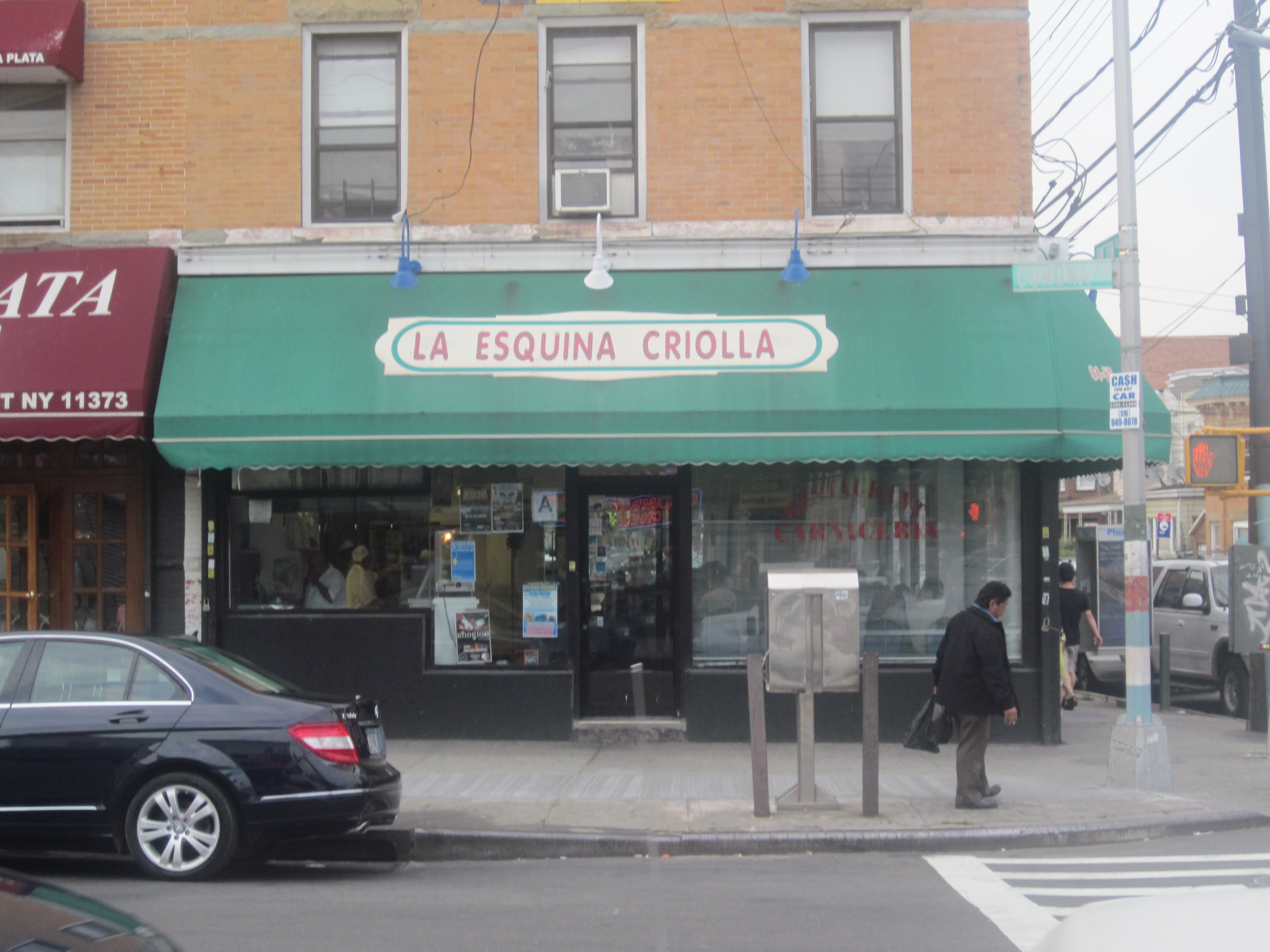
La Esquina Criolla

94-67 Corona Ave,
Elmhurst


“How do you want your steak cooked,” the waitress asked in her heavy Spanish accent.

We were in Elmhurst at the corner of Corona Avenue and Junction Boulevard in what was advertised as an Argentinean/Uruguayan restaurant called La Esquina Criolla.

“That’s a first for our group,” Rick said after hearing the question from our waitress.  And he was right. It was the first time in the ten plus years we had been convening that we were asked how we wanted anything cooked, much less a steak.

Did that mean our standards were changing? That now we were graduating to a different, higher quality of restaurant? I certainly hoped not and believed that the question before us was just a blip; an aberration in our continual journey to unearth diverse, ethnic eats within our frugal, even grubby, standards.

When I chose La Esquina Criolla, I knew I was treading on dangerous ground. That we would we probably be going over our $20 per person budget as well as dining at an established foodie destination where, what was confirmed later, wine was served in stemmed wine glasses. But that did not stop me. I went ahead with the choice anyway. Red meat was something our group rarely, if at all, dined on and I thought that for once we should have that experience despite the potential monetary risks. I believed this place, La Esquina Criolla would be our best bet to at least keep it close.

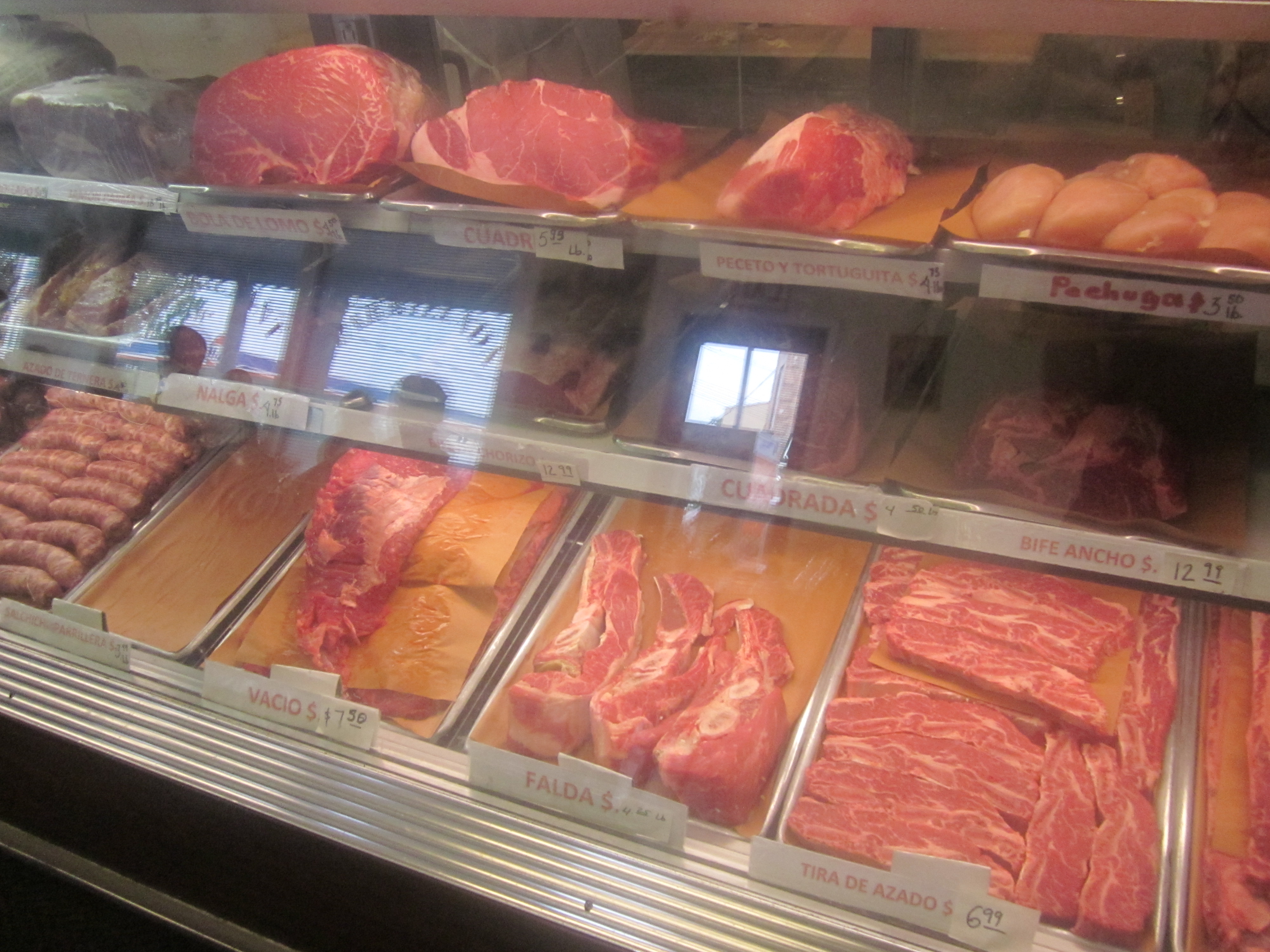
Red meat for sale.

“You’re in trouble with this one,” Gerry teased, glancing at the menu and the prices next to many of the “carnes a la parilla,” which ranged from $16 to $24.

“I have an allowance,” I said, trying to rationalize the stark reality spelled out in front of us. “Most of my other choices were so under our budget, that I’m entitled to go over here and still, really, come out no worse than even. It’s called a carryover balance.”

Eugene’s reading glasses were balanced on the tip of his nose. “Uh huh,” he nodded dubiously.

The raw meats we were soon to order were displayed behind the counter; La Esquina Criolla doubled as a butcher shop. There was flank steak, skirt steak, shell steak, blood sausage, known as morcilla, chorizo, kidney, sweetbreads, lamb, and short ribs.

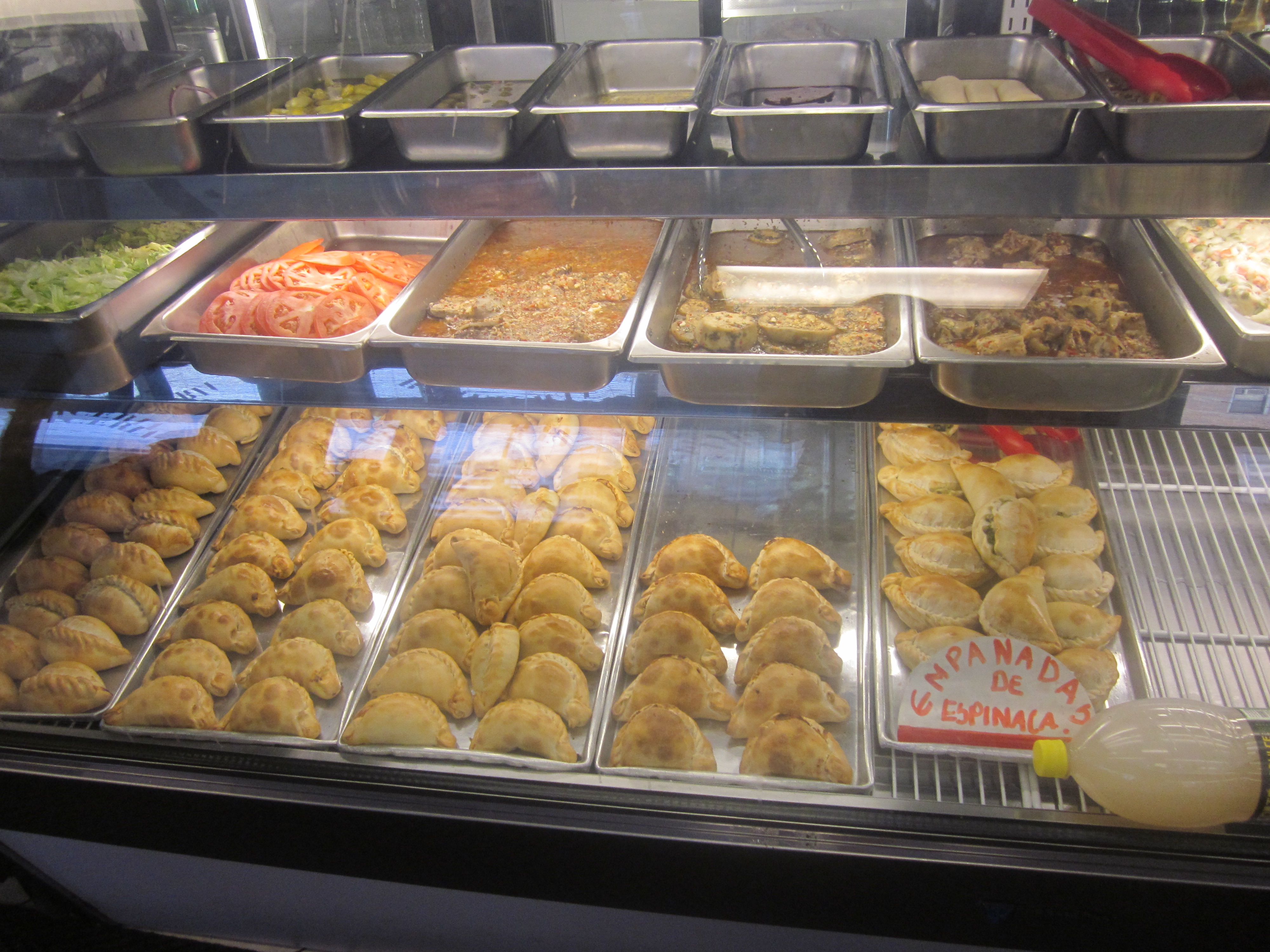
Displayed behind the counter adjacent to the meats were a selection of empanadas; meat, chicken and spinach along with a few other appetizers; marinated eggplant, beef tongue, and hearts of palm to name a few.

Empanadas…and more empanadas.

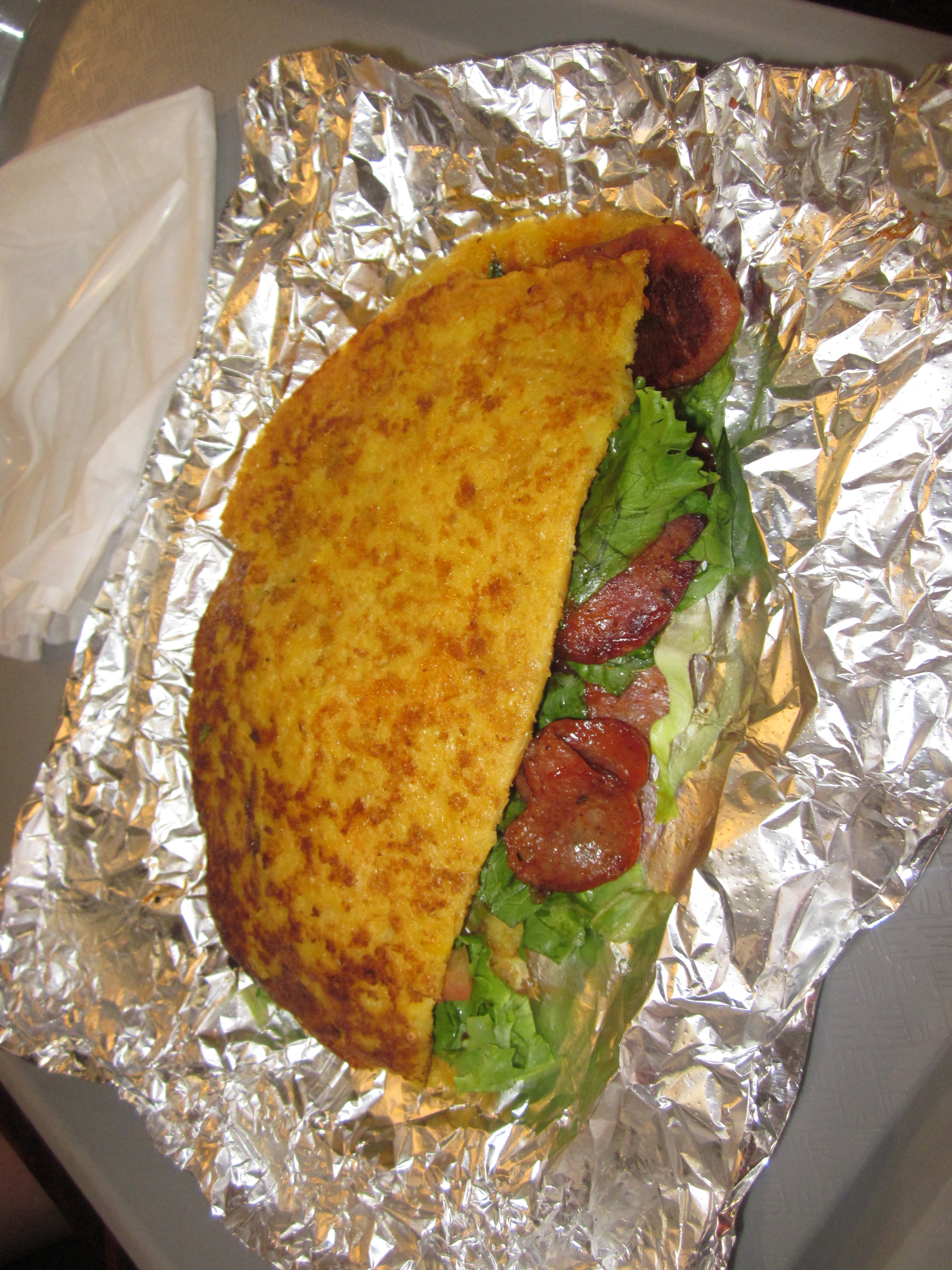
While we decided what to order, we were brought toasted bread and slices of grilled sausage. We knew we had to be careful how we ordered, but the temptations were many. The empanadas, of course were a must. A “parrillada completa,” or combination of a variety of meats made sense, despite the $38 price (for two). With it we would get to sample skirt steak, short rib, sweetbread, tripe, kidney, black and Argentinean sausage. To that we added another skirt steak for two, a flank steak, and an appetizer of grilled provolone in oregano sauce.

The entrees all came with side orders; a dry potato salad, potato, beet and hard boiled egg, a bland mixed salad, and plantains.

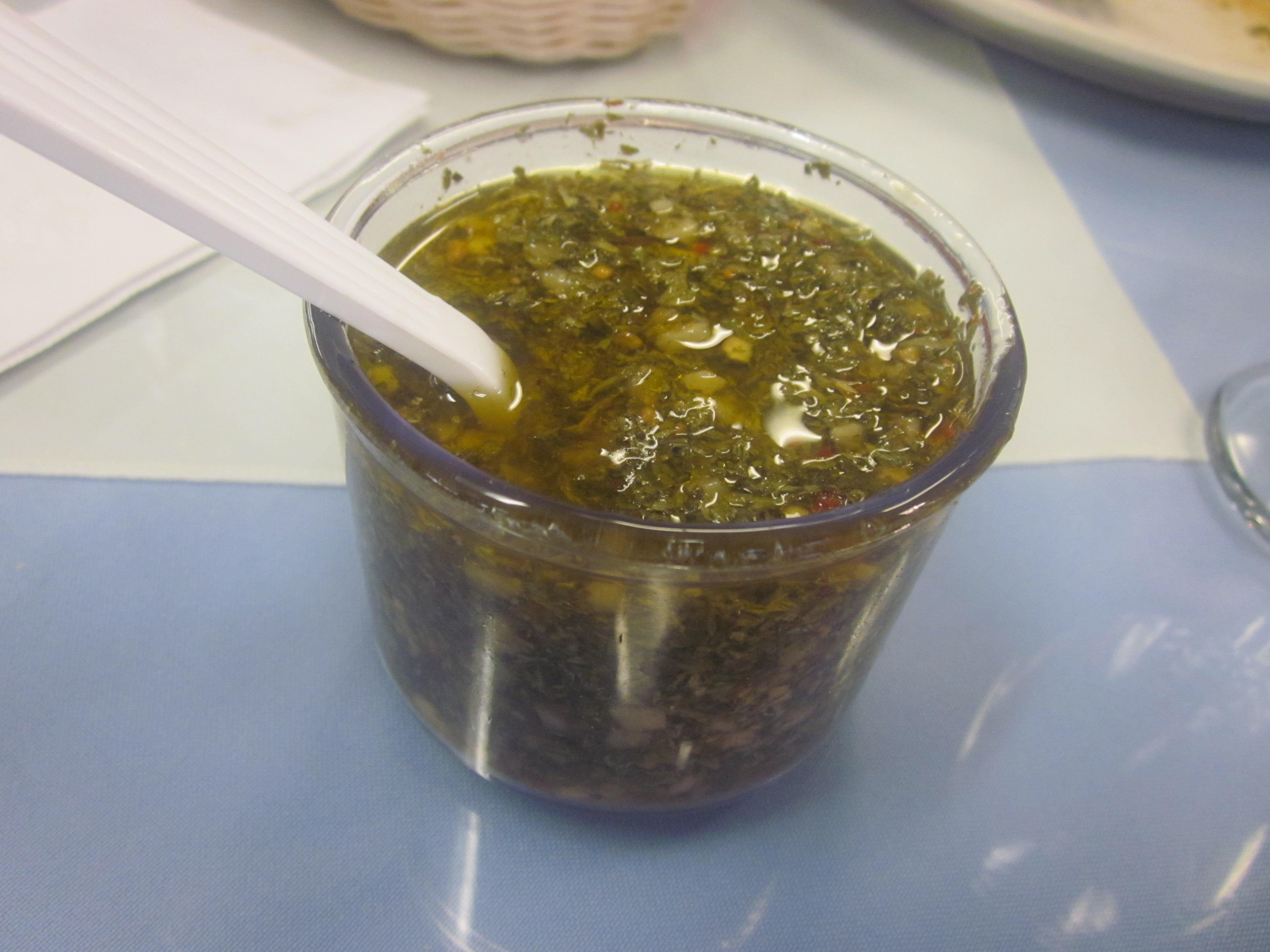
While we ate the buttery-crusted empanadas served with the tableside tangy homemade chimichurri sauce, a procession of ancient tango ballads played.

An Argentinean condiment supreme.

“Why does this music make me think of monocle-wearing Nazis,” Zio pondered.

“You’re confused,” Gerry said to him. “Those were the Boys of Brazil you’re thinking of. Wrong country.”

“Didn’t they escape to Argentina also?”

“Sure, there are plenty of retired Nazis in Argentina,” Rick confirmed. “And they love that old school tango.”

“Yes, herr commandant, I have heard about the tango classes at the Russian front.”

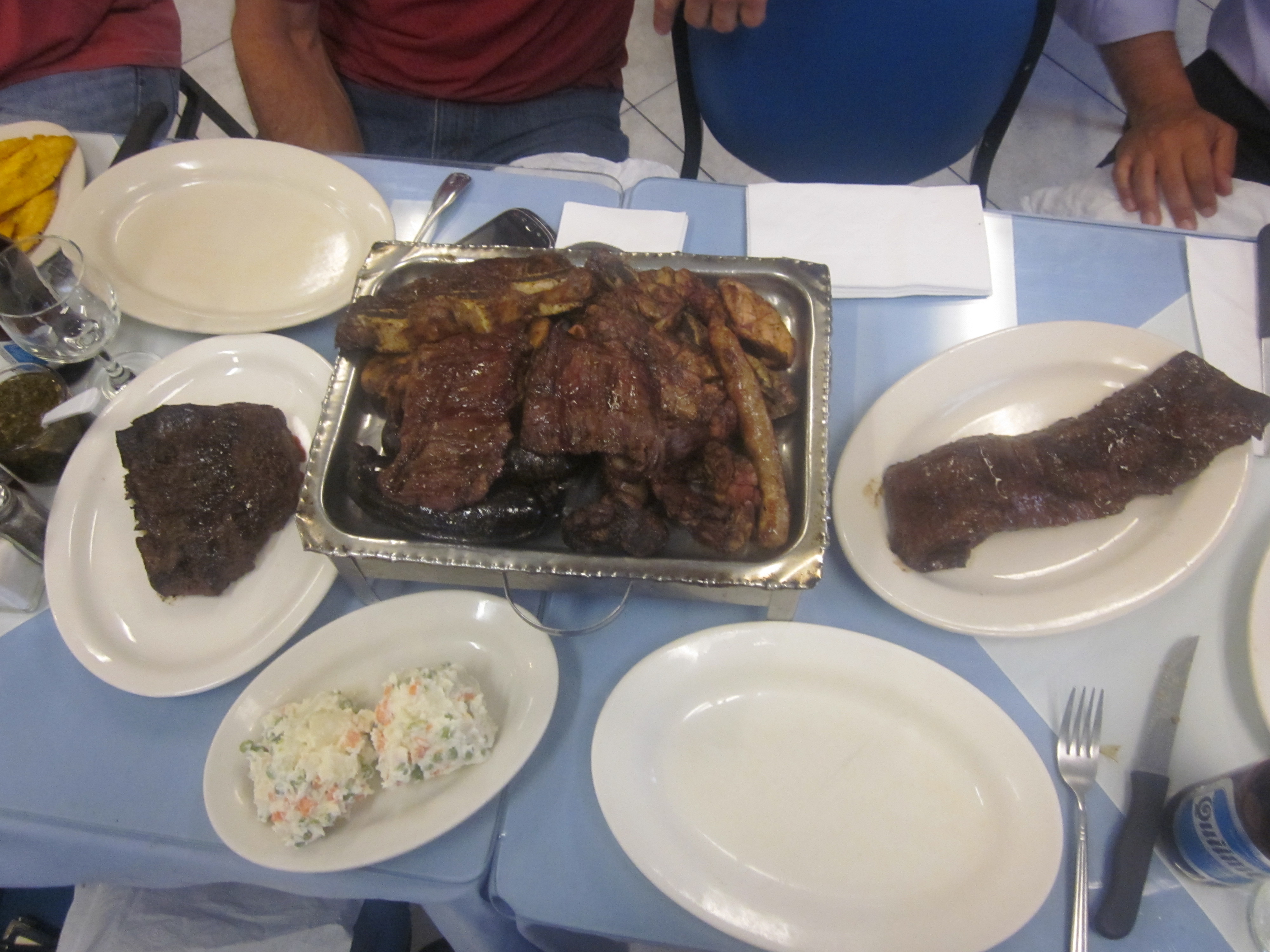
Halting the conversation was the arrival of a sizable silver serving tray adorned with a selection of charred meats. This was the “parrillada completa” for two, but judging from the size of it, was more than enough for three or four, even if the three or four included the gluttons in our group.

The Parillada Completa for two, flanked by flank steak on the left and skirt steak on the right.

On separate smaller plates were the other meats; the flank steak and the skirt steak for two. Including what we got in the “parrillada completa,” if you did the math we had enough skirt steak for three, but who was counting?

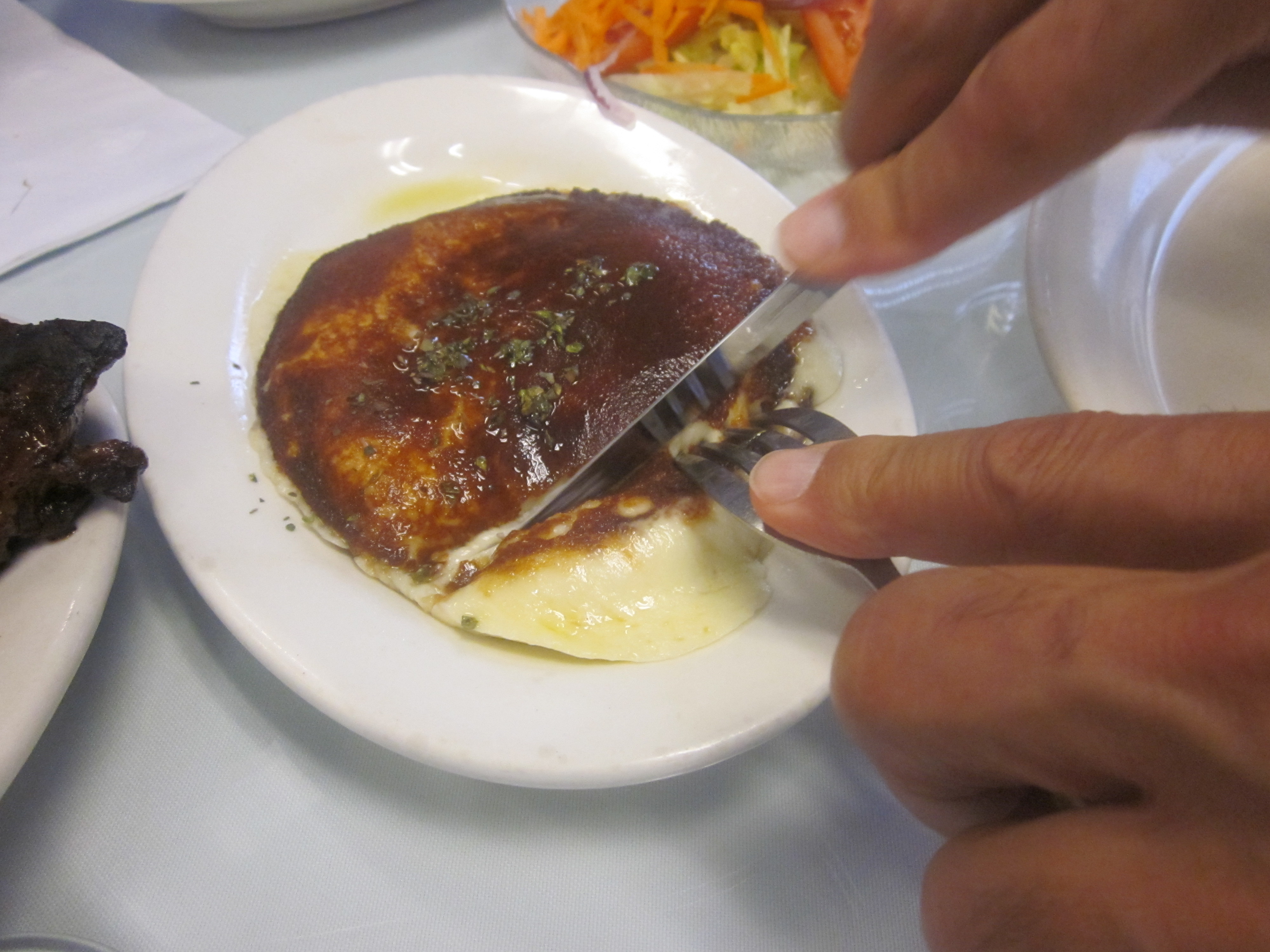
The grilled provolone came as advertised, toasted on the outside, the cheese oozing from it when sliced and doused with oregano flavored olive oil. We sawed through the steaks, cooked as we ordered, medium rare; the juices flowing from them onto the platters.

Grilled Provolone

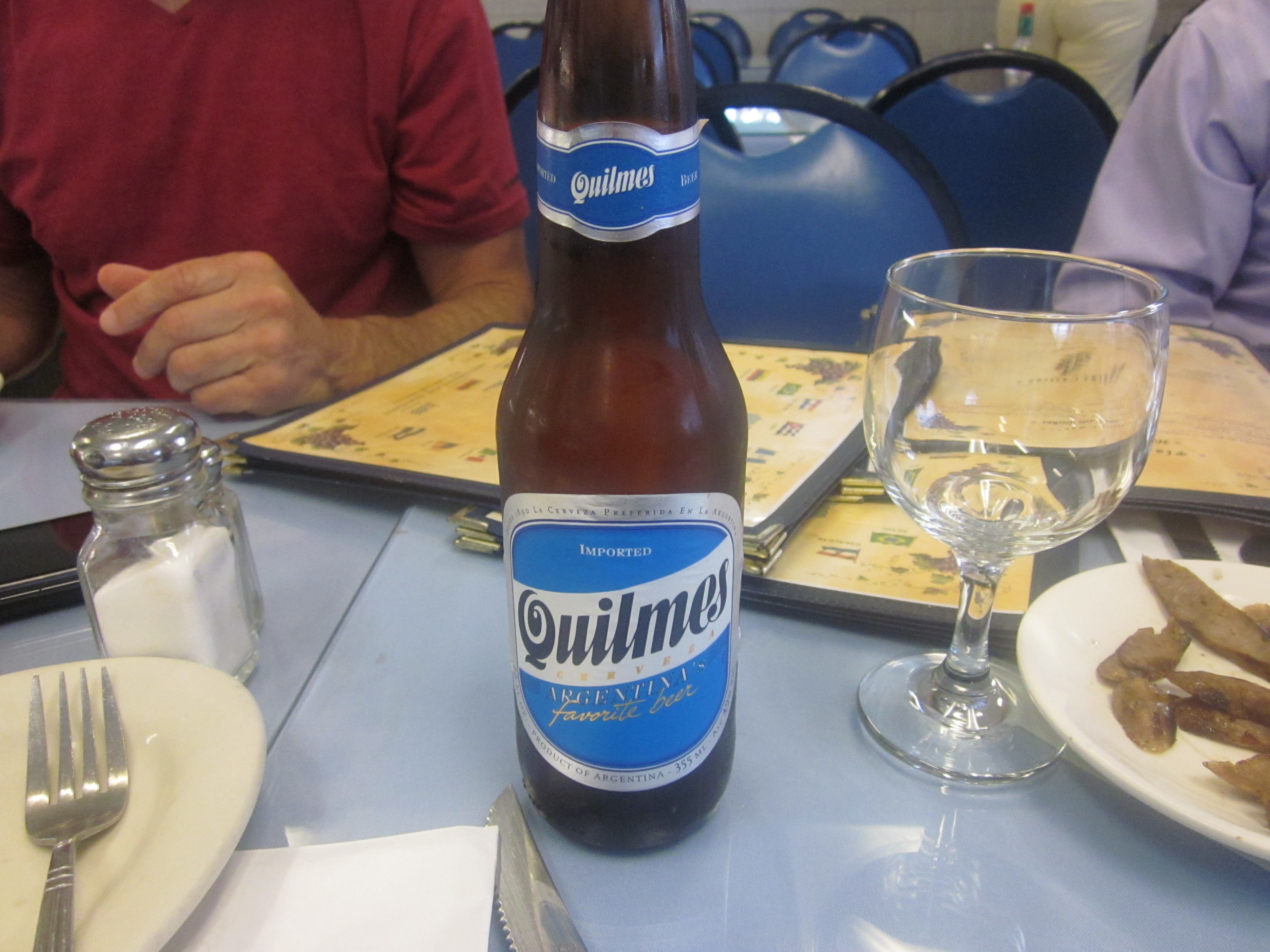
While we chewed, moving from one cut of meat to the other, some of us paused to cleanse our palates with gulps of the Argentinean beer, Quilmes; Zio instead choosing the toxic sludge that is diet Coke to accompany his meal.

A beer and a glass…with a stem.

It was about then when, to my astonishment I noticed Rick sipping red wine from the aforementioned stemmed glass. He shrugged when he saw that I had noticed. He didn’t have to qualify his choice in any way. It was the glass that was more of note than what was in it.

We were making very good progress; the meats on the platters were slowly vanishing.

“You want a beet?” Rick offered Zio from the platter of cold potato and beets.

Zio thought about it for a moment and then nodded. “Yeah, what the hell. Give me a beet.”

Soon all was gone with the exception of a shriveled piece of tripe and a “burnt end” of sweetbread that even Gerry would not touch.

A sweetbread burnt end.

Seeing that there really was nothing left in front of us, the waitress recited what was on the menu for dessert. Zio, who seemed to go silent after that last beet, perked up when he heard there was quince paste.

“I love quince paste,” he announced. “I had it the other day.”

“Bring us the check,” Eugene said, making the executive decision that there would be no dessert, as if we needed it after all that. No one, not even Zio and his penchant for quince paste, dared to stand up to Eugene’s resolve.

The check came. We waited silently as Eugene perused it. We knew we had done some major damage. I chewed on my knuckles in anticipation. My own self-imposed standards were on the line here.

“$30 each,” he said. I let out a sigh of moderate relief. We were over budget, but we had beer, some of us more than one, and even red wine—in a stemmed wine glass. That would account for at least $5. And of course our waitress deserved a generous tip for having to put up with us. It wasn’t as bad as it could have been.

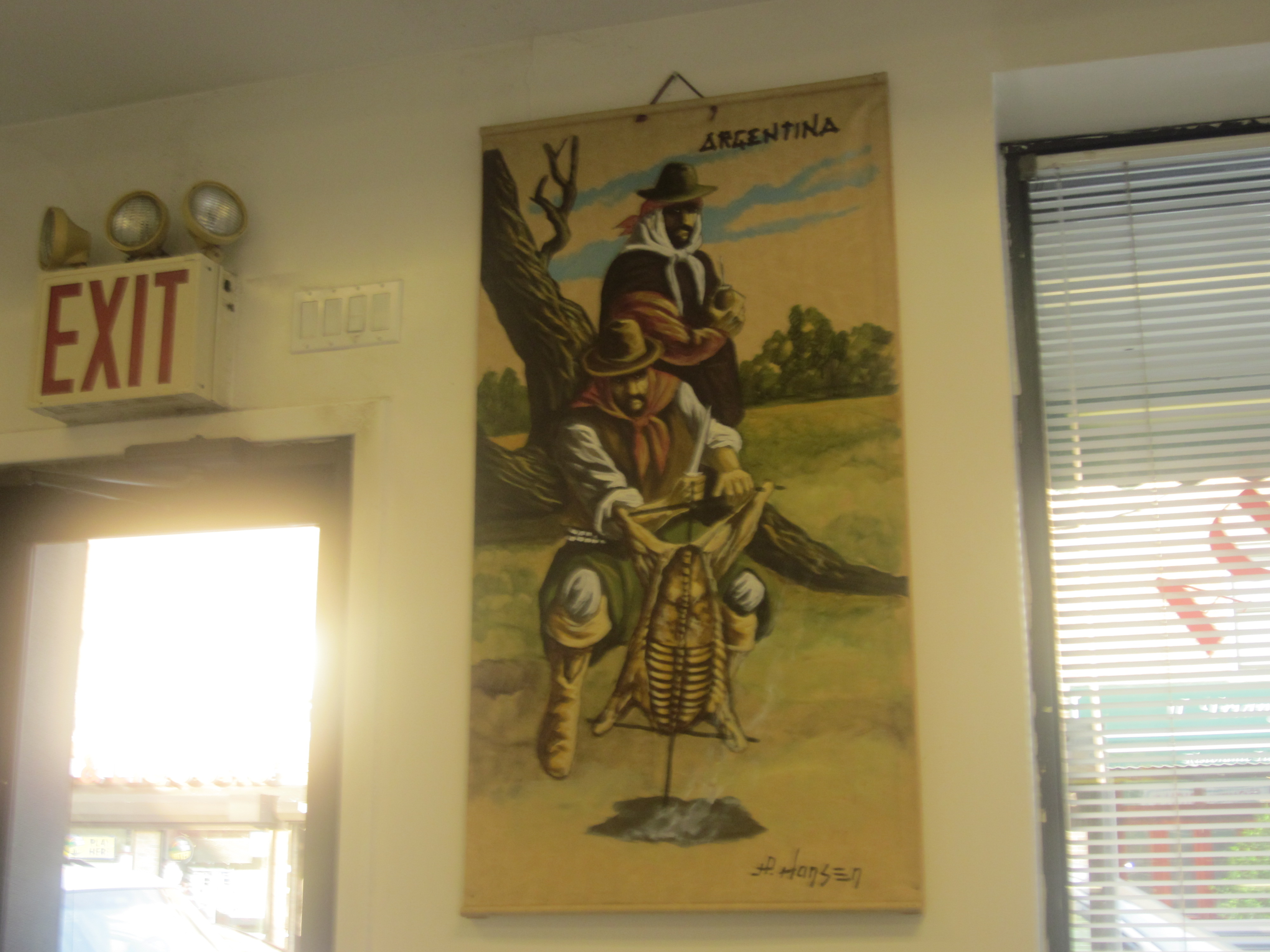
The rough life on the pampas of Elmhurst.

We stumbled out of the restaurant. The tango music was still playing. I had a piece of parsley from the chimichurri sauce stuck between my teeth. There wasn’t much I could do;  I would have to wait until I got home before I could attend to it.

The Noodles on Prince Street

22 May

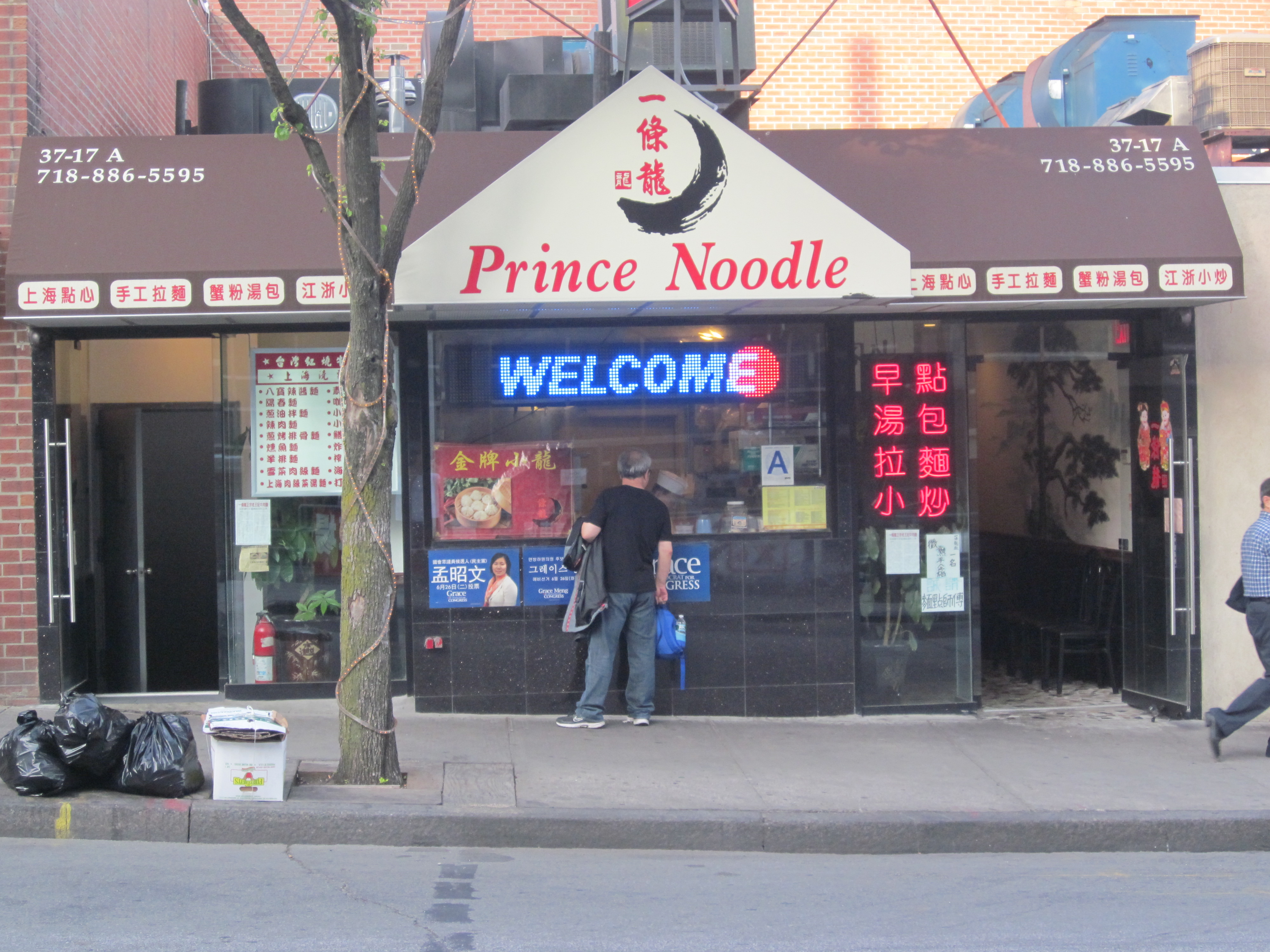
Prince Noodle House
3717 Prince Street
Unit A
Flushing

I’ve gone over the rules of our Chow City group many times in these electronic pages. We look for $20 and under places. We do our best to unearth those that are under the foodie radar, which nowadays is practically impossible. We look for virgin territory in terms of cuisines, but after ten years, the only cuisines we’ve skipped are the big name items (French, German, “American,” nouveau or fusion anything).

But there was one clause that was really never discussed or spelled out in our unwritten rule book. It didn’t have to be; it was taken for granted. That was the concept of waiting in line for a table at a restaurant. It goes against everything we hold sacred when it comes to eating; it’s a shock to our eating sensibilities.

So when Rick suggested a very well documented—at least by foodies—noodles and dumpling place in Flushing called Nan Xiang Dumpling House, I gently pointed out that, from my knowledge of these things, the place has become a “foodie destination.”

Rick understood immediately and, knowing the unwritten (and never mentioned) rule, quickly dismissed his original choice and instead went with an alternate, quite literally, down the road from Nan Xiang, the road in this case being Prince Street, called Prince Noodle House.

Of our group, only Mike from Yonkers, who was called to an urgent co-op board meeting, did not make the trip to bustling Flushing. There was absolutely no wait or line to get into the Prince Noodle House and we were given a big round table next to a large celebratory party of Asians.

One of the reasons Rick decided on, first Nan Xiang Dumpling, and then the Prince Noodle House were the aforementioned dumplings; in particular soup dumplings. He wanted to experience the Shanghai-style dumpling where the soup is “frozen” within the dumpling only to melt inside when steamed. Prince Noodle had them on their menu, here called  “soup buns,” so we ordered the crab meat mini buns and the “special” mini buns for the table.

Crab meat soup buns

While we ate the soup buns, improperly at first and not with the provided spoons, the soup bursting all over our plates, Eugene told us of his trip to Jefferson City, Missouri where he attended a wedding.

“It was ridiculous,” he complained. “The wedding was catered. All they had was Mountain Dew, a keg of beer, and franks and beans. Can you imagine that?”

We couldn’t imagine it especially for a man used to the all you can eat buffets on the cruise ships and all-inclusive resort he regularly frequents.

While Eugene railed about his Jefferson City experience, I peered behind me at the big table. They were given one of those rotating round trays so they could spin it around making sharing easier. How come we didn’t get one of those, I wondered? The food was beginning to assemble on their table and I liked what I saw.

I asked our waiter about a dish they ordered that was a mix of a green, spinach like vegetable combined with what looked like tofu.

The waiter pointed to something on the menu called “malantou (kalimeris indica) w. dried tofu.”

“Indica means cannabis, or marijuana,” Zio offered as if he really knew of such things.

I ordered one for our table along with five spiced beef.

Kalimeris indica, also known as malantou with dried tofu

Served at room temperature, the malantou, vinegary greens mixed with dried shredded tofu, was a refreshing appetizer, though did not induce the melancholic buzz worthy of its name. The five spiced beef, on the other hand, thin slices of roast beef, cured with five spice powder and a sweet soy sauce drizzled over it, also served at room temperature, were addictive in a more familiar way, at least for us, than what Zio had presumed we would experience with the malantou.

Five spiced (roast) beef

Gerry immediately had his sight set on the “sliced fish swimm hot chili pepper sauce,” that was on the menu, highlighted in red to indicate that it was spicy. No one had any disagreement with his choice or of Rick’s twice sautéed pork belly.

I thought we should at least try some of the noodles at Prince Noodle House and ordered hot and spicy pork noodle soup. I added a rice dish, snow cabbage with rice cake and pork, while Zio studied the menu for one last dish.

The waiter hovered over his shoulder. “I want this,” he said, pointing to something on the menu.

The waiter bent down closer to see what Zio was pointing to.

“You want crap fish?” he said.

“Huh?” Zio immediately got flustered.

“The crap fish?” the waiter said again.

Zio looked at the menu. What he was pointing to read: “spicy bean paste Buffalo crap fish.”

“Yes, I want…number 102,” Zio concurred, indicating the number adjacent to the item where the a and the r had obviously and mistakenly transposed.

Sliced fish “swimm” in hot chili pepper sauce

First to come out was the family-sized sliced fish that, in an enormous casserole dish, was literally “swimm” in hot chili pepper sauce. A few bites brought tears to Eugene’s eyes, a sheen to Rick’s forehead, and loud honking from Gerry’s prominent, yet distinguished nose.

The noodle soup was equally spicy and the noodles, hand pulled, gelatinous in texture, lived up to its princely reputation.

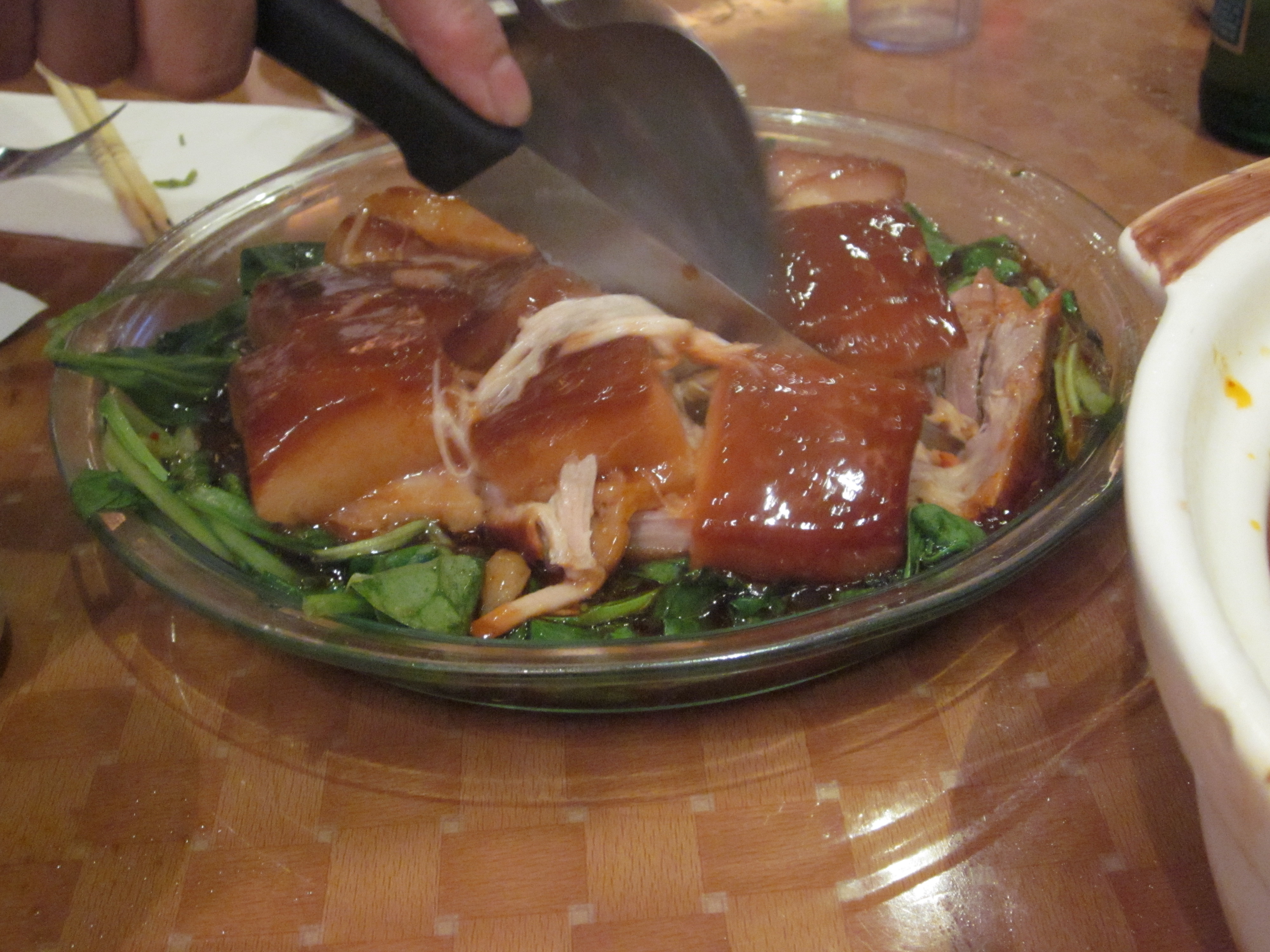
Relief from the heat came with the arrival of the pork belly and the snow cabbage and rice cake. Covered with a one inch layer of fat and glazed to a burnished reddish color, the pork belly was ultra tender; the meat kept moist by its fatty coat and marinated with light soy sauce, sugar and rice wine.

Sauteed pork belly

Last to arrive was the whole carp. Smothered in a bean paste and topped with scallions and ginger, Zio was the first to sample it. He didn’t have much to say as he picked through the many bones. Gerry tried a few bites.

“Hmmm, crap fish has a very unique taste,” he said with a straight face.

There’s crap fish under all that spicy bean paste.

While we polished off almost everything but the unfortunate carp, the dishes on the rotating tray on the table behind us kept piling up. We were done and they were just starting on a huge platter of lobster. Despite having completely stuffed our faces, we gawked enviously as we paraded out of the now fully booked restaurant.

Good thing we didn’t have to wait, I thought to myself as I made my way back to the parking lot where my car was parked. Once inside my car, I stared through the windshield at Prince Street. I noticed a line had formed outside of the Nan Xiang Dumpling House. Maybe the soup dumplings and noodles were better than the stuff we just experienced at Prince Noodle House, but I wasn’t going to wait to find out.

The line for soup dumplings at Nan Xiang

Cinco de Mayo Tacos on Veinticinco de Abril

1 May

Los Portales Taqueria
25-08 Broadway
Astoria

Cinco de Mayo was more than ten days away, yet Rick used the Mexican heritage celebration as his reasoning for choosing the Astoria-located, Los Portales Taqueria as our next eating destination.

A few hours before our assigned dining date, however, I received a text from Rick saying his boss was “urging” him to have dinner with him in New Jersey. So instead of celebrating an early Cinco de Mayo at a taqueria in Queens, Rick was in Newark eating red meat at a Brazilian steakhouse.

And it some ways, it was a good thing. As it was, we had to squeeze an extra chair around the biggest table at Los Portales to fit the five of us. If Rick were present, one of us would have had to eat at a separate table, which, depending on who was the odd man out, was not necessarily a bad thing.

Just beyond the portales of the taqueria was a cauldron of meats along with a burnt red glazed slab of pork (al pastor) on a spit. All of it looked authentically promising though that was expected when in Rick’s initial email declaring our destination he wrote “don’t try to call them—English is limited.”

A cauldron of meats.

The menu covered all the basics: tacos, cemitas, tortas, burritos, tostadas, quesadillas, and assorted familiar platters like pechuga de pollo, bistec en salsa rojo, and fajitas. There were also bonus items that we had no interest in like wraps, “hamburgesas,” vegetarian specials, and hard shell tacos.

Despite the limited English, hand gestures and finger pointing made ordering very easy. We started with two orders of guacamole. They came on plates with chips sticking out of the bright green mounds of guacamole like Mayan temples. With the guacamole we also tried the grilled green scallions, some so big they were more like spring onions; the char bringing out their sweetness.

Grilled scallions

Zio quickly gravitated to the oreja taco, known in English as pig’s ear while I started with a saudero (veal flank). Sprinkling some of the restaurant’s red salsa on it, I devoured the taco quickly. Zio was a little more hesitant with his pig ear taco, however. The tiny pieces of chopped ear were so smooth it was as if the pig had them waxed. Gerry noticed that Zio had left an assortment of the ear pieces on his plate. “You’re not eating those,” he inquired.

“What? You want some?” Zio wondered. “You can have them if you want.”

Gerry shook his head. “No, they’re all yours.”

“Thanks,” Zio muttered.

Pig’s ears tacos

Who am I to judge on what another man orders at an authentic taqueria? So I tried to keep my mouth shut when both Eugene and Zio chose the pedestrian chicken fajita. Gerry went a bit more adventurous with the chilaquiles with huevos; a variation of huevos rancheros; the eggs served over cut corn tortillas and doused in a green tomatillo sauce.

My choice; the al pastor cemita, a fresh sesame seeded roll stuffed with chunks of the burnt-red roasted pork, avocado, cheese, and salsa rojo was so good I plan on scouring the nearby taquerias of East Harlem to see if  the sandwich can be replicated thus saving me a subway ride to Astoria.

Al pastor cemita

While the rest of us had long finished, Mike from Yonkers was deliberately nibbling at whatever it was he ordered that included shrimp, and from what I could make out, also peppers and onions, and lots of them. The eating of the meal was a studied process. He would break off a small piece of the tortillas that came with his meal, scoop some shrimp onto it, add a little rice, then some beans, a drizzle of one of the salsas; sometimes green, other times red, and then slowly chew, swallow and then repeat the process.

When he finally finished, he abruptly headed to the rest room. His absence was not immediately noted; the hysterical clamoring from a Spanish-language comedy Zio dubbed the “Mexican Honeymooners” that played on the television in the restaurant distracting us from Mike from Yonker’s wherabouts.

When we were no longer amused by the bizarre comedy on the television, Zio proudly whipped out a card. “Do you know what this is?” He asked waving it in front of us.

None of us had a clue.

“With this I can get into the subway at half price,” he said. “One of the many advantages of becoming a senior citizen.”

Like Zio, Mayor Bloomberg is also very proud of his senior citizen metrocard.

Zio’s senior citizen metrocard held our interest for a few minutes more and when the thrill receded, I realized the seat next to me remained empty. Mike from Yonkers had been gone for a long time. “I hope he’s alright,” I said and as if on cue, he emerged from the rest room.

“Everything okay?” I asked

He sighed; his face a bit sallow. “Um…I forgot to tell you. I had Mexican food for lunch. Enchiladas.”

Mike from Yonkers’ downfall

With that admission, we all looked at each other. There wasn’t much to say. If a man wants to celebrate Cinco de Mayo ten days before the actual holiday with a double dose of Mexican food that is his right. But, still, we didn’t have to stick around to witness the potentially nasty consequences of such a decision. And with that we parted company.