Archive | Harlem RSS feed for this section

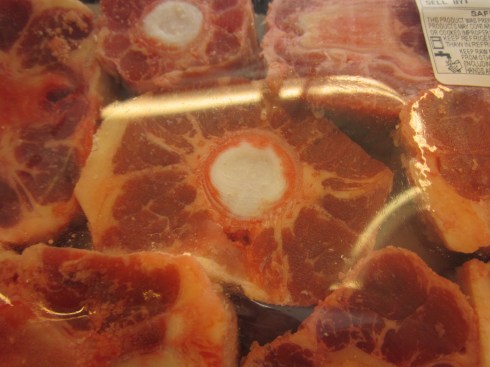
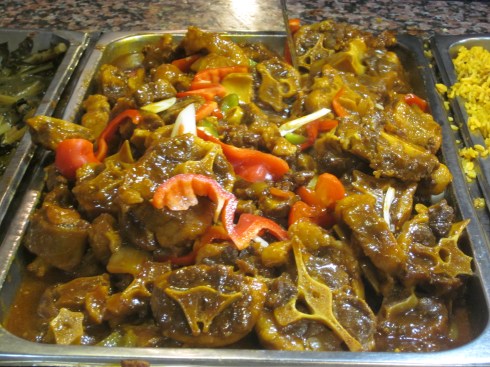
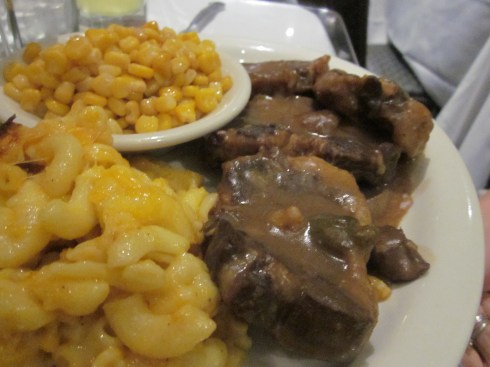
It’s an Oxtail World…

14 Dec

Ox 003

oxtail5

oxtail6

oxtails (8)

oxtails (10)

Sylvia's and stuff 002


oxtail7 (2)

Ox 007

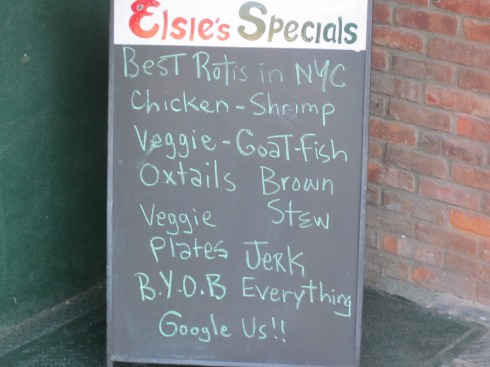
Elsie's

We just live in it.


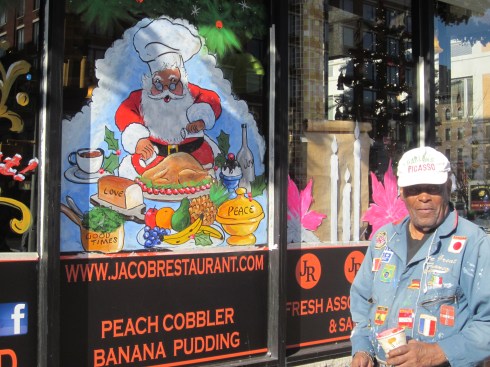
Santa’s Got Soul (Courtesy of Picasso)

30 Nov

Harlem’s Picasso that is.

Harlem's Picasso

The master himself putting the finishing touches on his seasonal creation.

Harlem Picasso

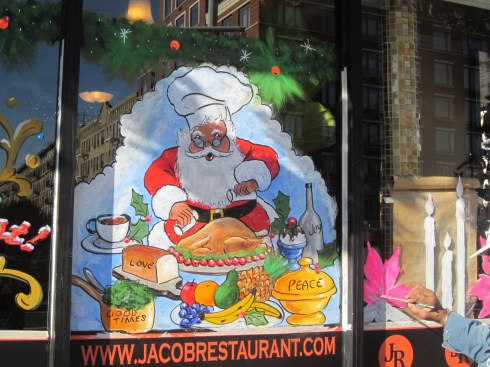
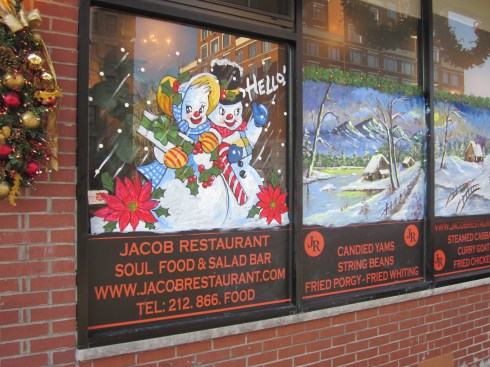
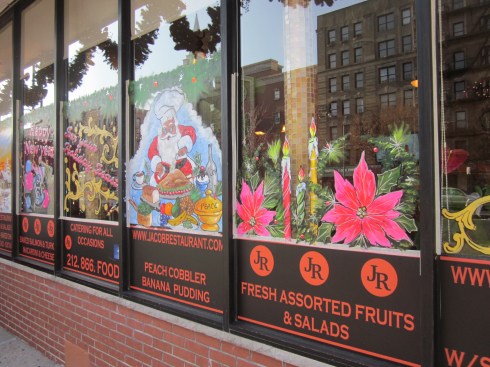
And below, a few glimpses of the Christmas collection at Jacob Restaurant.

Jacob Restaurant

Jacob Restaurant

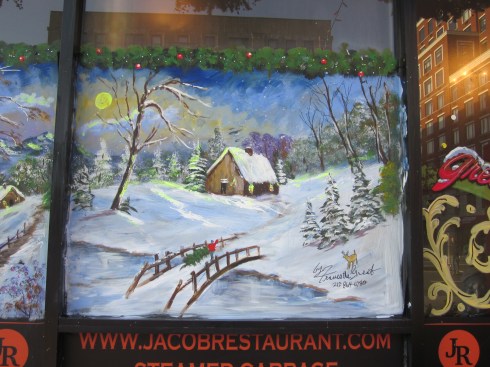
The artist's signature confirms the work's authenticity.

Note the artist’s signature confirming the work’s authenticity.

So there is really no need to brave the midtown crowds for a peek at the windows of Sak’s or Lord & Taylor’s when you can come uptown to Harlem and not only admire Picasso’s work, but eat real good too.

Injera Ingestion

14 Nov

“In all our time as a group, how have we missed eating at an Ethiopian place?” I asked Gerry, who was with me at an Ethiopian place in Harlem called Abyssinia.

“Too expensive usually,” Gerry responded, referring to our group’s tight $20 per person budget.

I looked at Abyssinia’s menu. Nothing was over $16. “Not here,” I said.

“No, definitely not here,” Gerry concurred.

It was a day after a nor’easter left a few inches of wet snow on the already soggy city streets and a little over a week after the big storm. Our group was scheduled to meet the previous day, but we were currently on hurricane hiatus. Though the group could not gather, Gerry decided to leave his still heatless Westchester home where he claimed there were no lines for gas, to drive into the city for what he hoped would be much needed spicy food.

His hopes were quickly realized. Not only was the small restaurant deliciously fragrant, it had heat—lots of it. And adding to the warmth from the clanking radiators was the heat from the meat “sambusas” brought to us by our pleasantly quiet waiter.

Similar to the Indian “samosa,” the sambusa was fiery and though berbere sauce, Ethiopian hot sauce,  accompanied it, the added spice was not needed.

Sambusas with Ethiopian hot sauce.

To get a good sampling of the meats, we ordered the “meat combo,” featuring three meat options along with a separate order of yebeg awaze tibs, cubes of lamb sautéed with onions and jalapeno in an awaze (berbere) sauce.

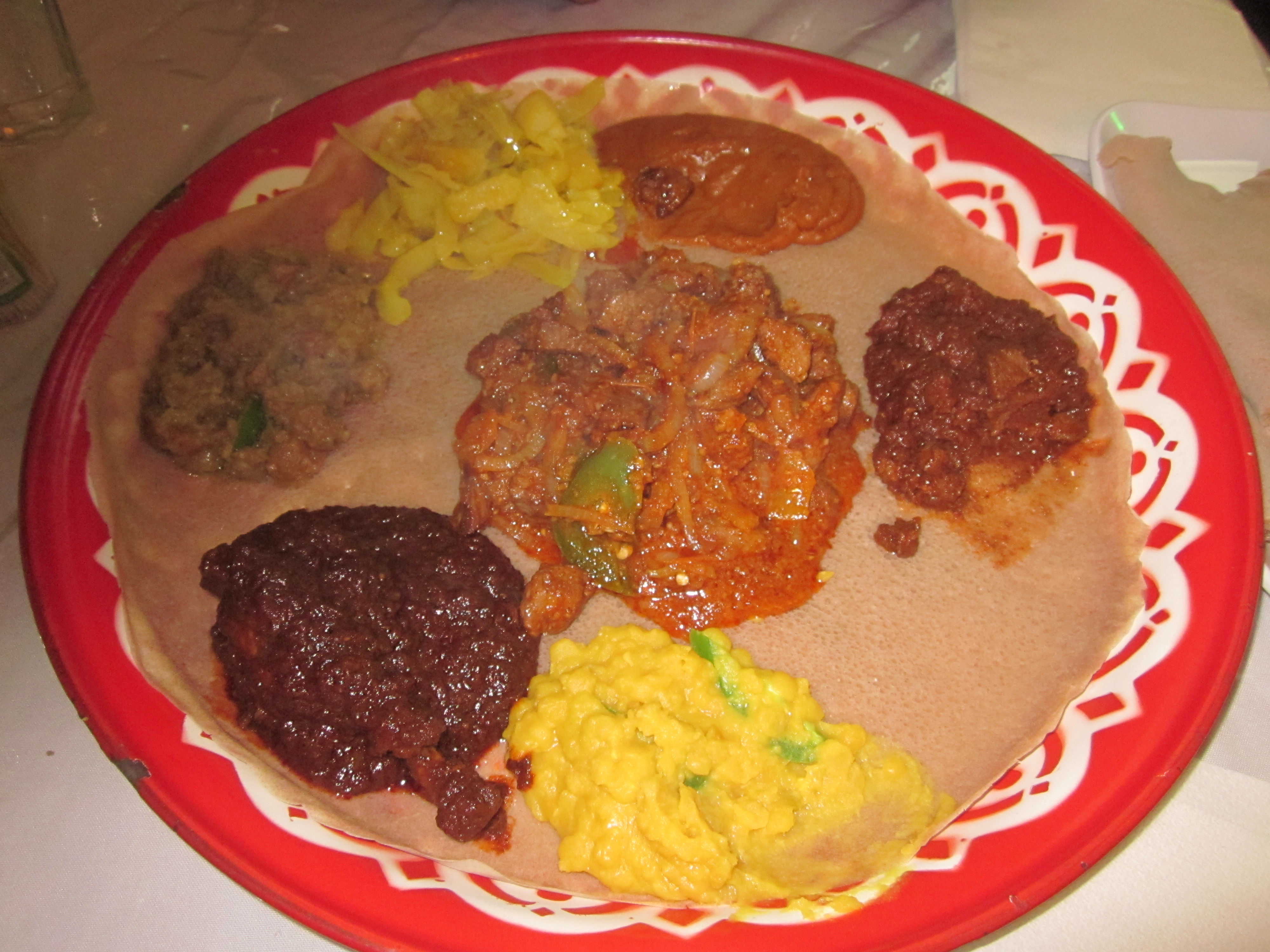
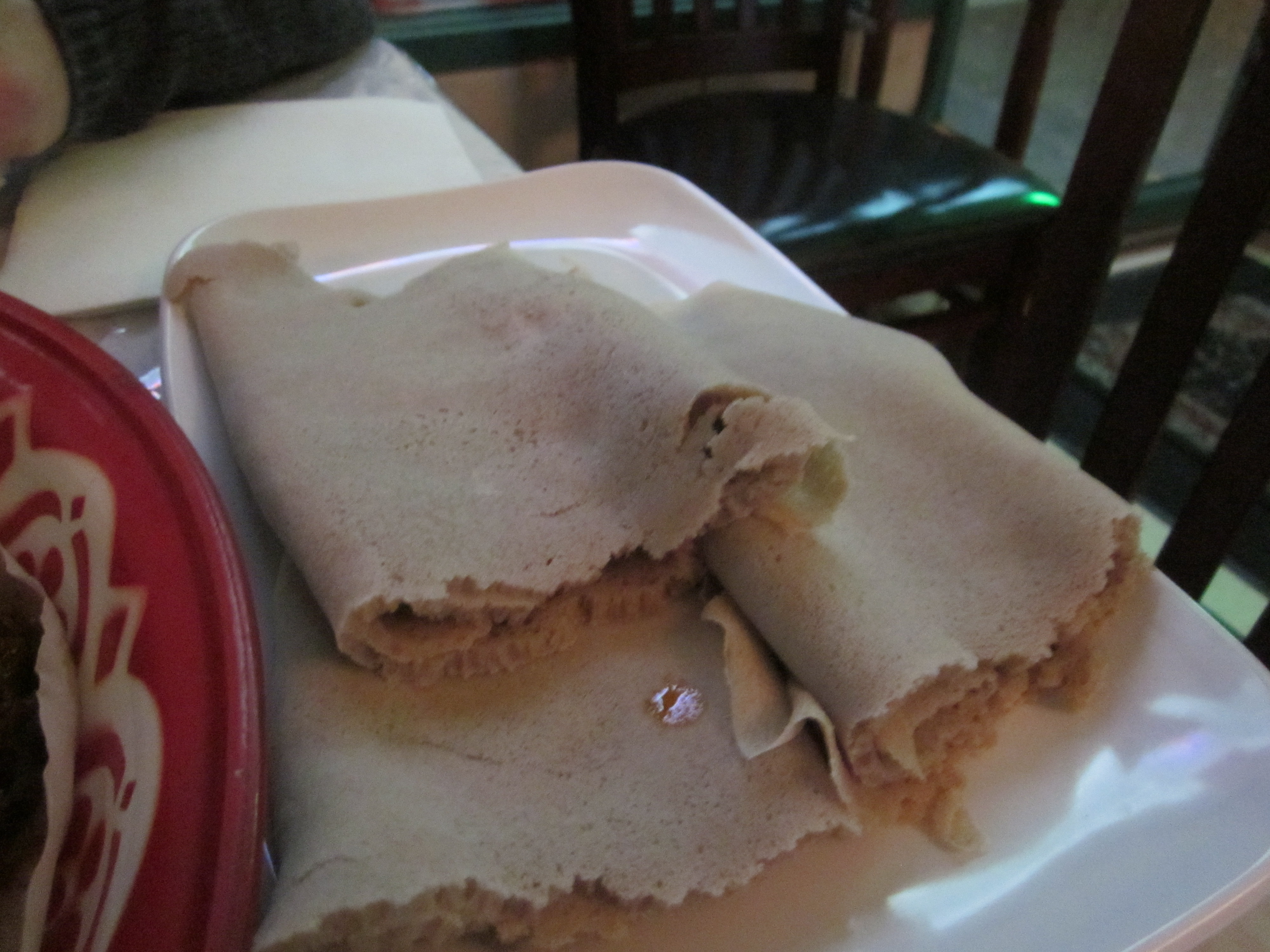
The meats came assembled on a colorful platter with each individual meat dish in a small mound along with a few vegetable sides and layered on top of the spongy Ethiopian bread known as injera.

The Abyssinia meat combo platter.

Along with the platter, we were given an additional plate of injera. There were no forks, spoons or knives on the table. With bread like this, who needed utensils? We scooped up the meat and veggies with the accompanying injera and shoved it into our mouths, doing our best not to let anything fall our already food-stained clothes.

These meats were not on the day’s menu at Abyssinia.

The doro wat, a chicken leg in a rich berbere sauce was tender, falling off the bone, the sauce identical to what coated the beef in the ye siga wat. The lamb, though not as tender as the beef or chicken, was aromatically addictive. Soon our “utensils” were gone and our waiter returned with another fresh plate of the injera for us.

We went through that plate as well and still much of the meat remained. We were not ones to waste anything, but we just could not continue. It was as if the injera had expanded in our gullets.

We ate all the “utensils.”

The waiter came to our table. He smiled slyly and examined what was left and then shook his head. “This is the best part,” he said, indicating the injera that the meats were layered and now saturated with their juices.

What was left did look delicious, but regrettably, any attempt to taste it might have resulted in a not very pleasant finale to what had been a much needed most comforting, post-hurricane meal.

As he took away the platter, I stared at it longingly. We both knew we erred, but if you do not learn from your mistakes, you are destined to repeat them…or something like that.  It would not happen again.

Abyssinia Restaurant
268 W. 135th
Harlem

Some Good News About Sandy

31 Oct

It’s been downgraded to a lechonera.

Time to remove the plywood and roast some pork.

I hope all my friends and followers are safe and moving forward post-hurricane.

The Happiest of All Hours: Paris Blues

26 Oct

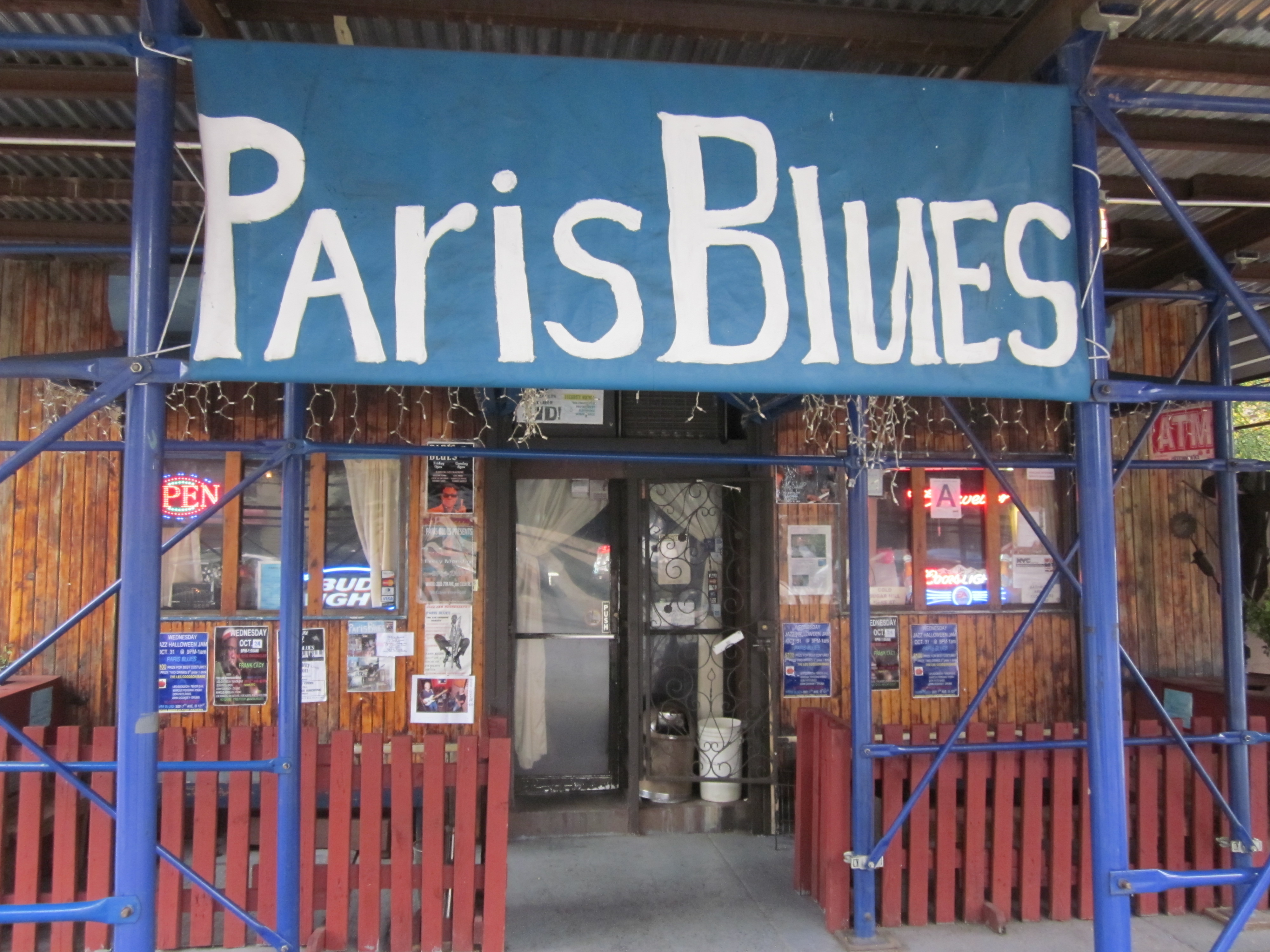
I was taking pictures of the scaffold-shrouded exterior of Paris Blues when a man’s head popped out of the door.

“Come on in,” the man said to me.

“I plan to,” I responded.

And after taking a few more pictures, I walked into the dark bar.

I took a seat and noticed a third person hunched at the end of the bar near the door sleeping comfortably.

It had been several years since I’d been to Paris Blues, but not much had changed inside except for the small stage where, at the time I walked in, another man was fiddling with a drum set.

The stage at Paris Blues

Live music was new—at least to me. The man who had gestured me inside was now behind the bar. He mumbled something about the other man up on the stage with the drum set.

“Taught him everything he knows about drums,” the bartender, who told me his name was Jer, short for Jerry, said.

“You play?” I asked.

“Used to,” he said.

Live music at Paris Blues

The younger man up on the stage snorted and soon their conversation turned to the Jets.

“They lost because they were playing scared,” the younger man said.

“No, they weren’t scared,” Jer said, ‘They lost, that’s all.” And that effectively ended the conversation.

A super-sized television set behind the stage that I knew had not been there when I visited last was on to a late afternoon rerun of  Bonanza.

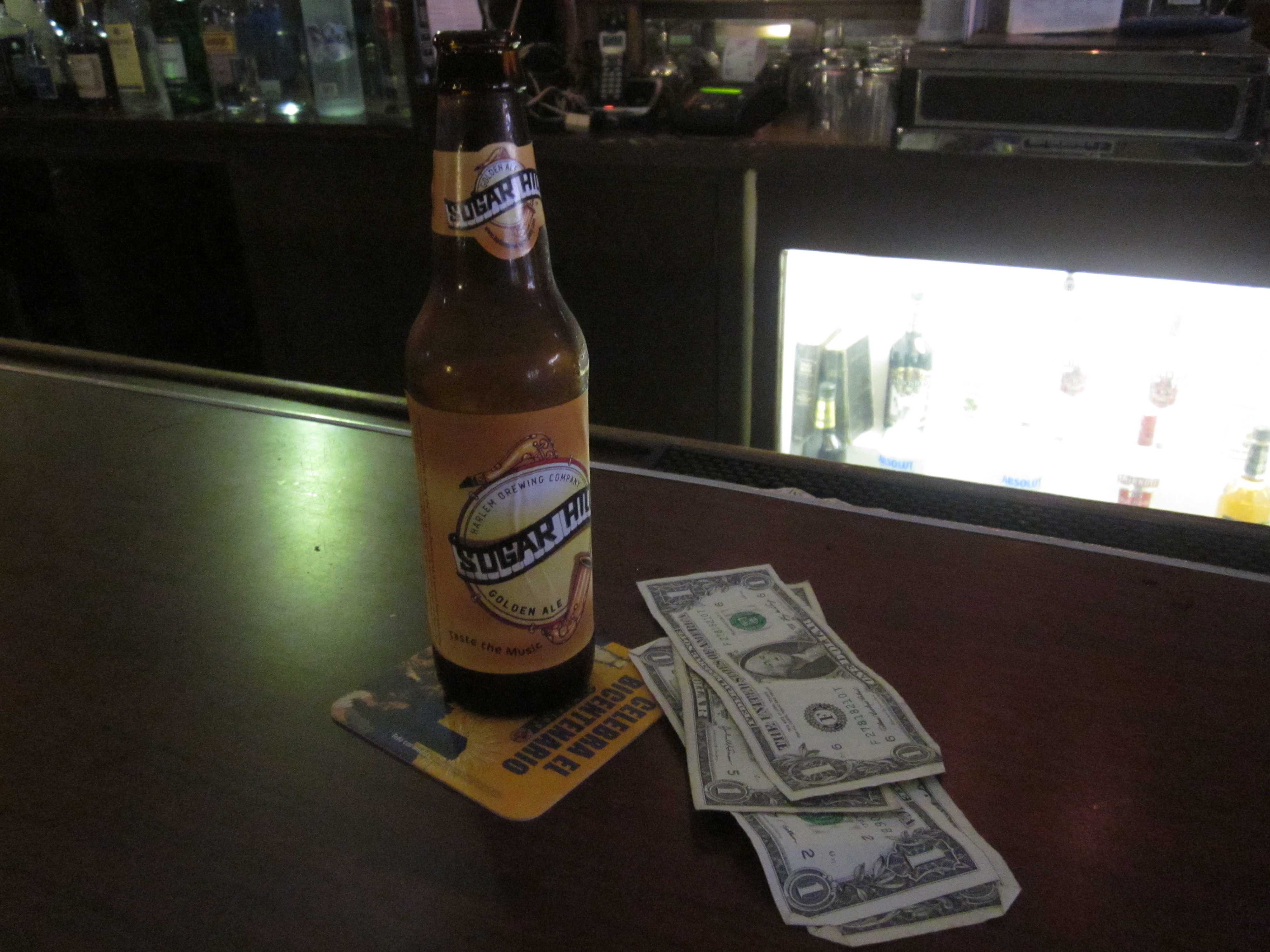
The beer options, according to Jer, included Budweiser, Corona, “Heiny,” and Sugar Hill. I was in Harlem. I thought it only fitting to choose the latter.

The beer of choice in Harlem

After serving me the beer, Jer moved around the bar and roused the sleeping man who silently got up and went outside.

Paris Blues, Jer told me, had been open for 43 years.

“How many of those have you been working here?” I asked.

“’bout 30 or so,” he answered.

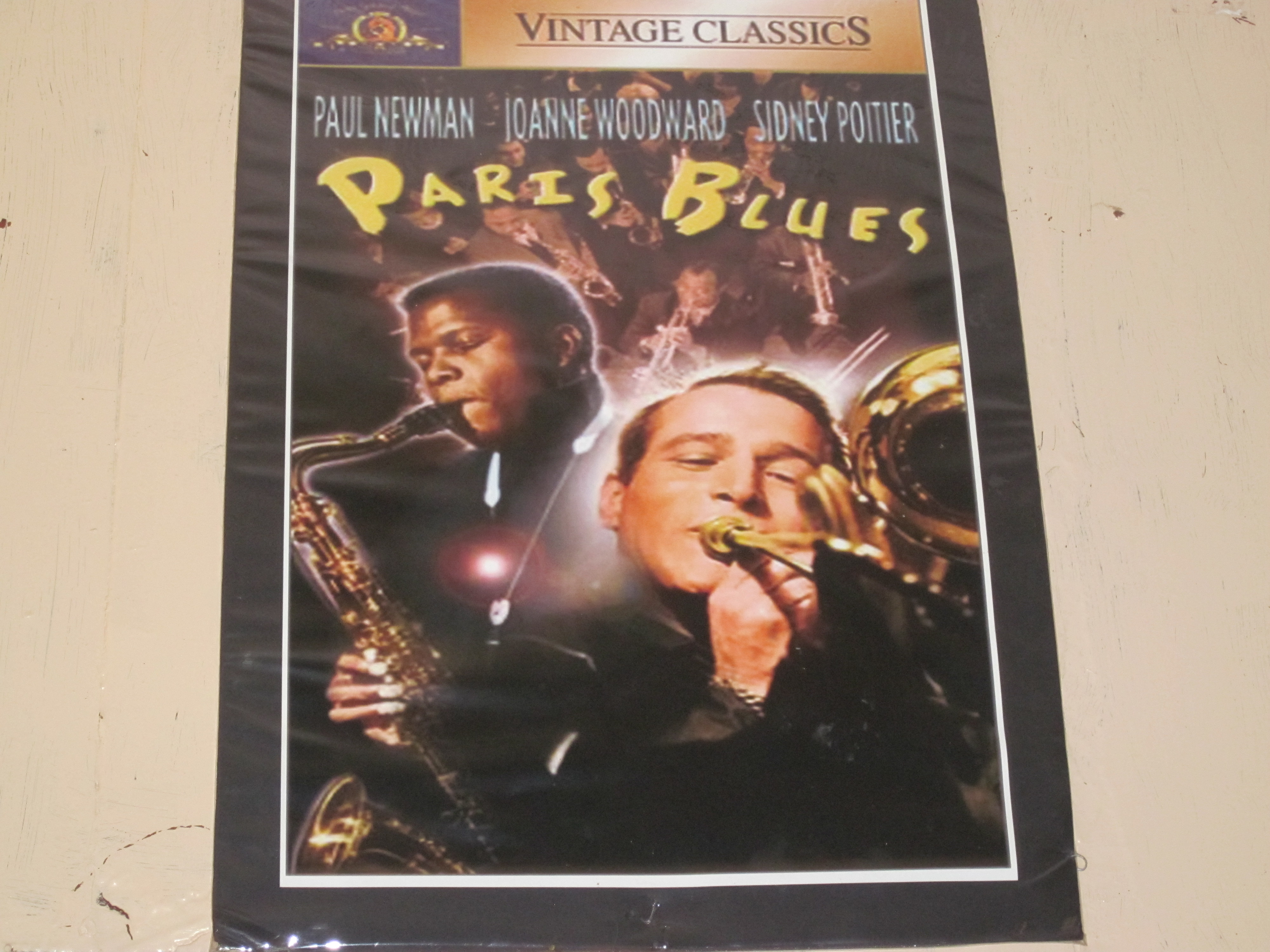
African American icons proudly on display.

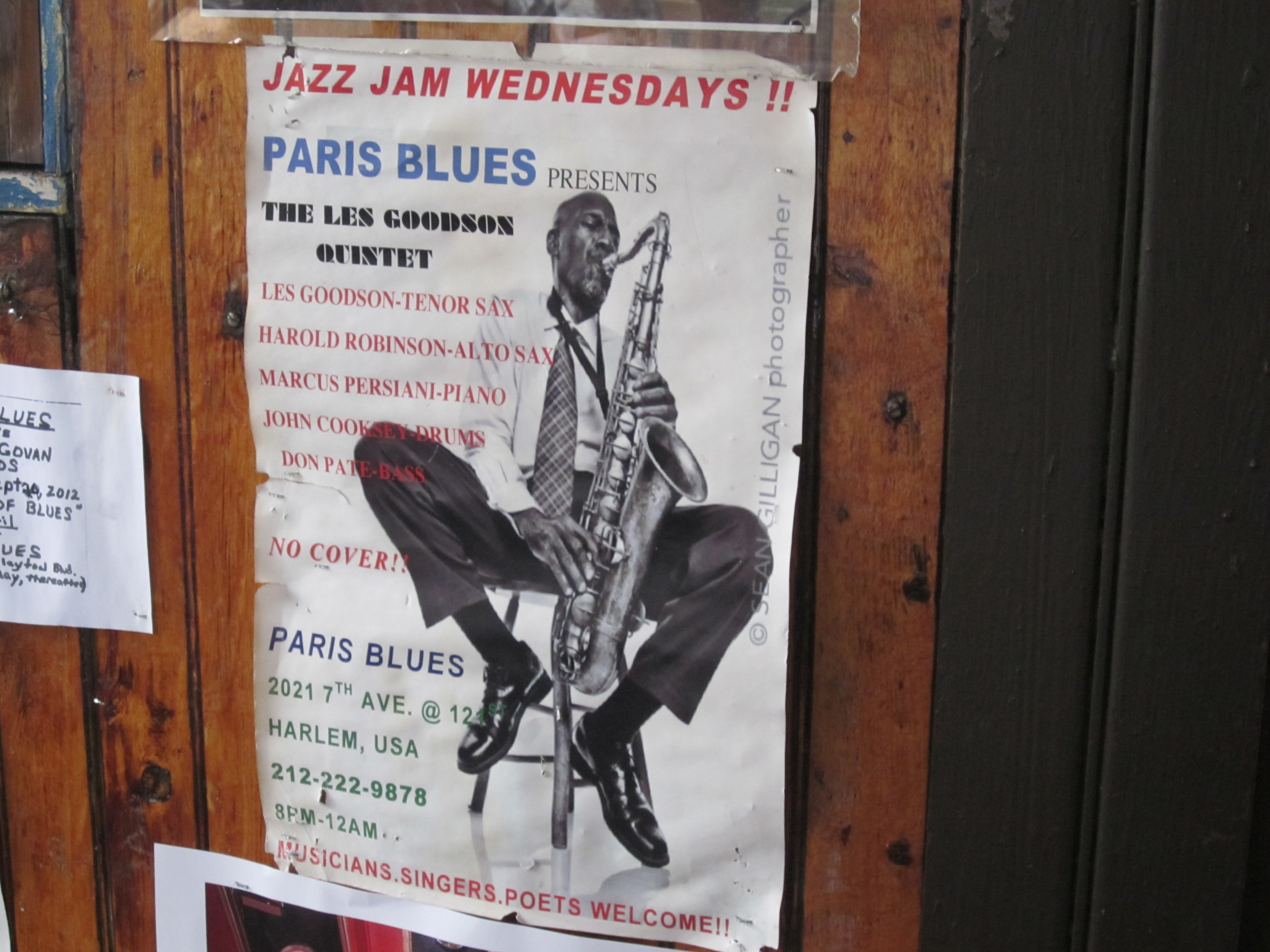
I really didn’t know why it had taken me so long to return to Paris Blues. Trombonist Frank Lacey, who I once saw perform with trumpet player, Roy Hargrove on the French Caribbean island of Martinique, was scheduled to perform later that evening.

“You get lots of tourists here?” I asked as I sipped more of my beer.

Jer nodded. “Japanese, Germans, busloads of ‘em. They’ll be in here tonight.”

On the television, a rainmaker had brought rain to the Ponderosa and a little girl was healed of a television sickness. The Cartwright men all smiled at the end and then the familiar theme song played.

Happy hour entertainment.

I finished my beer and thanked Jer.

“Come on back,” he said as I was leaving.

I told him I would.

The man who had been sleeping inside was sitting on a bench outside the bar. I nodded at him and headed down the street. It was beginning to rain in Harlem. After about a block, I turned around.  I could see the man on the bench slowly get up from his seat. I watched for a moment as he walked back into Paris Blues.

Paris Blues
2021 Adam Clayton Powell, Jr. Blvd
Harlem

The Uptown Burger Deluxe

21 Sep

There was a time when the type of beef used in making a basic diner/coffee shop burger was never disclosed. We didn’t know if the diner ground the meat or not. We didn’t know if they made the patties themselves or if they were pre-made. The beef patty—or should I say the slab of chopped beef—was tossed onto a hot griddle, or, in some cases, a grill, and cooked until done. “How do you want it cooked?” was never asked.

Once done, some cheese (for a few coins more) was melted onto the meat. The patty was then was put onto a bun with a leaf of iceberg lettuce, and a slice of tasteless, out-of-season tomato. In various instances, a pickle and grilled or raw onions were also added to the bun. The burger was assembled onto a plate surrounded by French fries. This was the prototypical “Burger Deluxe” found at countless diners, luncheonettes, and coffee shops when I first moved to New York. And I ate at a lot of them.

Many food folks these days, when given their weekly—or monthly—burger allowance, would rather spend it at a place where the beef is derived from animals that eat only grass, never consume hormones or supplements, and are treated with the utmost kindness before being slaughtered. And I can’t blame them. In most instances I would rather travel to a shack, bistro, or joint for a high quality, organic, grass fed, humane, rare or bare, juicy five napkin burger. But sometimes nostalgia gets the better of me and I just can’t help myself. That’s when I yearn for the “burger deluxe.” And, thankfully, they are still out there.

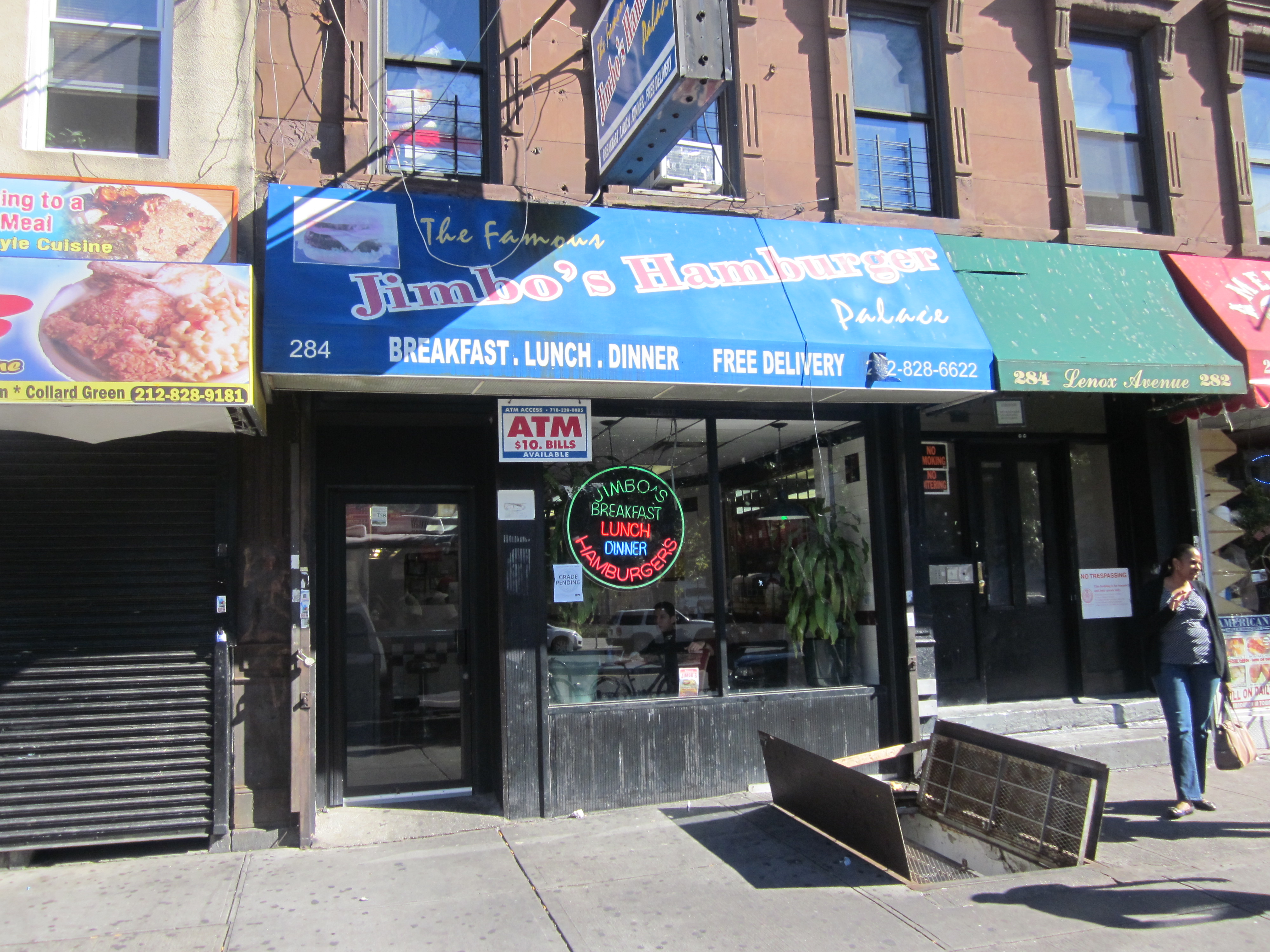
There’s a soul classic called Across 110th Street, by the great Bobby Womack. And north of that street, from river to river, is where you will have your pick of a mini-chain of diners called  Jimbo’s Hamburger Palace. At Jimbo’s, the “burger deluxe” is a mainstay on the menu.

Jimbo’s Hamburger Palace at 284 Lenox Avenue

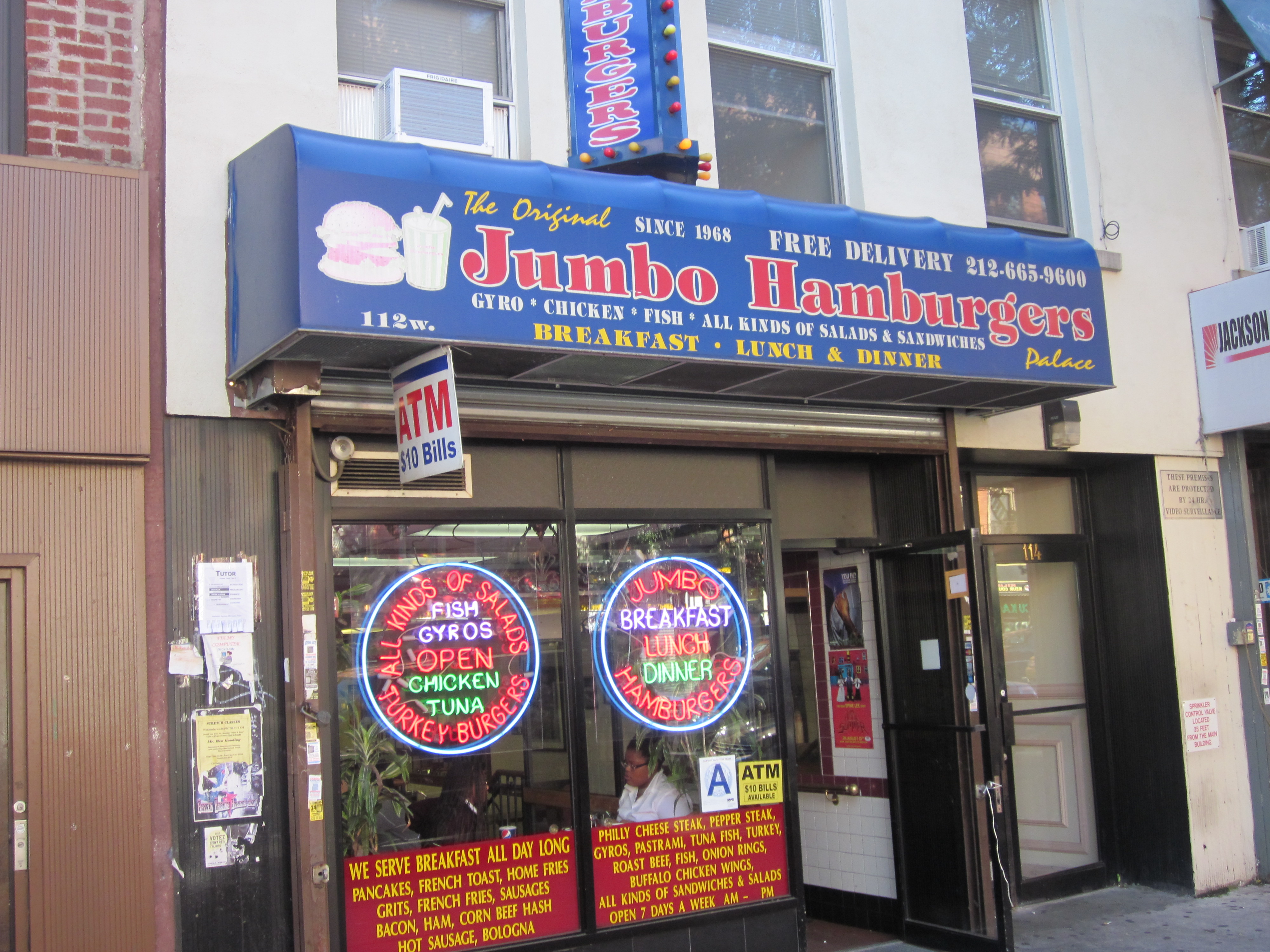
Jumbo’s on 116th Street, not to be confused with Jimbo’s, and how could you?

To satisfy my nostalgia craving, I found myself at the Jimbo’s on Lenox Avenue across from Harlem Hospital. I sat at the pristine counter and, not bothering with  pondering the sandwich wraps, gyros, or delicious breakfast options, went directly to the cheeseburger deluxe. The waitress who took my order did not ask me how I wanted it cooked. She didn’t even ask what type of cheese I wanted. She only asked if I wanted everything on it which I assumed were the various vegetable condiments. I said I did.

From my seat I watched as a generous patty/slab of meat was tossed onto the hot griddle and then covered with a bowl to steam heat it through.

It wasn’t long before the cheese was added—a thin slice of bright orange American. The bun was assembled by another cook, a slather of mayo, iceberg lettuce, a few grilled onions and two slices of an under-ripe tomato.

It took enormous self control, but I was able to keep my mouth shut.

The fries were frozen, dumped into a deep fryer and then scattered around the burger. Ketchup came in a red squeeze bottle. I decorated the burger and the fries with it. Though if I had been asked, I would have said “medium rare,” in regards to how I wanted it cook, but really, it didn’t matter. The meat was cooked the way a burger deluxe should be cooked; juices running from it dampening the bun, the ketchup, tomato, and thin layer of mayonnaise all melding together to form a perfect hot mess.

The fries, however, were another story. Maybe my memory of past burger deluxe experiences have dimmed so much I forgot how tasteless the fries were. Or maybe it’s just that I doused them so thoroughly with ketchup it never really mattered how they tasted. How could fries like these make a burger deluxe? And then I realized that of course they did. That the starchy blandness of the frozen French fries bolstered the already intense flavor of the meat—they were the perfect accompaniment.

Deluxe!


Pig Prejudice Redux

3 Aug

It’s tough to be a pig in Harlem as evidenced by A Little Love for the Pig (Please) and Pig Prejudice Revisited, 

Despite the chill, the mighty swine abides.

Lechonera Encanto

8 Jun

Lechonera La Isla
256 E. 125th Street

Last year, around this time, when I started seeing the Puerto Rican flags streaming from car antennas, out of apartment windows, and draped across uptown streets, I immediately thought of the Cuchy Frito man, specifically, Cal Tjader’s rendition and the celebration of all pig parts fried Cuchy Frito Man.

I am seeing those same flags again now. And this year, instead of Cal Tjader and cuchifritos, I thought I would celebrate La Isla del Encanto by stopping by my local lechonera, Lechonera La Isla, for a taste of pernil, roast pork shoulder.

Plenty of room at the lechonera.

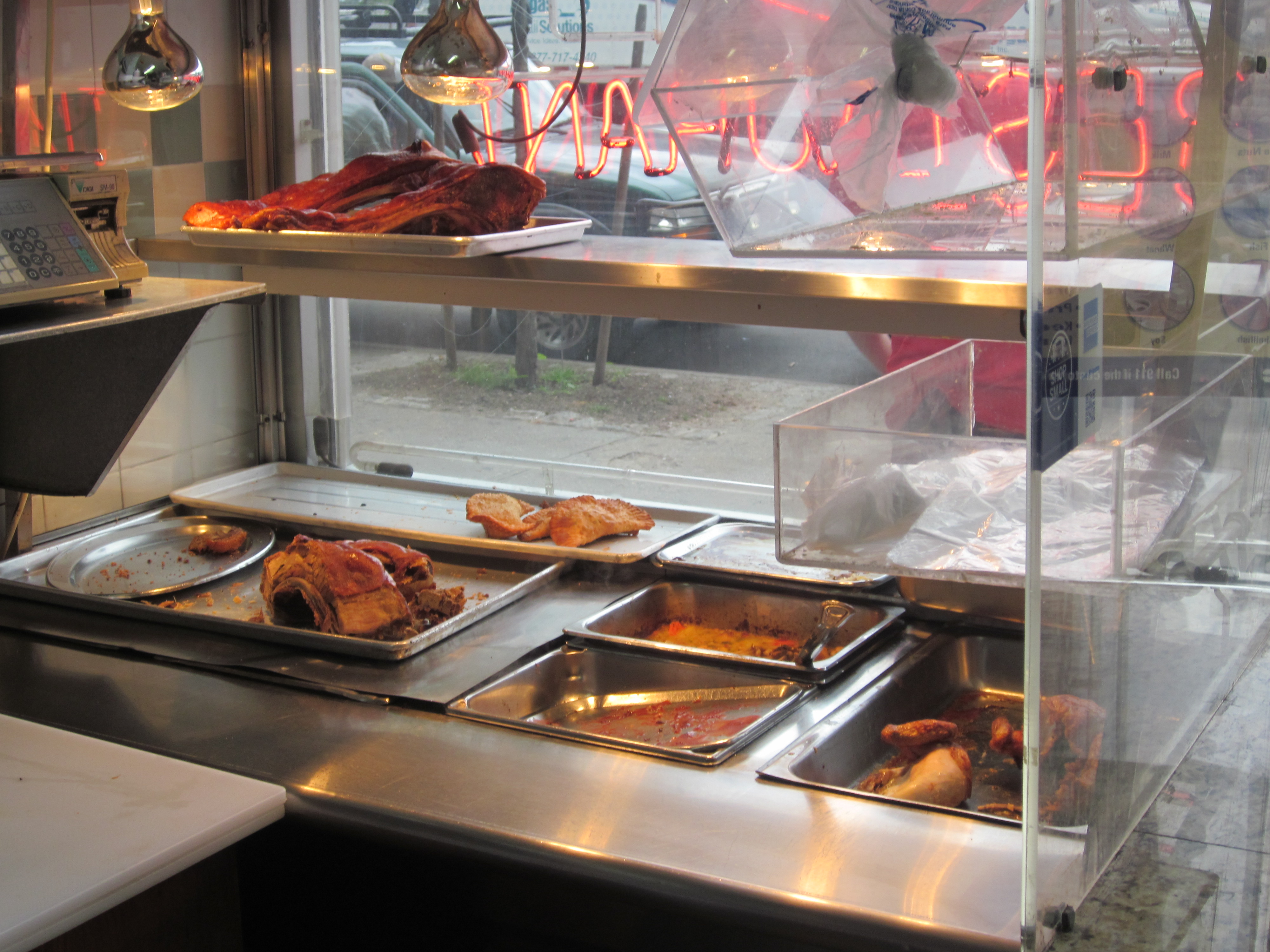
La Lechonera La Isla was quiet when I walked in; the few stools of the small restaurant counter were empty. There was beef stew available along with oxtails and roast chicken. And there were a few slabs of pernil that had been roasted to sweet oblivion.

The day’s remains soon to be devoured.

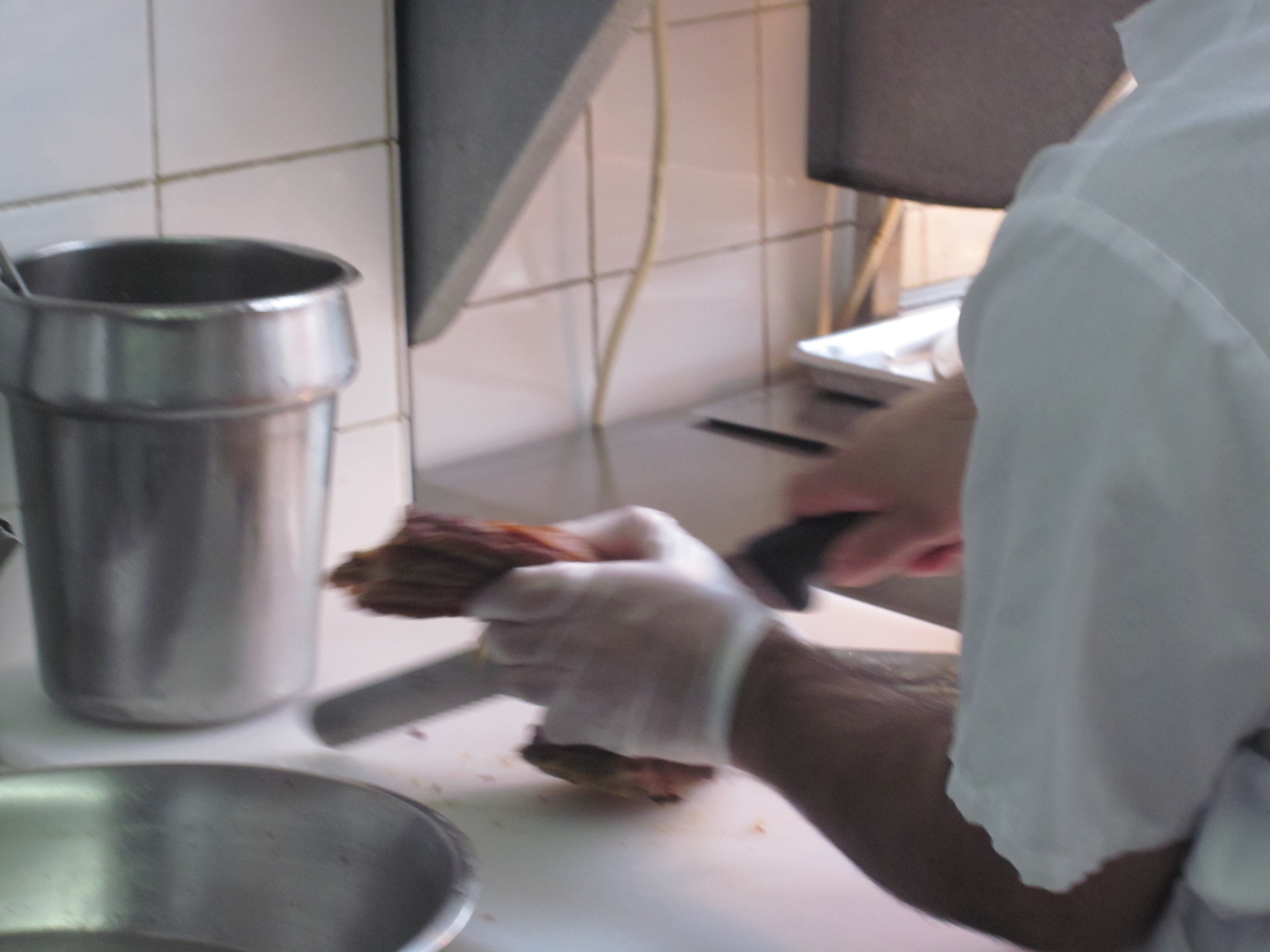
“When do you close,” I asked the young man who was chopping the pernil into pieces for me.

“When we run out of food,” he replied, his cleaver slamming into the very dense crackling of the pig skin. “Basically, my Mom cooks everything in the morning and when it’s gone, I can go home.”

I was lucky;  he hadn’t gone home.

Trying not to be too bold, I peered into the kitchen hoping to catch a glimpse of Mom at work. But from what I could see, the kitchen was dark and quiet. Apparently Mom had gone home.

Sawing through the good stuff.

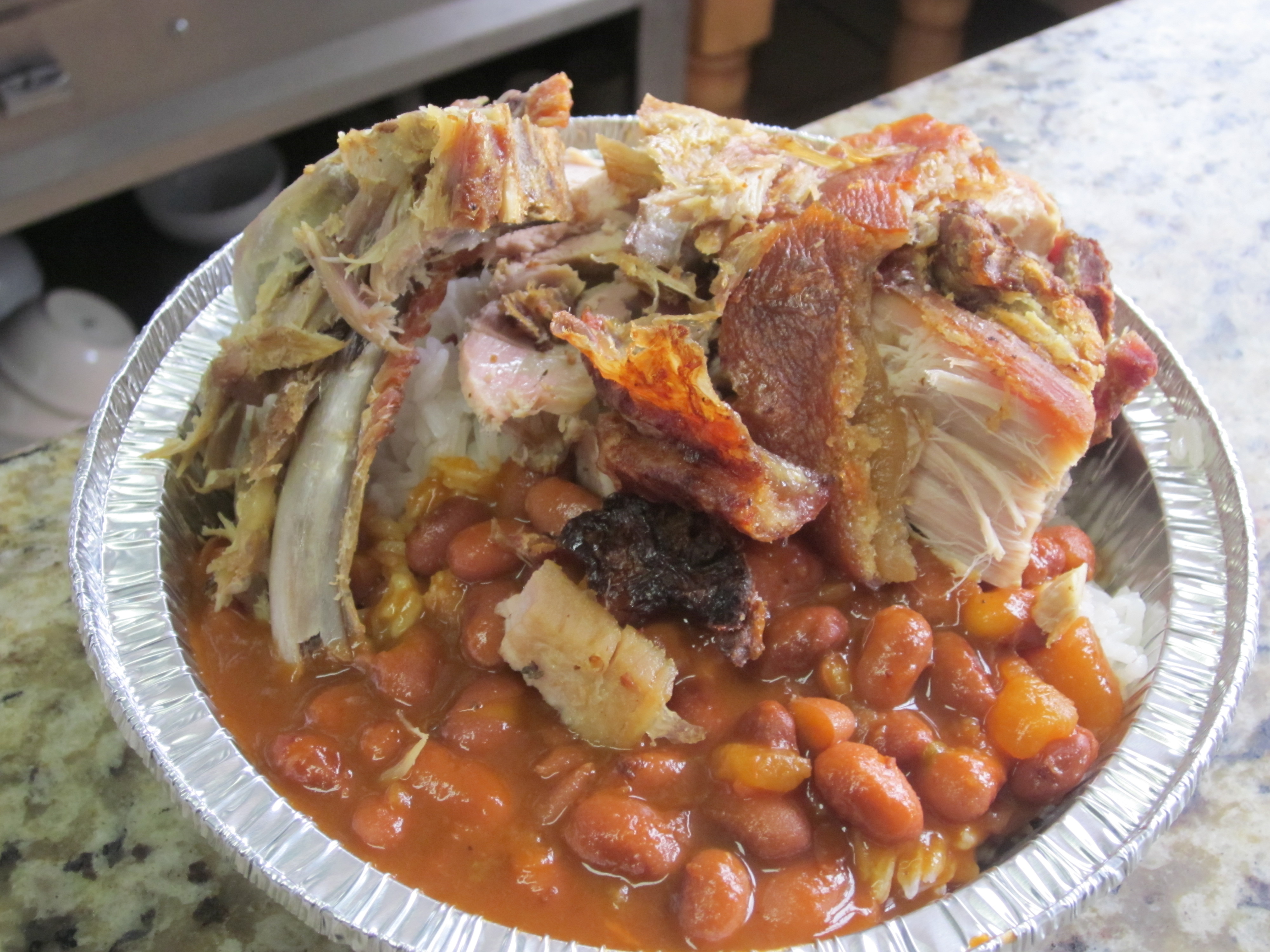
He layered a generous portion of pork on top of rice and red beans. An accompaniment of a homemade hot sauce; onions marinated in scotch bonnet peppers and vinegar set my mouth happily on fire while a drizzle of a tangy mojo (garlic sauce) just added to the gathering of fiery flavors now imbedded there.

Roast pork and rice and beans.

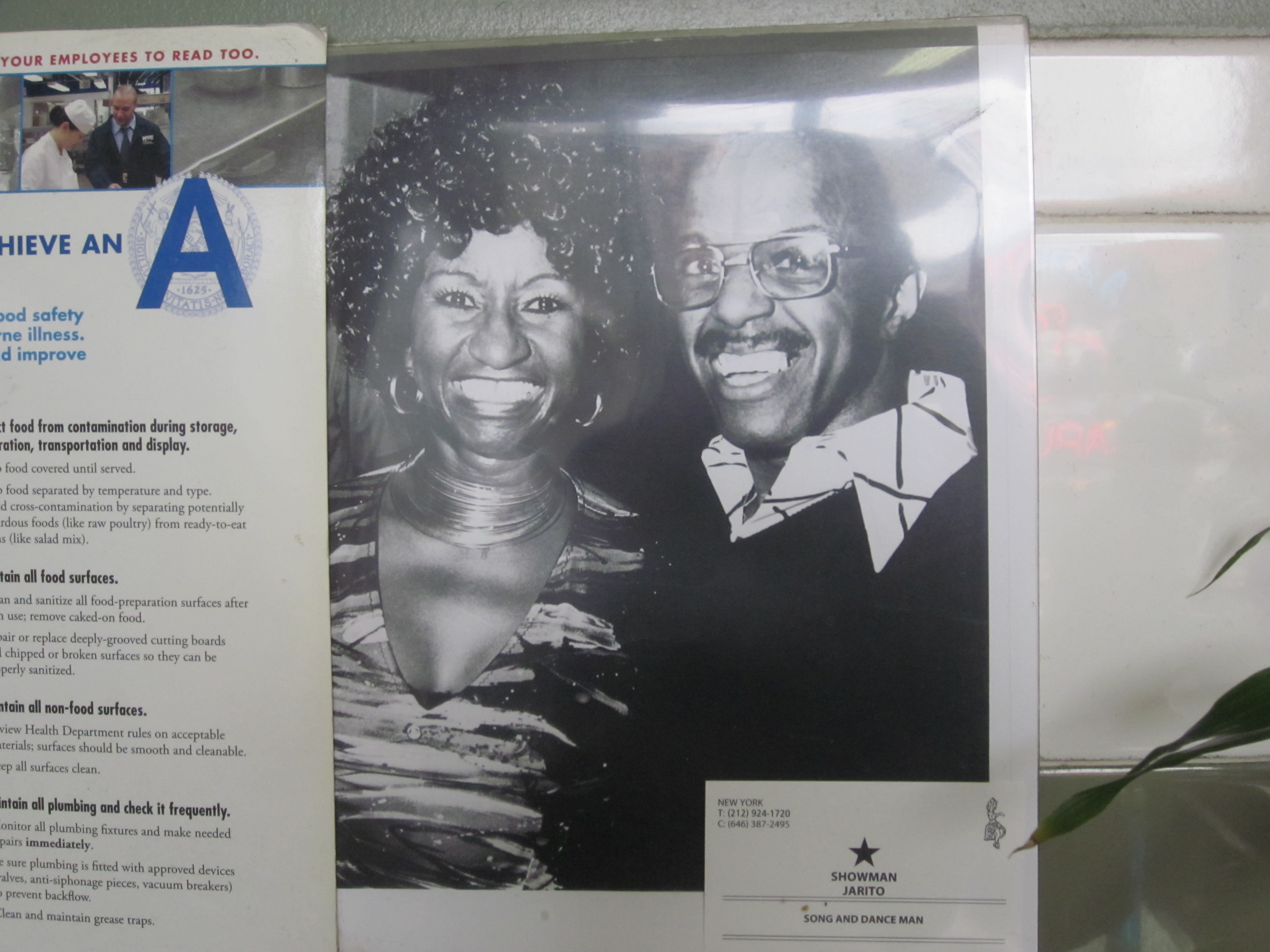
The traffic on 125th Street heading towards the Triorough (now known as the RFK) Bridge was bumper to bumper. Instead of Cuban-born Celia Cruz whose picture was adorned on the busy walls of the lechonera, or Tito Puente, who I once saw on 86th Street just after performing at the parade, sitting in the shade being fanned by a group of elderly ladies, the only sounds I heard while gnawing through the delicious cracklings, was that of honking horns. I really didn’t mind, the food provided all the music I needed.

A smile from Celia Cruz to help the pernil go down.


Gourmet Comes to Harlem: An Essay in Photos (and a few words)

20 Apr

What I mean when I say “Gourmet Comes to Harlem” is not this:

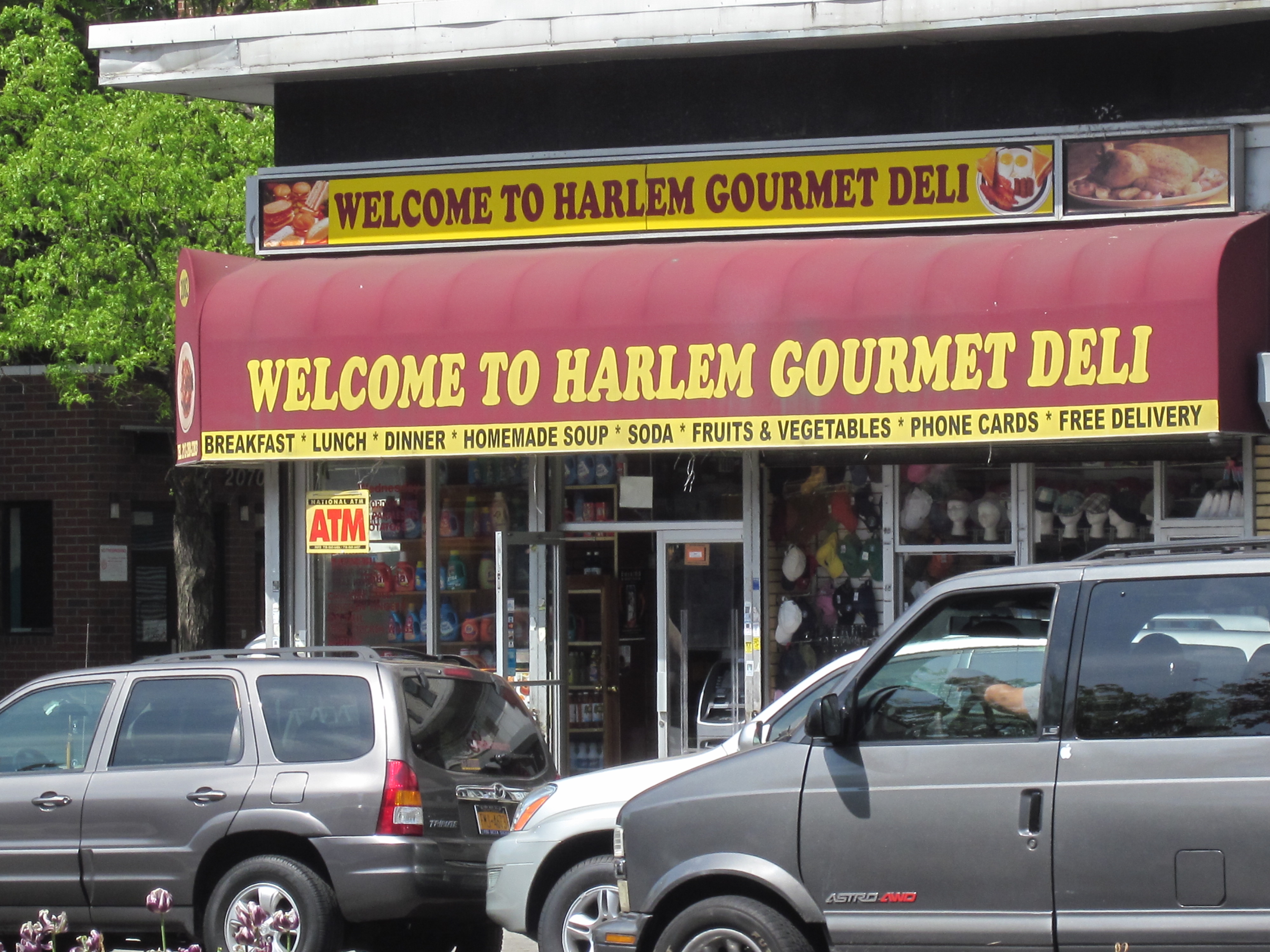
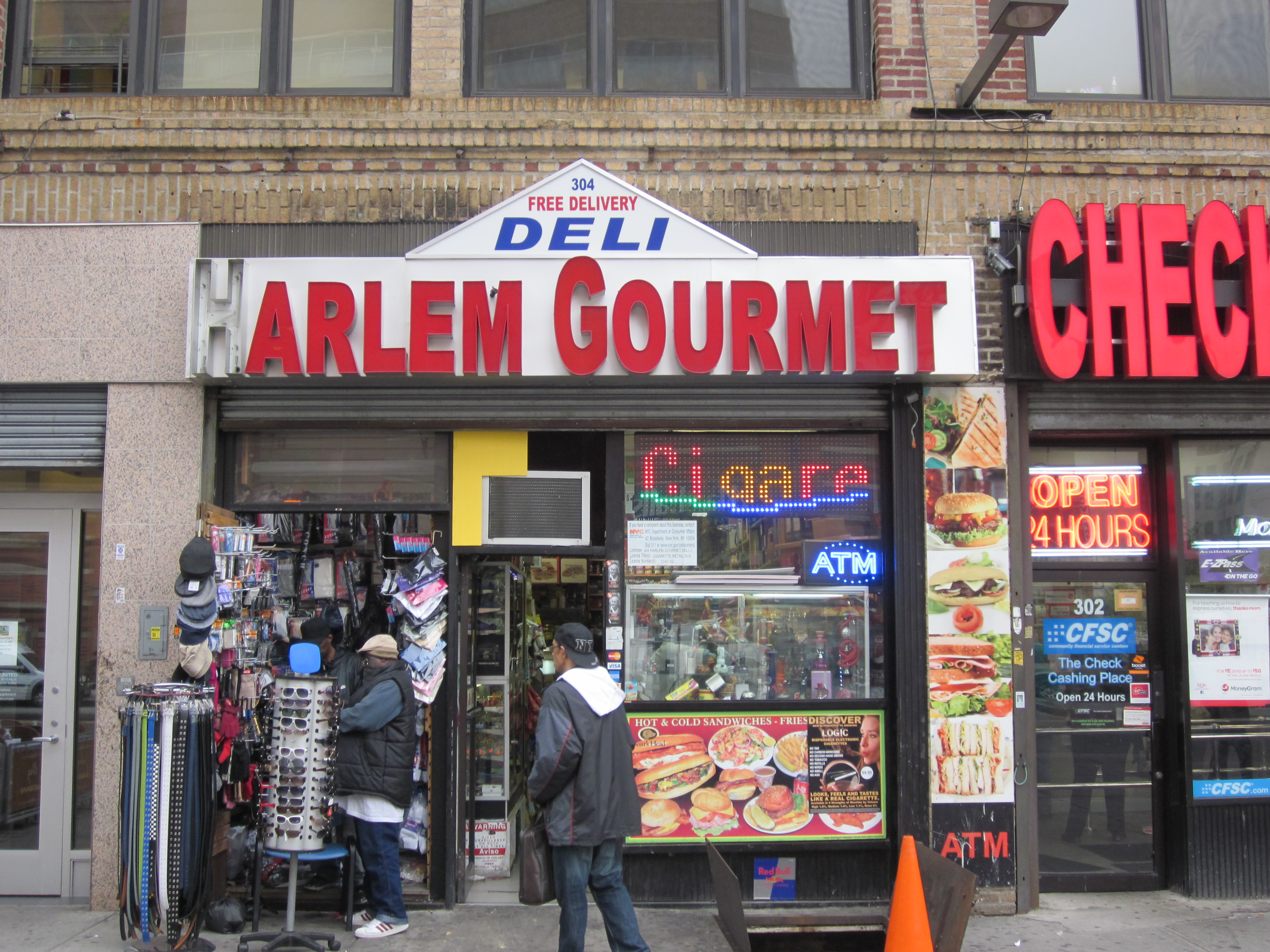
It’s this:

This new, welcome, trend in Harlem has, despite gentrification, transformed the word “gourmet” to a populist term.

At the gourmet deli,  alongside fruits, vegetables, and homemade soups, you can also purchase a phone card.

Some delis have flashing and streaming neon lights, offer free delivery, and even sell fashionable hats and sunglasses.

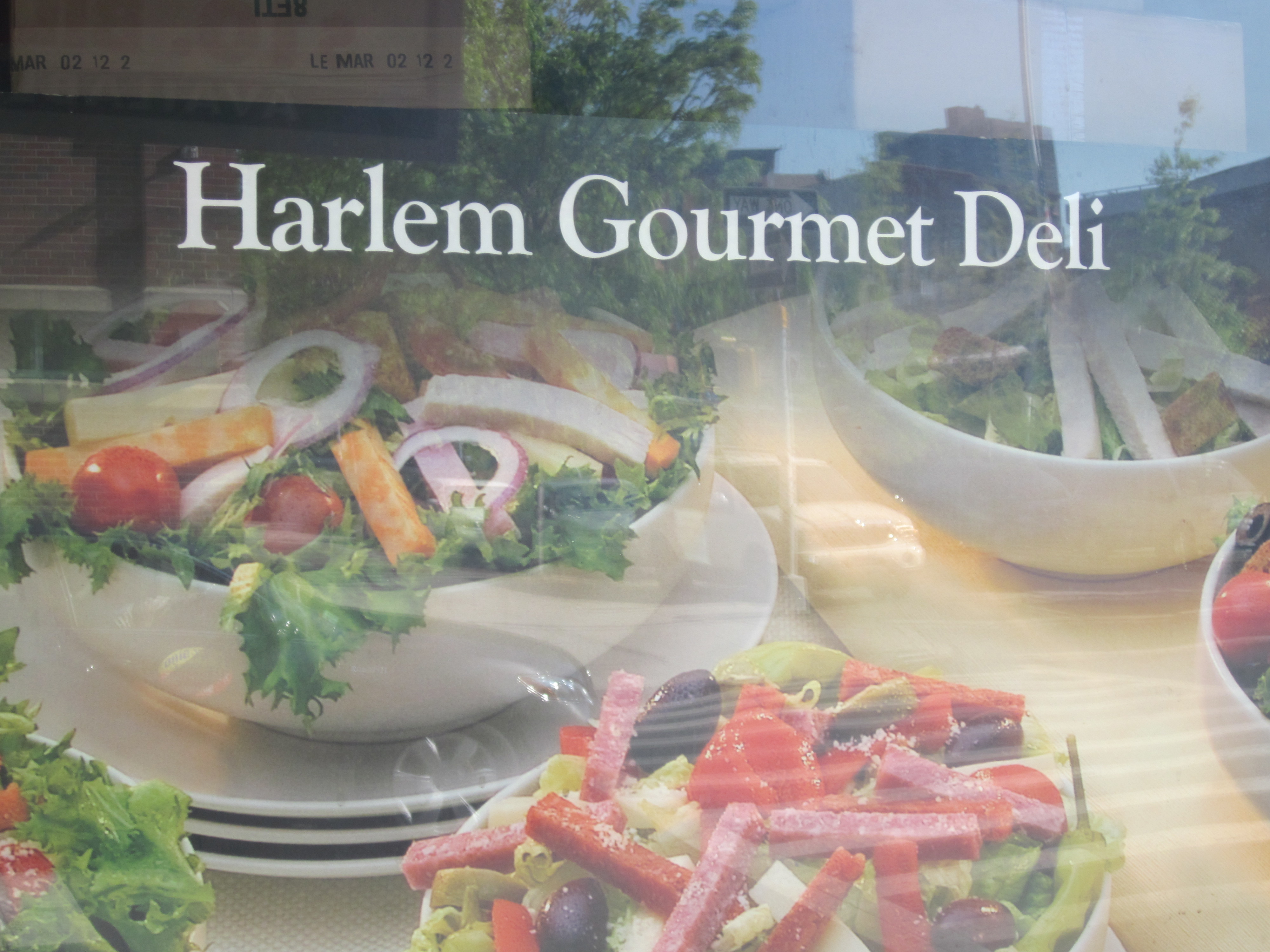
Others have beautiful photographic displays of the delicious dishes they prepare along with the many combination options.

If you are short of cash, the gourmet deli conveniently provides the services of an ATM, with only a small, $2 to $5 surcharge.

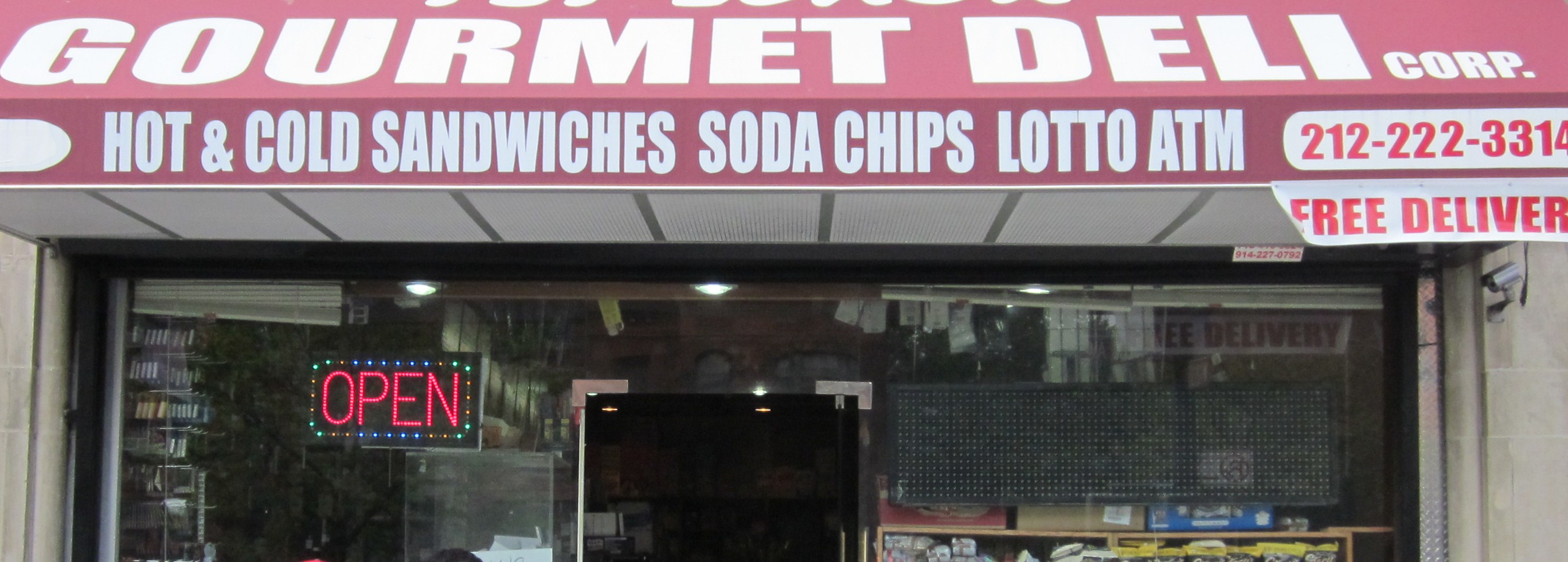
Many of the gourmet delis also offer, along with soda and chips, games of chance like Lotto.

Depending on the religious convictions of the owner, beer is often available at the gourmet deli and sometimes even wine.

But religious convictions are never a consideration or factor regarding cigarettes.

Here’s  one that hasn’t even opened yet. Welcome to the neighborhood A&A Gourmet!

A Senegalese Stomping Ground on 116th Street

17 Apr

Africa Kine
256 W. 116th Street

Mike from Yonkers notified our group via email that he wanted to choose a place from his “old stomping ground.” Who knew that Mike from Yonkers’ old stomping ground was the area around 116th Street and Eighth Avenue known as Little Senegal? What we do know is that Mike from Yonkers has some sort of obsession or kinship with African food. In the past, he has directed us to the late, Treichville Treichville Tasting Menu, African American Marayway in the Bronx The Un American African Place, and Salimata Eating Guinea Fowl in a Guinean Place in Little Senegal, just around the corner from his most recent pick, Africa Kine. And like 116th being his old stomping ground, this obsession has never been explained.

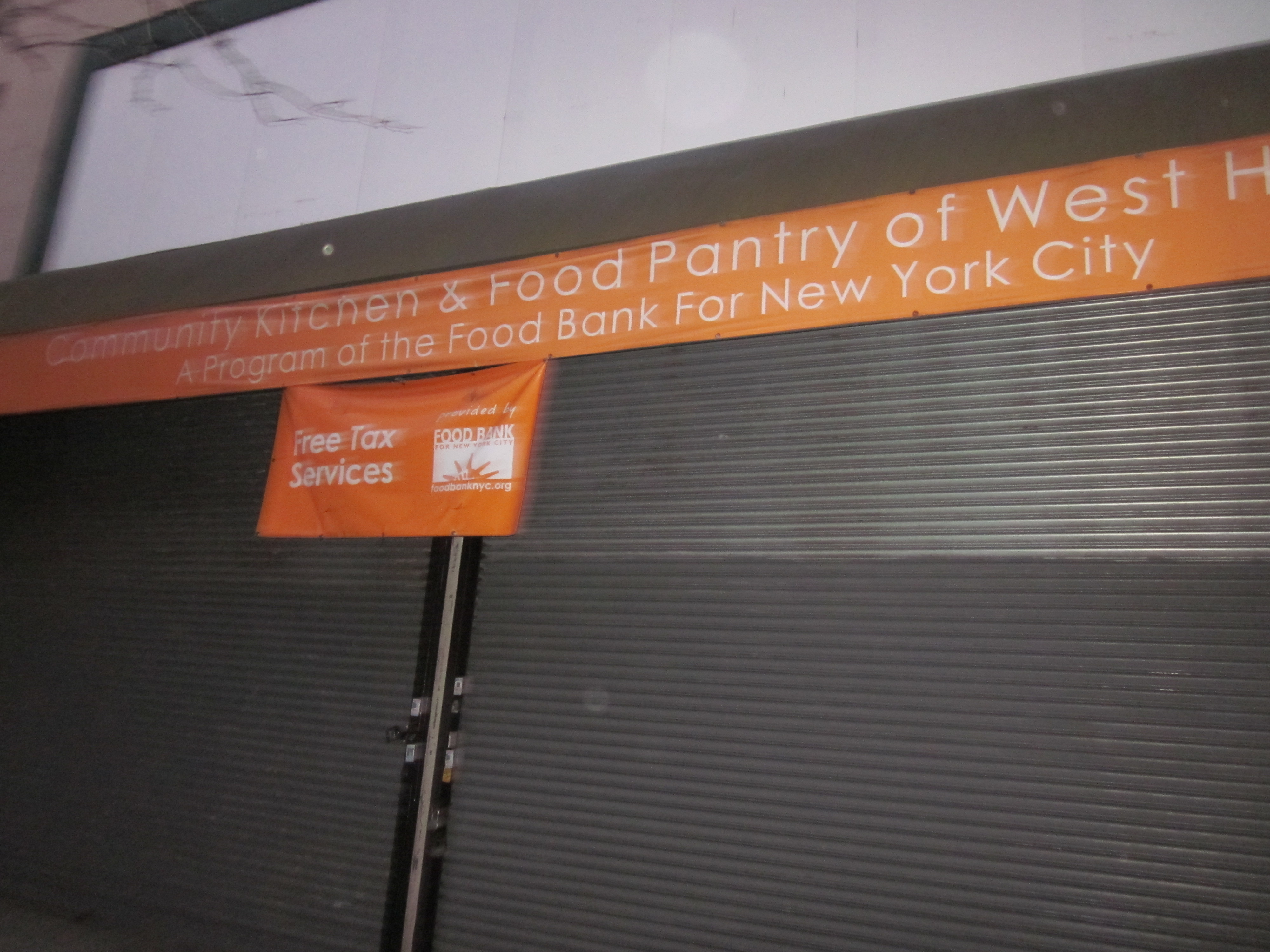
I never claimed the same area as my old stomping ground, but having lived just a couple of blocks from it, I could have been justified for doing so. I even spent a few months volunteering at the community food bank next door to Africa Kine, just after the economic meltdown of 2008.

The soup kitchen next door.

I worked at the soup kitchen washing pots and pans, bagging garbage, prepping food, and even shoveling ice and snow so the food trucks could gain entry to the kitchen. I stopped soon after the chef of the kitchen, who caught on that I was a writer, had me read the beginnings of his autobiographical novel and when, local Mormon missionaries began to flood in to help out making the kitchen more populated than one you would find at a four-star restaurant. But those are stories for another time and place.

Since my work at the food bank, a raucous, busy beer garden, called the Harlem Tavern has opened across the street, along with a meat market that specializes in local, organic beef and where the butchers wear pork pie hats while they work, and a cookie place where the cheapest, albeit, very good and very large cookie, is four dollars.

Those new establishments, among others made parking tough for the group, but Zio and I had no troubles getting to Africa Kine, which was enshrouded in dark netting along with scaffolding in front making it hard to distinguish. On the way in, we passed a legless beggar in a wheelchair and as we entered and started upstairs to the dining area, we both noticed a woman, face down, arms out on a prayer mat.

“Don’t take her picture,” Zio whispered to me. “It would be disrespectful. We don’t want an incident.”
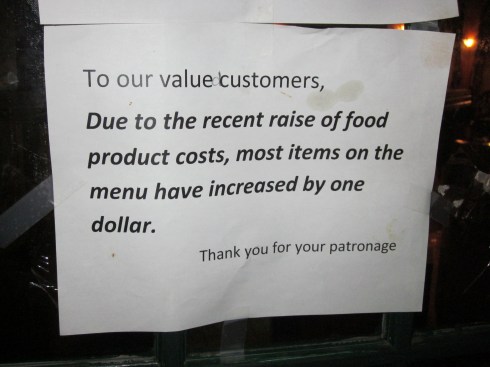
Inflation hits Little Senegal.

Africa Kine is possibly the most notable Senegalese restaurant in Little Senegal. The dining area is spacious and modern, with high ceilings, comfortable booths, big tables and a number of flat screen televisions, and described in the restaurant’s elaborate website Africa Kine as “luxurious.” Either way, it was most definitely a far cry from what we experienced at either Salimata, Treichville or African American Marayway.

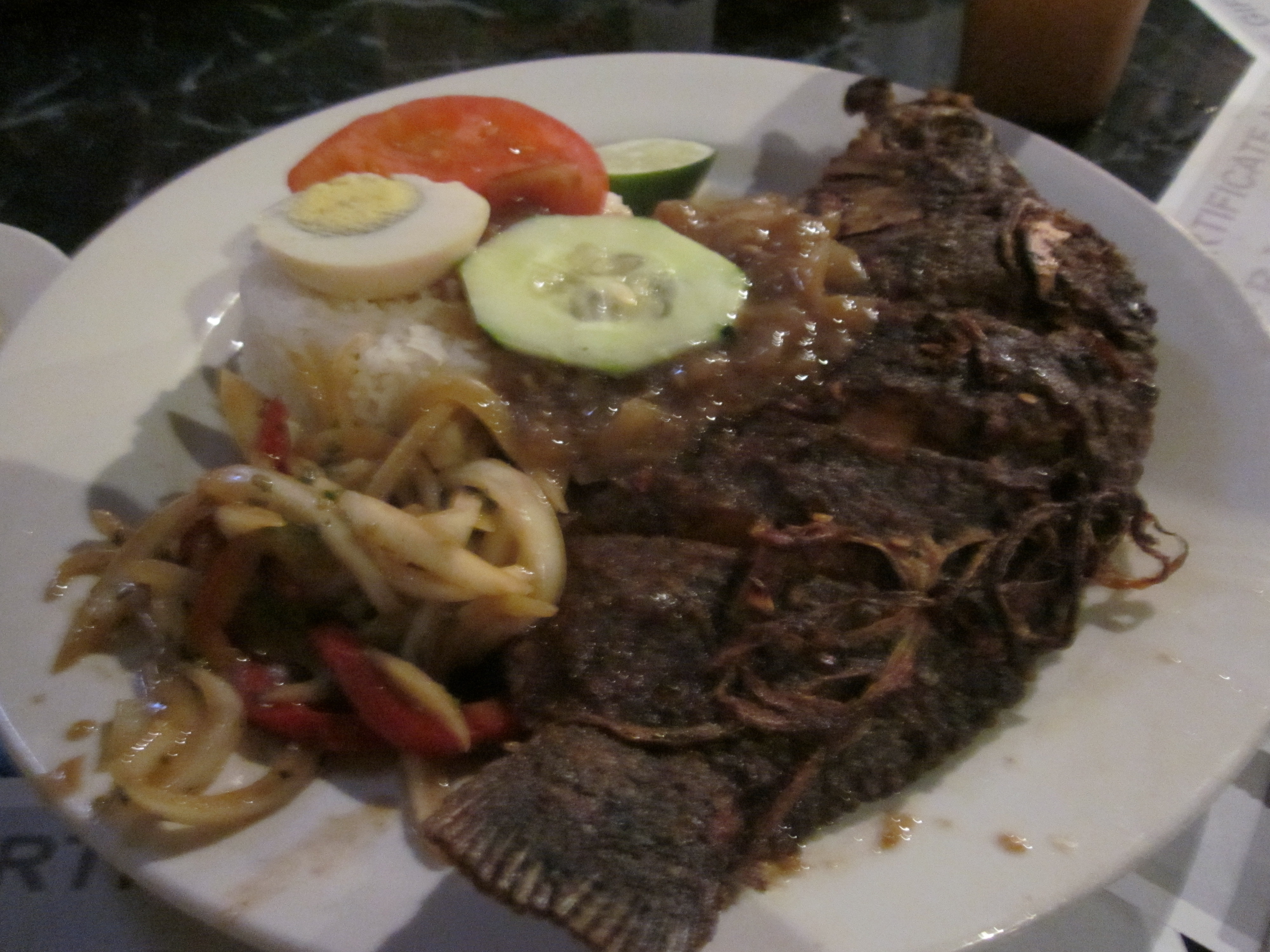
The others joined us soon after at a big table in the back of the “luxurious” dining room. While we sipped spicy homemade ginger beer, we perused what, by now was a familiar menu thanks to the African culinary education bestowed upon us courtesy of Mike from Yonkers. There was guinea fowl, chicken, lamb, goat, fish, grilled or fried, and steak. The entrees all came with a choice of one of an assortment of starches; couscous, rice, plantains, yam and a small chopped iceberg salad. Each dish came with onions, sliced, lightly grilled with a mustard-based sauce on them, and scattered over the meat and fish. Most of the entrees also included half a hard boiled egg.
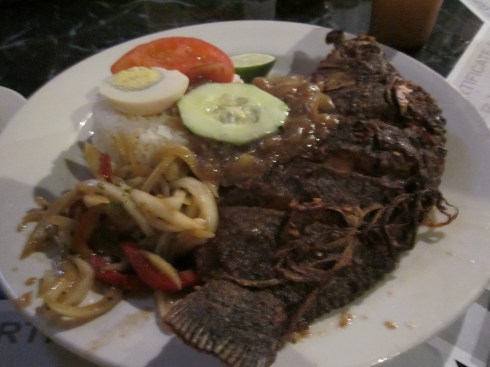
Grilled fish with onions and half a hard boiled egg.

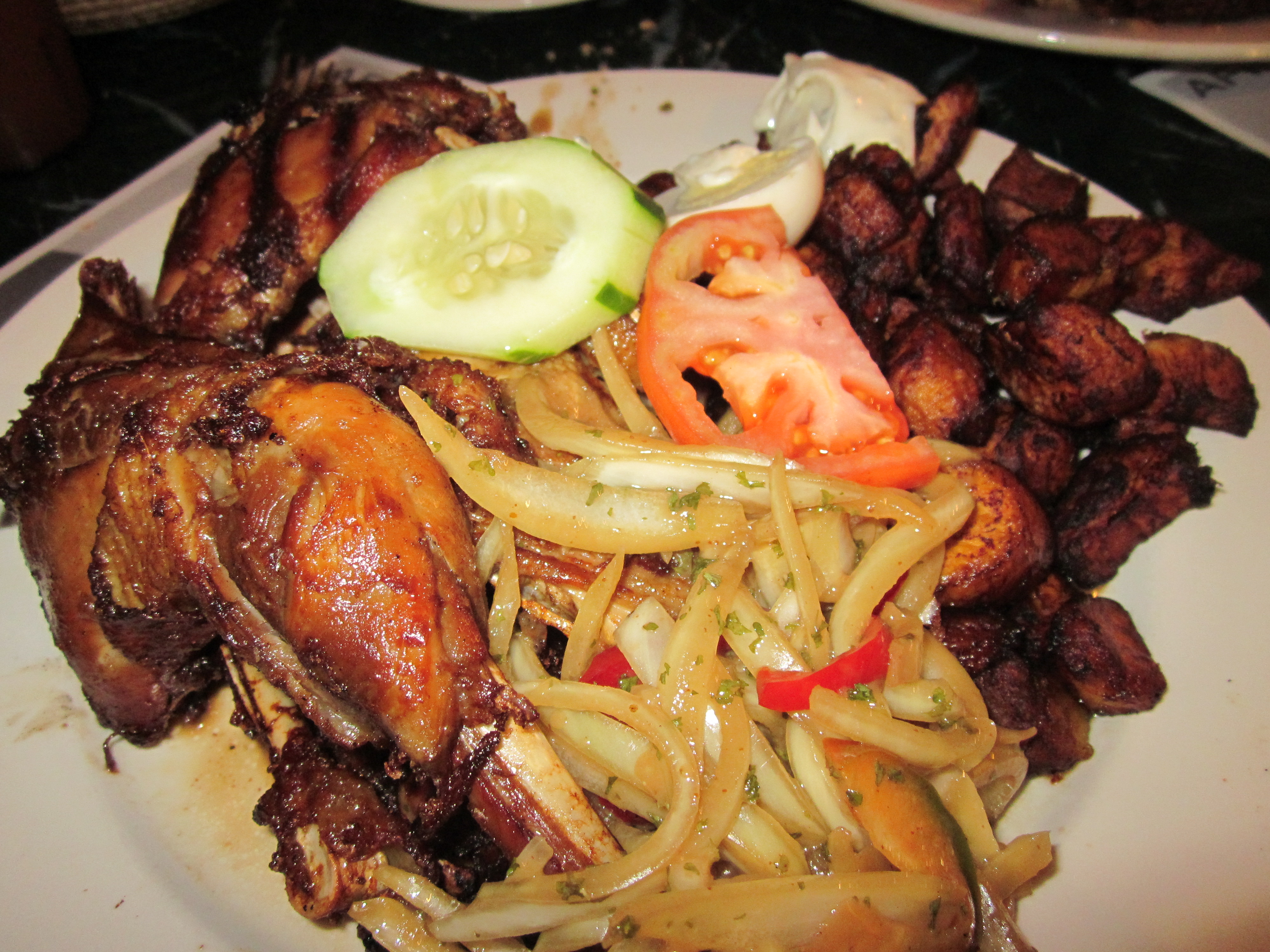
I’m no expert on guinea fowl, but if I recall, the guinea fowl at Salimata was better, or maybe more distinguishable, than what we experienced at Africa Kine. The fish and lamb were also all solid, but there were no raves from our now very picky Senegalese aficionados. So, though the surroundings were comfortable, and yes, bordering on luxurious, the food was not as memorable as many of the more humble African places we have visited.
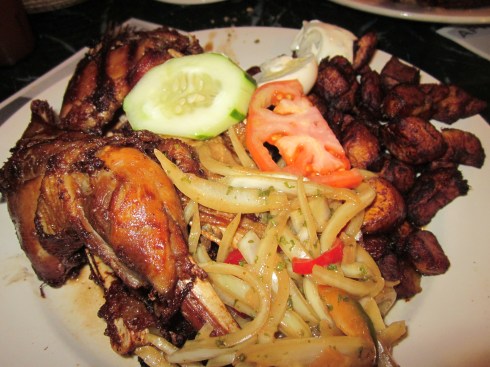
Grilled guinea fowl with onions and a half hard boiled egg (and plantains).

What there was at Africa Kine, however, was plenty of food; the portions more than generous.

“Really now, how can they say people in Africa are starving? Zio griped. “Just look at all this food?”
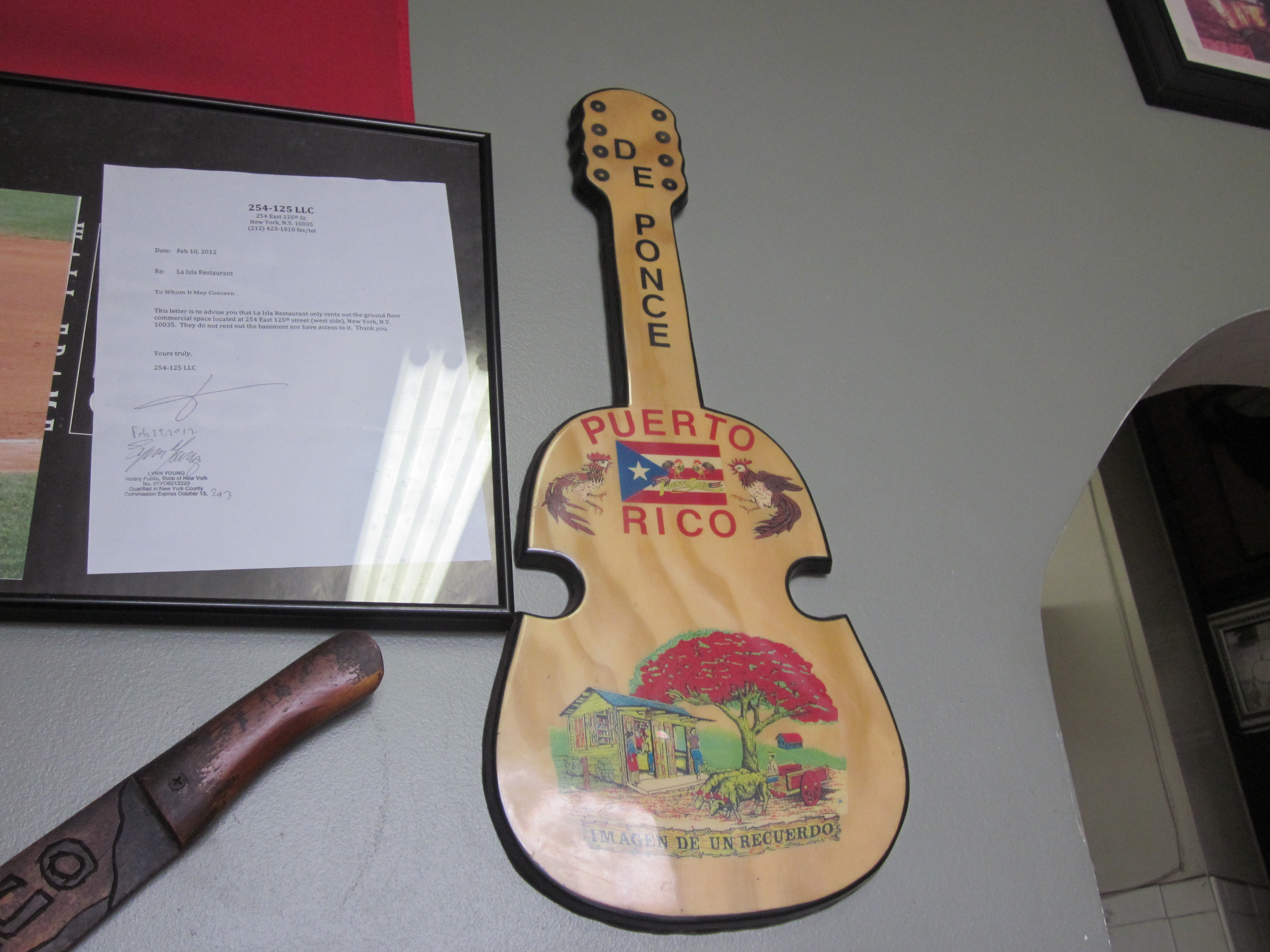
“Yeah, we just ate a village,” Gerry quipped.

And of that village, there were no leftovers.