Archive | Queens RSS feed for this section

Stars Across the River

24 May

Five Star Punjabi Indian
13-05 43rd Avenue
Long Island City

I emerged from the station at 23rd St/Ely Avenue to hear the rumbling of another train above. It was dark, cold and windy. I could see the lights of Manhattan flickering across the river. I really didn’t know where I was going as I made my way down the desolate street toward 43rd Avenue in Long Island City passing warehouses and seemingly empty factories, my eyes on the alert for signs of life; for a tavern, restaurant, deli—anything. Like a welcoming beacon, in the distance I could see bright neon lights. I wasn’t sure what it was. A car wash, maybe—service station—something automobile-related. And then I got closer and could read the lights: “Banquet Hall.”  Peering inside, a slim diner-like dining room  was in disarray and obviously closed. Could this be the Five Star Punjabi Indian Restaurant? Had Zio not done his homework and the restaurant was closed?  But then I saw activity in an adjacent room—a lone diner was eating and I noticed an unused steam tray. The room was brightly lit and just as I was about to enter, Zio emerged from his car. “This can’t be it,” he exclaimed.
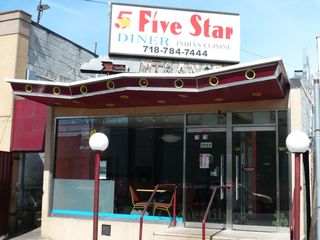

But it was. Between the dilapidated “diner” and a vacant “banquet hall” was the Five Star Punjabi Restaurant. The room was nondescript and mainly empty. We were given an ample table to accommodate our group along with menus that were written on decorative swiveling paddles. Gerry, Eugene, and Mike from Yonkers arrived followed soon after by Rick. All were wary and doubtful that they were in the right spot. Zio and I assured them that we were.

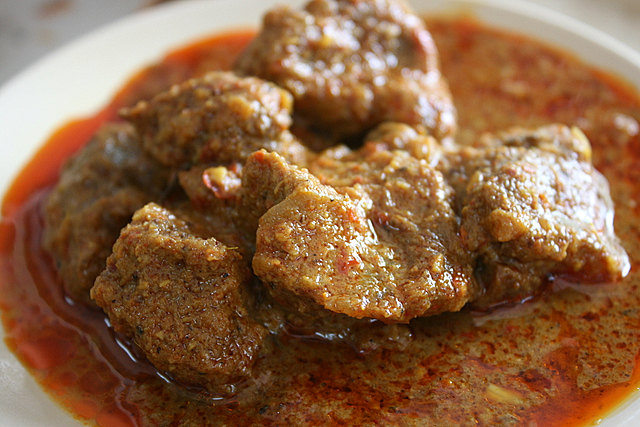
Those swiveling menus featured familiar Indian items, pakoras and samosas for appetizers, a variety of breads, assorted tandoori, and an array of vegetarian dishes and curries. The lone diner, an Indian talking quietly through a headphone attachment on his cellphone, was brought a huge platter of tandoori chicken. Rick eyed the platter covetously and immediately put in an order in for the same only to have his hopes just as quickly dashed when the waitress informed him that the Five Star Punjabi Indian restaurant had just run out of tandoori chicken. As an alternative, Rick, with the group’s unanimous approval, opted for the fish tandoori. Though there was nothing on the menu that described what chicken mughlai might be, Zio, for reasons known only to him, was determined to try it. On the other hand, Eugene, after learning that the chicken tikka was both boneless and prepared spicy, was sold on the dish, while Mike from Yonkers went for the tried and true, sag paneer. It was now up to Gerry and I to find something a little bit out of that ordinary that might justify this journey to the wastelands of Long Island City. The best we could come up with was the mutton roganjosh and the goat curry.

Zio’s Ship of the Damned

While the bottles of Taj beer began to crowd the table, Zio regaled us with his adventure on the high seas and his narrow escape from the cruise vessel that carried 2,800 passenger, of which 700 were stricken with a “norovirus” including three that, according to Zio, were “mouldering (sic) in a freezer somewhere in the bowels of the ship.” Zio was particularly graphic in his description going on to tell us that “in the close quarters of the ship’s hold you could hear people retching and gagging. But this still didn’t stop them from clamoring for the next buffet, after all, some of them had not eaten in a half hour.”

Zio was particularly grateful for useful tips from the cruise boat crew.

Despite Zio’s grisly tale, once the food arrived and in absolutely no particular order; the fish tandoori first followed by bread, then the entrees, and lastly, the mixed pakoras we requested as an appetizer, we began to stuff our own faces. And we didn’t stop until the plates were wiped clean with the bread.

 Everyone seemed satisfied with their food, though I’m not sure any of us were ready to award the restaurant five stars. Rick was pleased with the fish tandoori which might actually have been quickly fried in its rub as opposed to slow cooked. Not a bad alternative considering the fish was tilapia and most assuredly would have dried out if slow cooked in a tandoori oven. Gerry, however, was not as enamored with the goat. What was wrong with it, I asked?

    “All I got was bone,” he answered incredulously.

    I shrugged. “Yeah, it can be like that with goat.”
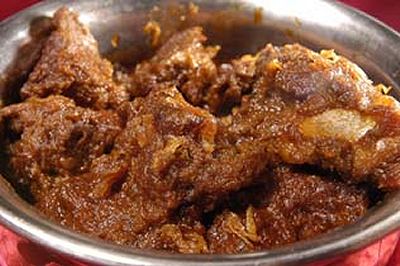
Goat curry: Bones included.

When we visited Five Star Punjabi in early 2007, the condo boom in Long Island City was just beginning.  In the four years since, high rises abound yet the funky Five Star has survived the change…at least for now.

A Night on Steinway Street

3 May

Rick steered us to the Middle Eastern enclave on Steinway Street in Astoria on a summer night in 2006. Our destination was an Egyptian restaurant called Eastern Nights. What follows is our experience on our night on Steinway Street.

Eastern Nights
2535 Steinway St
Astoria

The man with the Middle Eastern accent grumbled on the phone that the R Train-Steinway Street stop was the closest subway station to Eastern Nights, the Egyptian restaurant, assigned by Rick. When I got out of the station and onto Steinway, I began to walk west. My phone buzzed. It was Zio telling me that the address for the restaurant was a billiards club, not Eastern Nights. I looked at the address I had; the numbers had been inadvertently transposed. The restaurant was east of the subway station—I was going in the wrong direction. I waited in front of a Colombian bakery while Zio circled back to pick me up. I saw the Connecticut plates and hopped into the car, the sound of Zio’s precious pesticides splashing in their containers in the back. Steinway Street was as congested as the teeming alleys of Old Cairo and it was slow going with no sign of our destination. It wasn’t until we began seeing men sitting on folding chairs in front of cafes sucking on hookahs that we knew we were close.

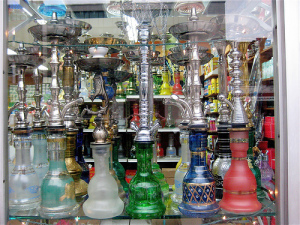
 We all arrived pretty much at the same time and were escorted into the back, under a big tent to a round table that was wet with water—the waiter joking with us that it had just rained, though we hadn’t had rain in days. There were a number of televisions suspended from the tent’s ceiling; a 1950’s black and white Egyptian romantic comedy was playing; the female lead looking a bit like Lucille Ball and not a head scarf in sight. The waiter mopped up the water and we sat and took a look at the menu. The first page was dominated by a variety of flavored teas and a separate hookah menu. We were in the back of the tent and in clear view of a large collection of hookahs that were maintained by a man whose only job was to maintain the hookahs, to blend the tobacco and light the coals. Inhaling tobacco with fruit flavors like apricot and mango would make for a unique experience, but we were here for the food, not the hookahs or the teas.

Hookahs

And the food was enough of an experience for us. So much so that our round table was just not big enough to hold all of it; the overworked waiter had to bring over a spare chair to use as a side table. Our unabashed excess drew looks from others in the restaurant, but nothing we weren’t used to. The feast began with fattoush, a cucumber, tomato salad followed by something called foul which turned out to be refried fava beans. A mound of warm pita bread was accompanied by a platter of hummus and baba ganoush, both swimming in olive oil.

Foul…but it really wasn’t.

A plate of grilled sausages, comprised mostly of casing stuffed with rice went alongside the hummus. Soon a platter of dry, tough and undernourished rabbit and duck crowded the table along with fatta, a stew made with a gamy lamb shank. Shrimp and calamari tajin, cooked in a crock and overwhelmed in a thick tomato sauce was squeezed onto the table as was a big plate where a whole grilled striped bass, cooked to perfect moistness was centered. We also had rice and something like rice with pieces of pita in it.

And then the pigeon arrived. Eastern Nights was the first restaurant of the many we had visited in almost four years that served the tiny, big city bird. It was magnificently presented; trussed lovingly—its tiny wings tied delicately together, a greasy glaze over its succulent skin. Zio looked at it and wondered if the chef has put a rub on it and if so, what could it be? The pigeon was stuffed with wheatberries and mint, which was a good thing because the meat on the tiny bird was scarce, to say the least. We picked at the pigeon, leaving the upper portion intact, its wings still tied together. That there would actually be something left to eat on our table was a rare occurrence in our outings, but at Eastern Nights, portions of the duck, rabbit and lamb tellingly remained. The striped bass, however was picked clean.

Urban poultry

Desserts were tempting and we would have liked to try them, but our waiter was scrambling from table to table, all alone in his work with the exception of the Hookah Man who was preparing the hookahs for use. Instead, we wandered across the street to a Middle Eastern café where we did our best to enjoy phyllo-wrapped sweets, but the Arabic newspaper prominently displayed in the café with its front page of color photos of the mutilated bodies of Lebanese children made dessert bittersweet to say the least.*

*Our visit to Steinway Street occurred during the peak of the Israeli/Lebanon conflict of 2006.

Searching the internet, I learned that Eastern Nights is now Eastern Nights Hookah Cafe. They have their own Facebook page which proclaims that it is also under new ownership and management. From Facebook I also learned that there is a DJ at the café Sunday through Friday nights and a belly dancer on Saturdays which, I’m sure, would make sucking on a hookah an almost pleasurable experience.

Kebab Inspiration

12 Apr

Salute Kosher Restaurant
63-42 108 Street
Forest Hills

“Time is flying! You’re getting older, but you don’t feel you’ve accomplished anything with your life.” Those were the opening lines to Everything is Possible, a pamphlet based on the teachings of Rabbi Nachman of Breslov that I was handed at the conclusion of our dinner at Salute Kosher Restaurant. The Hasid who fittingly choose that particular pamphlet for me was genial despite our initial reservations about accepting his pamphlets. He remained genial as he took our “tax deductible” contribution to Breslov City in the Galilee in return for the pamphlets. It was the least we could do after our feast of countless inexpensive shish kebabs at this self proclaimed, Uzbek-style restaurant.


Salute Kosher was Eugene ’s second choice. La Kasbah, a Moroccan restaurant in Astoria , was his first, but the phone at the restaurant was no longer in service meaning the restaurant was most likely out of business, so the ever-diligent Eugene steered us to the Forest Hills section of Queens to Salute. Just as the cuisine of Tibet intrigued him enough to choose it in his last pick, the food from Uzbekistan now, for some reason known only to Eugene, piqued his interest.

Suspicious eyes greeted Zio as he was the first to enter the restaurant. The regulars in this Uzbek-Russian enclave of Queens must have wondered what to make of the rotund stranger. The glares were too unsettling for Zio and he decided to wait for the rest of us outside the restaurant. Once Eugene announced his presence inside, however, the guarded looks eased. With his Sicilian-swarthy countenance, Eugene could pass for a Moroccan, not to mention an Uzbek. But when he opened his mouth, and despite reciting the one word of Russian he did know, it was obvious he was anything but an Uzbek. What he couldn’t express to the English-struggling waitress, he compensated by raising his voice until it was booming within the busy restaurant causing more than a few disturbing glances our way. He finally explained to the waitress that we were there to sample a good portion of the extensive menu. After that, language was no longer an issue.

Though Mike from Yonkers had been excused, Rick, whose presence was in doubt, showed up just in time to sample the home made babaganush served with “national” bread.  What distinguishes Turkish babaganush from, say, Egyptian, or Greek? The differences are subtle, and Salute’s Uzbek version had an intense creaminess that put it high on the world wide babaganoush meter. We followed that up with a platter of assorted smoked fish. The cured fish were salty and tough enough to survive the harsh winters of Uzbekistan. And I’m only assuming that Uzbekistan has harsh winters.


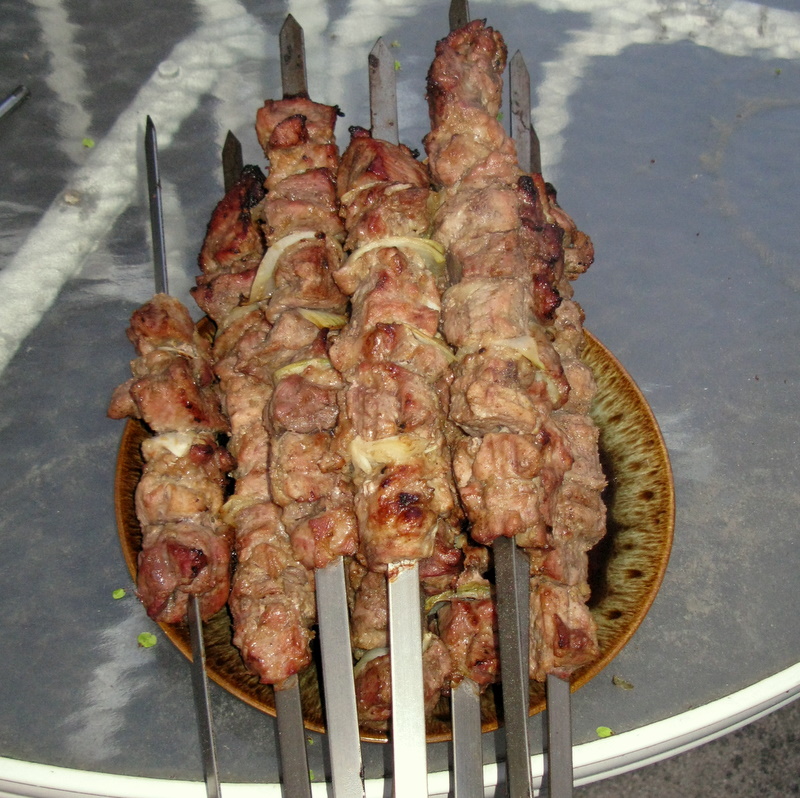
Our final appetizer was the Uzbek mantu, homemade meat dumplings whose gaminess, after the strong flavor of the fish, I, much to Zio’s horror, just could not tolerate. Even a swill from the Russian beer we were drinking could not extinguish the taste. Thankfully the parade of shish kebabs soon followed. We tried the lamb, the lamb ribs, the lula (ground seasoned lamb), the chicken with bones kebab, and the beef kebab (special cut). But this wasn’t enough for Gerry and Zio, who, in their gluttony, insisted we order another round of  lula, chicken (with bones) and, because it was special cut, more beef. Now picked clean of their meat, the sharp-edged skewers on our table were piled dangerously high. Our waitress arrived soon and, without comment, cleared the cutlass-like utensils before Zio could use one to clean his teeth with.

Assortment of kebabs.

As we pondered dessert, a honey-noodle pudding in a box from the grocery store next door, the Hasid entered and despite our initial protestations passed out appropriate pamphlets to all of us.  Flipping through “Everything is Possible” I noticed that, according to Rabbi Nachman, the drives—sexual, monetary, pride, eating, and drinking are “water-based” but can be controlled by giving your life back to “G-d.” I’m not sure if it was the forlorn look of the noodle pudding in a box or the words of Rabbi Nachman, that helped me decline dessert, but whatever it was, I made sure I stopped at the grocery store next door for a bottle of water for the ride back home.

The Intestine Quandary

5 Apr

Just a few blocks from the Himalayan Yak and Braulio’s & Familia, Zio revisited the “epicenter” to discover Zabb Queens.

Zabb Queens
(RIP)


As is his modus operandi, Zio scoured the internet food blogs and websites to find an appropriate destination for our group. His meticulous research unearthed a restaurant in the shadow of the elevated number 7 train tracks on Roosevelt Avenue in Queens, in the area he has referred to as our “outdoor food court,” also known in our circle as “The Epicenter” or “Ground Zero” for cheap, global grub. This one, a Thai place called Zabb Queens, was just a few train stops from our other favorite Thai restaurant, Arunee.

Upon entering, I noticed a review from the New York Times prominently displayed. I pointed this out to Zio. A notice in the Times usually is a warning—a red flag that what was once an authentic local establishment would almost immediately become gentrified and dulled down to appease the masses. Zio just shrugged and I decided not to hold it against the restaurant. I had to keep an open mind.

Zabb, unlike Arunee, advertised as “Esan” Thai food. Of course we were clueless as to what Esan might be but Eugene, always handy with the print outs of reviews of the restaurants we visit, pulled out his file on Zabb and we learned that Esan was actually Isaan, the northeastern province of Thailand and close to Vietnam and Laos. We had no idea what made the food of northeast Thailand different from what was prepared in the southwest until we took a look at the booklet that served as the menu and noticed a variety of organ meats; intestines, offal, hearts, liver, stomach, and pork skin. Along with the organ meats, catfish was also plentiful on the menu. This was Thai soul food.


The clientele in Zabb’s narrow dining room was a mix of Asian and adventurous non-Asians like our intrepid group. Before ordering, we, pompously, explained to the eager waitress that we did not want to experience generic Thai food; we would not accept any compromises in heat or anything else—we wanted it the way she would have it. She understood and, though we passed on the chicken heart on a skewer, we bravely ordered the House special soup with liver heart and a choice of either pork or beef intestine. Don’t ask me why, but we decided on the intestine of the pig as opposed to the cow, and then to complement that, ordered the “pedestrian” tom yum soup with shrimp. A sip of the tom yum was anything but pedestrian. I immediately began to hiccup; a reaction I experience when something is so hot it is off the spice meter if there is such a thing. Hoping the House special soup would possibly cool my scorched palate I took a sip and chewed a piece of the aforementioned pig’s intestine. The heat from this soup, though not as brutally sharp as that of the tom yum, had more of a slow, yet just as fiery, burn. As my body adjusted to the heat, the hiccups calmed but the soups had elicited a sweaty sheen on all our brows with the exception of Mike from Yonkers , whose face remained dry and cool as he slurped down bowl after bowl.


The BBQ beef in a spicy sauce was mild in contrast to the soups as were the trio of salads we ordered, green papaya with salted crab, crispy duck, and crispy catfish. The latter two, the duck and catfish, crisped beyond recognition. Zabb’s rendition of pad Thai noodles was not on the same level as Arunee’s, but the sautéed drunken noodles, the Thai version of chow fun, with a mix of seafood in a dry curry sauce, was the consensus winner and almost instantly devoured. Eugene would not leave until his request for a plate of chicken panang was met. We had no choice but to accommodate him and though he grumbled that we never received rice, he was ecstatic, immediately claiming that it was the best panang he ever had, if that’s worth anything. Dessert was orange-coated sweet doughy balls that were stacked in plastic take out containers by the door and the less said about them the better.

Zabb Elee, formerly Zabb Queens

Though the original Zabb Queens we visited in 2006 is gone, it has been replaced with an even less pandering Thai “Isaan” (or “Esarn” as it is spelled on the menu) place called Zabb Elee that doesn’t even bother to include pedestrian Thai like panang or pad Thai (sorry Eugene) but keeps those favorites like grilled chicken liver and chicken hearts along with pork legs soup.  In fact, Zabb fever has gripped the city—at least the East Village—with two Zabb restaurants, a sister Zabb Elee and another called Zabb City. It’s encouraging to note that, at least in the East Village, there is now a demand for chicken hearts and snake head fish.

Romanian Pickles and Polenta

22 Mar

Our last gathering in 2005 was Romanian Garden which still exists on Skillman Avenue in Sunnyside. As far as I know, none of our group has returned for a second taste. And maybe that tells you all you need to know about our first taste, chronicled below.

Romanian Garden
4604 Skillman Avenue
Sunnyside, Queens


The cuisine of Romania is not one of the world’s most celebrated. And I admit to not knowing much about Romania beyond what I’ve learned from vampire lore—that it’s a country with a bloody past whose most well known historical figure was called Vlad the Impaler. That there was a Romanian restaurant in Sunnyside, Queens, and that Rick was able to find it was impressive and yet again displayed that the borough was indeed the epicenter of international eats. There were only four of our group at Romanian Gardens on this holiday week evening, and we were most likely the only four in the comfortable, bright restaurant who could not claim a Romanian past, though Eugene might remind one of a middle-aged Sicilian Vlad the Impaler.

Vlad the Impaler bears an uncanny resemblence to Eugene…in his better days.

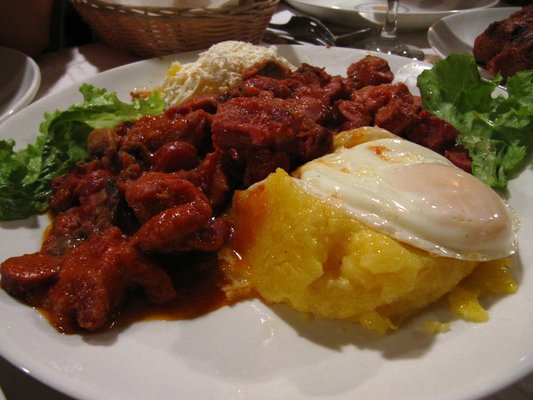
The menu featured hearty Romanian fare—meaning stews or dishes accompanied by rich polenta. Who would have guessed that polenta was a staple of Romanian cooking? And the polenta we tried, in an appetizer topped with eggs over easy and sprinkled with a non-descript cheese was creamy and moist. The polenta also came with the stuffed cabbage and was the highlight of that dish. The Romanian stew was bits of pork in a bland tomato gravy while the red garlic chicken stew seemed to be missing garlic, red or otherwise. The appetizers fared better at Romanian Garden with the fish roe spread, a Romanian-version of the Greek specialty taramasalata being the standout. After overhearing a senior citizen with a thick Eastern European accent sitting at the table behind us reminiscing over the homemade pickles of her youth, and seeing that there were pickles on the menu, how could we resist. Though I can only hope the pickles she remembered, maybe from her village in the foothills of the Carpathian Mountains were better than what we experienced at Romanian Garden. Strudel was the dessert offering, but after all that polenta, only Zio, who was back in Connecticut recovering from post-holiday stress syndrome, would be the one to brave it.

Garlic chicken stew, an egg, and polenta.

Yak Under the Tracks

15 Mar

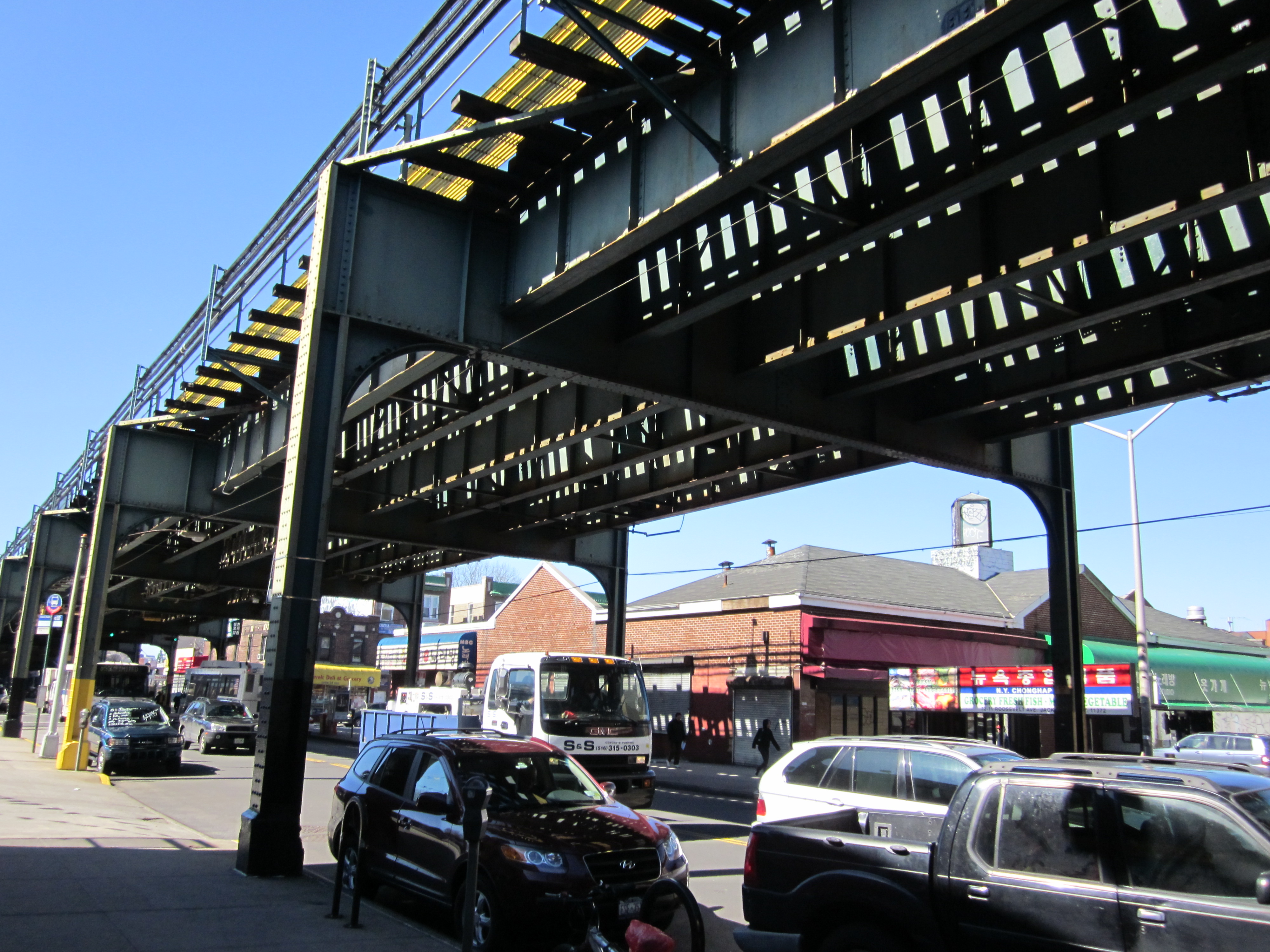
After traveling to Queens numerous times in the almost four years we had been doing this, in 2005, we coined the area under the number 7 train tracks around Roosevelt Avenue and in the environs of Woodside, East Elmhurst and Jackson Heights as the “epicenter” of our Chow City food universe. And it pretty much remains so six years later.

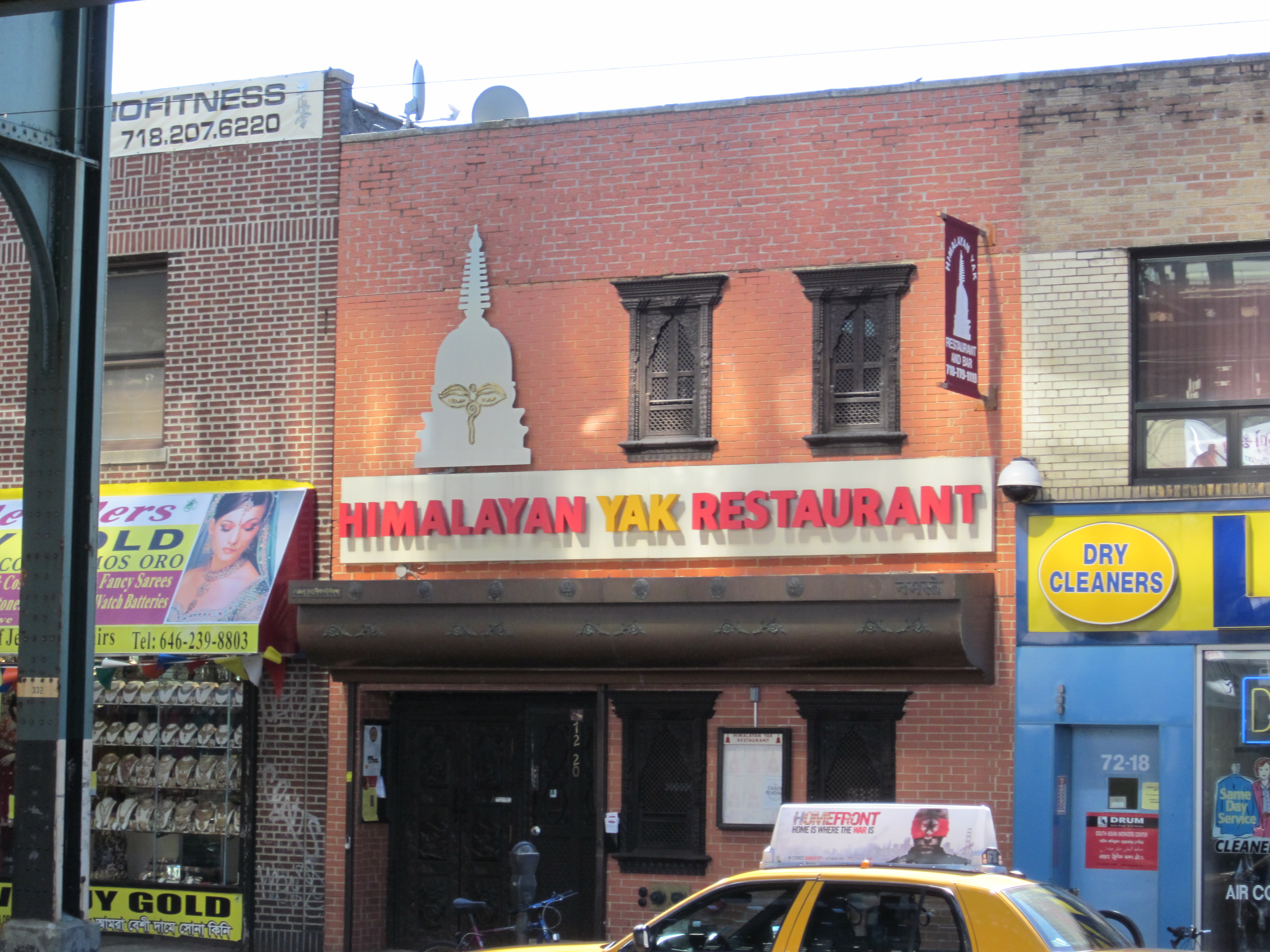
Himalayan Yak
72-20 Roosevelt Avenue
Jackson Heights, Queens

Eugene had his sights set on a Tibetan restaurant for a long time. We really don’t know why the cuisine of Tibet intrigued him. He didn’t know much about the region. He didn’t know it had many high mountains. He didn’t know it had monks. But something was telling him—or so he casually said as if he were referring to Chinese food, “that it was time we ate Tibetan.”


So Himalayan Yak was found—in the epicenter of our culinary universe, just under the number 7 train on Roosevelt Avenue in Jackson Heights, Queens. Though the title implied yak might be on the menu, there were no yak offerings to be found there. That was fine with Zio who grumbled upon learning where we were to eat that he was, quite frankly, getting sick of yak. “No matter how you prepare it, it still tastes like yak, smells like yak, and looks like yak.”


Though there was no yak on the menu, there was, however the promise of goat brain and ox tongue. Zio brightened at that prospect but was disappointed when our genial Tibetan waiter quickly informed us with a straight face that they were out of brains and tongue. We would have to settle for more pedestrian fare such as shabaleb, a doughy patty stuffed with a tough slab of ground beef that was pink, almost tartare-like. Or the la phing, a cold spicy bean jelly that was tossed with garlic, vinegar and soy sauce that our newest member, Mike from Yonkers took one bite of and, to the dismay of the rest of us, immediately spit out into his napkin and excused himself to run to the bathroom. The la phing and its slime-like consistency certainly had to be an acquired tasted among the Tibetans, but regardless, we expected more temerity from the Tae Kwon Do-trained Mike from Yonkers.  The tsel phing, on the other hand, bean thread in a broth with vegetables and two tingmos (Tibetan steamed rolls) was the perfect comforting antidote to the admittedly revolting la phing.


One of Yak’s special entrees was the gyuma, ten very dark sausages filled with beef that were so good would they would undoubtedly tempt even a vegan monk. What we sampled from the Nepalese kitchen side of the menu was reminiscent to Indian food. The haku chhwela, roasted pieces of lamb were tender and fragrant with Indian spices, while the achar was similar to aloo gobi, pieces of potato and cauliflower in a thick curry. Both were devoured almost instantaneously by our gluttonous group.

Though they do not need worldly pleasures to find fulfillment, Tibetan monks, I had heard, make an exception when it comes to sweets. You wouldn’t know it from what was offered at the Yak. The dey-see, steamed rice with yogurt, raisins and butter had only a hint of sugar and would have made a better breakfast choice than one to follow the likes of ten beef-filled sausages, while the bhatsa markhu, a hand made pasta that reminded Rick of cavetelli with barley, sugar, butter and grated cheese and according to Gerry tasted somewhat like the Jewish dish, kugel, remained practically untouched, a rarity in our insatiable circle.

Our feast was accompanied by a pot of buttered and salted Tibetan tea. The creamy, salty tea at first was a shock, but after a few sips grew on all of us. It would have been the perfect beverage for a wind-chilled night in a tent in the mountains. Not so perfect, however, for a muggy September evening with the scent of gasoline from the next door gas station.


“Good news for all meat lovers,” proclaims a streaming headline on the Himalayan Yak website: www.himalayanyakrestaurant.com. “We now have Yak meat on our menu.” This might be good news for meat lovers, but maybe not so for yaks. I recently returned to Himalayan Yak for the first time since our 2005 visit and could not find any yak on my menu. Besides the supposed addition of yak meat, the restaurant has blossomed—if you can call it that—by adding three flat panel LCD television screens positioned next to bucolic scenes of Tibet and a Buddhist altar and proudly, as all restaurants do, displaying their well earned blue A from the Department of Health in their window…and on their website. There is also live Tibetan, Hindi, and Nepali music in the now sleek dining room. I confess to never having heard Nepali or Tibetan music but wonder if it’s prominent enough to help drown out the consistent rumbling of the number 7 train just outside Himalayan Yak’s door.

Extending Familia

8 Mar

This 2005 visit to Braulio’s & Familia marked a return, albeit, temporarily by Charlie to our group. More significantly, it was the debut of new member, Mike from Yonkers. And as I recall, the company was more memorable than the meal.

Braulio’s & Familia
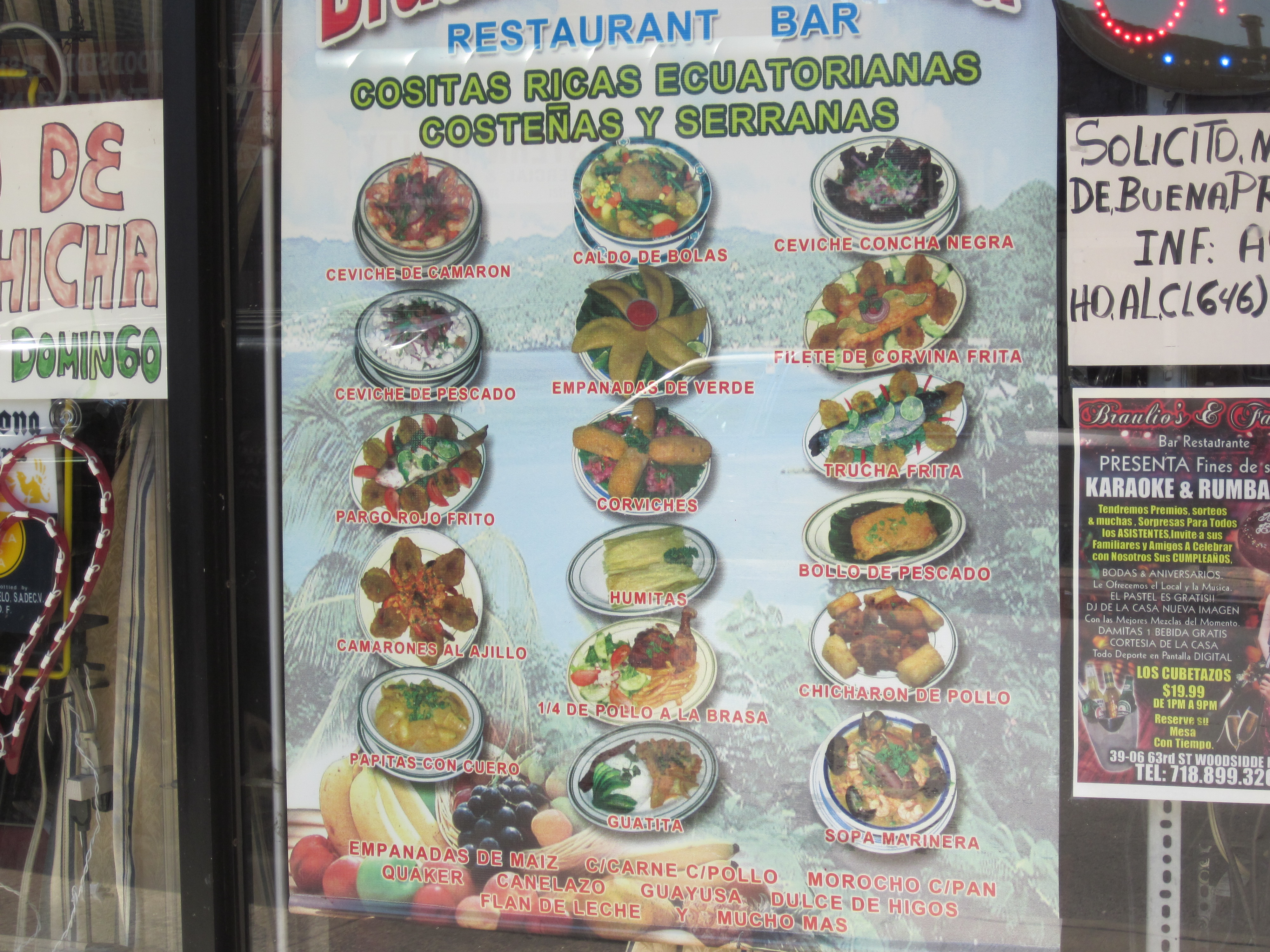
3908 63rd Street
Woodside

Was Gerry usurped when Zio choose Braulio’s & Famlia, the Ecuadorian restaurant, as our most recent destination? Or was there a leak among the participants to aide Zio in his choice. The facts show that there was no crime committed. A couple of months back Gerry had chosen an Ecuadorian restaurant in Portchester, an increasingly multi-ethnic suburb in Westchester. But his pick was waylaid by circumstances beyond anyone’s control: a wall collapsed on the West Side Highway and Gerry’s knee buckled under the pain of the knife; he had surgery on it the day before. Thinking he might be a food hero and limp courageously to the table, he did not postpone our dinner. But even as devoted Gerry is to our cause, the percodan he was taking to alleviate the pain would not only take away the pain, it would numb his senses, including the all important sense of taste. So, regrettably, his unique yet remote Portchester selection was nixed.

Zio’s selection came next and, as he always does, he researched the internet studiously,  narrowing his choices between Braulio’s and an Indian restaurant in Richmond Hill , Queens . The pick was Braulio’s, located in Woodside, a block from the shadow of the elevated number 7 train, a neighborhood so ripe with a variety of inexpensive ethnic restaurants that traveling to Portchester would be folly. Though Rick was excused from joining us, we were most happy to welcome Charlie back, who made the trek from Pennsylvania .

Our host, Senor Braulio, was on hand to make sure we were comfortable and if he could be of any help with the menu. We always appreciate assistance from the waiters or owners who might guide us in properly selecting the restaurant’s absolute authentic cuisine and Senor Braulio was more than happy to do so. So, instead of poring over the impressive and extensive menu ourselves, we gladly let him order for the table.


Both Peru and Ecuador are renowned for their ceviche and we previously experienced Peruvian ceviche at the excellent La Pollada de Laura in Corona two years ago. Now was our chance to sample the Ecuadorian version. To accommodate our extended familia of six, Senor Braulio had the kitchen prepare a custom-made, mixed seafood ceviche.

Dried hominy corn kernels, crackers, a spicy yellow pepper garlic sauce and bread that intentionally or not, was stale, was brought to our table as accompaniments to our ceviche. We, however, are an impatient group and began munching on the accompaniments—even the stale bread. Finally the big bowl of ceviche arrived brimming with seafood in a marinade. Unlike the clear marinade of Peru, this marinade was green. There was octopus, shrimp, fish, and what is known as “black clam.” I asked Senor Braulio about the black clam and it wasn’t that the clam belly was black, just the shell. Since there were no shells to be seen, we took his word on this. The ceviche was tangy with lime and vinegar, the green color coming from the extremely generous amount of cilantro tossed in. The seafood was “cooked” perfectly in the marinade; nothing tough or suspicious tasting or smelling.


As we waited for our meat platter, Senor Braulio pulled down a big screen and turned his many televisions on to EcuaTV, the television station of Ecuador . He came over to our table and apologetically exclaimed that there was a big soccer match on and hoped we wouldn’t mind, which of course we did not. It was Barcelona (not the Spanish city) vs. Nacional, two Ecuadorian club teams. The restaurant soon was full with groups of men, large bottles of Pilsener, Ecuodorian beer in front of them, watching the game with comparable zeal to our watching a Sunday NFL game.

Soon the huge meat platter appeared; a variety of grilled, seasoned meats, beef, pork, chicken, and sausage along with steamed hominy, green fried plantains, and a very pleasant green salad in a cilantro-flavored vinaigrette. Senor Braulio estimated properly and there was more than enough for the six of us. The meats and the accompaniments were perfectly fine, but what was missing was variety. By ordering familia-style we were not able to sample the curiously-named “ball soup” or the Ecuadorian fried fish, or the rice with black clams, or the tripe with potato, just to name some of the menu’s interesting offerings. In retrospect, opting for the easy route and having Senor Braulio order was a mistake.

Joining us to help devour the food was a potentially new member to our group, Mike from Yonkers . Mike from Yonkers displayed proper passion for our venture, but raised a few eyebrows within our circle when he expressed concern that there might be more food coming after the gigantic meat platter. He quickly realized his error—the promise of more food should never be cause for concern—and knew better than to refuse a few bites of the dessert of figs and cheese.

There’s always room for some figs and cheese.

On a recent visit to, I passed Braulio’s & Familia. They have prospered since our 2005 visit and on the take out menu I noticed that they now have karaoke on the weekends and that the ball soup is still available. Their menu also claimed a website but when I tried it at home, it came up blank.  Charlie has not returned to the group since our visit to Braulio’s & Familia, though Mike from Yonkers has become a mainstay. You will read much more about him in the posts to come here on the Adventures of Chow City segment of Fried Neck Bones…and Some Home Fries.

Spice Tsunami

22 Feb

Upi Jaya, of which I have written of below, was our first experience as a group with Indonesian food. We still had not replaced Charlie and for this venture were only four. After eating at Upi Jaya, I think those of us that were present were unanimous in proclaiming the restaurant, along with Tandoori Hut and Malaysian Rasa Sayang as our top three places in the three years we had been gathering for these dinners.


Upi Jaya
76-04 Woodside Aveue
Elmhurst


Upon awakening the morning after eating at Upi Jaya my youngest son shrieked, my wife cowered, and the dog sniffed curiously around me. It was as if there had been a full moon and I had been out all night stalking fresh meat in the forest. There was a raw, coarse odor permeating from my pores; something earthy, yet not of this earth.

It has been a very tough year for Indonesia. The tsunami devastated many of the islands and the earthquake last month added another tragic punch. We’ve all donated to tsunami relief, but I thought that bringing our intrepid group to eat at this Indonesian restaurant in Elmhurst, Queens, one of only five in New York, would, in some small way, help the suffering economy thousands of miles and half a world away. And at the same time we would be satisfying our collective consciences, we would be happily filling our already bloated stomachs.


Rick was a late scratch so there were only four of us for this outing, but Som, the owner of Upi Jaya and a very helpful host, had a table ready. He was anxious for us to try Indonesian cuisine and pleased that we were the adventurous types who were willing to take on anything. And here that meant pulling no punches when it came to the spice meter. None of us had really ever had authentic Indonesian food, so just about everything on the menu was virgin territory. We left the ordering in Som’s very capable hands.

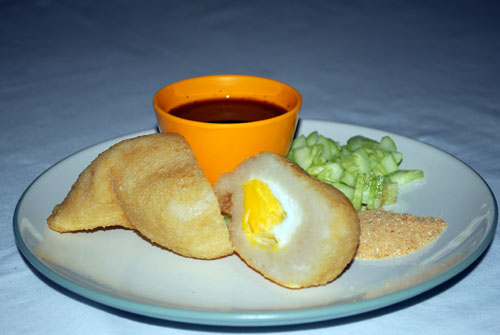
While we waited for our food, Indonesian Karaoke tracks with videos were playing on the television. With the words slowly displayed on the screen, we soon were getting the hang of the tricky Malay language spoken in Indonesia. But the music and the videos were, after a bit, just a distraction to the food. To start, Som brought out one of the specialties of the house, gado gado, a mixed salad smothered in a spicy, though not hiccup-inducing, peanut sauce—kind of an Indonesian cole slaw. Along with the salad, we had pempek kapal selam, a broiled fish cake with a cooked egg yolk inside, served in a hot and sour, cold soup like sauce, and the one familiar item on the menu, beef sate, though the dark, spicy peanut sauce was different than what I’ve had in Thai and Malaysian restaurants.


The most famous item on the menu, according to Som, was rending padang, pieces of beef rubbed in a fiery paste and slow cooked to absolute tenderness. We ordered the small portion, which was more than enough for our group especially since, with the heat in the dish  being truly volcanic, a little went a very long way. Then there were the curry beef ribs in a chili/garlic coconut milk sauce and shrimp broiled and cooked with chopped chili peppers. The only relief for the spice assault was the white rice—and that, with shaved fried garlic bits on top, even had a bite to it. Finally, Som recommended a vegetable which we, thinking it would be a cooling alternative, gladly agreed to. But we should have known better; the sayur daun singkong, a soup of kale and coconut leaf also had a sizzling snap to it.

The waiter kept the water coming, but it did nothing to diminish the heat in our mouths. Some might think eating hot spicy food like what was served at Upi Jaya is a masochistic experience, but they are wrong. If done right, as it was here, the experience is thrilling; almost cleansing in a way. We were having food that yes had intense heat, but it also had intense flavor and for the first time all winter, at least temporarily, my sinuses actually seemed clear. But would I risk a night banished from the bed and quarantined from my children to repeat the experience? I think, for another taste of the amazing rending padang, I might just risk it and I’m sure, if necessary,  Zio would allow me refuge at his Astoria love shack.


Upi Jaya is, thankfully, still in business but I, unfortunately, have never been back since that early spring evening in 2005. A big mistake on my part and one I hope to rectify very soon.

Malaysian Zoloft

1 Feb

I tried to stay away from politics and/or timely events while writing this recaps of our restaurant experiences, but this one, November 4, 2004, was just too close and fresh to just ignore. And in the case of Malaysian Rasa Sayang, our experience was affected by those events.

Malaysian Rasa Sayang
R.I.P

Bad

The rain was coming down hard—a sense of gloom had enveloped the city and was evident even in multi-ethnic Elmhurst, Queens. It was two days after the election of 2004. We had not planned this dinner to be a post-mortem, but the chance was always there and now it was up to Zio’s well-researched selection of Malaysian Rasa Sayang to boost our sagging spirits. Eugene was the first to arrive and it was evident that his spirits were far from sagged: he didn’t care that Bush recaptured the White House, all that mattered to him was that his Red Sox finally did in the Yankees and won a World Series.  Eugene was in prime form to sample the cuisine of Malaysia. And, so were we all—anything to divert us from the sad political reality of the day.

Worse

The menu featured 183 items plus 16 house specials, but Gerry’s eyes zeroed immediately in on the crispy pork intestines appetizer which he demanded we order. No one was in a debating mood and maybe a big plate of crispy pork intestines would zap us out of our collective funk. I was intrigued by item number 9, simply called “rojak,” described as a “cool delicious crunchy medley of pineapple, cucumber, jicama, and mango cubes with squid & shrimp crackers and our intensely flavoured shrimp-paste & pulverized peanuts.” Intense flavor is what we always seek, so rojak seemed like a natural. The popiah roll, a steamed roll filled with shrimp, tofu and egg was Zio’s recommendation while I suggested the roti canai,  a pancake-like bread served with a curry dipping sauce.

Intestinal relief.

The pork intestines, thankfully accompanied by two dipping sauces, was the first dish to arrive. They were followed by the popiah roll, the roti canai, and finally, a big plate of rojak, which certainly lived up to it’s intensely-flavored billing.

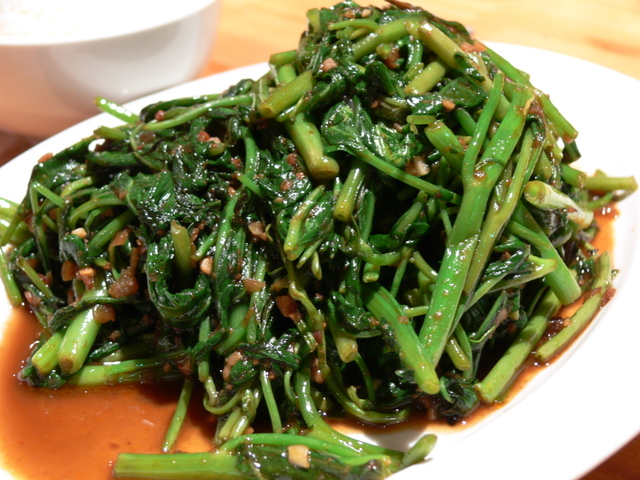
With help from our waiter, who had the look of an aging horse jockey, we began ordering more from the vast menu. He steered me confidently to the kang kung with belecan Sauce, kang kung, he explained as being the Malaysian equivalent of watercress. He also suggested number 66 on the menu, chow kueh teaw, which he claimed were noodles “very popular in Malaysia.” Zio, for some unknown reason was committed to the sarang burong, described as shaped fried taro with shrimp, chicken, and mixed vegetables topped with cashews while Eugene insisted on beef renang, cubes of beef shank slow cooked to “perfect tenderness” in a rich dry curry sauce.  Gerry settled on number 78, the steamed fish with bean sauce.

Kang Kung

In no particular order, the dishes arrived on our round table. The kang kung, looking like something found growing wild on the shores of the Amazon, was sautéed with garlic   had a crunchy, though not impenetrable consistency. The whole fish, a tilapia, taking up much of the space on the table, sat on a huge platter covered in a sweet and spicy bean sauce while the sarang burong appeared like hollowed out gourd stuffed with vegetables, shrimp, and chicken. Lastly came a big bowl of beef rendang, a fiery, Asian version of beef stew. I’m not sure of the exact moment, but it could have been when I was carefully excising a fish bone from the back of my throat when Eugene, as if we were interested, informed us that he once rode a bus to Radio City Music Hall driven by former New York Yankee, Joe Pepitone’s cousin.  It was soon after that, maybe when soaking up the sauce from the beef rendang in the coconut rice, when we all learned, also by way of Eugene that this day also happened to be Ralph Macchio’s (The Karate Kid) 43rd birthday. It was tidbits like these that made Eugene such a fountain of knowledge.


Again, as is our custom, all the plates were picked clean, including the skeleton of the tilapia. Our taste buds had been intensely flavored and for a few hours at least we forgot about the uncertain future. But then we walked out into the rain. And speaking for myself, it would take a few more meals on the level of Malaysian Rasa Sayang to ultimately remove the bitter taste in my mouth.

Now more than a full election cycle and a half since our dinner at Malaysian Rasa Sayang and it’s almost as if nothing has changed in terms of our “uncertain future.” The future for  Malaysian Rasa Sayang was even worse than uncertain. It is no more replaced instead by a Thai restaurant.

The Greek Uncle (R.I.P)

21 Dec

When Zio picked Uncle George’s in Astoria, the restaurant really didn’t qualify for our criteria. This was late 2003 and having been around since 1985, it was well known among the burgeoning foodie crowd. But we hadn’t done “Greek” yet and it was cheap, so we let Zio slide on the pick. As you’ll read below, that was our mistake.

Uncle George’s Greek Tavern
33-19 Broadway
Astoria

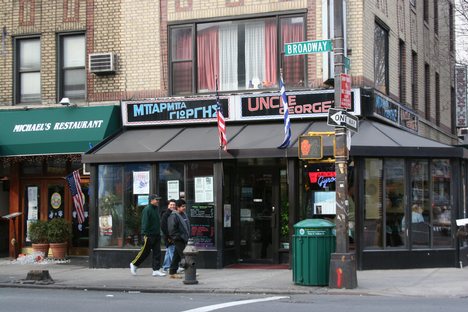
Is Astoria now to Greek restaurants what Little Italy is to Italian restaurants? Are they just there to appease the tourist or wandering foodie; to present a pale imitation of what Greek-American or Italian-American cuisine was like 40 years ago. That’s what I was afraid of when Zio choose Uncle George’s as the next destination for our group of intrepid eaters. Uncle George’s had a reputation as one of those authentic Greek restaurants, but my sources had warned that the food had there had gone downhill. This was Zio’s choice, however, and it was not my place to interfere.

When I entered Uncle George’s, the fluorescent-bright interior looked much more like a dingy diner than a Greek tavern. This was a good sign, I thought. There were other good signs: men with bushy forearms reading newspapers with undecipherable, to me, Greek lettering, a bilingual menu in English and that same undecipherable Greek on the wall, a surly, casting-couch Greek waiter who scoffed at Gerry when he inquired about a glass of ouzo: “No ouzo here! Whattya think? This a bar?.”  Lamb head on the menu. I was encouraged. Maybe Zio picked Uncle George’s truly for the food and not just for the convenience; surely that it was only a couple of blocks from his Astoria love shack was not a factor at all.

After we finally all assembled and sipped retsina; bad Greek wine served ice cold out of an olive oil container, our brusque waiter took our orders. Of course most of the items we desired were not available. The waiter recited what was left and when one of our large, slightly deaf, contingent inquired again about something not on the menu, he became exasperated with us. Still, there were plenty of items to choose from—lamb head, sadly, was not one of them.


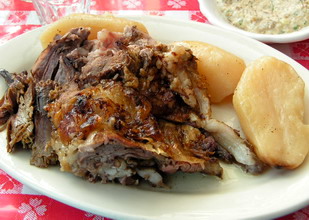
We started with the typical Greek dips; fish roe (taramaslata) yogurt, garlic and cucumber (tzatziki) and the very garlicky potato dip (skoradilia). All were very good and served with warm pita bread. Gerry tried the fried cheese and Rick was curious about the spinach pie, which was not anywhere near the equal of what I commonly ordered at Big Nick’s Burger Joint on the Upper West Side, not to be confused with Uncle Nick’s in Hell’s Kitchen, which also had a better spinach pie than Uncle George. I erred badly by choosing the baked macaroni and octopus. The macaroni, baked to a mushy consistency, was the antithesis of “al dente” and the octopus, canned and accompanied with an overdose of dill. Gerry had a similar unfortunate experience with his pastitio, the Greek version of baked ziti. Eugene fared better with the grilled whiting as did Rick with the barbecued baby lamb. Zio tried the lamb stew with spinach, which reminded me of one of the many common themes on meats, whether beef, pork or veal, that was the few dinner options at my college dormitory. Charlie’s roast leg of lamb was if nothing else, slow-cooked tender and highlighted by a large portion of lemon potatoes.

The food was certainly plentiful, but we’ll leave it at that. Zio had a “sheepish” look on his face as we left and it had nothing to do with our consumption of lamb. He shrugged. “They make good eggs,” he said. And to that we had no response.

No lamb head today!

Uncle George continues to thrive 24 hours a day in Astoria. It’s been “remodeled” since we visited in 2003, but the menu remains the same. Now, I think, the restaurant is more a guilty pleasure to its followers; like Wo Hop in Chinatown or Vincent’s Clam Bar in Little Italy. They are comforting reminders of the past that are knowingly not very good, but still irresistible for, if nothing else, their continued existence in an ever-changing food universe.