Tag Archives: Travel

Cooked in Corona

23 Nov

A few weeks before our trip to La Pollada De Laura, we visited a Thai restaurant in Woodside called Arunee. At the time in 2003, the legend of Sripraphai, the most famous Thai restaurant in Queens, was already cemented. Arunee, on the other hand, in Jackson Heights, was still comparatively undiscovered until Eugene steered us in its direction.  The meal, I recall was spectacular, but, unfortunately it was one of the few, due to a family emergency at home, I never reported on. Queens was our destination again, and what follows is our experience at a Peruvian restaurant called La Pollada de Laura.

La Pollada de Laura
(R.I.P)

Zio’s misadventures driving around Jackson Heights searching feebly for Arunee, the Thai restaurant we last visited, convinced him to take the subway from his love nest in Astoria to our next destination, La Pollada de Laura in Corona.  I also planned on the subway, the 7 train, and before leaving we tried to coordinate it that we would meet at the 103rd St Corona station. To help we came equipped with cell phones.

The Peruvian restaurant Rick chose was located on Northern Boulevard. Having been in Corona only once, when my car broke down on the Long Island Expressway many years ago, I was clueless as to how to get to Northern Boulevard. The Colombians, Mexicans, Dominicans, and others Latin American immigrants were out in large numbers around Roosevelt Avenue on this pleasant Spring night, but getting an answer to my question; which direction was Northern Boulevard, spoken in English, did not produce immediate results. I tried calling Zio’s cell phone but another 7 train had rumbled into the station above muffling any chance I had of communicating with him. Finally, using sign language, I was pointed in the direction of Northern Boulevard. Once clear of the elevated tracks, I was able to make phone contact with Zio who had already found the restaurant. As I made my way the very long five blocks to Northern Boulevard, Zio and I had a running commentary on the bustling neighborhood where even the music from the ice cream trucks had a Latin tinge to it.

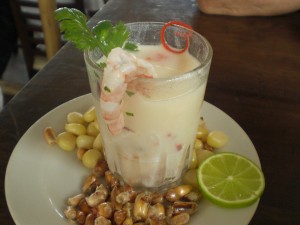
Gerry and Eugene were seated and the music was blasting as I entered La Pollada de Laura. Rick soon joined us and after Eugene regaled us with stories of his Times Square Madame Tussaud’s experience, as if we were interested, we were just about ready to order. The menu featured numerous ceviches, a Peruvian staple. Eugene, without elaborating, was determined to sample leche de tigre, otherwise known as “Peruvian Viagra.” The very friendly waitress happily explained the lore of the dish; that among its health benefits was an enhancement of male virility. Not that anyone of us, with the possible exception of Eugene, believed her, but it was the sweetly innocent way she explained it that made us order not one, but two leche de tigres.
Rick had mentioned that the owner of the restaurant, Manny, would help us decide what to order from the menu. But Manny had not arrived, so it was up to the ever-helpful waitress to recommend how we should proceed. Instead of a few different ceviches, she suggested we go with the ceviche mixto, which had a little of everything; fish, octopus, squid, shrimp and conch. I’ve had the famous Peruvian pollo a la brasa (roast chicken) at other Spanish restaurants, but wanted to try it here. We also ordered a jalea grande, a mix of fried fish, shellfish, potatoes accompanied with a salsa criolla, and with a nod from our waitress, lomo saltado de carne; beef with slices of onions, tomatoes and French fries.

While we waited, we were brought a pre-meal snack; tiny pieces of purple, salted corn kernels. They went well with our Peruvian beer, Cusquena. The leche de tigre was first to arrive at our table. Large shrimp and half a blue crab hanging over a tall glass filled with a milky liquid; the “tigers’ milk.” I immediately tasted a spoonful of the liquid—the “leche”—was the juice used to marinate, or “cook” the fish with lemon, lime, cilantro and peppers. And there was only so much of that juice you could actually drink without “cooking” the inside of your own mouth. Virility, male or female, was most definitely needed to down a big glass of leche de tigre.

At most of our food adventures, once the food begins to arrive, there is little room on our table. But we eat quickly not only because we can’t help ourselves, but because the quicker we eat and dispose of a platter, the more room will be found at our table for another entrée.  This night was no exception.  The delicious lomo saltado was devoured before the ceviche mixto even arrived, but still, our table was crammed with a whole pollo a la brasa and a monumental-sized mound of jalea, fried mixed seafood cooked to perfection.  When the ceviche arrived, we found room on the table for the equally large portion; the squid, octopus, fish and other seafood tenderly marinated, smothered in red onions and swimming in the lemon juice.

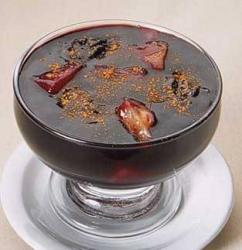
Manny eventually showed up and brought us his homemade hot sauce. Ignoring Manny’s warning of its intensity, Rick smothered his ceviche with the sauce and soon the sweat was flowing alarmingly from his forehead. Finishing what was on the table seemed impossible, but given time we did not disappoint. We even had room for dessert, trying Manny’s recommendation, mazamorra morada, a crimson-colored gelatinous mess that prompted Zio to make a comment about blood, brains, and shotguns. Though collectively not to our liking, Eugene could not resist mentioning that it was better than the infamous beans of halo halo from Ihawan, the Filipino restaurant we visited a year ago.
Amazingly, all of what we ate came under our budget and then some. As Zio and I tried to walk off the meal in the four blocks to the subway, we wondered how, with prices like that, La Pollada de Laura could actually stay in business. Before either of us could respond, the sound of the number 7 train drowned out any hope of further conversation.

In the book I write about New York City, I recommended pairing a meal at La Pollada de Laura with a visit to the nearby Louis Armstrong House Museum, where the jazz great lived from the 1940’s until his death in 1971. Unfortunately, several years ago, La Pollada de Laura closed thus answering our 2003 question wondering how they could stay in business considering the prices they were charging.

Fire on Grand Street

16 Nov

When we visited Nyonya in early 2003, before the internet food site explosion, the Malaysian restaurant, though located in Little Italy a few doors from the great Di Palo Fine Foods, was still somewhat under the radar. At the time, it had a following, but nothing like it does now. It was our group’s first experience with Malaysian food and the unadulterated heat that distinguishes it.  We like unadulterated—heat or otherwise—so Malaysian food became one of our most repeated cuisines.

Nyonya
199 Grand Street
Little Italy

Zio confided that he had many options for our upcoming food destination, but the thought of crispy pork intestines, beef tripe noodle soup, fresh fish head cooked with lemon grass, and sooi pooi (sour plum) drink which Nyonya, the place he ultimately chose, offered, was too enticing for him to pass on. So all of us, Eugene excepted, who was on a Caribbean cruise and most likely at work on the unlimited buffet line, assembled in the bustling tiki-hut like restaurant in Chinatown. We were the few non-Asians in the restaurant; a very promising sign.

The menu was extensive and when not entranced by the bloated fish swimming in the tank behind our table, we had to concentrate on the task ahead: what to order. Crunch time came and all Zio could come up with after the promise of a variety of organ meats in coconut milk was the relatively conventional mango chicken. Eugene was probably experiencing more exotic fare on his cruise.  Zio’s selection was vociferously vetoed and after much urging switched to the more adventurous, kari ayam, described in the menu as chicken cooked over low heat with lemongrass and chili paste and simmered in thick rich coconut curry. Charlie stuck with chicken as well and gambled on the Hainanese chicken, steamed (room temperature) with a chef’s soy sauce. Gerry ordered the kang kung belacan, which translated meant sautéed “convolus” with spicy Malaysian shrimp paste sauce. We had to ask one of the dozen or so waitresses who were attending to our table for the translation of “convolus,” and were told that it was Malaysian string beans. Rick showed his fortitude by ordering cheng-lai stingray while I went with the comparatively mundane curry spareribs.


It wasn’t that the promise of gargantuan main courses was not enough for us. It was that Nyona’s appetizers looked much too good on paper to pass up. So we started with the so-called “Malaysian national dish,” roti canai, an Indian pancake with a curry chicken dipping sauce. Chicken satay and Poh Piah, a Malaysian spring roll stuffed with jicama and minced shrimp rounded out our first courses. To drink there was Chinese beer for most of us while Zio insisted instead on the fresh coconut juice. When his drink arrived in half a real coconut and a big straw, we wondered why the pink umbrella was missing.  Zio, oblivious as always, cradled the coconut in his hands and sucked the juice from the straw. We looked at him for a moment, savoring the absurd sight, and then went back to our beer.

The parade of waitresses began piling the food on our table almost immediately and just as quickly we began to devour it, eating the roti canai with our hands, dipping it into the murky, but very tasty curry, pulling at the tender satay, and wondering over the jicama in the spring roll. Rick’s sting ray (a.k.a. skate) was the first entrée to arrive and we picked at the perfectly cooked flesh, dipping it into a fiery sauce. At Nyonya, fiery was the theme; the curry spareribs particularly sinus-clearing while Zio’s chicken, also very spicy and falling off the bone. In fact, all of the food, including the sautéed “convolus” which tasted nothing like string beans, wax beans, green beans or anything else we had previously encountered, was hot with the one exception of Charlie’s wan-looking “room temperature” chicken, which many at the table found unappealing; though Gerry and I thought it’s blandness was the perfect antidote to the heat in the other dishes.


We worked through all the food at the table with only a few pieces of the above-mentioned Hainanese chicken remaining—and no volunteers to take it home. Our stomachs bloated, no one even mentioned dessert…not even the usually insatiable Zio. In Eugene’s absence, I was left to do the math and after tip and including drinks, we came in one dollar over our $20 budget—meaning, excluding the drinks, that we actually came under budget.


A few years ago Nyonya moved across Grand Street to a shiny new space. It also branched out to Brooklyn with two locations. I’m not sure if now Nyonya would qualify for our group. Too popular. Really almost a chain with three branches in the city. But that is now, and the above was then and none of us had any complaints about what we experienced in 2003.

The Seoul of Jersey

9 Nov

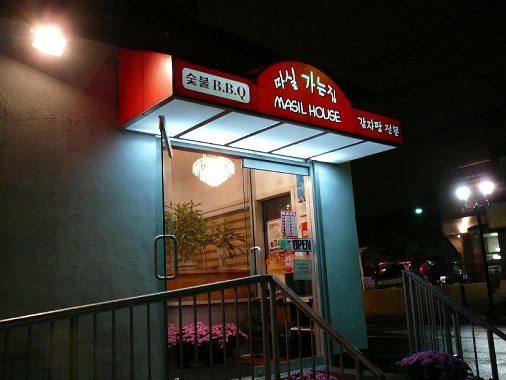
The following trip to New Jersey for Korean food was our first expedition outside of New York City. Gerry, who lives in the suburbs, has been the boldest of us all in finding places beyond New York, often to the major chagrin of the others, myself included. But after our trip to Masil House, no one was complaining. Here is what we experienced in the Korean enclave of Fort Lee.

Masil House
400 Main Street
Fort Lee, New Jersey


Gerry was bold and brave in his choice for our most recent food adventure. Not only did he gamble by summoning us across the Hudson River to the shores of Fort Lee, New Jersey, he also chose a place that we discovered upon our arrival, had velvet-covered menus. More used to grease-smeared paper menus, the velvet-covered menus immediately sent up warning signs.  But his was no brash act by someone irresponsibly leading the group astray. No, Gerry deliberated long on the subject taking his assignment extremely seriously. He even committed a first in our year-long gatherings. He, as Rick aptly put it, “called an audible,” switching the destination almost at the last moment from a tofu-laden, seemingly all-vegetarian Korean restaurant  to another Korean restaurant, this one with a barbecue grill in the middle of our table. The barbecue brought with it the promise of an abundance of meats and, though we have nothing against tofu and all the health-benefits it contains, Gerry’s audible was quietly endorsed by all.


While we waited for Rick’s arrival, we sipped barley tea and studied the thick menus. Gerry suggested we skip the appetizers and stay for the most part with the entrees; that as part of the Korean meal, many side dishes are included with the entrees. After making a few suggestions of our own, we turned over the ordering to Gerry. This was his show. The only exception came from Eugene who insisted we include an order of the stewed baby chicken with ginseng. Eugene’s insistence was based on the claim that we all needed some of the attributes that supposedly are contained in the fabled ancient Asian root.  “Speak for yourself,” Zio barked back to Eugene. And really, where was Eugene when he had the opportunity for “Johnny to get up and stand up” by trying some of the Jamaican Irish Moss drink and some of the other  “health” tonics that were available at Toyamadel, our last get together?

As soon as Gerry completed the order with the patient waiter, the side dishes he had told us about began arriving; aromatic and spicy kimchi, salted anchovies, sugared seaweed, pickled turnips, sesame-seeded soy sauce, vinegar peppers, and other items unidentifiable to me. We began picking at  the condiments as the waiter prepared the barbecue. It was a cold night in New Jersey and the extra warmth from the barbecue as well as from the spicy food was welcome.

Once the coals and grate were hot, pieces of marinated beef short ribs, Bul Gol Bi, removed from the rib were put on the grill. While the beef cooked, we tasted the ginseng chicken, a pancake filled with assorted seafood including shrimp and squid, and a very spicy stew of octopus and noodles. All were flavorful and immense in portion, but it was the barbecue that was the highlight. Like a taco, we wrapped the cooked meat in a lettuce leaf stuffed with condiments such as raw garlic, hot pepper, a garlicky bean paste, and whatever else you wanted to add and ate lustily. Along with the two orders of short ribs, there was one order of sliced marinated pork with peppers and onions.


As we have been trained to do, we devoured just about everything on the crowded table with only a few small overly-charred pieces of meat remaining on the grill.  It didn’t take long for all the fragrant accompaniments; garlic, cabbage, salted, cured fish, and spices to begin oozing from our pores.  And at the time, sated and satisfied, none of us really cared how truly “aromatic” our Korean feast had made us.

Dessert, apparently, was not an option. We were, however, brought complimentary slices of orange. The oranges had a cleansing effect—a clearing of the palette from the strong redolent assault we had just experienced. The bill came and adding in a very generous tip due to the fact that actual cooking was done by the waiters at our table, it came to $20 each–exactly our prescribed limit.  As it was coming over, crossing the river via the George Washington Bridge back to New York, the traffic was light. Gerry’s Jersey gamble was a success.

I haven’t been back to Fort Lee for Korean food or any other reason since that night in early 2003. Gerry’s success in getting us out of our comfortable New York City environs on this night apparently led him to take even more gambles, with, in many cases, much more mixed results. You will read of them as these adventures continue.

The Beans of Halo Halo

5 Oct

Our fourth expedition of 2002 took us to Queens again. Queens, I might point out, has probably been our most visited borough; the variety and number of restaurants that fit our criteria almost endless. This visit to a Philippine restaurant remains memorable by Eugene’s vehement, bordering on obsessive, dislike of a certain dessert he had. It has become the one dessert that, almost on cue, he reminds us of whenever the subject of dessert comes up. Here, then, is the origin of Eugene’s fixation.

Ihawan
40-06 70th Street
Woodside, Queens

Ihawan

Zio labored hard on his pick, our fourth since beginning these adventures. Not quite sure of himself and his instincts, he constantly sought out my consultation for his choice. This was the man who introduced me to the heavy brown sauces of subterranean Wo Hop, the sublime calamari marinara at Dominick’s on Arthur Avenue, the “zuppa di pesce” at the Pine Tavern on Bronxdale—well before the New York Yankees discovered it—one of Manhattan’s original Thai joints, the now defunct Bangkok Cuisine on Eighth Avenue, and the marinara pizza at Patsy’s in East Harlem. Now, years later, he wanted my advice. He can’t say that I didn’t warn him about what would happen if he moved to the food wasteland of Hartford, Connecticut.

What we ultimately came up with was a Philippine restaurant called Ihawan. The last time I had eaten Filipino food was in Los Angeles during my time as a starving screenwriter. There was a small, inexpensive family place near where I lived on Sunset Boulevard that specialized in Filipino dumplings and soups served by the very friendly daughters of the owner. The soups and dumplings were good, but I think I went more for the overly attentive service of the daughters.  What we were to experience at Ihawan was much different than my recollection of the Filipino food I had in LA.  Advertised as the “Home of the Best Barbecue in Town,” Ihawan was an easy find.  In Woodside, just off the BQE and under the number 7 train, Zio and I made it in less than a half hour, including the ten minutes we waited in front of the restaurant as a parade of busboys and kitchen help unloaded huge bag after bag of garbage into a garbage truck.  We were also, unfortunately, downwind of the truck and able to capture the alarming essence of the restaurant’s ripe leftovers.

Gerry and Eugene were already seated in the upstairs dining area. We would be a smaller group for this adventure with Rick and Charlie having to bow out due to last minute commitments. For a Tuesday evening, the mirrored, very bright dining room was bustling with local Filipino families, a variety of different ringtones constantly emanating from the multitude of cell phones. The menu was an immediate challenge to us. With items such as “milkfish in tamarind soup with vegetables,” “sizzling sisig” (pork ears and liver marinated with lemon and hot pepper on a hot plate), “dinuguan” (pork stewed in pork blood gravy), “laing” (gabi leaves sautéed in coconut milk), “kare-kare” (stewed oxtail in peanut butter sauce with mixed vegetables), and fried “lapu-lapu” (grouper) with sweet and sour sauce, we didn’t know where to begin or end. We started with drinks, Zio and I trying the cantaloupe juice, Eugene opting for the iced buko (young coconut juice), and Gerry, attempting the “sago at gulaman,” also known as sweet drink mixed with tapioca pearl and gelatin. The drinks came and we sipped, but none of us got much further. The sugar content would make a diabetic go into immediate insulin shock. And it was worse for Gerry; he had those multi-colored tapioca pearls to deal with.

The dinner plates began to pile onto our table soon after; chopped pork belly in liver sauce, deep fried marinated milk fish, sautéed long beans with shrimps and pork, the stewed oxtail in the peanut butter sauce, minced pork spring rolls, and barbecue pork and chicken on a stick. The tastes of the entrees were varied; there was Chinese, Thai, Vietnamese, and even Spanish mixed in there. The four of us easily consumed everything with the exception of Eugene, whose pathetic excuse for not finishing the pork belly in liver sauce was his lame claim that he ate too much the previous two days.

We forced ourselves to try the desserts; how often do you get to experience “mais con hielo” (sweetened corn with milk & crushed ice),  Filipino flan, and “halo-halo” (mixed fruits with milk & crushed ice), ?  As it turned out, the flan was the highlight of the desserts, denser and even more flavorful than the flan at La Fonda Boricua. Zio and Eugene took a few sips of the halo halo and while Zio finished the unusual offering, Eugene could not. Pondering the tall frothy glass that contained his drink, he said, “Sometimes when you order chili it comes with only meat. Other times it comes with just beans. I like to know what is in my chili when I order it.” I think what Eugene was really trying to say in his own bizarre way was: “Where the hell was the fruit? And why were there cannellini beans in my dessert?” Cannellini being the bean Zio thought they most resembled. Whatever they were, Eugene was actually offended by their presence in his dessert.


Despite the misfortunate, at least for Eugene, beans of halo halo, Ihawan, with its very exotic (to us) offerings proved to be a very worthy choice and at $13 per person, well under our allotted budget.

Ihawan is still around and doing so well that they have opened a sister restaurant. This one called Ihawan2 is located amongst the new condo empire of Long Island City. Though from what I can tell, maybe to best serve the demographic of that high rise haven, they do not highlight their Filipino food.  On their website, www.ihawan2.com, they instead have opted to feature those two dreaded words: “Asian fusion.” So if grilled pork ears and snout (sisig) just don’t work for you, you now have other options like California rolls, tempura, and chop suey. And for dessert there is always halo halo.

Life Before the GPS

1 Oct

Back in 2002, none of our group had GPS navigational systems yet.  And I’m not even sure if they were around at that time.  For those who drove, getting to our third destination, an African restaurant in the now bustling, and renamed by real estate prospectors “Gold Coast” of Harlem, was comical.  What follows is my depiction of that experience in the spring of 2002.

Leworo Dou Gou
(R.I.P.)

When I arrived at Leworo Dou Gou restaurant, after getting off the B train at 116th Street and walking two blocks up “8th” Avenue to 118th street, I was relieved to see Charlie already at a table and waiting. In fact, he was the only one waiting in the restaurant. Our dinner was scheduled for 7:30. Charlie and I waited, inhaling the pronounced aroma of a fish market mixed in with other strong, yet unfamiliar smells. The aroma, coupled with the fuzzy reception of “Wheel of Fortune” on the restaurant’s television, was beginning to make me feel a bit dubious about this outing, our third of 2002. I glanced at the menu and was relieved to see that none of the “Natural African Dish From the Motherland” were priced above $7. At Leworo Dou Gou we would be very hard pressed to surpass the $20 limit we imposed on ourselves when beginning this venture.

The Motherland encompasses a very vast mother of a land, but Leworo Dou Gou claimed to represent the Ivory Coast portion of that continent. Charlie and I were still waiting when my cell phone rang. Zio was close by, searching for Eighth Avenue. I told him to look for Frederick Douglass Boulevard, which on maps and in the phone book goes by the name of Eighth Avenue. A few minutes later, he walked in. So now there were three of us. The smells, which were beginning to test my stomach, immediately enticed Zio.  But Zio would salivate at the smell of burnt toast. While we waited for the remaining three in our party, we studied the menu wondering what “dry okra sauce,” “cassava leaf,” and “LaFide” might be. There was also something called “agouti.” The name was familiar and I recalled that I actually tasted agouti on the island of Grenada in the Caribbean. It was in the rodent family and I remember it being very tough and gamey. That not so complimentary description only reinforced Zio’s determination to taste the rat.

The three of us continued to wait, we were beginning to worry. The phone rang in the restaurant and a woman behind the take out counter of the restaurant answered. I could hear her struggling, in her English with strong French inflections, to give directions. One of our own was lost. A few minutes later, Rick pulled up. He had been searching for Eighth Avenue. A big mistake, as we were beginning to find out, since there were no street signs proclaiming the street we were on as being Eighth Avenue. After a few more minutes the phone rang again. Again the same woman was attempting to give directions. She gave up and handed the phone to a man who was sitting behind us, the owner, we later learned. He spoke perfect English and explained, on the phone to whomever he was talking to, that Frederick Douglass Boulevard was Eighth Avenue. He had been, it turned out, talking to Gerry and a few minutes later both he and Eugene walked in.

By now, either the smells had mellowed or I was too hungry to notice or care anymore. We all were ready to eat, but we had no clue what to order. We did learn that there was no more grilled fish, and to Zio’s disappointment, no agouti. Rick made the wise choice, he told the waitress to bring six dishes, a combination of some of the different items on the menu. While our food was being prepared we all had homemade ginger beer, tangy with a sharp hint of lime along with the zesty ginger. To entertain us while we drank and ate, the owner switched from the fuzzy network television, to a video of “soukous” music from West Africa, some of which, he claimed he personally photographed while at a concert back in the “motherland.” The music was infectious and the video production, gritty especially the scenes with the dancing midget. Or was he a dwarf?

Our food came, one heaping plate at a time. Fried whole fish (croaker) with plantain. Fried whole fish with cassava and yams. Stewed “hard” chicken, grilled chicken and beef on a stick, stewed fish in okra sauce, and an aspic-type wedge of what seemed to be pounded banana, which, by itself was bland, but worked with the sauce from either the stew chicken or fish. We were given forks and knives, but noticed that one of the restaurant’s customers expertly ate his meal without either. Even with forks and knives, our hands got greasy and we made what probably was the unusual request at Leworo Dou Gou for napkins. What we got were sections of paper towels.

The six of us soon devoured the food leaving only fish bones and cleanly picked pieces of chicken. Everything else had been eaten with Zio and Gerry even sucking up the last of okra sauce with the remaining few kernels of rice. There was no mention of dessert on the menu and the owner wasn’t offering anything but coffee, so we ended it there. All that for only $12 dollars per person left us wondering how Leworo Dou Gou could stay in business.

Leworo Dou Gou did not stay in business for long. Within a few months of our visit it was gone.  But that’s not uncommon among the African restaurants around the area of West 116th Street known as “Little Senegal.” They come and go with great frequency.  Though as the neighborhood changes and rents increase, I wonder how long the African influence in the area will remain. In 2002 there were vacant lots and tenements surroiunding Leworo Dou Gou. Now, across the street from where Leworo Dou Gou was there is a market price condo with a Chase bank, Starbucks, and a gourmet supermarket. A few blocks up an Aloft Hotel ( a divison of  W Hotels) will soon open while new restaurants are so prevelant on Frederick Douglass Blvd that some are saying the street will become Harlem’s “Restaurant Row.” But will they qualify for our $20 and under crowd?

The storefront that was once Leworo Gou Dou

Chinese without Chinese

29 Sep

It was my turn to pick next and about a month after we visited La Fonda Boricua, I came up with my choice by “word of mouth.” One of my son’s pre-school teachers was Guyanese. I asked her for a place where I could find authentic Guyanese food. I was familiar with some items having traveled to the Caribbean extensively and, in particular, the islands of Grenada and Trinidad and Tobago which, like Guyana, featured a blend of people and influences from the Caribbean, Africa, China, East India, and indigenous peoples. I knew and tasted roti and pepper pot, both Guyanese specialties, but beyond that not much. And as far as I knew at the time, there were no Guyanese restaurants in Manhattan and few, if any, in the outer boroughs as well. At first my son’s teacher was evasive; she was curious why I would consider traveling outside of Manhattan for Guyanese food. But I mentioned my search for good pepper pot in the city and that impressed her. Finally, she steered me to Atlantic Bamboo Garden in Richmond Hill Queens.

Here is what we I wrote after our experience almost nine years ago at what is now simply called “Bamboo Garden.”

Atlantic Bamboo Garden
10704 Atlantic Avenue
Richmond Hill, Queens

It was dark on Atlantic Avenue. So dark it was hard to distinguish one chop shop from the other. The rain was erratic; on and off, just like Zio’s windshield wipers. But there it was. Set a bit off the street. The colored lights advertising “Bamboo Garden” inviting on such a raw, dreary night. It was like something out of a Scorsese movie. To be more accurate, out of Good Fellas. Was it the place that was torched by the Wise Guys of the movie made out of the book of the same name? That was the opening debate as we convened for our second food adventure. The next debate was whether Eugene’s tropical fruit milkshake was actually a milk of magnesia shake? Eugene, we are still waiting for your answer.


Gerry and I immediately took care of the inclement weather outside by ordering rum punches G/T style. Whatever the style, the rum was very punchy and if I hadn’t been so concerned about Zio’s  aged eyesight along with his shaky windshield wipers, I too would have gone for another round as Gerry bravely did.
After complaints about under ordering at La Fonda Boricua, we over compensated by ordering three appetizers. By the time we finished off the garlic pork, jerk chicken, and fried shark, G/T Style (G/T explained as Georgetown, the capital city of Guyana), Bamboo Gardens was filling up with parties of extended Guyanese families. A mix of soca, R&B, Caribbean Chutney (Indian), and reggae was playing on the sound system. The place advertised itself as the No. 1 West Indian style cooking and Guyanese-Style Chinese food. We couldn’t vouch for it being No. 1, but none of us had ever had Guyanese-Style Chinese food before, so in our limited food experiences it was the one and only. Maybe pepper shrimp fried rice, which I sampled, distinguished this Chinese food from, say, Cuban-Chinese food. Or maybe it was the snapper in coconut milk sauce, which Eugene devoured, that made it different. Rick thought it was the fact that Bamboo Garden was the first and only Chinese restaurant he had ever eaten where there was a total absence of Chinese people either working or eating at the restaurant that was the real difference.
Once the various and hearty West Indian and Guyanese-Chinese courses were polished off, only Zio and I dared dessert. Zio, trying to recreate the red jello* experience, ordered that Guyanese specialty, cheesecake, while I tried the soursop ice cream. Neither were the equal of what we had eaten in our first two courses. . .and it was that cheesecake, I believe, that pushed us slightly over the $20 mark.
The rain had stopped by the time we left Bamboo Garden. We could see the facade of the restaurant more clearly now. No, the consensus on hand believed it probably wasn’t the same Bamboo Garden from
Good Fellas. But the consensus also believed it was worth the trip to Richmond Hill Queens to try Guyanese-Chinese food.

*For those who do not know, Zio is famous for an eating experience at the Court Deli, near Yankee Stadium. The Court Deli is a popular pre-Yankee game restaurant and known for their succulent Kosher hot dogs, pastrami, corned beef and other deli items. Zio, however,  for one particular pre-game meal was, it seems, watching his waistline and instead of stuffing his face with the usual, two hot dogs and a knish, was found hunched over a plate of cottage cheese and red jello. I can verify that he rectified that embarrassing moment by bringing two potato knish’s into the Stadium eating one in the third inning and then finishing off the other two innings later.

The restaurant now has a website http://bamboogardennyc.com that proclaims it as “New York’s Finest Restaurant.”

Welcome to Fried Neck Bones…and Some Home Fries

28 Sep

In late 2001, I came up with the idea to gather together friends who, like me, enjoyed finding, out of the way, unusual, usually ethnic, usually cheap eats throughout New York. To add to the experience, I suggested that we meet together every month or six weeks with one of the members of the group picking the destination. I targeted friends, or friends of friends, who were uninhibited about their food choices; meaning they had to be open to any type of food, meat, fish, spicy, raw, whatever. Anyone whose diet had restrictions due to health, philosophical or religious reasons where red meat, pork, shellfish, entrails or any other food product were prohibited really could not participate. Thankfully, that did not stop any of my first choices. Eventually, our original group came to six men.

Part of the loose criteria I came up with in my “proposal” for our group, was a $20 food limit per person, excluding beverages. So wherever we choose, it had to meet or come very close to that dollar amount. Also, I made it clear that we should steer clear of restaurants that had already been “discovered.” We wanted to find places that were under the radar; that had not yet been written up by Eric Asimov of the New York Times, the then “$25 and Under” column writer in the paper’s weekly Dining section, New York Magazine, or any other major publication. This was well before the internet explosion of food related websites like Chowhound, Grub Street, Eater, Serious Eats, and Yelp to name just some of the hundreds out there now discussing new restaurants including the type we were pursuing.

The six men, who comprised the original group, leaving their last names out, were Charlie, Rick, Gerry, Eugene, Zio, and myself. The only change in the group over the almost nine years we have been doing this was the loss of Charlie, who moved a couple of hours outside of the city making his commute for our gatherings not very practical. He was replaced by a friend of Gerry’s we call, Mike from Yonkers.

Since we began these expeditions, I chronicled each restaurant we visited with a sometimes brief, sometimes wordy summary of our experience at that restaurant. In this blog, I’m calling Fried Neck Bones…and some home fries, in honor of the Willie Bobo song of the same name, I will, at first, post many of the original blogs. Once readers familiarize themselves with the cast of characters involved and read about many of the places we have visited, I will add each new summary to this blog, hopefully with photos to enhance the written description I’ve provided.

Feedback, of course, is encouraged as is any news on either many of our already visited destinations or new discoveries we might want to visit.  So here now is a very brief summery of the first restaurant our group visited in February of 2002, East Harlem’s, La Fonda Boricua.

La Fonda Boricua
169 E. 106th Street
East Harlem

My wife commented, not too favorably, on the special “tostones” sauce at La Fonda Boricua. Of course she tasted it second hand. And with a flu-stuffed nose. To me that meant the sauce was a true success…as was the rest of the collective meal.

Kudos must go to Rick for experimenting with the chivo (goat) and Gerry, a brave man to eat those chicken gizzards. He deserved that six-pack of Corona Light. I guess the liquor license did not apply to wine. But who’s complaining? At least they finally took our order. Charlie met the match and delivered with an authentic global eatery for under $20. . .including flan…vanilla only.

The Ayala brothers, owners of La Fonda Boricua, are now interested in adding to the art on their wall. I hear they would like to contact the Puerto Rican artist who has scribbled the tiny portraits forming the thumbprint. What they are looking for now is a new theme; a portrait of Zio, in the shape of a big toe, which, coincidentally, resembles his physique, and a mountain of mofongo, slathered with brown gravy, in front of him.

Since our visit, La Fonda Boricua has continued to thrive and was “discovered” by the Food Network and even involved in a “Throwdown” with chef Bobby Flay going up against the owners in a battle for the best arroz con pollo. But what has been good publicity for La Fonda would have the opposite effect on our group. A spot on television would have immediately eliminated the restaurant from our consideration. They now have an extensive website www.fondaboricua.com and have opened a sister lounge across the street with live Latin music called FB Lounge.