Archive | Harlem RSS feed for this section

Name That Place

3 Jun

As instructed by the sign above, I checked this place out. As you can see it is in a industrial-like setting. It is not a restaurant, but you will find food here with the emphasis on salt fish, a.k.a  salted cod, baccala, bacalao, etc, etc. In fact, the competition for the best “salt fish” boneless or not at this place is fierce. That should be enough of a hint for all you New York food junkies. Leave your answer in the comments section below. On Monday, the place will be revealed right here at Fried Neck Bones…and Some Home Fries.

Harlem’s Sisters

1 Mar

I remember having dual purposes in bringing our group to Sister’s Caribbean Cuisine. It met our criteria as you will read below and I also had been assigned to review it for a weekly New York-based magazine. I felt slightly guilty about reviewing it. Would my coverage of Sister’s in a major glossy destroy the authenticity we seek out for our group? Read my postscript  below to learn the answer.

Sister’s Caribbean Cuisine
47 E. 124th
Harlem

With a few notable exceptions (overpriced Turkish food in remote Sheepshead Bay—thanks Gerry) our group has had little difficulty in meeting our criteria of a $20 per person maximum tab, drinks excluded. Many of our choices have been much less than that; the Old Poland Bakery from earlier this year possibly being the record low. But it’s not only about price with us, it’s also about atmosphere. For our group the ideal atmosphere is no atmosphere. Paper plates and utensils are a good sign. Wobbly tables are encouraging. Friendly waiters and/or owners whom we have to converse with using hand signals due to language difficulties is usually a plus. And, of course, the food must be exciting and genuine. It can’t be dumbed down for a “crossover” clientele. We want what “they” are having; “they” being those who live or work near the establishment usually of the same ethnicity of that particular restaurant.

In many ways, Sister’s Caribbean Cuisine, located in the middle of Harlem across from Marcus Garvey Park, epitomized what we search for. The restaurant was small and much of the business was takeout, but it was sparkling clean and along with a few paintings of Caribbean scenes, curiously and to Eugene’s delight, there was a large photo of the 1980’s Boston Celtics playing on the parquet floor of old Boston Garden. Good R&B from the ‘70’s was playing. Our table was not wobbly, nor did we need sign language to converse with the affable Marlyn, host/owner of Sister’s. But we did eat off paper plates and the menu seemed genuine.


The food on the menu was primarily Caribbean, though not from one particular island. Marlyn, was from Guyana and her country was represented on the menu by masala curry chicken, chunks of chicken on the bone in a thick, dark brown curry fragrant with Caribbean and East Indian spices, her cooks were from Trinidad and that island’s specialty, roti, curried chicken, beef or vegetables wrapped in an Indian-spiced flatbread was available, as was Jamaican jerk chicken, here minus the smoky flavor from a genuine jerk pit, but tender and fragrant with a mild bite of heat. Salt cod, known as “saltfish” in the Caribbean was stewed in a piquant tomato-based sauce. Marlyn was impressed with our tenacity when we went above and beyond by ordering yet another dish, the oxtail stew, served in the same tomato-based sauce as the codfish.

It wasn’t that the four of us, Zio was absent, back in Glastonbury doing his part in ridding eastern Connecticut of a variety of pests and vermin, could not handle the entrees, it was what came with them. Each entrée was accompanied by a paper plate with two sides that exceeded the size of the entrée. We had piles of rice and peas, the rice speckled with kidney beans and infused with coconut milk. We had callaloo, the Caribbean equivalent of collard greens, here mixed with okra. We had curried chick peas and potatoes, and cabbage and carrots, and string beans, and collard greens, and macaroni and cheese, and corn bread. And, of course, we ate all of it and added three desserts as well; carrot cake, pecan pie, and despite Gerry’s vague “I just don’t like it,” referring to our last choice: red velvet cake. For all that food, and a few drinks, including sweet homemade sorrel and lemonade, our tab was a lowly $45. So, as far as our experience at Sister’s Caribbean Cuisine, in the words of our ignominious commander-in-chief, “mission accomplished.”


I now live not far from Sister’s and I am happy to report that despite my review, it remains exactly as it was in 2005. Even the photo of Boston Garden is still on the wall. Though in my recent visit, I chatted with a man working the orders behind the counter. He explained that Marlyn had “retired” but soon her sister (one of the three “Sisters” of Sisters) was about to resume her lead role in running the restaurant. And when she did there might be “some changes.” I wasn’t sure if that was good or bad, but I planned on finding out.

Across 125th Street

7 Dec

For years I would drive past the M&G Diner on 125th Street and wonder at the restaurant’s flamboyant signs “Soul Food” and “Southern Fried Chicken.” The signage looked authentically from the 1960’s and 70’s and I was curious if the food was, as another one of its signs said, “Old Fashion’, But Good!” Yet I continued to just “drive by;” never getting out of the car to check it out. When it was my turn to pick our destination in September of 2003, the time had finally come. Below is our M&G Diner experience.
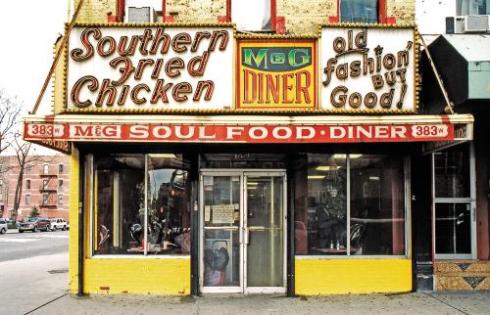
M&G Diner: Circa 1974

M&G Diner
R.I.P

If it weren’t for the small poster tacked onto the entrance to the 125th St. subway station announcing an upcoming rally for “Reparations: It’s Time They Pay,” I would have thought I had just stepped onto the set of a 1970’s blaxploitation movie. There was the West African Hair Groomers just a few doors down from Showman’s Café, est. 1942 and on the corner of 125th and Morningside, the big neon “soul food” sign at the M&G Diner. Gerry and Eugene were waiting outside when I arrived. Eugene had arrived first and was marveling at the contrasts found on 125th street where in one store an NBA jacket sold for almost $800 while in another pants were selling for $1 each.

Peering into the spectacularly unadorned diner, I noticed only a few tables; this Harlem legend which I had never experienced was much smaller than I had thought. I suggested we take one of the tables before they disappeared. Rick had already bowed out of this trip due to an attack of either too much drink the night before, some tainted food, or the combination of both. That made five of us—the capacity for one of the tables at the M &G.

“What they do!…they smile in your face…”

“Back Stabbers,” by the O ‘Jays was playing when we entered. We were off to an excellent start.

It had been almost two months since our last venture and judging by Zio’s trim appearance a few minutes later, the layoff had been very good for his waistline. But we were now in a self proclaimed soul food restaurant and we couldn’t worry about our waistlines.  While we waited for Charlie, we perused the succinct menu: fried chicken (leg or breast), short ribs of beef, meat loaf, shell steak, chopped steak, chitterlings, smothered pork chops, ham hocks, fish and grits. With each dinner you were to choose two sides including soul food standards like lima beans, green beans, macaroni and cheese, collard greens, black eyed peas, and yams. Even though the options were not foreign to us, deciding what to order, as it always does, requires deep clear thinking. While looking at the menu, Eugene mentioned jokingly about ordering eggs and despite the music playing loudly from the jukebox, the lone woman behind the counter heard him and barked: “No breakfast served now!” The hand-written signs on the walls announced that the M&G was open 24 hours and that breakfast was served daily but only between 12:00 am until 1:00 pm. You obviously don’t joke about defying the one written rule of the M&G Diner.

We had given Charlie a half hour grace period and he still hadn’t arrived; it was time to begin the ordering process. The woman came from behind the counter equipped with pad in hand. She was running the show; handling all the tables, the counter service and the outgoing orders with brisk, yet good natured efficiency. Now she had moved to our table; she wanted decisive answers—waffling would not be tolerated. After each of us recited our dinner orders, she barked out “Sides?” We were ready for her with our responses and then: “Dinner roll or corn muffin?” Despite her formidable presence and our novice status at the M&G, we handled the drill reasonably well. Zio and Eugene went for the fried chicken, Gerry the smothered pork chops.

“Short ribs,” I said to her when it was my turn to order, but then the pressure got to me and my response of macaroni and cheese and collard greens came out with a slight stammer. I could tell she sensed weakness in me so, in response to the bread query, I rallied with a strong, definitive “corn muffin.”

Charlie walked in soon after we ordered with the lame excuse of being stuck in the office as an alibi for his tardiness. There was no way we were going to risk the wrath of the M&G Queen by summoning her to our table again, so we sent Charlie to the counter to put in his own order.


With nothing to munch on and the beverage choices being soda or overly sweet lemonade, all we could do while waiting for our food was listen to the Main Ingredient remind us that “Everybody Plays the Fool.” And then the M&G Queen arrived with our orders, carrying a few plates at a time without, as far as I could tell, even breaking a sweat.

The chicken had been proclaimed in our research as a highlight, and judging from what I saw and sampled, that assessment was accurate; tender and lightly pan-fried the way fried chicken was meant to be prepared as opposed to deep fried in a heavy batter. My short ribs were perfectly cooked, the meat separating cleanly from the fat and bones; the brown sauce, however, a bit thick and bland for my taste. The corn muffins were warm and not overly sweet and Gerry’s pork chops, tender and seasoned perfectly.

Despite the gargantuan portions, almost all of us were willing to sample the cakes and pies for dessert. I was the lone dissenter instead choosing an extra fork in which to pick at all the others. I tried a bit of Zio’s coconut cake, a bit more of Gerry’s sweet potato pie and almost all of Charlie’s chocolate cake and immediately regretted my decision in not ordering a slice of cake for myself. So impressed were we by the desserts, we asked if they were made at the diner. The M&G Queen said no and held out for a minute in revealing where they were from. Without too much coaxing, she gave in and, finally, offering us a smile as well, said they came from the H&H Bakery in Brooklyn as if that meant anything to any of us.

Our tab came in well under the $20 limit and as we were leaving, I heard O.V. Wright on the jukebox moaning something about “A Nickel and a Nail.”  We went our separate ways at 125th St, and as I walked toward the subway,  I noticed that the velvet rope was already out in front of Showman’s Café.
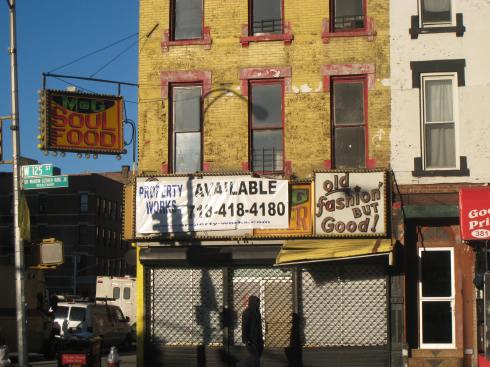


The M&G closed in 2008. A new condo tower had been proposed to be built on the corner where it was located. That project fell through; a casualty of the recession, but the damage was done. M&G was gone and I guess it gave an already struggling business an early out. It’s not easy for something “old fashion’ But Good” to compete with “DD,” “BK,’ “MickeyDs” and the other fast food joints that are now, unfortunately a permanent part of the 125th Street landscape.

Literary Tacos

30 Nov

We visited El Paso Taqueria, which is chronicled below, in the summer of 2003. It was the first Mexican restaurant we had been to since forming our group. I remember being very surprised as well as upset that soon after Charlie circulated his choice with the other members, the New Yorker magazine came out with one of their restaurant blurbs on, coincidentally, El Paso Taqueria.

El Paso Taqueria
1643 Lexington Ave
East Harlem

Charlie didn’t know that the New Yorker magazine would scoop him on El Paso Taqueria. If he did, he surely would have looked elsewhere to take the group. Once a restaurant is written up by the New Yorker, the kiss of death has been delivered at least for our purposes. A cheap “ethnic” restaurant mentioned by the New Yorker pretty much guarantees that there will be a major change in both clientele and attitude at the restaurant and that was, apparently, the case the night we visited. As a result, our sense of adventure was immediately deflated. But there are other problems: the influx of bluebloods from the neighborhood a few blocks to the south called “Carnegie Hill”, and their incessant questions about what’s on the menu, what to order, how spicy is it, etc., can also breed resentment on a suddenly overworked staff; and  resentment can lead to petulance and impatience. Unfortunately, at El Paso Taqueria, that scenario was playing out for us.


Our listless waitress asked if we wanted guacamole to start, as if we had a choice. Guacamole? Now if she asked us if we wanted the “corn fungus,” that was described in the New Yorker or a “flor de calabaza” quesadilla we would have been seriously impressed. Instead, we got guacamole which turned out to be her final suggestion for us. We were on our own, but maybe, in this case, that was okay. Zio wasted no time and actually restrained himself here and only ordered a mere six varieties of tacos, including tripe and tongue. The mention of tongue prompted Eugene, as if he had rehearsed it, to repeatedly state that he only had one preference for “tongue.” His sniggering comment got a minimal chuckle the first time we heard it, but he persisted with his sad routine until it soon became background noise. I delved in with an order of sopes; a thick tortilla covered with various meats and topped with soft cheese. Of the “platos tipicos” or typical plates, we all were interested in the mole poblano, and the “famous puebla stew.” Could we go wrong if it was so famous? Charlie suggested the “adobo de puerco,” spare ribs in a hot and spicy sauce, and Gerry opted for the exotic “cecina asada” salted beef with cactus jalapenos and onion. Was it enough, we asked the waitress? She shrugged.

It was enough. Everything came at once making the table look like one giant open-faced taco. Most of the dishes, certainly the tacos and sopes looked alike, with the meat simmered in a tomato and pepper sauce and sprinkled with cotija cheese. Only by sampling the meats, could you tell the difference between the tongue and the salted beef or the tripe and the spicy pork. The mole poblano was dark and rich with chocolate while Gerry’s salted beef was extremely high on the spice meter. Charlie’s spare ribs were an interesting variation, but at least from this experience, ribs are not what they do best in Mexico. The stew, with chicken, tomatillos, peppers, and potatoes, was hearty and comforting, but we still wondered what made it famous. Dessert was strawberries in whip cream or bananas in whip cream. We tried both. And, though nothing very exciting, they were a refreshing end to the meal.


From the New Yorker blurb, we learned that El Paso Taqueria began as a lunch truck feeding the Mexican immigrants that were new to the neighborhood of East Harlem, offering a quick, inexpensive and authentic taco or two before getting back to work. The lunch truck became so popular it sprouted the restaurant on 104th and Lexington where we were and a new one on 97th between Madison and Park. But after eating in the restaurant, I think the lunch truck, where you can savor one, two, or maybe three or four tacos at a time, is probably the best and most authentic way to enjoy the food and flavors of El Paso Taqueria. And you don’t even have to order the guacamole.

Looking back on what I wrote, I see how I let being scooped by the New Yorker cloud my summary of our El Paso Taqueria experience. I was hard on the restaurant though it was no fault of theirs. All I could do was complain that the guacamole was pushed on us and that the tacos looked alike. I’ve since reformed my ways and even have an El Paso Taqueria take out menu in my possession which my family uses as our first option when it comes to having Mexican delivered to our home.

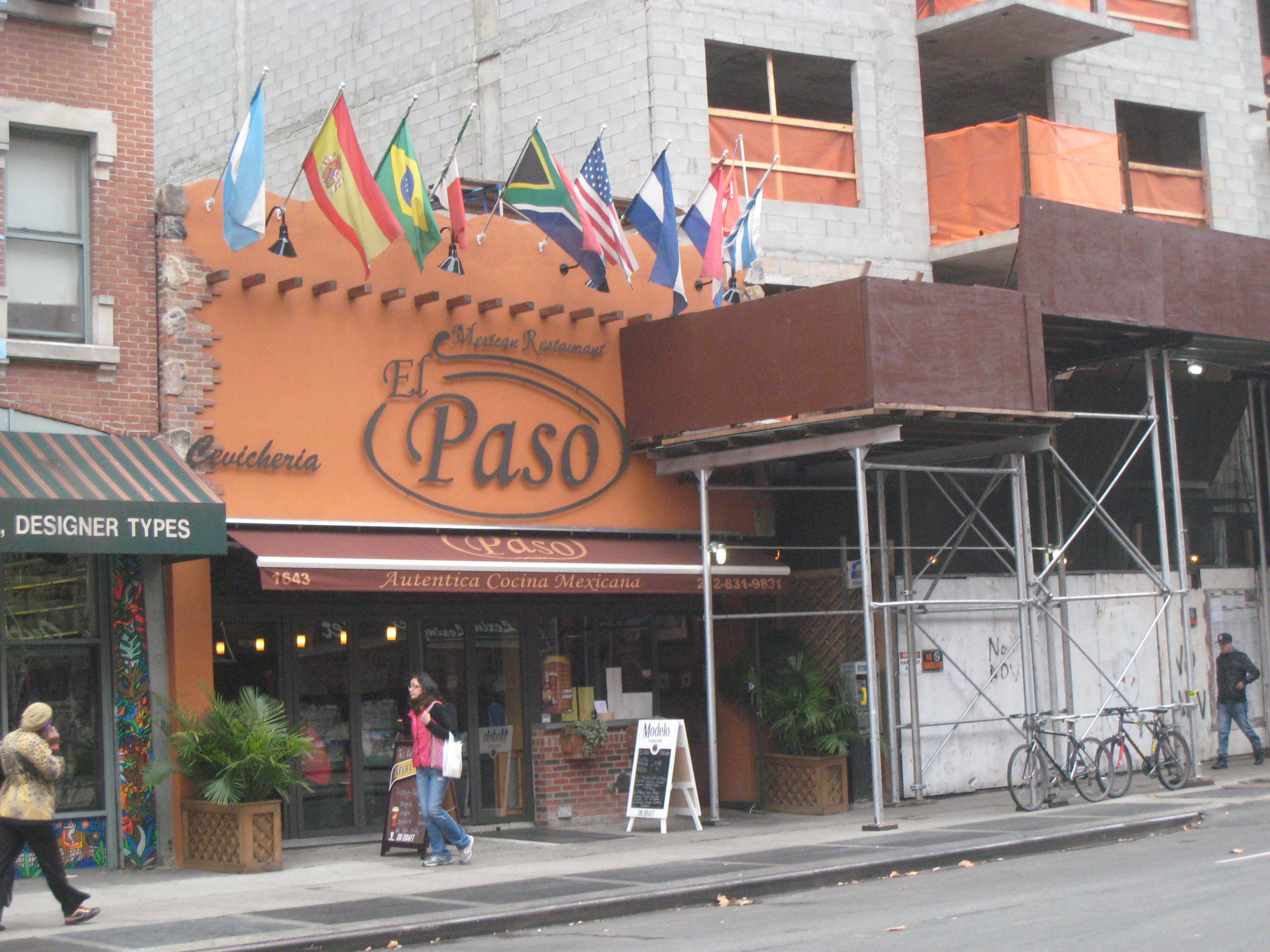
The newest El Paso Taqueria complete with cevicheria and scaffolding.

Like the growing Mexican population in East Harlem—they now are the largest immigrant group in that community surpassing Puerto Ricans and Dominicans—El Paso Taqueria has grown as well. There are now three El Paso Taqueria outlets, including one on 116th Street and another across the street from the original that advertises a “cocktail list” and a “cevicheria.” For the record, there was no ceviche or cockails on the menu when we visited. The original location where we dined has been turned into a take-out taqueria (see photo above).  They also have a colorful website www.elpasotaqueria.com and a new, flashy lunch truck proving that, along with a pretty good taco, there’s nothing like what a little publicity from a renowned literary magazine will do for business.

Cool Jerk

2 Nov

I had been to Jamaica many times for both business and for vacations and was very familiar with the food. I knew it would be hard to replicate my island experiences, but I was curious to see how this one compared when we visited in December of 2002.

Toyamadel
(Now Known As The Food Hut)
1709 Amsterdam Avenue
Hamilton Heights

The place formerly known as Toyamadel

The wind was howling down the northern fringes of Amsterdam Avenue on a frigid early December night. I was waiting for a transfer to the M101 bus from 135th Street to take me ten blocks up to my destination: Toyamadel, the Jamaican eatery I chose for our stouthearted group of diners. But on this night, the stouthearted were diminished in numbers. Charlie took an early exit by having a tennis match (indoors we hope) scheduled on the evening of our meet while Gerry, due to a family commitment was also absent. So when that 101 finally and thankfully arrived and shuttled me the ten blocks north to Toyamadel, only poor Eugene was waiting, cell phone in hand thinking he would be left deserted on that desolate night in the brightly-lit restaurant dining room surrounded by root tonics and coco bread.

Soon Zio appeared, layered in his favorite arctic gear, and then Rick, more urbane in his noir-New York threads. Whatever your attire, you had to keep the coats on here—the heat from the restaurant’s radiator was feeble at best. Toyamadel was not like our other experiences. With a miniscule dining area, the restaurant was mostly take-out. We didn’t waste time making small talk before ordering from the somewhat beleaguered woman behind the sturdy plexiglass shield.

By 7:30 the menu had been remarkably paired down. Many of the desired items typical of Jamaican cuisine had a blue star next to them. This blue star, we were told, signified they were out of that item. The curry goat was gone. The ital vegetable stew was history. The brown stewed chicken, a memory. The red and the blue snapper: finis.  And to Zio’s dismay, they were even out of the stewed cow foot. But that did not mean we didn’t have anything to choose from. There were still both vegetable and chicken patties available and we tried two of each. The jerk chicken was without a blue star so Eugene and Phil quickly ordered it. I went for the stewed codfish, an item from the breakfast menu that had remarkably survived until dinner while Rick decided on the oxtails. The next major decision was the size of our dinner. Behind the shield and near the menu there were displays of the $6, $8, or $10 portions. The empty $10 portion plate just didn’t look like much up there on the display, so, without really any hesitation, we went for the biggest portion.


The drink menu, though non-alcoholic, was extensive. None of us were courageous enough to sample any of the pricey herbal tonics on the menu such as “Doctor Bird Bitters,” “Sun Dial Wood Root,” “Groundation Root,” “Root Force,”  “Rage Roots,” “SSS Tonic,” and “Irish Moss” that promised, among other things, to help get “Johnny” in the words of Bob Marley, to “get up, and stand up.” The prospect that presented was, considering our motley group, just too frightening to even consider, so we stuck to more familiar fare; lemonade, ginger beer and the Caribbean Christmas specialty, Sorrel, which Eugene sampled and immediately approved of. Months after the sweet bean dessert experience at the Filipino restaurant in Queens, Eugene, it seems, was still having difficulties coming to terms with the fact that what was supposed to be a sweet fruit dessert had cannellini beans in it. Something about those beans had, evidently, struck a primal chord in his subconscious memory. But Eugene’s subconscious was an area we really did not want to explore.

The patties were slipped to us in a brown paper bag under the plastic shield. Topped with Pickapeppa sauce, both the chicken and vegetable varieties were quickly devoured. The $10 dinners came next; the tins in which they were served weighed down with meat, rice and peas, plantains and salad. My stewed codfish was tender and not overly salty. But the combination of rice and peas, yams and plantains—a serious starch overload—was doing me in.

Being the jerk aficionado I am, I had to sample Zio’s chicken. With the possible exception of what I’ve prepared on a Weber grill, back in the days when I had a Weber grill, I’ve not had jerk chicken replicated anywhere near what you can get in Jamaica. Toyamadel, I’m afraid, was no exception. The chicken was tender and the sauce flavorful, though not too fiery. But it just didn’t have that smoky, earthy flavor you get when ordering from an open air jerk stand on the island.

As usual, we over-ordered, the $8 plates would have been more than enough. But that didn’t stop Zio and I from consuming slices of a freshly made carrot cake. By the time we paid, $14 per person, well under our allotted $20, there were even more blue stars next to items. But the customers kept coming. And the door kept opening and closing with freezing regularity.

Toyamadel closed soon after we visited and reopened as “The Food Hut.”  I returned recently and noted that the menu was exactly the same as I remembered nor were any alterations made to the bare bones interior. Even the prices had remarkably held with plates ranging from $6 to $10 dollars.  I tried a veggie and beef patty; ordering at the steam table and then paying and receiving my order under the plexiglass shield just as I had eight years earlier.  Grateful that some things just don’t change, I found a seat at one of the tiny restaurant’s tables and ate the patties.


Life Before the GPS

1 Oct

Back in 2002, none of our group had GPS navigational systems yet.  And I’m not even sure if they were around at that time.  For those who drove, getting to our third destination, an African restaurant in the now bustling, and renamed by real estate prospectors “Gold Coast” of Harlem, was comical.  What follows is my depiction of that experience in the spring of 2002.

Leworo Dou Gou
(R.I.P.)

When I arrived at Leworo Dou Gou restaurant, after getting off the B train at 116th Street and walking two blocks up “8th” Avenue to 118th street, I was relieved to see Charlie already at a table and waiting. In fact, he was the only one waiting in the restaurant. Our dinner was scheduled for 7:30. Charlie and I waited, inhaling the pronounced aroma of a fish market mixed in with other strong, yet unfamiliar smells. The aroma, coupled with the fuzzy reception of “Wheel of Fortune” on the restaurant’s television, was beginning to make me feel a bit dubious about this outing, our third of 2002. I glanced at the menu and was relieved to see that none of the “Natural African Dish From the Motherland” were priced above $7. At Leworo Dou Gou we would be very hard pressed to surpass the $20 limit we imposed on ourselves when beginning this venture.

The Motherland encompasses a very vast mother of a land, but Leworo Dou Gou claimed to represent the Ivory Coast portion of that continent. Charlie and I were still waiting when my cell phone rang. Zio was close by, searching for Eighth Avenue. I told him to look for Frederick Douglass Boulevard, which on maps and in the phone book goes by the name of Eighth Avenue. A few minutes later, he walked in. So now there were three of us. The smells, which were beginning to test my stomach, immediately enticed Zio.  But Zio would salivate at the smell of burnt toast. While we waited for the remaining three in our party, we studied the menu wondering what “dry okra sauce,” “cassava leaf,” and “LaFide” might be. There was also something called “agouti.” The name was familiar and I recalled that I actually tasted agouti on the island of Grenada in the Caribbean. It was in the rodent family and I remember it being very tough and gamey. That not so complimentary description only reinforced Zio’s determination to taste the rat.

The three of us continued to wait, we were beginning to worry. The phone rang in the restaurant and a woman behind the take out counter of the restaurant answered. I could hear her struggling, in her English with strong French inflections, to give directions. One of our own was lost. A few minutes later, Rick pulled up. He had been searching for Eighth Avenue. A big mistake, as we were beginning to find out, since there were no street signs proclaiming the street we were on as being Eighth Avenue. After a few more minutes the phone rang again. Again the same woman was attempting to give directions. She gave up and handed the phone to a man who was sitting behind us, the owner, we later learned. He spoke perfect English and explained, on the phone to whomever he was talking to, that Frederick Douglass Boulevard was Eighth Avenue. He had been, it turned out, talking to Gerry and a few minutes later both he and Eugene walked in.

By now, either the smells had mellowed or I was too hungry to notice or care anymore. We all were ready to eat, but we had no clue what to order. We did learn that there was no more grilled fish, and to Zio’s disappointment, no agouti. Rick made the wise choice, he told the waitress to bring six dishes, a combination of some of the different items on the menu. While our food was being prepared we all had homemade ginger beer, tangy with a sharp hint of lime along with the zesty ginger. To entertain us while we drank and ate, the owner switched from the fuzzy network television, to a video of “soukous” music from West Africa, some of which, he claimed he personally photographed while at a concert back in the “motherland.” The music was infectious and the video production, gritty especially the scenes with the dancing midget. Or was he a dwarf?

Our food came, one heaping plate at a time. Fried whole fish (croaker) with plantain. Fried whole fish with cassava and yams. Stewed “hard” chicken, grilled chicken and beef on a stick, stewed fish in okra sauce, and an aspic-type wedge of what seemed to be pounded banana, which, by itself was bland, but worked with the sauce from either the stew chicken or fish. We were given forks and knives, but noticed that one of the restaurant’s customers expertly ate his meal without either. Even with forks and knives, our hands got greasy and we made what probably was the unusual request at Leworo Dou Gou for napkins. What we got were sections of paper towels.

The six of us soon devoured the food leaving only fish bones and cleanly picked pieces of chicken. Everything else had been eaten with Zio and Gerry even sucking up the last of okra sauce with the remaining few kernels of rice. There was no mention of dessert on the menu and the owner wasn’t offering anything but coffee, so we ended it there. All that for only $12 dollars per person left us wondering how Leworo Dou Gou could stay in business.

Leworo Dou Gou did not stay in business for long. Within a few months of our visit it was gone.  But that’s not uncommon among the African restaurants around the area of West 116th Street known as “Little Senegal.” They come and go with great frequency.  Though as the neighborhood changes and rents increase, I wonder how long the African influence in the area will remain. In 2002 there were vacant lots and tenements surroiunding Leworo Dou Gou. Now, across the street from where Leworo Dou Gou was there is a market price condo with a Chase bank, Starbucks, and a gourmet supermarket. A few blocks up an Aloft Hotel ( a divison of  W Hotels) will soon open while new restaurants are so prevelant on Frederick Douglass Blvd that some are saying the street will become Harlem’s “Restaurant Row.” But will they qualify for our $20 and under crowd?

The storefront that was once Leworo Gou Dou