Tag Archives: culture

And the Answer is…

19 Nov

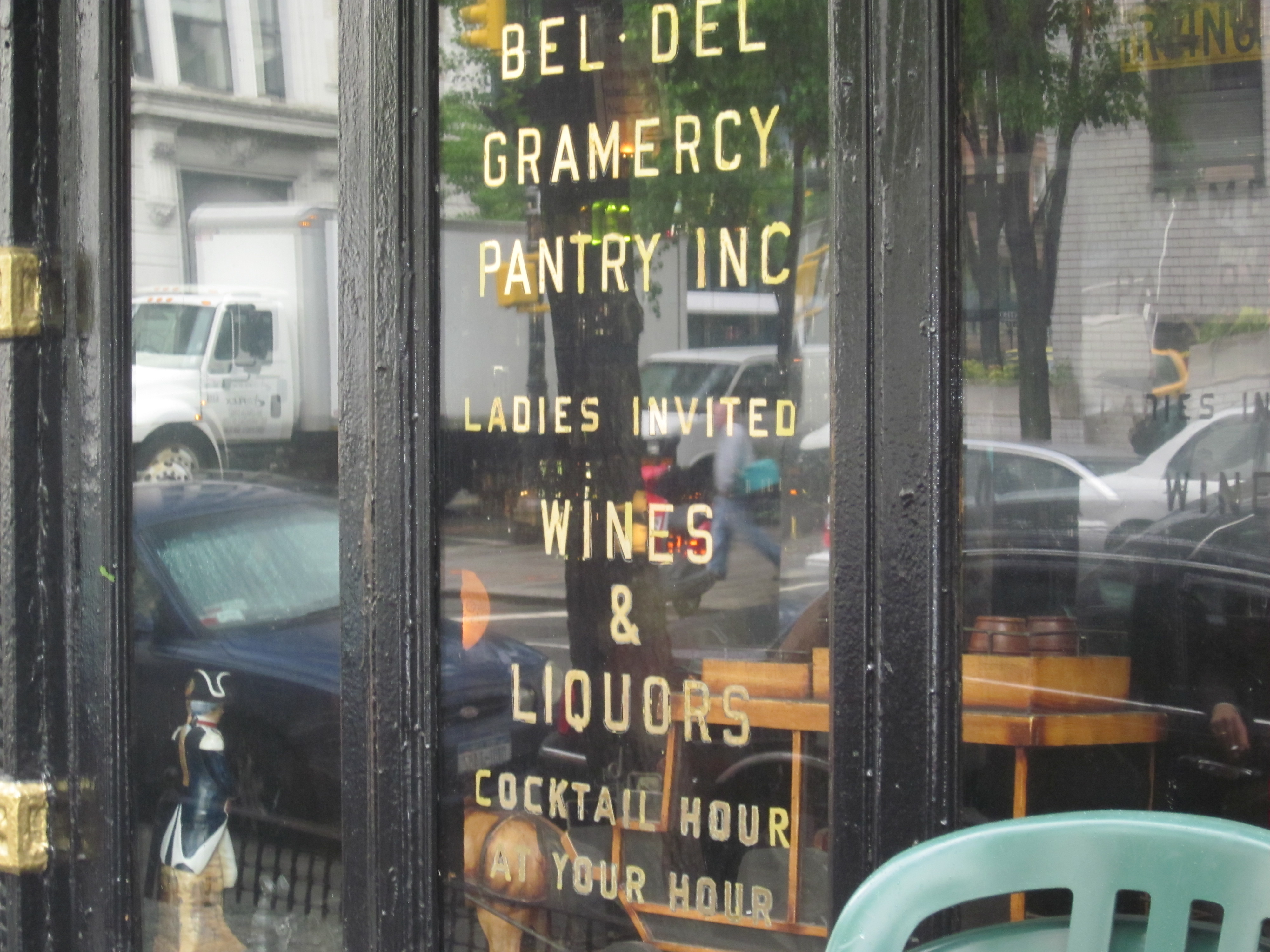
On Friday I posted the photo below and challenged you to Name That Place.

I thought it was a “gift” to all of you, it would be that easy to identify. But maybe we all aren’t up on our city history as we should be. No one was able to identify the place in question. No one knew that the “gift” had to do with the history of the place.

There just aren’t that many saloons in this town anymore where a starving writer can create in a “nurturing atmosphere.”

It seems Ludwig Bemelman did a lot of writing in saloons. He has a bar named after him about sixty blocks north in the Carlyle Hotel, while  back on 18th Street, O’ Henry got his own “Way.”


Name That Place

16 Nov

After a difficult couple of weeks here in New York, I thought another entry of that  semi-regular game, Name That Place, played here on Fried Neck Bones…and Some Home Fries might lighten the mood.

The photo below should immediately set off whatever bells, whistles or sparks within the cognitive memories of all you dedicated, cocktail-loving gentleman, and ladies too, who call New York home.

This one is so easy, I would be insulting you if I added another photo or offered more hints. Take it as a post-Hurricane, pre-Thanksgiving gift to all my followers. I am always grateful for your support.

As always, reply with your answers in the comments section here. The name of the place will be revealed on Monday.

A Pair of Pepper Sauces

12 Nov

I heard tell there was a big wind coming our way. A super storm they were calling it. The terrace had to be cleared of potentially dangerous projectiles. The few herbs that remained were not a threat, but the never ending procession of hot peppers that were still going strong in late October had to be “terminated with extreme prejudice.”

In May I planted two types of hot peppers I bought in the Arthur Avenue Retail market in the Bronx including one I’ve grown before called “Portugal Hots,” a long thin pepper similar to the cayenne. The other was labeled an “Italian chili pepper.” I wasn’t sure what an “Italian chili pepper” was but hoped that it was similar to what was sold in the same retail market in the fall; bunches of slender, one-inch long red, fiery chilies still attached to their stalks. I was assured by the salesperson that it was.
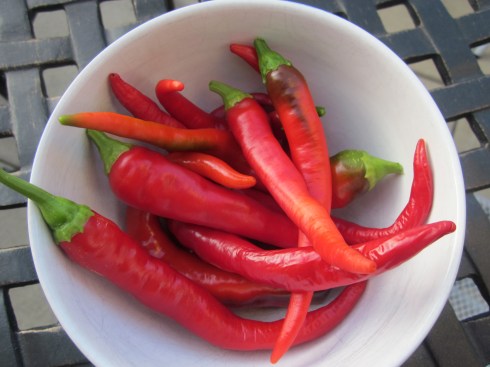
Portugal Hots

In the abnormally warm spring and hot summer, the plants grew fast and when the first fruits began to appear, I was surprised by what I saw on the so-called Italian chili pepper plant. The peppers were growing upright and looked something like jalapeno peppers. Once they were green and fully formed, they were definitely not the Italian red chili peppers I had hoped for.

I scoured the internet to find a match to what I was growing. What I discovered was that the peppers were called “Fresno” and, according to my research, similar to a jalapeno. I was disappointed. I didn’t want a jalapeno or anything “similar.” The plants were healthy and the numbers of peppers on them countless. When the first pepper turned red, I tried it. It had very little heat adding to my disappointment.

A few weeks later, as more turned red, I cut up another. This time I was blasted by heat. And as the summer wore on and the peppers matured further, their fire became explosive—much hotter than a jalapeno, Serrano, and spicier than the Portugal hots that were growing next to them. I had some serious hotties on my hand. If the Scoville scale that is my tongue was any indication, these Fresnos were just a notch behind the habanero in heat quotient.
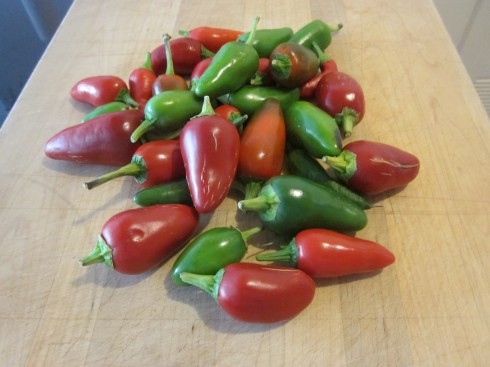
Fresno peppers

As both the Portugal hots and the Fresnos prospered throughout the summer and into early fall, I bagged bunches and put them in the freezer where they would last a year. Frozen, I use them in stews, sauces and anything else that required a blast of spice. I had more than enough already to last a year so I gave bags away to others who, like me, get masochistic enjoyment when the inside of their mouths are blistered.

Still, many peppers kept coming as summer faded and though some were still green, a super storm was on its way and I had no alternative but to harvest what remained.

As any self respecting citizen should, I have several bottles of hot pepper sauce in my refrigerator ranging from mild to hiccup-inducing hot.  Is there such a thing as having too much hot sauce? I didn’t think so. So inspired by a fellow bloggers at website caled Putney Farm who had a similar dilemma and turned that profusion of peppers into a homemade pepper sauce, I thought I would try it as well. But because I had two different types of peppers, I decided to make two different pepper sauces.

As I do with many recipes, I cull the internet and usually mix and match from a variety I like and try to come up with something my own.  The first, using the Portugal hots, was to be a “fermented” pepper sauce or one I would have steep in a brine for several days before actually pureeing into a sauce.

Since I just used what I had of peppers, the quantities of the ingredients I pretty much played by ear. For the fermented hot pepper sauce, I had enough of the Portugal hots, (green stems removed) to fill up a pint jar.
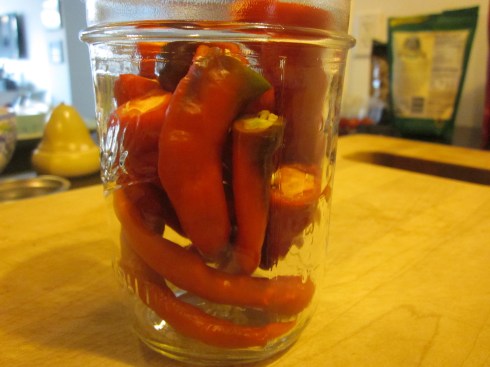
To the jar I added three peeled whole garlic cloves and two teaspoons of sea salt.

I then filled the jar with water and made sure the peppers and the garlic were submerged before tightening the lid of the jar.
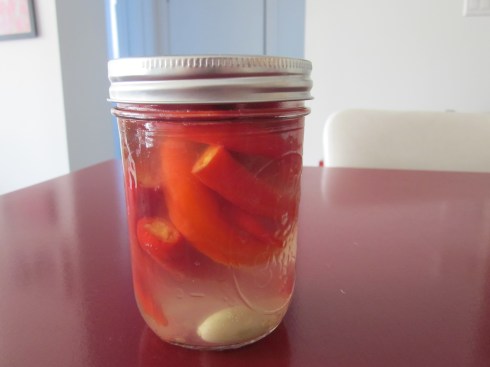
Once the jar was sealed, I placed it in the back of a dark cabinet and let it ferment for about 10 days. You can ferment, from what I gathered, for as little as a few days up to two weeks. I was in no rush.

After ten days, I opened the jar and drained off the water (now a brine), saving it to add back into the sauce. I put the garlic and the peppers into a blender and added back half of the brine along with an equal amount of white vinegar.  Depending on how you like your hot sauce; chunky or smooth, is how long you puree. I wanted mine closer to smooth than chunky so I pureed long enough to get that consistency.

After pureeing, I poured the hot sauce back into the pint jar, sealed it, and put it in the refrigerator. The sauce will last a year—or until you are ready to make another batch next year.
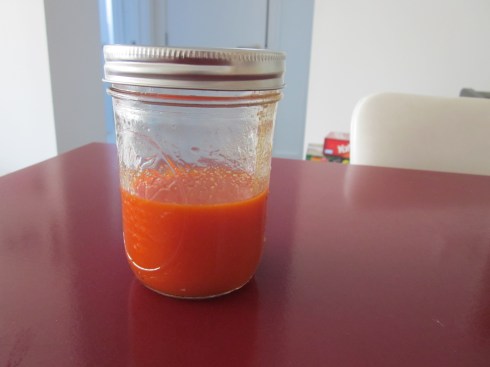
Portugal Hot pepper sauce pureed smooth.

The recipe for the Fresno hot sauce was pretty much identical to what my friends at Putney Farms laid out in their blog post Homemade Hot Sauce. In theirs, they used Serrano peppers. The Fresnos I grew, as I said, were hotter than Serranos, but I didn’t think that would necessitate a change in the recipe.

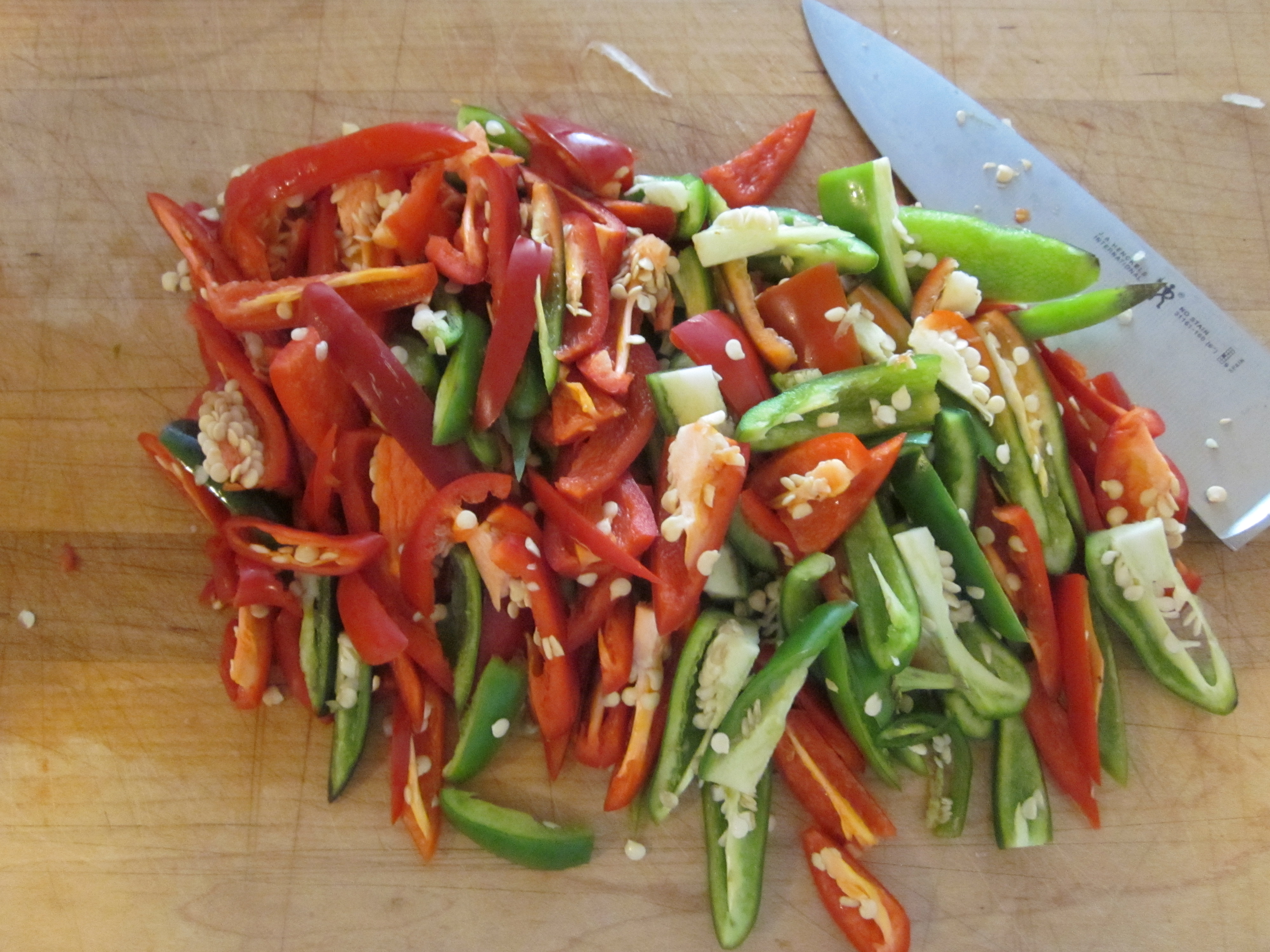
Their recipe called for 8 ounces of peppers. I had more and adjusted accordingly. Not using rubber gloves, I sliced all the Fresno peppers, but made sure I kept my hands away from my eyes, nose, and private parts until I could sufficiently wash them.
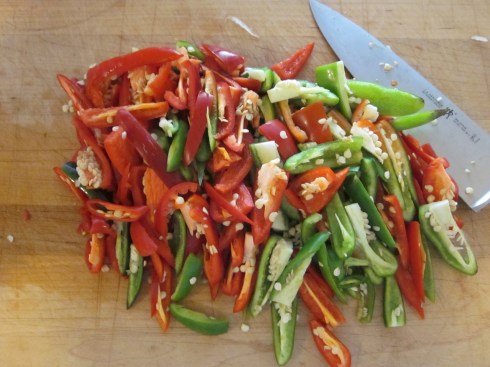
Along with the peppers I sliced one large white onion and minced two garlic cloves.

To a medium saucepan, I put a tablespoon of olive oil. And then, on medium heat, added the peppers, onions and garlic. The recipe at Putney Farms warns of the fiery vapors that will be unleashed from the sautéing of the peppers. It was in the forties outside, yet I opened the windows, turned on the ceiling fan, and commenced the sautéing. For extra protection I wore a surgical mask. After a few minutes, however, I removed it. The vapors were helping to clear congestion in my chest. Just another one of the magical benefits of the revered and cherished capsicum.

After sautéing for about five minutes, I added two cups of water and two tablespoons of brown Demerara sugar.  I cooked all for about twenty minutes or until most of the water was evaporated.
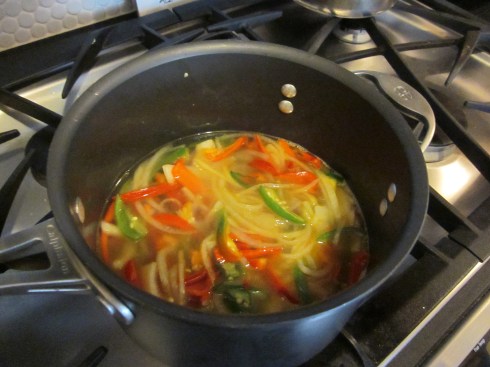
Once the mix of peppers, onions and garlic cooled to room temperature, I added a cup of cider vinegar and pureed in a blender.

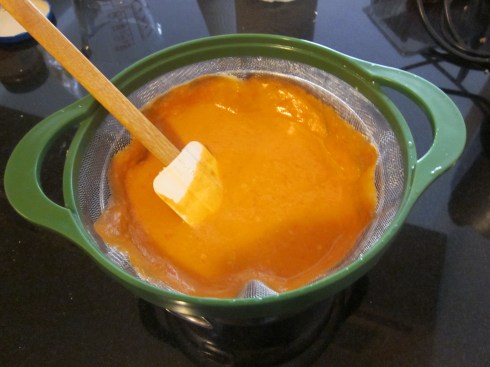
I poured the puree through a fine mesh sieve until only the thick skins and seeds still remained and what passed through was a smooth, creamy, pinkish mixture.
Now I had two hot sauces. I tried them both.

The Portugal hot fermented sauce had a mild pepper kick. The Portugal hots, I’ve found, can be inconsistent in terms of heat. Some are very hot while there might be a few that have barely a trace of fire. Knowing that, I still like them for their intensely sweet pepper flavor that when combined with the heat makes a unique taste. The sauce, however, though with a slight, vinegary tang, was overpowered by garlic. I would definitely limit the garlic if I decided to make the sauce again. Still, I looked forward to sprinkling a generous amount over roast chicken with yellow rice and beans.

Portual hots hot sauce

The Fresno pepper sauce on the other hand was everything I wanted. Just a few drops would suffice on any dish, it was that hot. There was also a sweetness from the inclusion of brown sugar and cider vinegar that added to the flavor. If anything, I would cut down on the sugar a bit next time.

Fresno hot sauce


Today’s Special

7 Nov


So good, it’s worth having twice.


Some Good News About Sandy

31 Oct

It’s been downgraded to a lechonera.

Time to remove the plywood and roast some pork.

I hope all my friends and followers are safe and moving forward post-hurricane.

Cantonese Favors on Allen Street

23 Oct

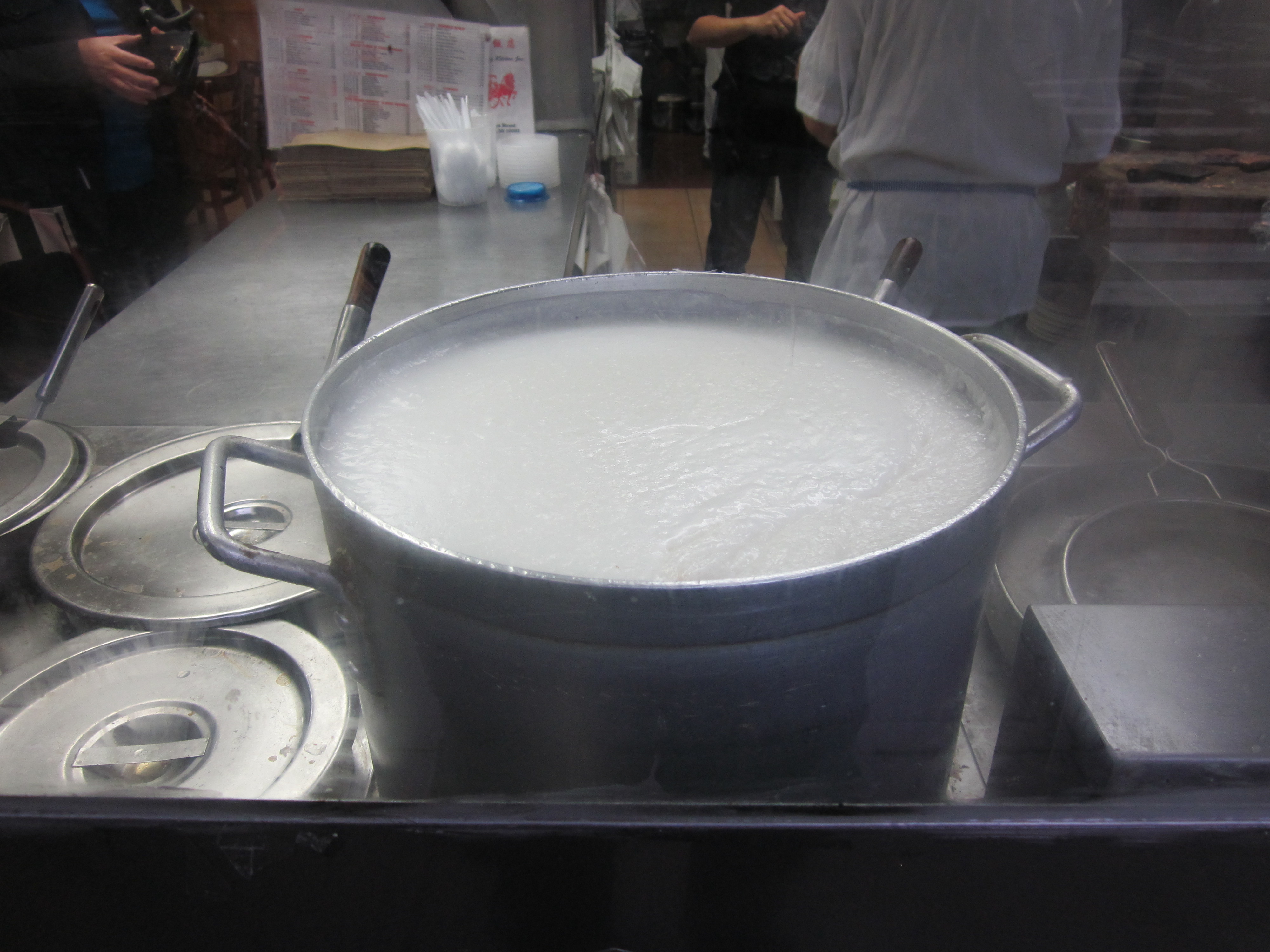
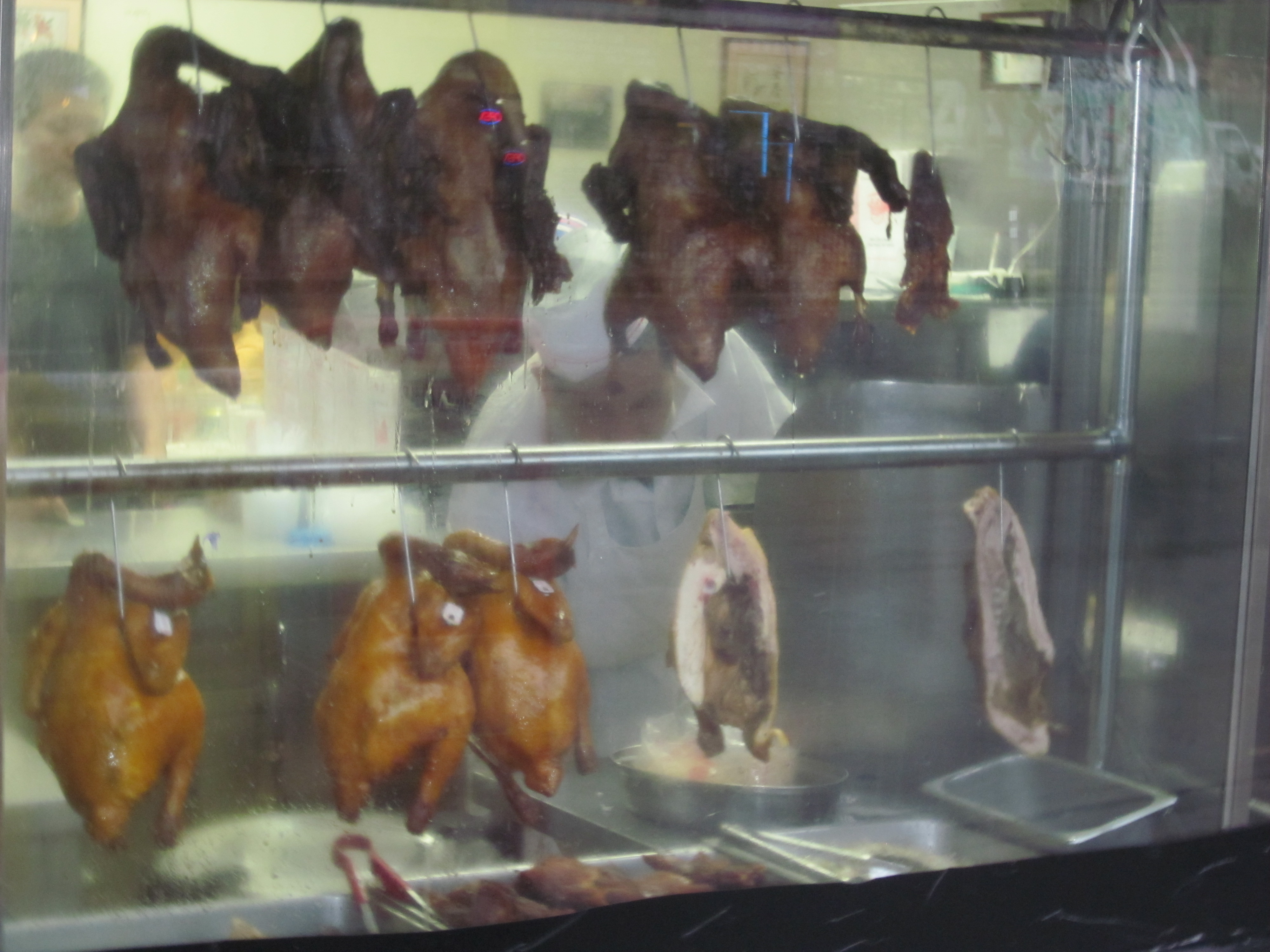
The man in the red nylon sweat suit smoking a cigarette saw me peering into Cheung Wong Kitchen as I waited for Zio to waddle over from a half block away. I could see a bubbling cauldron of congee through one window while in the other hung roast ducks and chickens.

Congee on the fire.

“This place is the best,” the man said to me as Zio joined me. “For five bucks, you’ll eat like a king.”

There were only a few tables inside the small, somewhat dingy restaurant and most were occupied. One big round table was empty except for a carton of green beans that were about to be trimmed for cooking. It was starting to rain. There were other places we could go that had more space and maybe better, more comfortable accommodations.
I looked at Zio. He was thinking the same thing I was. We were on Allen Street in Chinatown, a few blocks east of Canal; comfort and space just were not the point.

“Let’s go in,” he said resolutely.

Cheung Wong’s window display.

The lone waitress placed two settings on the round table where she was also trimming the green beans. We glanced at the menu. There were traditional Cantonese items on one side of the menu; chicken with black bean sauce, roast pork lo mein, sweet and sour shrimp, etc—most priced more than five dollars.

The other side of the menu, however, were the “discounted” items—the dishes for royalty, which in this case included Zio and I. There was congee, noodle soups, Hong Kong style lo mein, and a two page spread of “rice plates.”

I zeroed in quickly on the rice plates and was intrigued by something called “double favor” on rice. I’m very used to misspellings on menus and never hold that against a restaurant. I see no correlation between a few spelling mistakes and good food. I assumed here that “favor” was meant to mean “flavor.”  Still, when the waitress came over to take our order I had to ask.

“Double favor is chicken and duck, or pork and beef,” she said, in, frankly, very good English.

I understood her answer to mean that it was a choice of two meats on rice. So I had to make a decision. The soy sauce chicken that I saw hanging in the window looked tempting. I paired it with what is usually an old reliable at a Cantonese place: roast pork.

Zio bypassed the meat and decided on fish stew with curry sauce on the rice.

I suggested to Zio that we should try something else on the menu. The additional item would increase our budget to around $7 as opposed to $5, but I didn’t think Zio would care as long as it involved more food for him.

And as I suspected, he endorsed my suggestion of beef stew with wonton noodle soup. But there was a stipulation.

“Shouldn’t we just spring and get one each. It’s only $5.50.” he whined, thinking I was being even cheaper with my money than I normally am and worrying that maybe it wouldn’t be enough for our collective king-sized appetites.

I told him to look around at some of the bowls others in the restaurant were slurping from.

“Yeah, you’re right,” he said. “One should be enough.”

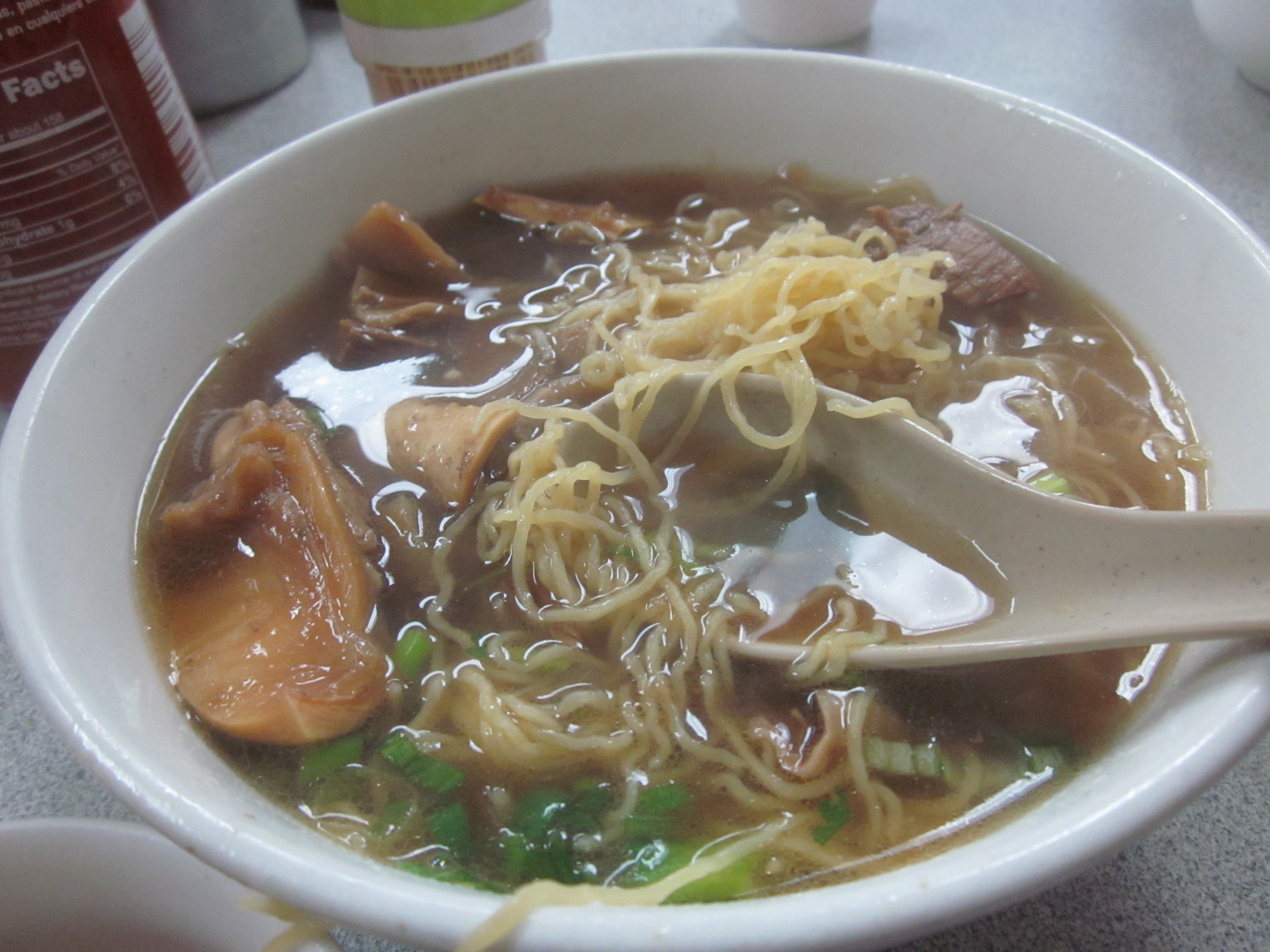
Beef stew noodle soup

And it was more than enough. The big bowl was brimming with fat encased beef in a rich meaty broth, thick with noodles and small tender pieces of winter melon.

While we ate the soup, the waitress took a few more minutes at our table to continue trimming the beans and then left, returning quickly, even before we could finish the soup, with our rice platters.

Double “favor” over rice: soy sauce chicken and roast pork.

The chicken and pork were chopped into slices and arranged neatly over the rice. Both were served at room temperature; the chicken incredibly moist and easily pulled from the bone and cartilage, while the pork tasted almost like jerky, but subtly sweet from the hoisin sauce.  This favor, or should I say flavor, was addictive.

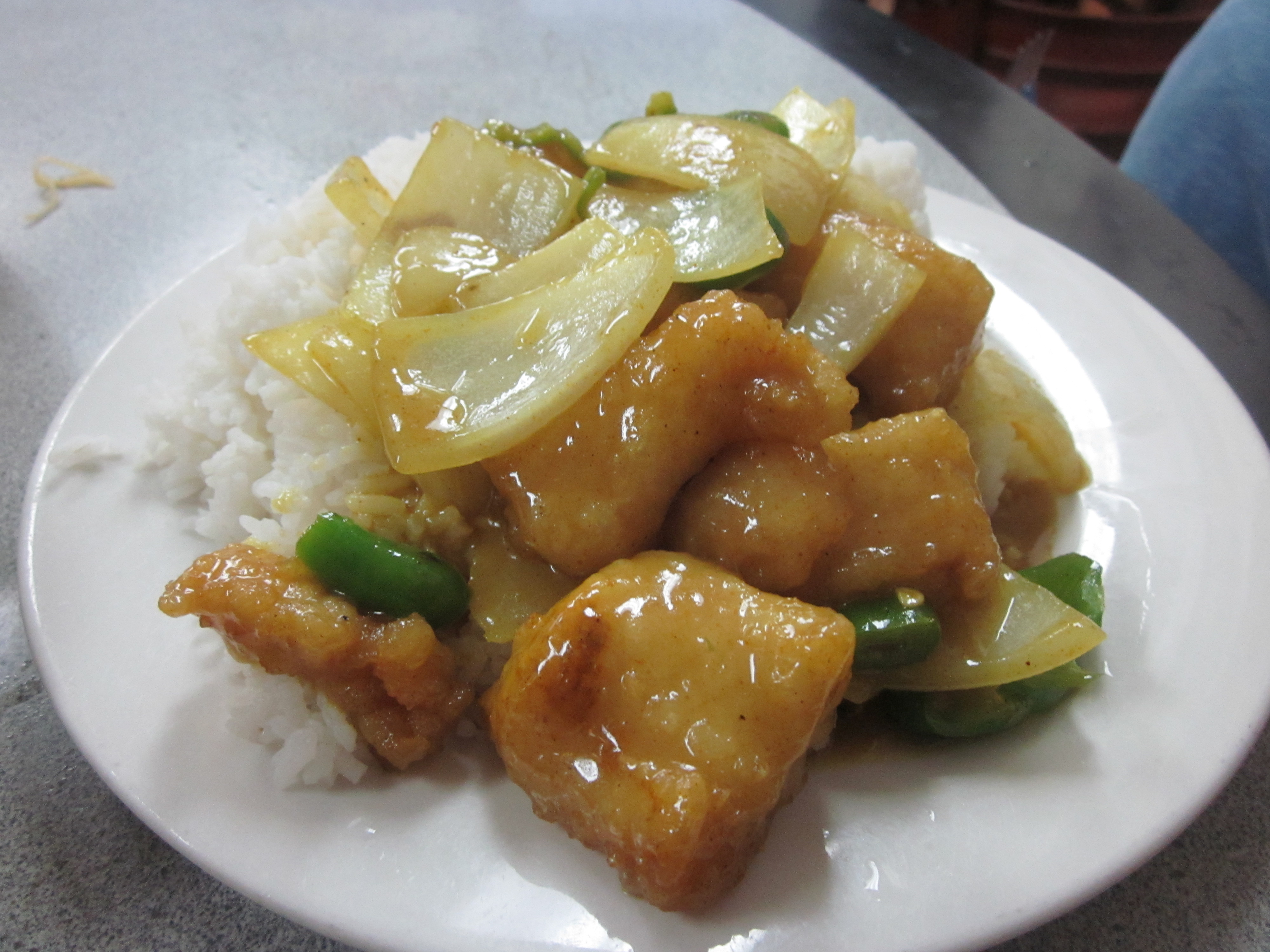
I worked through the mound of food in front of me methodically, matched only by Zio’s devotion to the chunks of white fish, fried and smothered in a yellow curry sauce.

Curry fish over rice.

Eventually it was all gone with the exception of a few spoonfuls of broth from the beef stew soup. Our check came. We ate $7 worth of food each.  If $5 was enough for a king, what did the additional two dollars make the two of us if not kings?  The man in the red nylon sweat suit was no longer outside to ask.

Cheung Wong Kitchen Inc
38A Allen Street
Chinatown

Baklava in the Bleachers

16 Oct

As I said in these pages about a month ago (New Year’s Penicillin), I’ve been spending a lot of time just off the 230th Street exit of the Major Deegan, sitting on crooked aluminum bleacher seats watching baseball on a small field. The field borders the Deegan and the hum of traffic is a constant.

The bleacher seats: no admission charge.

In between games or while waiting for the games to begin, I’ve become very familiar with the Kingsbridge neighborhood that surrounds the field.  A café con leche at Malecon Restaurant has become a weekly treat and as I reported here, I “discovered” a 50 year old Kosher deli named Loeser’s where the penicillin includes chicken broth, noodles, or maybe a matzoh ball.

More recently, as I waited for the games to begin, I happened on another place. Just a few paces from the 50th police precinct and across the street from the Nice Guys Car Wash, I found a small, shed of a diner called Christos Gyro & Souvlaki.

The souvlaki of Christos.

Christos, I learned, has been at its tiny location on Kingsbridge Road the past eight years—at least that was what the owner, Christopher, a.k.a Christos, said to me as he also proudly handed me a laminated Daily News article about his restaurant where that newspaper rated his gyro the best in the city.

The weather was changing. An Indian summer day was quickly turning into a brisk autumn one. I’d have to take the Daily News’ word on the gyro. I wanted something else. I didn’t need New Year’s penicillin, but the close Greek equivalent would do very well.

“You want the avgolemono?” Christos asked.

“Yes I do,” was my definitive response.

“Anything else?”

“Moussaka,” I said, not caring that I might miss the beginning of the game.

“Very good choice.”

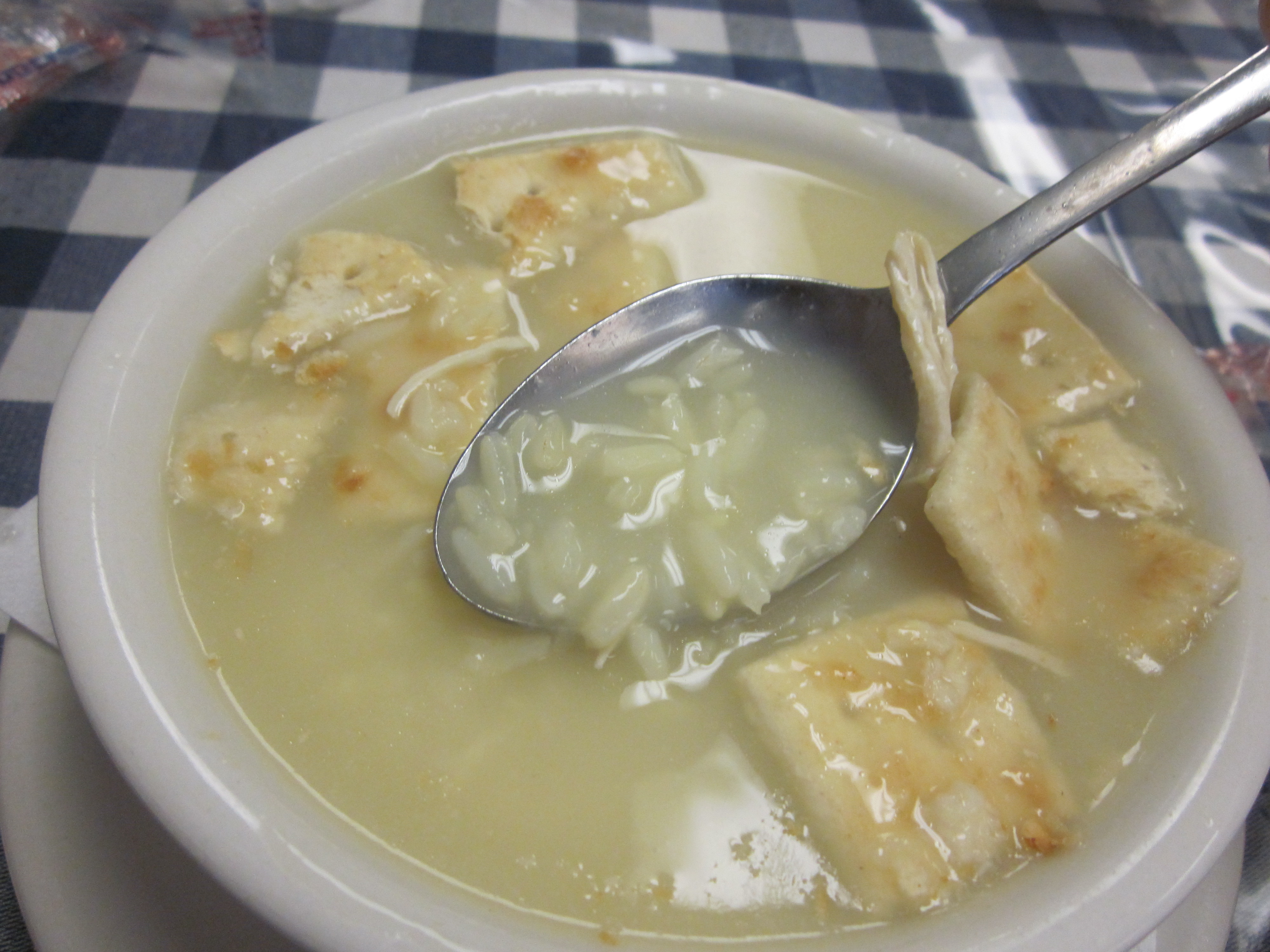
The bowl of the yellow-tinged, lemon chicken soup was steaming. Spherical dots of orzo floated within along with slivers of chicken. The distinct citrus snap of lemon meshed magically with the hearty, comforting chicken broth.

I crumbled a few saltines into the bowl and slurped. It wasn’t long before the bowl was empty.

Christos’ avgolemono

Moussaka awaited, paired with a simple Greek salad, pita bread and a generous bowl of tzatziki. I dipped the pita into the creamy, garlicky yogurt…and then I double dipped.

The half inch of béchamel sauce on top of the ground beef and eggplant was airy, the filling scented with cinnamon. I alternated between bites of the moussaka and dips of the tzatziki until all was gone.

Moussaka, Greek salad, tzatziki

Christos came to clear my table. “You did good,” he said.

“I know,” I answered, happy to have made him proud.

As I waited to pay, I noticed a tray of baklava and remembered reading in the Daily News piece that Christos’ wife made them fresh daily. I pointed to it. Christos’ son was working the cashier—Christo’s was most certainly a family affair. “To go?”  he asked.

I nodded and took the bagged baklava back to the ball field. I devoured it watching baseball on the bleacher seats while like a continuous loop, the music of the Major Deegan played on and on.

Music to eat baklava by.

Beer Therapy

12 Oct

Life presents many complex problems.

Beer is not one of them.

Olive Etiquette

5 Oct

Before I’m embarrassed…

…define civilized.


Neck Bones Anniversary Anchovy Sauce

3 Oct

Last year, around this time, on the first anniversary of the launch of Fried Neck Bones…and Some Home Fries, I celebrated with a batch of Neck Bones Tomato Sauce, the recipe I shared on these pages (Neck Bones Anniversary Tomato Sauce). I don’t really consider myself a man of tradition, but when it comes to food, and eating, maybe I am. So to follow tradition, on this, the second anniversary of Fried Neck Bones…and Some Home Fries, I have celebrated with another pasta sauce. This one is meatless, but to compensate any lack of flavor, doused heavily with that favorite little fish; the anchovy.

Speaking of traditions, the origin of my romance with the anchovy began with a Christmas Eve tradition. One of the seven fishes (Seven Fishes for Seven Dishes), prepared for that Italian feast in our family was the anchovy. My grandmother was the chef and when I was young, the featured pasta was spaghetti with anchovies.

But anchovy love doesn’t come easily or immediately. The sight, smell and taste of the little brown oily and spiny fillets could cause a child to retch. I wanted no part of it and I wasn’t alone. My brothers felt the same way and instead, on Christmas Eve, we had our spaghetti with just butter and Parmesan cheese.

Soon after experiencing puberty, our taste buds became more open minded and, though anchovies were still a tough sell, we graduated to the milder, white clam sauce. There was now a seafood alternative to coat the spaghetti with.

I can’t pinpoint the actual date when I converted, but it was sometime in early adulthood. Soon I was actually adding a few of those fillets into my white clam sauce. There was definitely something about that stinky fishy fish that was working magic in my mouth. Friends looked at me in horror when I began to, voluntarily, decorate my slices of pizza with the fillets. It wasn’t long before, given the choice on Christmas Eve, I would take the anchovy sauce before the white clam.

The romance was on and grows stronger with each year. There is no chance I eat spaghetti with anchovies just on Christmas Eve. It’s now a treat I prepare every couple of months—and a simple, inexpensive one at that.

I’m sure many of you might have a prejudice against the anchovy stemming from early encounters when, like me, your sense of taste just wasn’t ready for such an assault of flavor. Try to move past that prejudice and give the little fish another chance. And here, to lead you on to the path of anchovy righteousness is my recipe for Spaghetti with Anchovies.

Some of the ingredients for spaghetti with anchovies.

Ingredients

1 small bottle of anchovies in olive oil.*

½ cup of olive oil

4-5 good-sized cloves of garlic, chopped into large pieces**

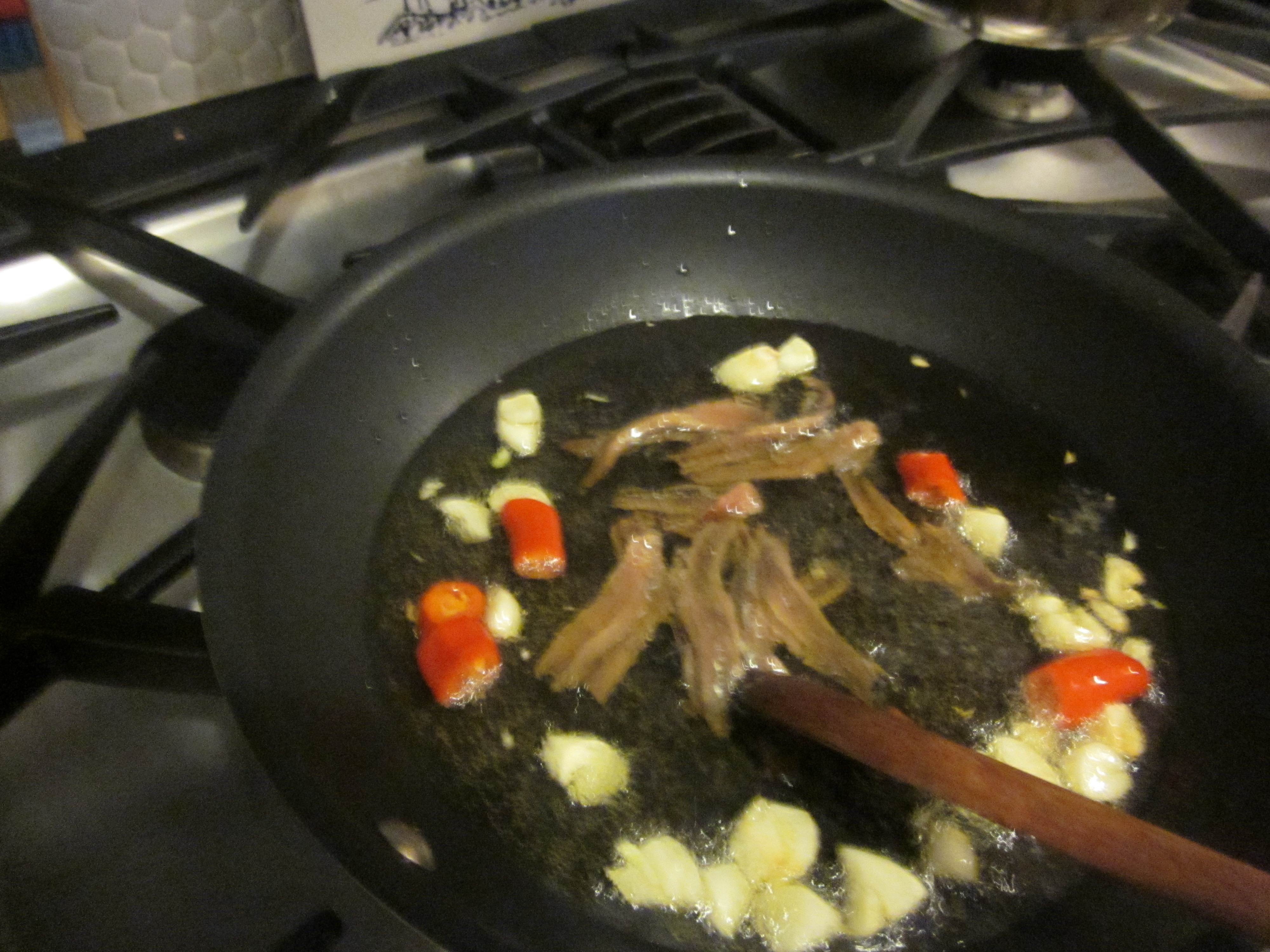
½ tsp of dried red pepper flakes or a few slices of fresh chili pepper (for this one I used a fresh chili from the garden)

2 tbs of chopped fresh Italian parsley

¼ cup of dry white wine or water

1lb of spaghetti

*Anchovies come in several forms. There are the tins or bottles in olive oil, or they can be bought packed in salt. The anchovies packed in salt are the most desired, but also the most expensive and most work. The salt packed anchovies need to be rinsed under cold water and then cleaned of the tail and whatever guts might still be attached. Sounds disgusting, but worth the effort in the long run. For this recipe, however, I used imported Italian anchovies from a jar and they’ll do just fine. The anchovies found in the tins work too, but are not quite up to the quality you will find in the jar or salt packed.

What I used.

**The finer you chop or mince garlic, the stronger the taste. For this dish, which already is overflowing with flavor from the anchovies and red pepper, I like a milder taste from the garlic so I keep the pieces coarsely chopped, rather than fine.

Breaking up the anchovies.

In a skillet, heat the oil on a medium flame. Add the garlic, but do not brown. Toss in the red pepper, cook for a minute and then add the anchovies. There will be sizzling. Stir the anchovies around the oil, breaking them up with a wooden spoon. Add the white wine or water and lower the heat. Once the sauce simmers, stir again until the anchovies have melted into the liquid forming a brown, almost gravy-like sauce. It should look a little like the Piedmontese specialty bagna cauda. Taste and if it is too strong, add more water or wine.

The sauce is now ready for serving.

Cook the spaghetti al dente, drain, and then add the sauce, topping with the fresh parsley. If you are an anchovy fanatic, like my father, you might want to also add a few extra uncooked fillets on top of your bowl.

Though the pasta police prohibit grated parmigiano  Reggiano or Romano cheese on seafood sauces, if you choose to indulge, you have my word that I won’t report you.

Spaghetti with anchovy sauce