Archive | Chinese RSS feed for this section

The Chinatown Congee Wars: Part Two

24 Jul

Great N.Y. Noodletown vs. Congee Village

With my trusty congee taster, Luigi, away on a fresh air fund break, I needed an aide to help me finalize the war I started a couple of weeks ago. I knew no other worthy accomplice than Zio. And he was more than ready for the task.

Great N.Y. Noodletown
28 ½ Bowery
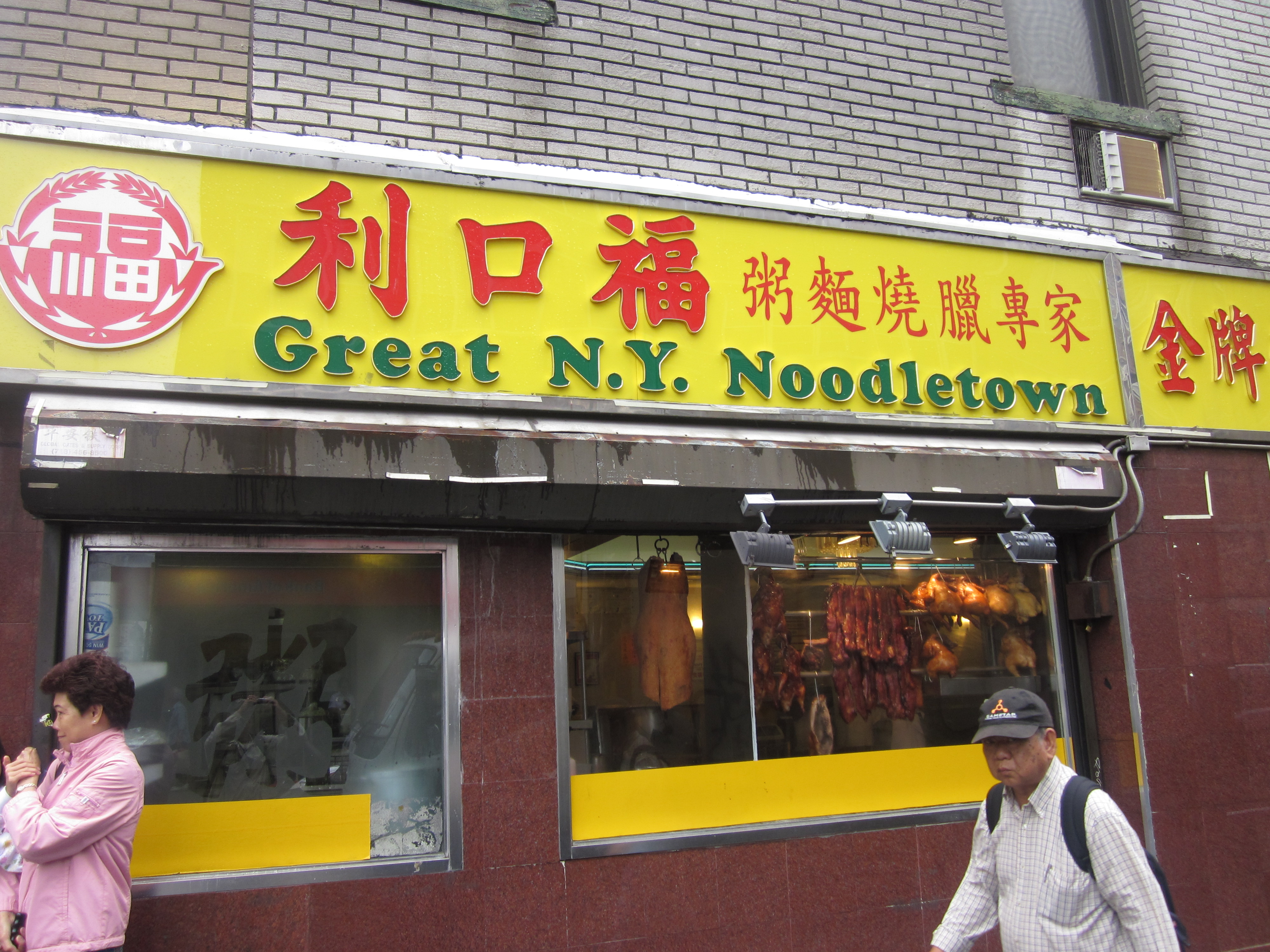
Noodletown

On an overcast morning, I found him loitering next to Great N.Y. Noodletown on the Bowery in Chinatown. One of the elderly women that Luigi had observed were so prevalent in Chinatown (The Chinatown Congee Wars: Part One) was sitting next to where Zio was standing, selling umbrellas, a handkerchief covering her mouth. Was she ahead of the whooping cough curve, or was the precaution a leftover from the bird flu epidemic? Zio didn’t seem to mind the close proximity and as soon as I arrived, we went into the restaurant.

Neither Zio nor I were strangers to Great N.Y. Noodletown though when I visited it was not usually for congee.  I do recall ordering the comforting porridge at least once, but my memory of it is dim. It must have made enough of an impression, however, for me to include it in this very serious challenge.

Using all our resolve, Zio and I tried not to peek at the salt baked shrimp, the roast pig on rice, the squid with flowering chives, the triple delight noodles and all the other Noodletown greatest hits found on the menu. Instead we focused on congee only.

Knowing how good the shrimp usually is at Noodletown, I ordered a bowl of shrimp congee. Zio, also sticking to seafood, went with the sliced fish.

Of course, I needed to also compare Noodletown’s “cruller” with Big Wong’s and Congee’s.
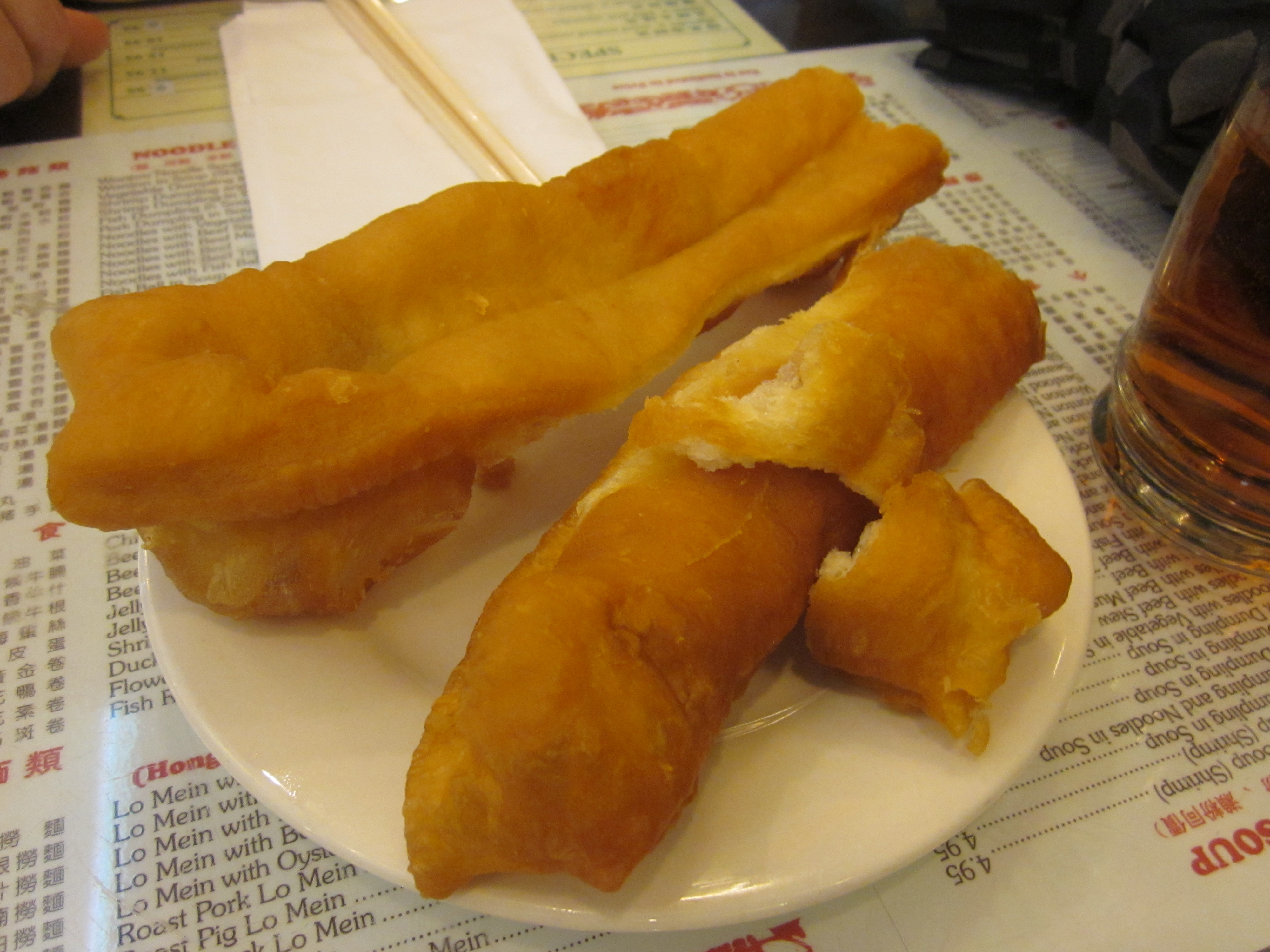
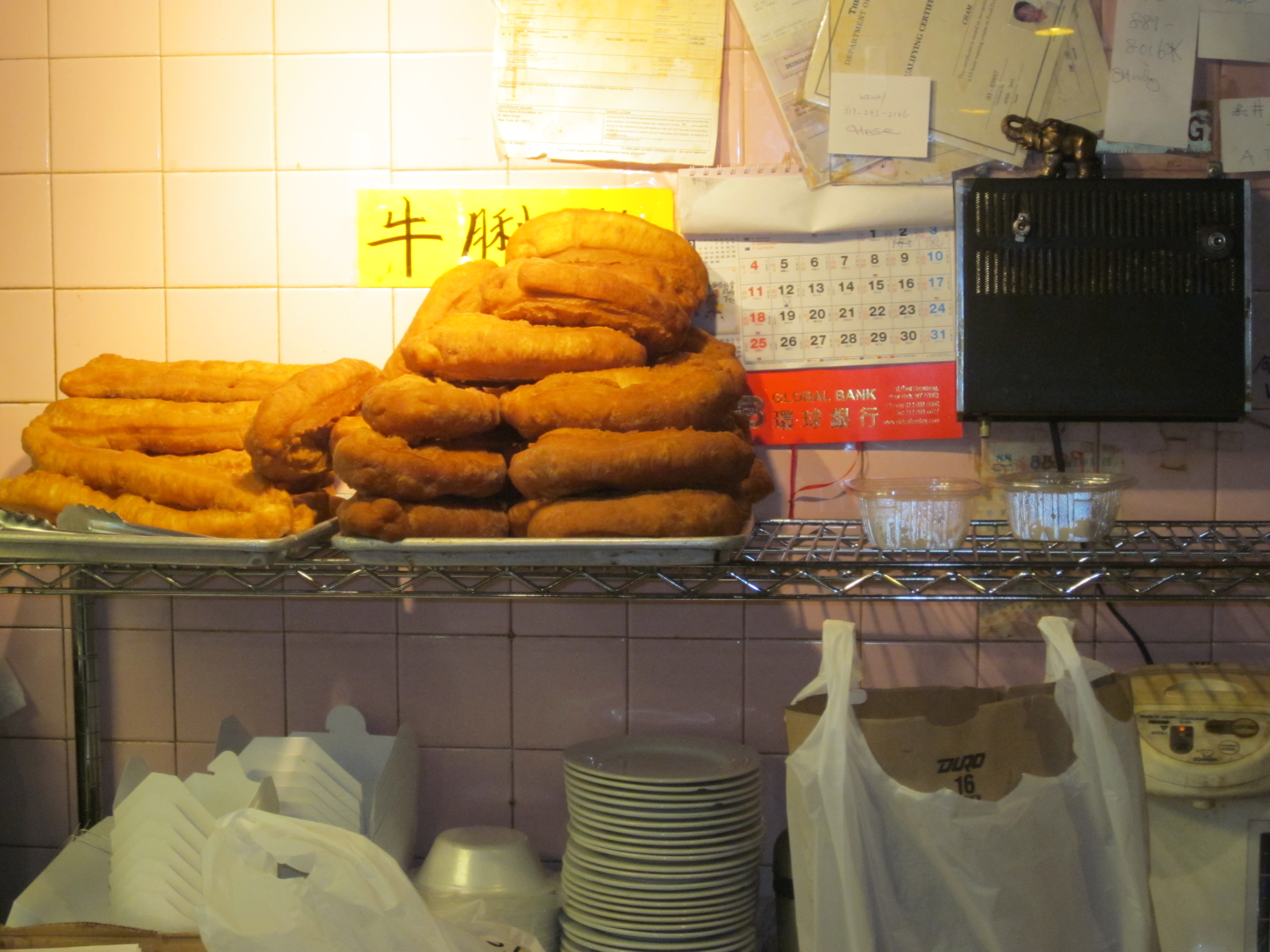
The Noodletown cruller

“What the…?” Zio gasped when the cruller appeared on our table.

“It goes with the congee,” I explained.

But he was skeptical. He broke off a piece and ate it. “It’s like a grease sponge,” he said, demonstrating by squeezing the cruller and showing me the oil slick on his finger.

“Yeah, that’s why it’s a perfect accompaniment to congee. The grease works as a foil to the starch of the congee,” was the justification I offered, though not with much conviction.

Our bowls arrived. The steam from them formed a cumulus-like cloud around Zio’s rotund face. “You can’t eat this for about ten minutes,” he said. “You’ll fry the inside of your mouth.”

“That’s what the cruller is for,” I said. “Dip it in, like a doughnut.”

Zio scoffed at the idea.

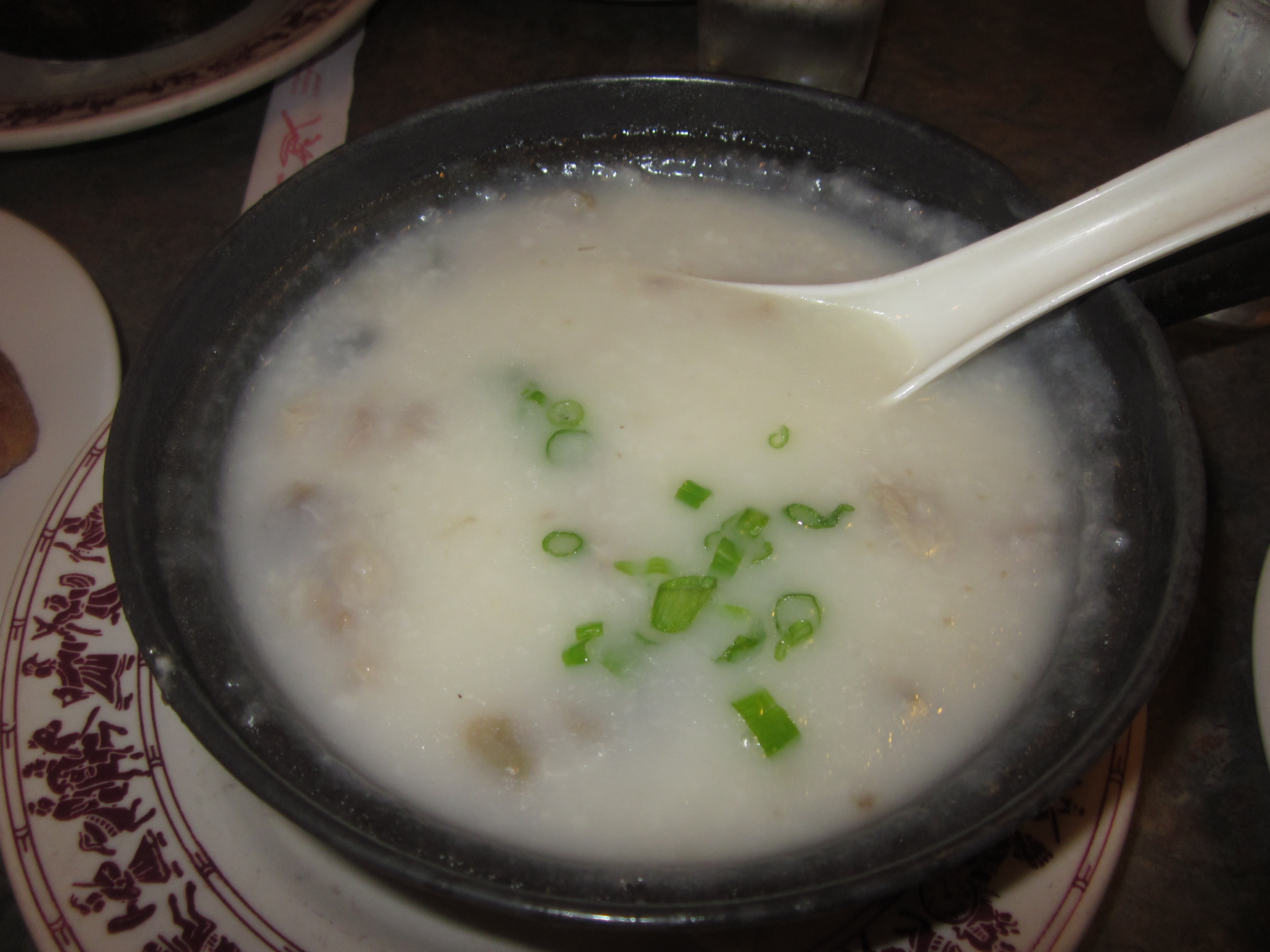
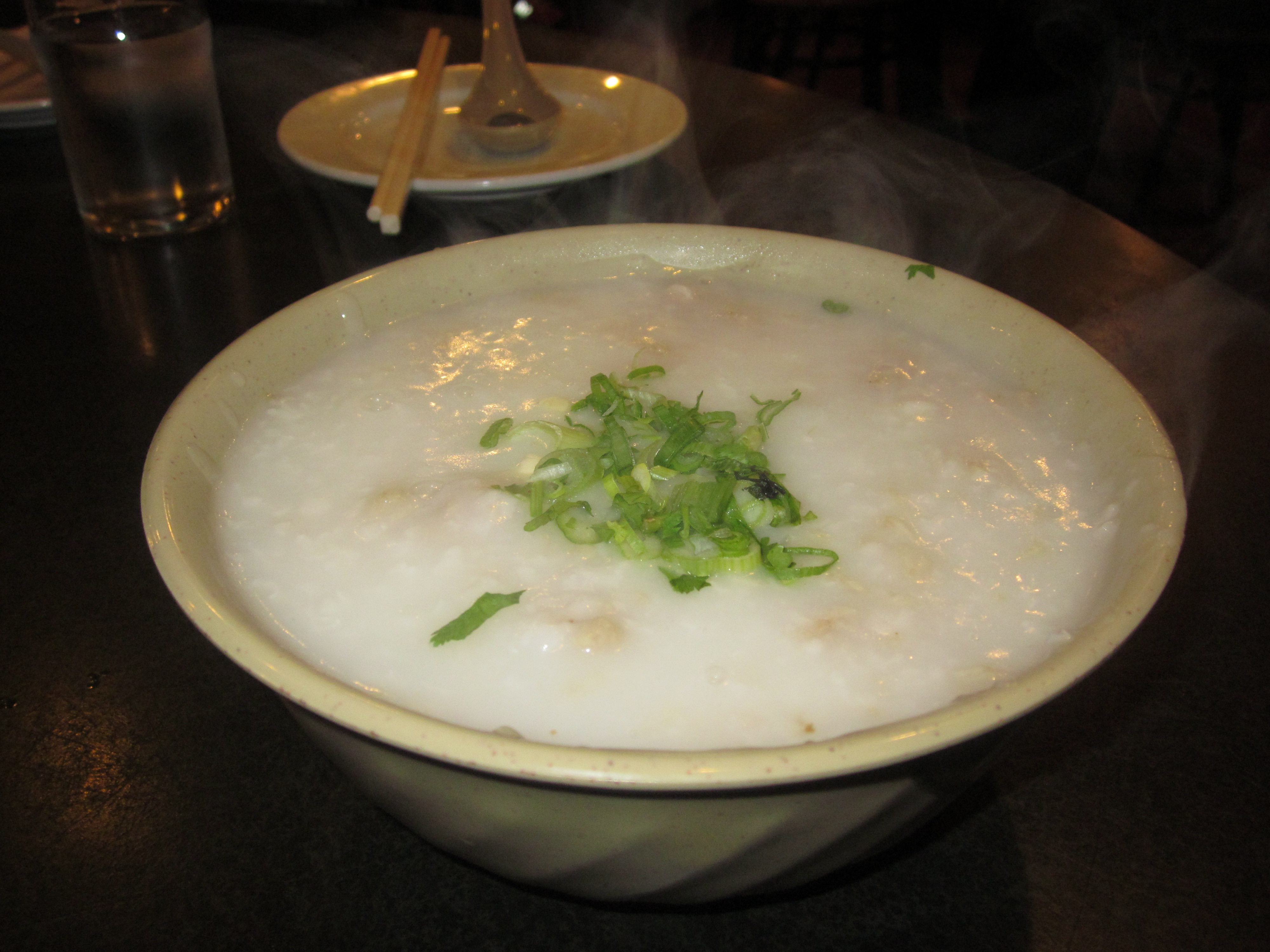
Less than ten minutes later we were sipping the brutally hot gruel. The thin, rice porridge was infused with the flavor of the shrimp. And the pieces of shrimp—I counted six in my bowl—were bigger than golf balls.
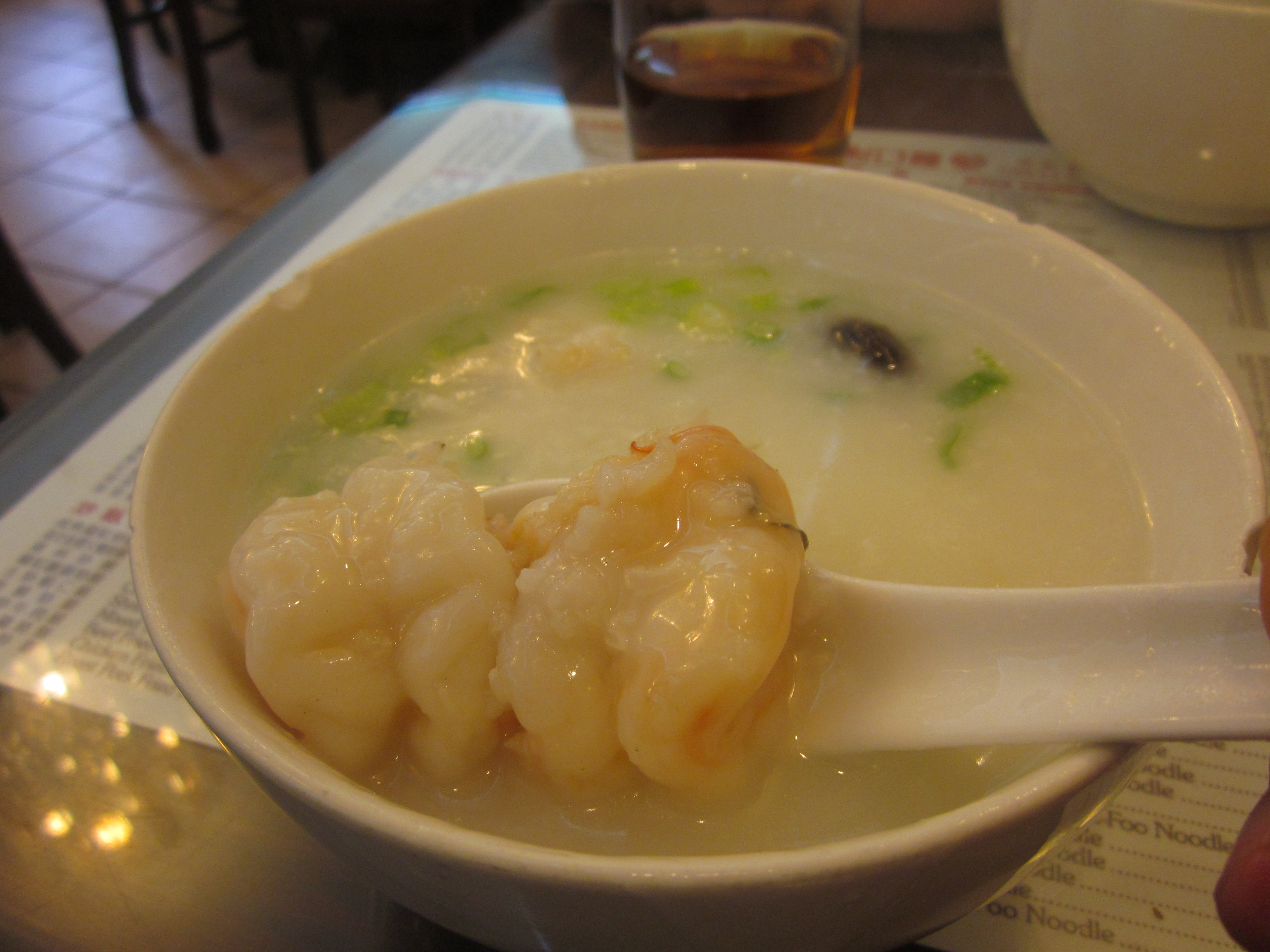
Golf ball-sized shrimp.

Zio soon had his head buried in his congee. Using his spoon like a skilled surgeon, he methodically brought the hot soup and pieces of sliced fish to his open mouth, taking it in masterfully.

I watched his performance for a moment and then said, “You might not want to finish it.”

He picked his head up. “Huh?”

“We’ve got another place to try after this,” I reminded him. “Save room. If you eat too much here, you won’t be able to give the other contestant a fair shake.”

He thought for a moment. “You’re right,” he said and put down his spoon.

Reluctantly, we had the bowls wrapped up; our waiter sliding on plastic gloves in front of us, and then pouring each bowl into a take out container.

Congee Village
207 Bowery
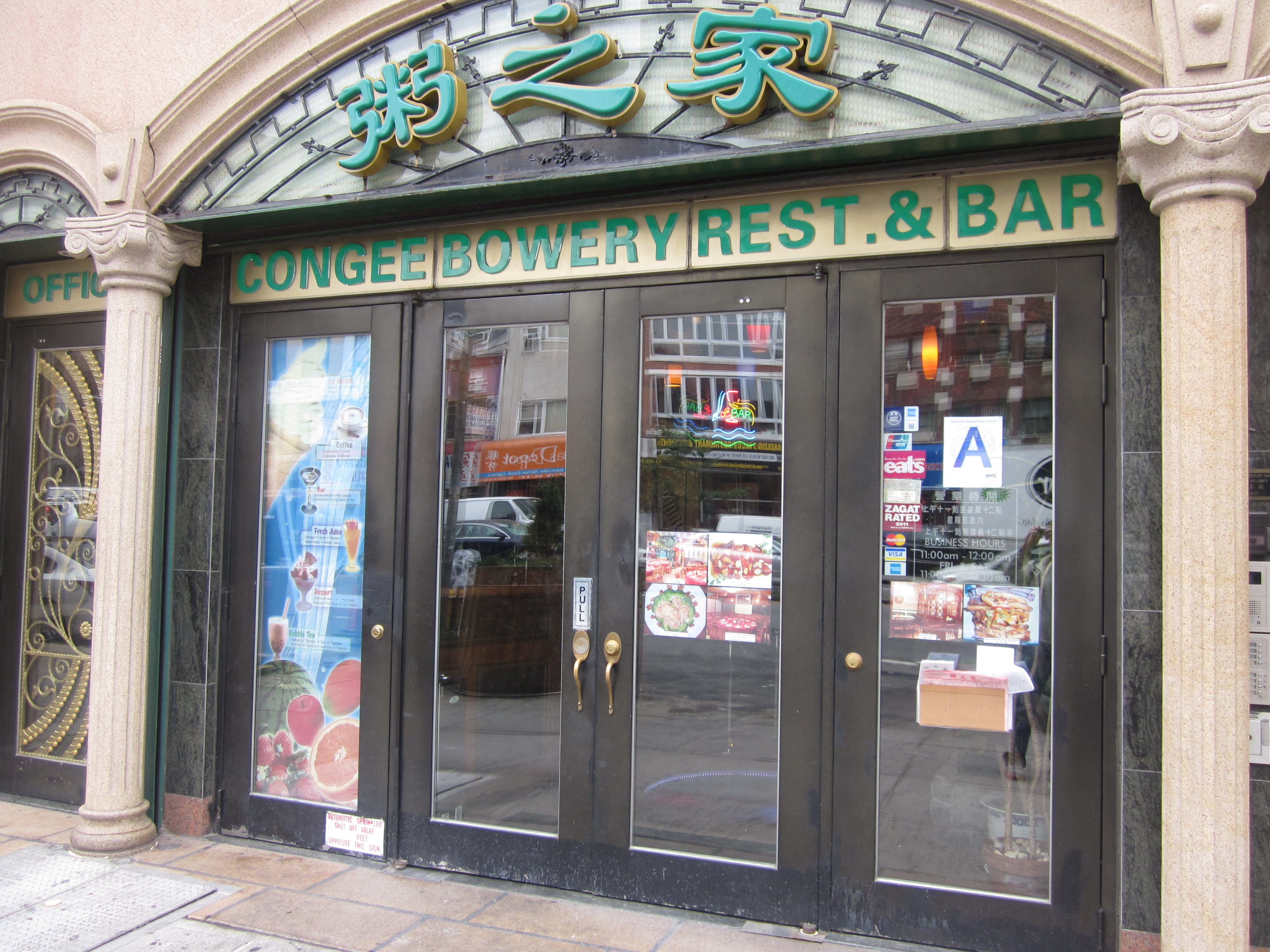
Though the congee at N.Y. Noodletown was light, I could feel the density of the two enormous shrimps I ate while walking up the Bowery to our next destination. I hoped the exercise would offer relief and lesson the load there. There was still more work to do.

For sticklers, Congee Village might not be considered a Chinatown restaurant. Located a few blocks north of Delancey Street, you could say the restaurant was technically in the Lower East Side. But Chinese-run restaurant supply and lighting stores populated the street northward, along with an abundance of signage in Chinese; enough to figure Congee Village within Chinatown’s expanding sprawl.

A full bar and a trickling waterfall greeted us as we entered the very ornate Congee Village. This was a complete departure from the grungy, yet refreshingly familiar confines just experienced at N.Y Noodletown.
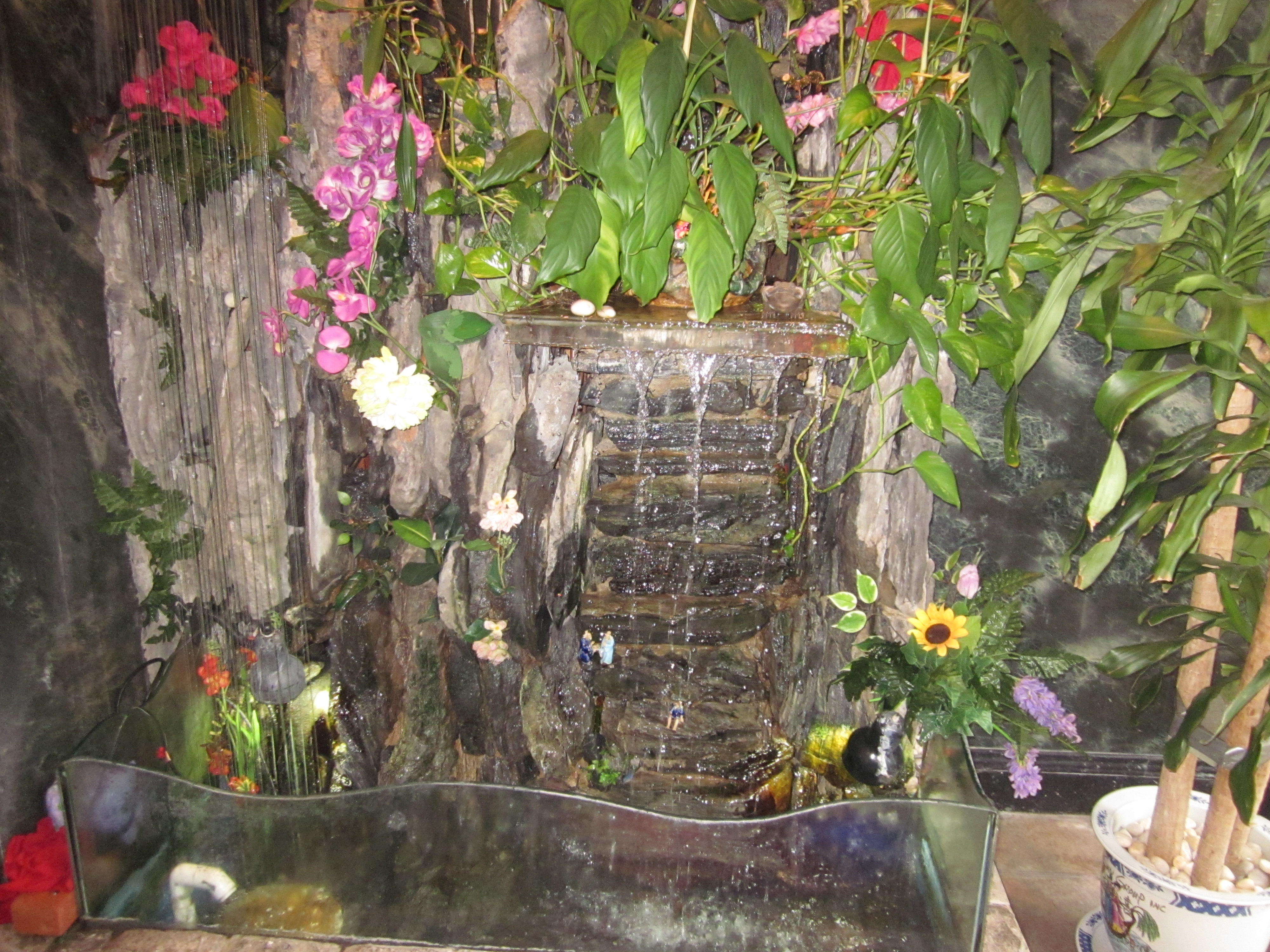
Congee Village waterfall

A lovely waterfall greets you upon entrance to Congee Village.

We were given a table in the dark, burnished wood laden dining room complete with large, family-sized booths and a flat screen television tuned, at this hour, to NY1 news. There were tablecloths and wine glasses on the tables yet the napkins were of the thin, paper variety.

“What a tourist trap,” Zio muttered.

I looked around. The few tables that were occupied were with groups of Chinese couples and families, and unless they were out of town Chinese, I had to disagree.

“Looks like a local favorite to me,” I said.

The menu, tourist trap or not, was impressive. Despite the name of the restaurant, we had to flip through a number of colorful pages to find the congee. When we did, the prices, waterfall and full bar notwithstanding, were actually lower than N.Y. Noodletown’s.

Sticking to the seafood theme of the day, I ordered the “crab porridge,” while Zio this time choose squid. If there were crullers, I just didn’t have the courage to order them.

The bowls arrived and looked like what Luigi and I had at Congee; pots with long handles. Smaller bowls were given out making it easier to share.
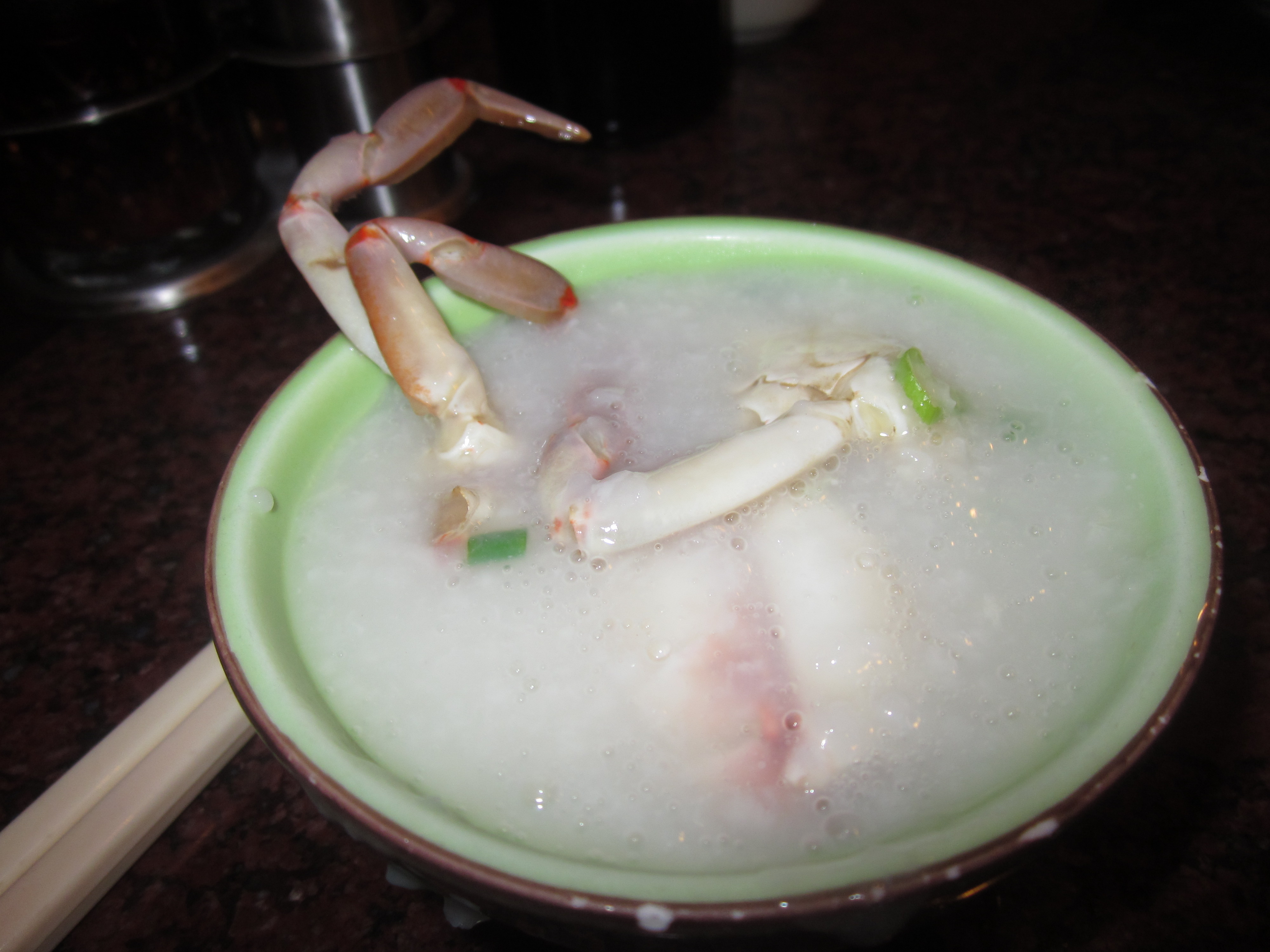
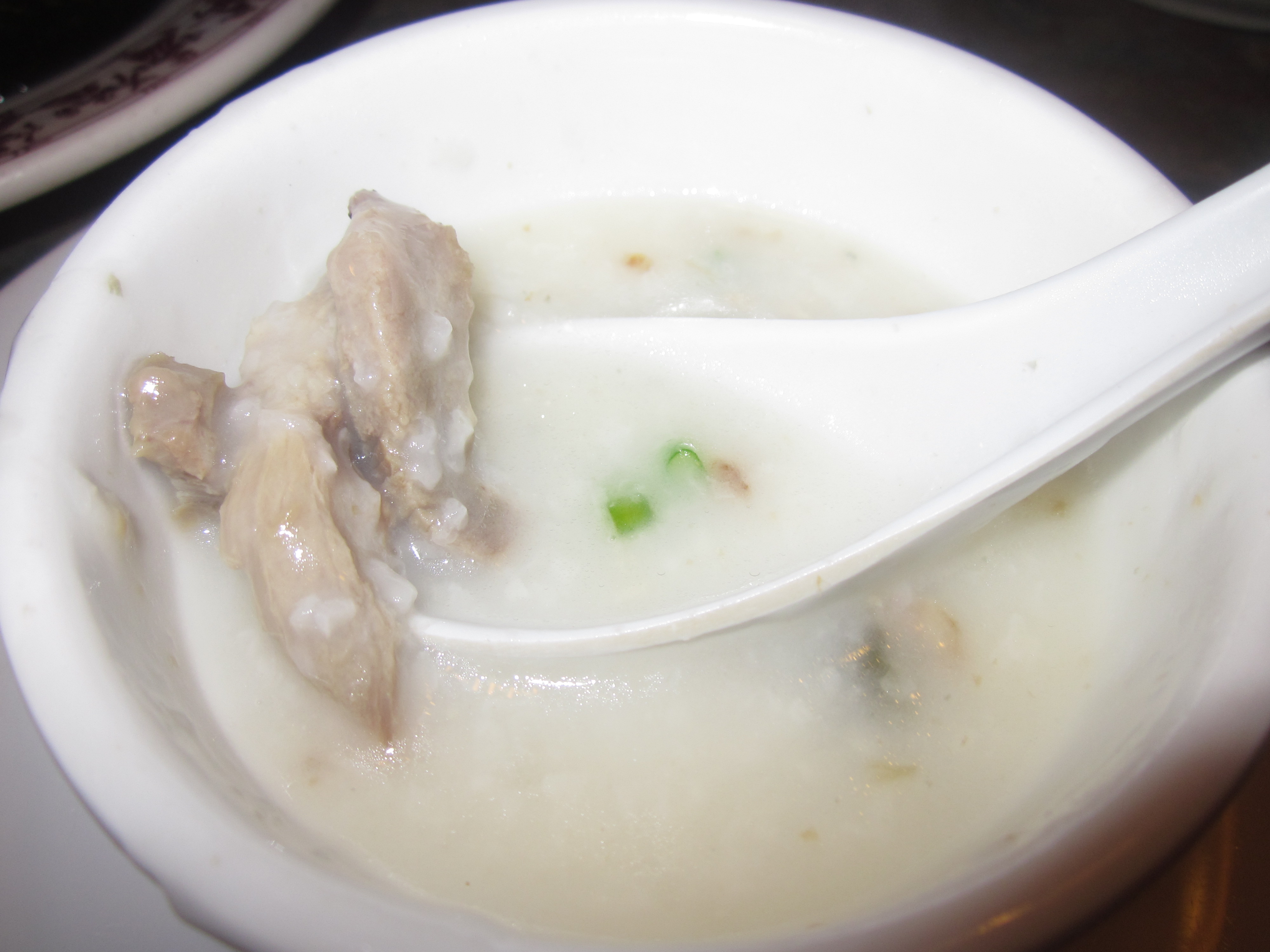
Crab porridge

A whole, blue crab was in my bowl, chopped into a few pieces. Like the shrimp infused the congee at Noodletown, the crab definitely added flavor to the bowl here at Congee Village. The melding of the shellfish broth with the rice congee was a revelatory match. To eat the crab, however, I had to fish out the pieces and pick the shells apart with my fingers. It was messy work and the thin napkins weren’t helping. But the congee was so good, even Zio’s crude, distasteful remark about what my fingers looked like coated in crab shells and overcooked rice gruel didn’t deter from my enjoyment of it.

Zio fished a piece of squid out of his congee. It was scored with numerous criss cross patterns. He examined it. “Why do they get fancy with the squid,” he complained.

“Does it taste good?” I asked.

“Yeah, it’s fantastic,” Zio said.

“Then who cares.”

I sampled a piece and though it was tougher than I like, it too worked amazingly with the bland congee.

There would be no leftovers here. We could finish the congee and not worry about having to sample another. The crab remains were scattered across my small plate.
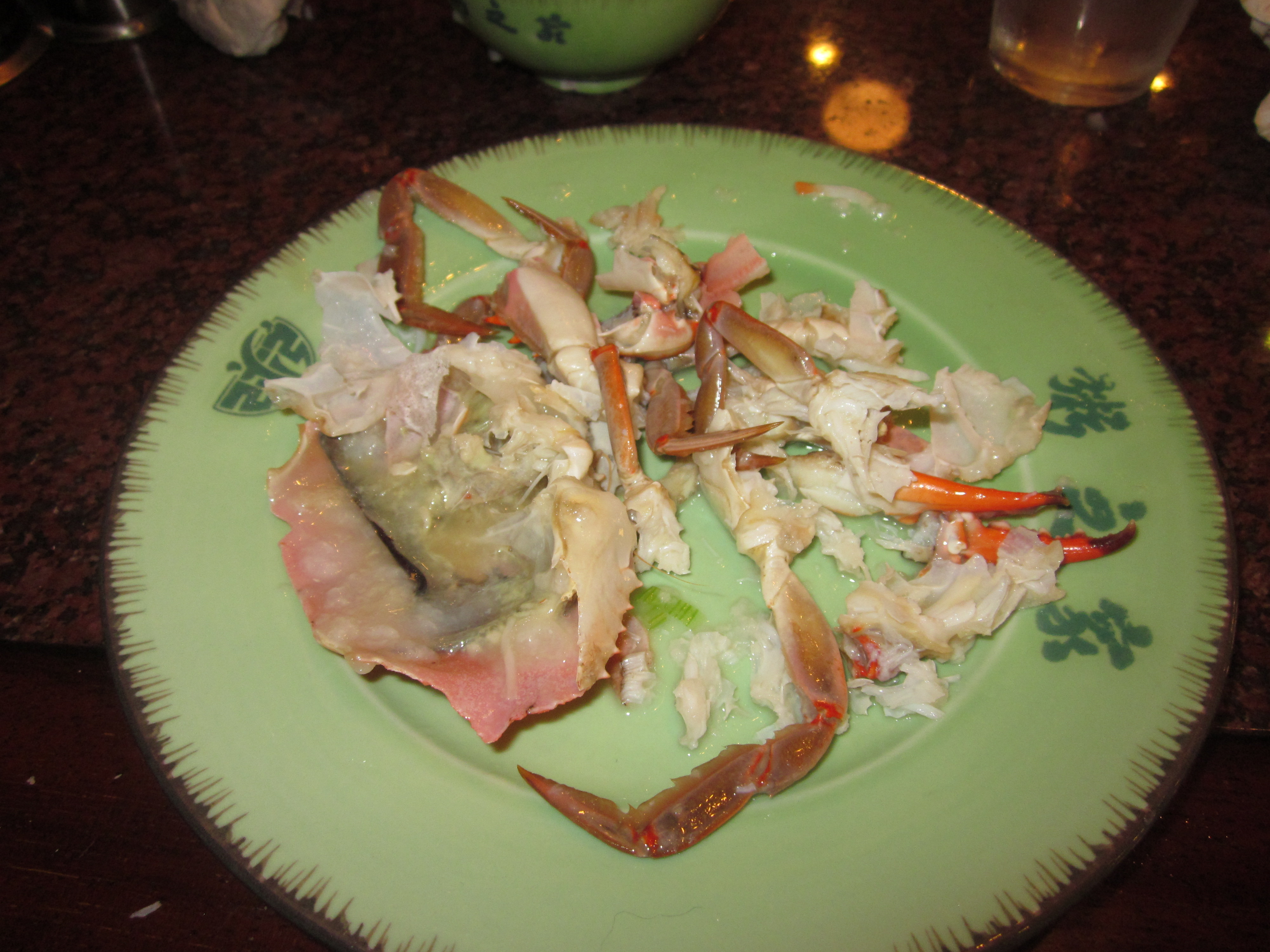
The remains of the crab.

“So what do you think?” I asked Zio.

“We really gotta pick a winner?” he whined.

I thought for a moment. I didn’t want to either. Each of the four congee joints had their merits. At Congee, I would stick with the pork and preserved egg while at Big Wong, how could I resist the roast pork congee? There was no denying that Noodletown’s shrimp congee was a one of a kind. And here, at Congee Village, I’ll forever swear by their crab porridge.

Yes, I know I’ve copped out. I couldn’t crown a champion. I’m just no good at these things—these numbered lists where you have to rank your favorites, whatever they may be. Congee preference is subjective. No matter how expert my opinion, I really can’t change someone else’s taste inclination. And in this case, one man’s congee just might be another man’s gruel.

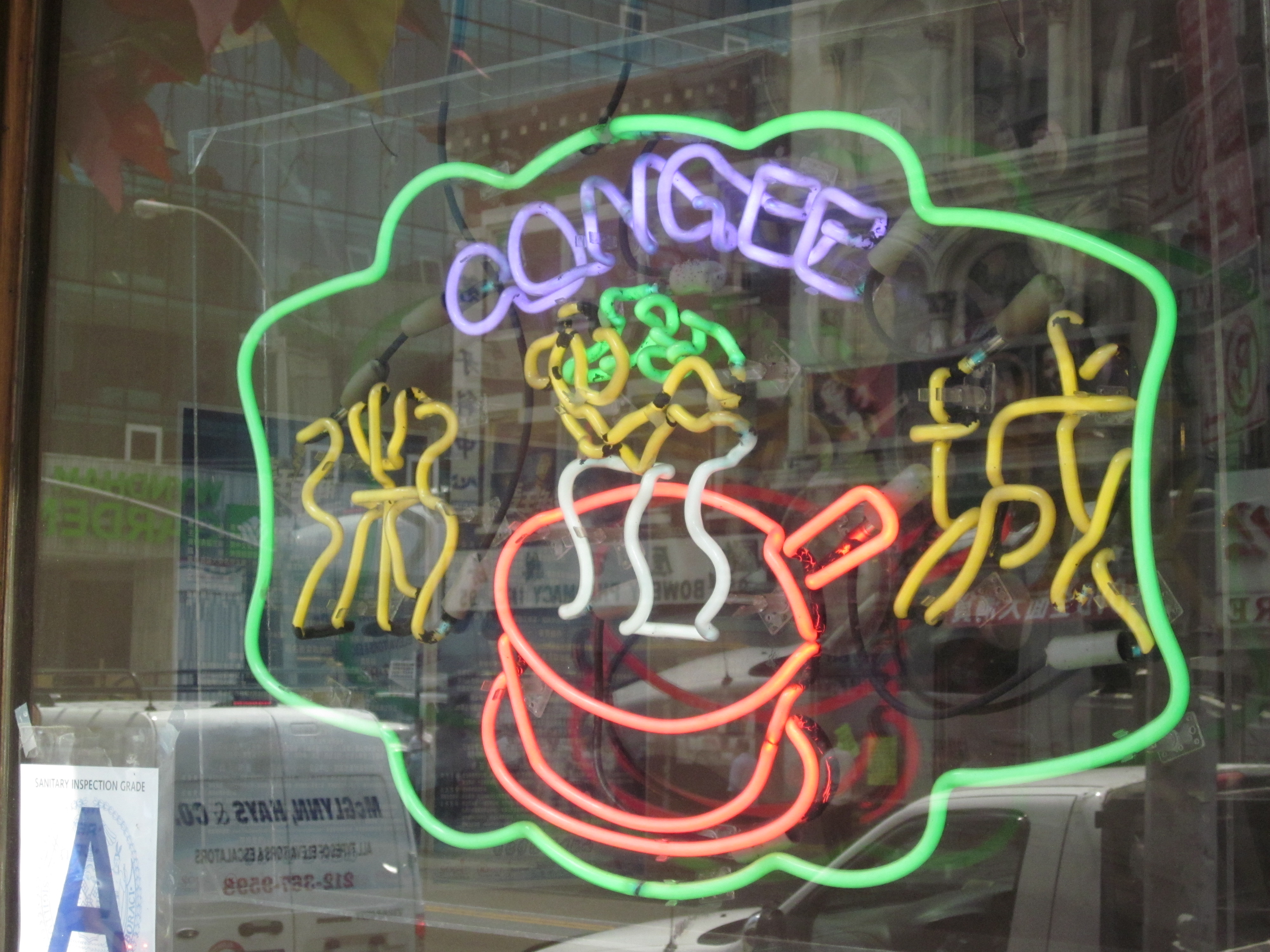
The Chinatown Congee Wars: Part One

13 Jul

Congee vs. Big Wong

Some call it porridge. A more medieval term for it is gruel. In Chinatown it is known as congee; white rice boiled with water, lots of water, until it becomes a thick, hot cereal or soup, depending on what you do with it.

For many who live in Chinatown here in New York it is a breakfast staple. In the last few years, Congee’s popularity has burgeoned beyond Chinatown and now people like me travel to the congested, cramped, sometimes ripe streets of lower Manhattan to get their congee fix.

Congee lovers are often blindly loyal to their favorite places. Me, I keep an open mind. I have, however, narrowed down the crowded Chinatown field to four serious contenders to the congee crown and here, in two parts, using my vast background and experience in the art of overcooked rice, I will ultimately reveal the best congee in Chinatown.

This will not be like the murky college football system known as the BCS where the true champion is settled more by sports writers than by the deserving teams battling it out on the field. The results of the Chinatown Congee Wars will be unequivocal. There will be no talk radio controversy. No happy hour debates. That is unless you happen to disagree with my choice. In which case, you are entitled to your opinion, no matter how misguided it might be. And please, don’t hesitate to express yourself here. I welcome it.

For this first round, I was accompanied by one of my offspring;  the 12-year-old, Luigi. Though he is a mere novice when it comes to the glories of congee, despite his youth, Luigi is a very accomplished eater. What he lacks in experience, he more than makes up for in exuberance. I had complete confidence that he would remain unbiased and not be swayed by perks such as complimentary hot tea or a plastic-wrapped fortune cookie. I was sure he would take his task seriously.

Congee

98 Bowery
Chinatown

Our first destination was the appropriately-named Congee.

Located on the Bowery, Congee, I knew was worthy of its name. When we arrived, just before the lunch time bustle, there was only a Chinese family with very young children at one of the other tables. The baby was making a racket in the otherwise quiet restaurant and I noticed, doing its best to decorate its pink, fat cheeks with spoonfuls of gruel.
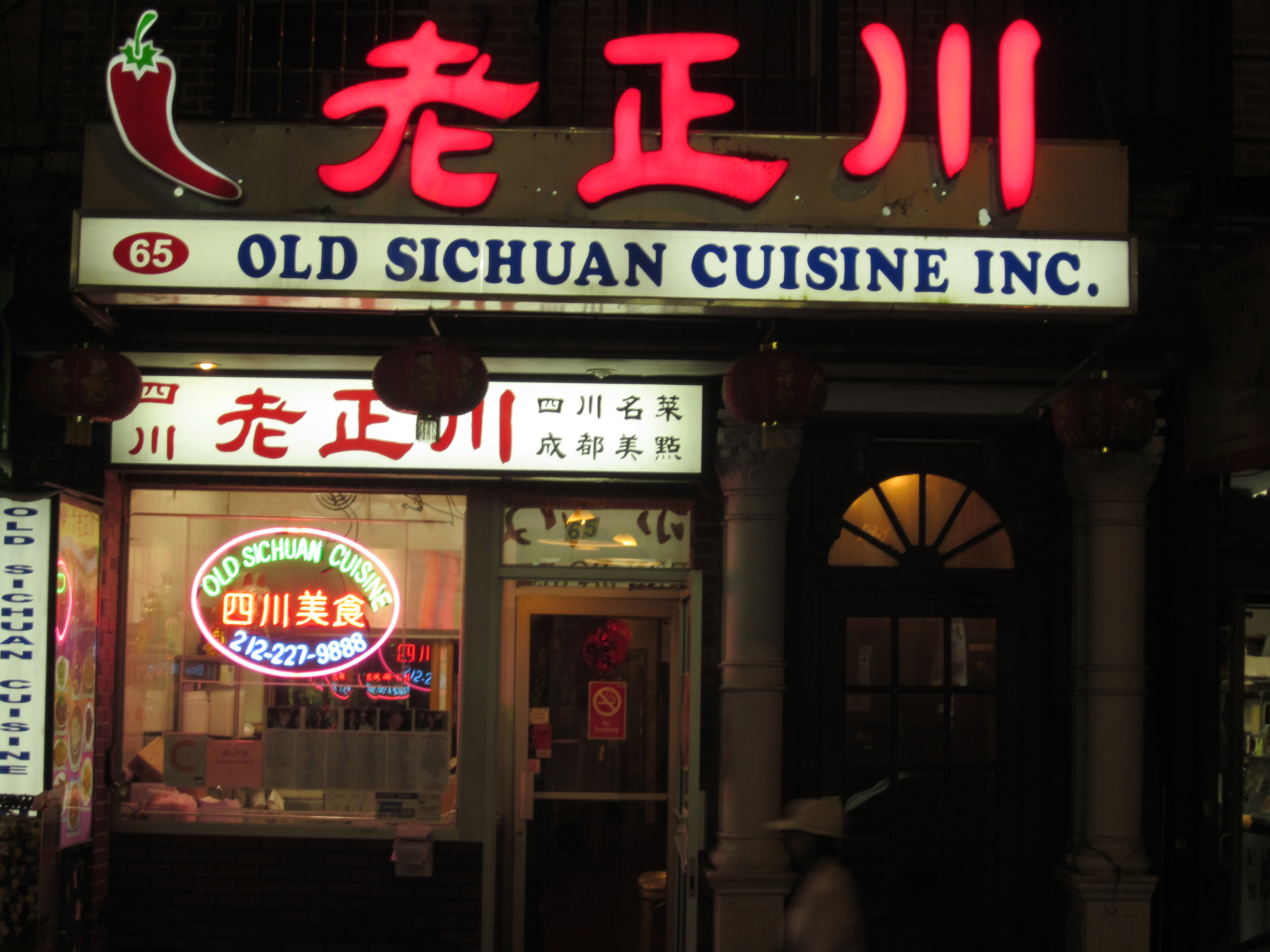
I told Luigi we had to have the congee. If he wanted something else to offset it, he could, but to be careful and pace himself; we had another congee place to judge.

There were a number of interesting congee offerings including snail and pig’s liver, abalone and frog, and dried scallop and gingko nut, but I wanted to keep it relatively simple. I needed to judge the congee on its own merits without too many exotic ingredients, so I went with the sliced pork and preserved egg variation.

Luigi scoffed at my suggestion of the “healthy vegetarian” congee, instead choosing the beef. Along with it, we had an order of “fried dough,” the usual, bland but deep fried, accompaniment to the porridge.

The congee came out steaming in pots with wooden handles. We stirred, trying to cool it down not wanting to scald our tongues and the roofs of our mouths thus immediately nullifying either of us as legitimate judges.

The inside of my mouth, however, after years of impatiently ingesting hot pizza, soup, and other blistering foods, has developed a tough, asbestos-like coating. That hard shell made it easier for me to begin the congee tasting sooner than Luigi. What I tasted I liked. The congee was not overly heavy; the balance of liquid to rice tipping slightly to the liquid. But the pork with preserved egg added a nice hearty supplement.

Sliced pork and preserved egg congee.

Luigi struggled at first with the big pieces of beef; trying to cut through them with spoon and chopstick but to no avail. Using his sharpened incisors, he was able to gnaw the beef apart and enjoy, so he said, the rest of his congee, dipping the somewhat stale pieces of fried dough into the porridge and scooping it into his mouth.

The beef congee at Congee.

I wouldn’t have had any difficulty finishing off the bowl of congee, but we had another place to visit. Using about all the self control I could muster, I signaled for the waiter to bag up our leftovers, and we made our way to our next destination.

Big Wong King

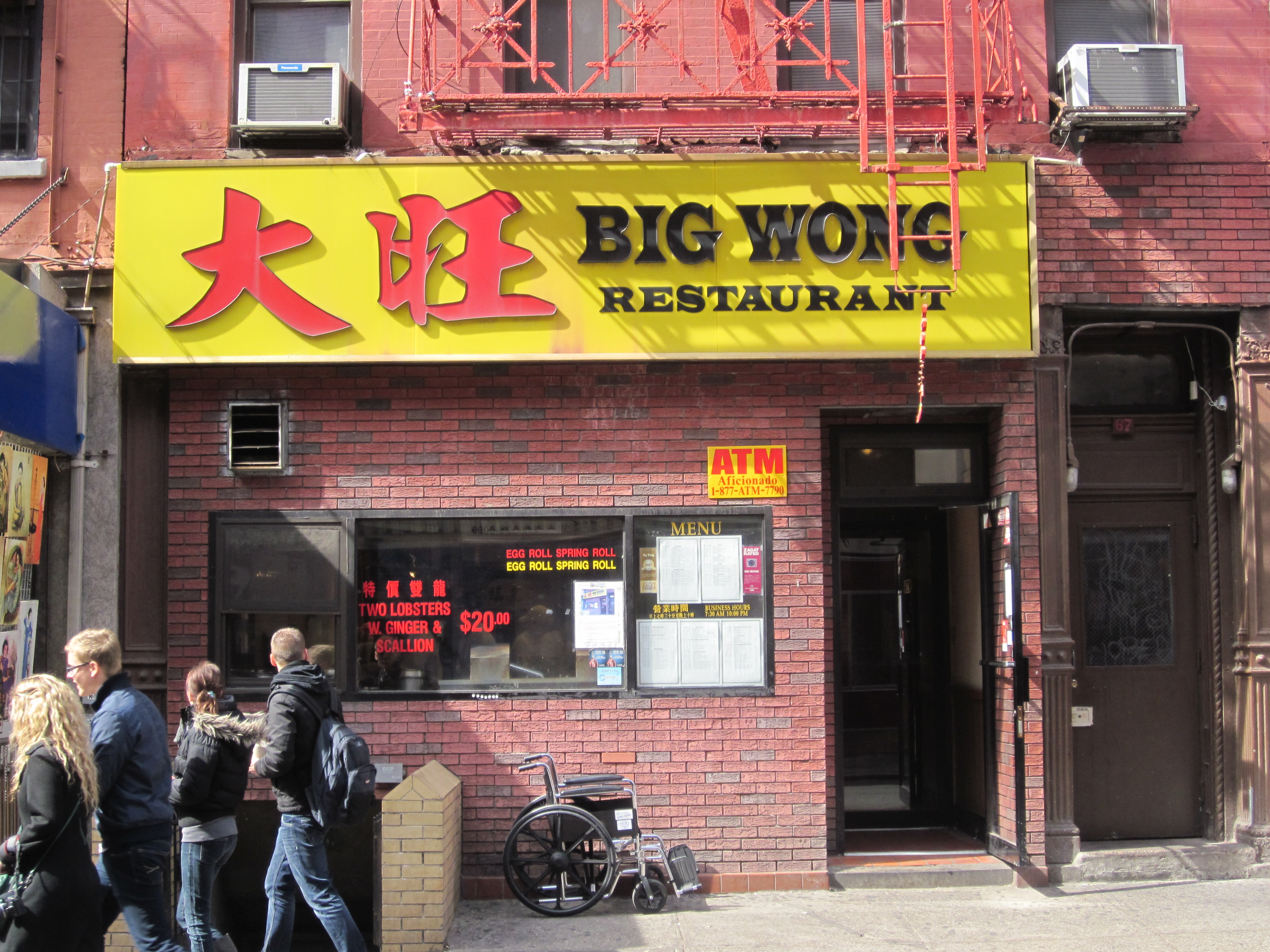
67 Mott Street
Chinatown


I admit to being partial to Big Wong. It’s been one of my “go to” spots in Chinatown for a very long time. And whenever I go, it’s hard to resist the congee.

I noticed immediately that Big Wong, located in the heart of the tourist mecca of Chinatown on Mott Street, had higher prices for their congee. At Congee, the standard bowls we ordered were $3.95. At Big Wong, most were a dollar, maybe two higher. I knew I couldn’t let price influence my evaluation. The congee had to stand alone regardless of what it cost.

I ordered the roast pork while Luigi went with the chopped beef. Like at Congee, we also ordered the “fried dough.”

Big Wong’s fried dough or “crullers” ready to be dipped into congee.

“I’m worried that Chinatown will change soon,” Luigi professed to me.

“Why is that?” I asked him.

“There are a lot of old people here,” he said.

I nodded. There were. In fact, we were sharing a round table with three seniors.

“But there are young people too,” I said, gesturing to many who were also dining at Big Wong.

“I hope it doesn’t die,” he said. “I like Chinatown.”

Our bowls arrived. The steam was flowing from them. These were even hotter than what we got at Congee. My asbestos mouth would be no match for the boiling cauldron in front of me.

Hot congee at Big Wong.

The fried dough, a long, fresh cruller, kept us busy until the congee cooled down somewhat. When I could brave it, I took a spoonful. Mine was rich with roast, barbecued pork, the barbecue tinting the white of the soup turning it  a bronze-like color. Luigi’s had crumbled ground beef. Both were sprinkled with cilantro adding a pleasant garnish to them.

I liked the congee at Big Wong better than what I experienced at Congee. It was heartier; more rice to water and stuffed with meat. Luigi disagreed. “Congee is better,” he said definitively.

“I don’t know, I like Big Wong’s even though it is a few more dollars.”

We were at a standstill. He favored one, while I the other. How would we resolve this?

“Well, the fried dough is better here, isn’t it?” I said.

He agreed, but we weren’t on this mission to judge fried dough.

Congees and a cruller

They say a tie is like kissing your sister? I never had a sister, so I wouldn’t know. Maybe Part Two of the Chinatown Congee Wars will help clear up the muddled picture I’ve created.

Until then, feel free to chime in with your own opinions though I will not be swayed in mine.

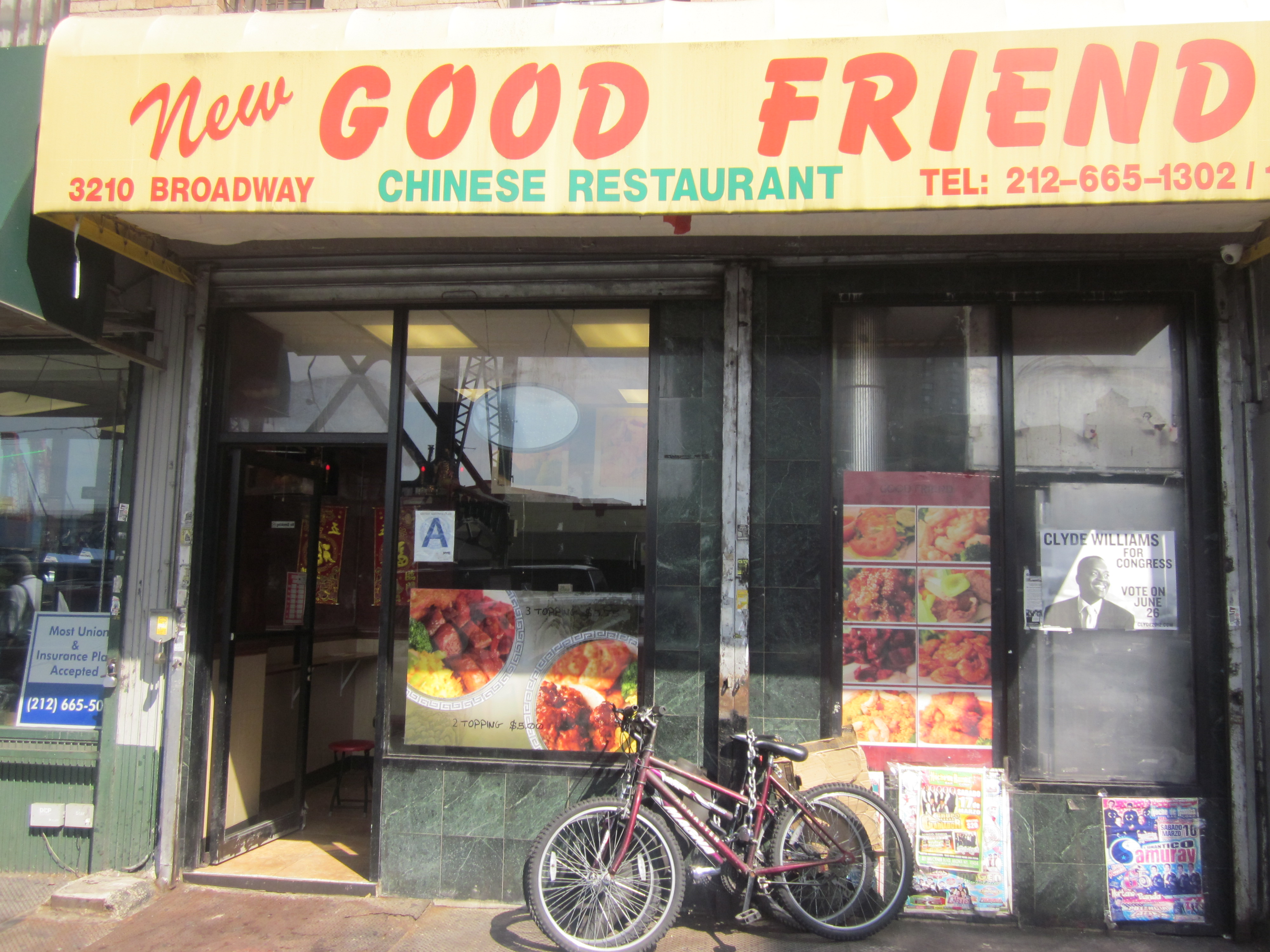
A Good Friend is Hard to Find

29 Jun

A New Good Friend is even harder.

I’m very happy I’ve found one.


And the Answer is…

18 Jun

On Friday I presented you with the following photos:

Note the tiny yellow speck of rice I thought was a giveaway.

And where else would you find such a combination of condiments.

With those hints I challenged you to Name That Place.

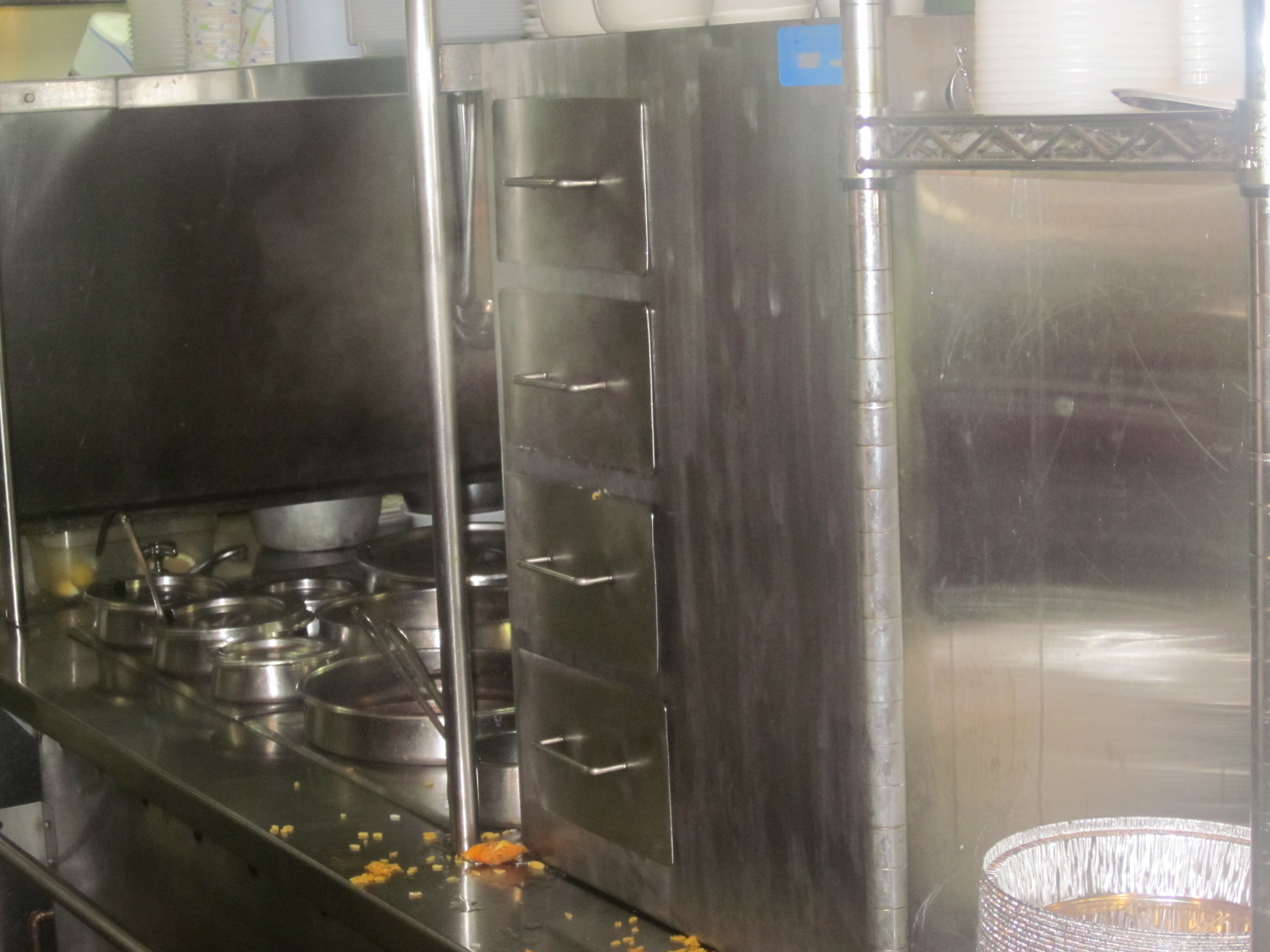
I thought the hints were more than obvious, yet I only received a few correct responses identifying the place that has this unusual kitchen apparatus.

Where if you open one of those drawers, you will find this…

Yellow rice. Which is a staple of this place and used when eating this:

Rice and beans

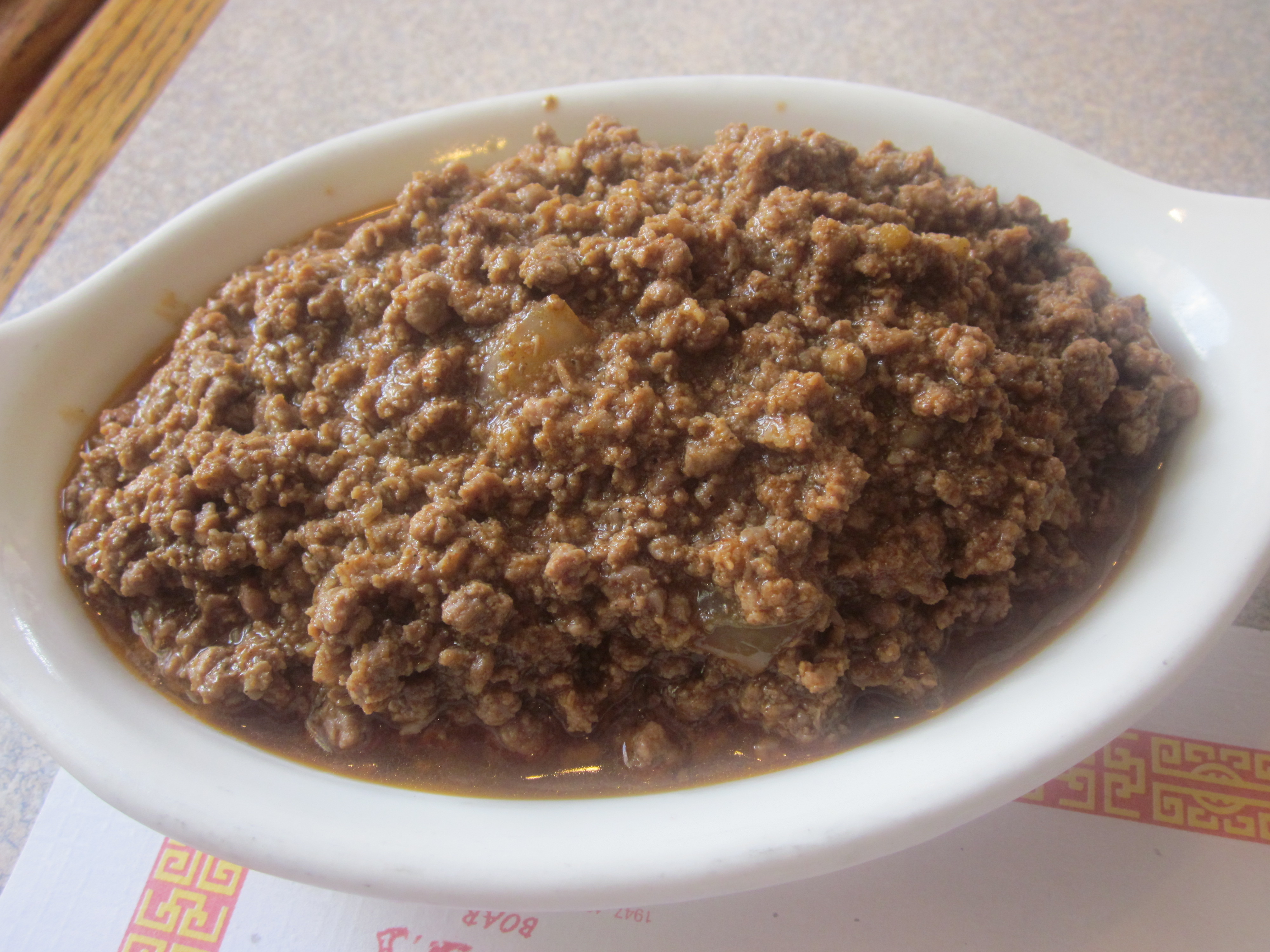
As an accompaniment to this:

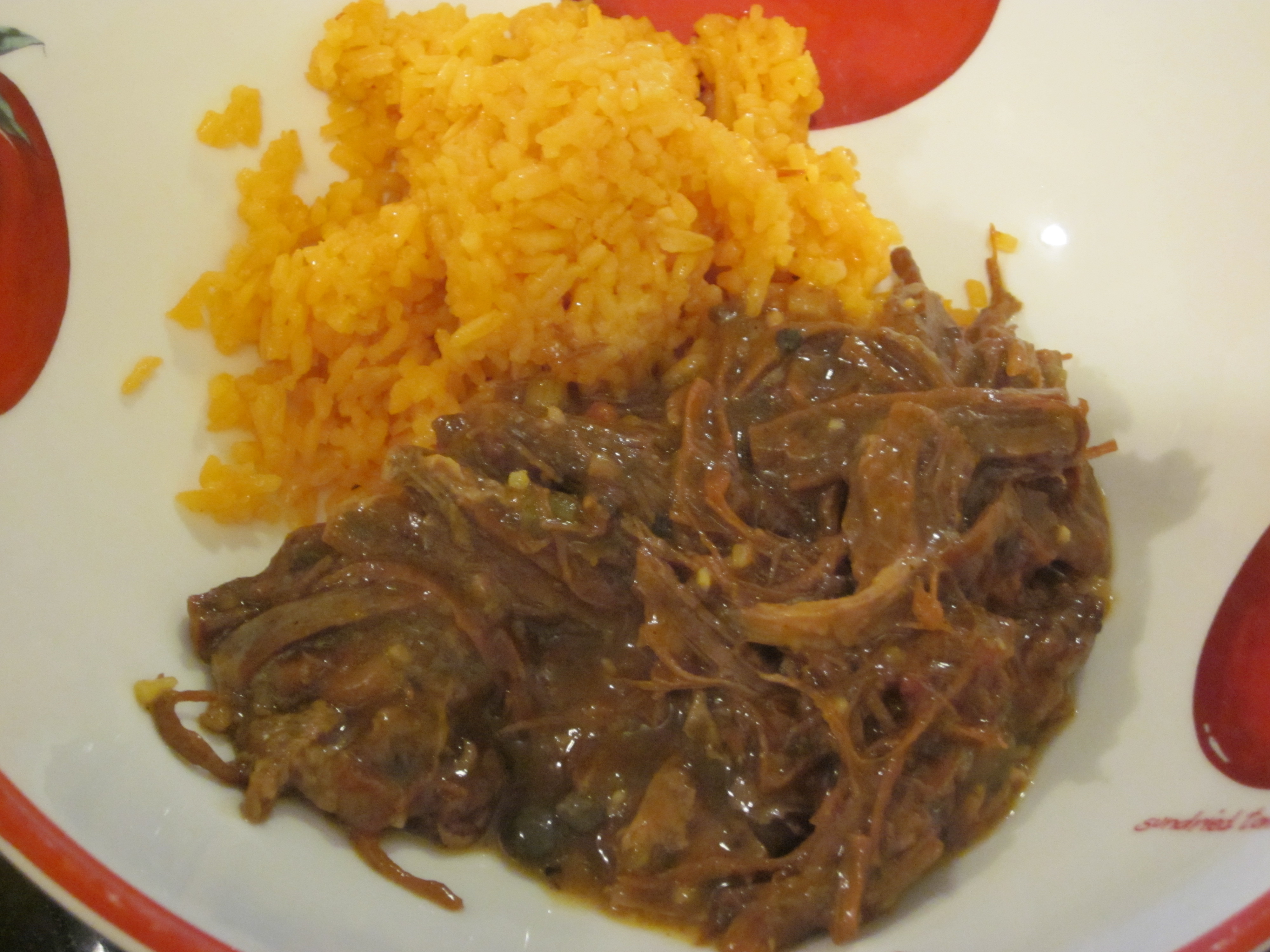
Picadillo

But that Chinese Zodiac paper place mat could confuse, as could the soy sauce above. Surely this is a Latin place with an Asian twist.

For forty plus years on the corner of 78th and Broadway, though remodeled several times, you can find this comidas china y criolla standby:

Le Caridad 78


The Noodles on Prince Street

22 May

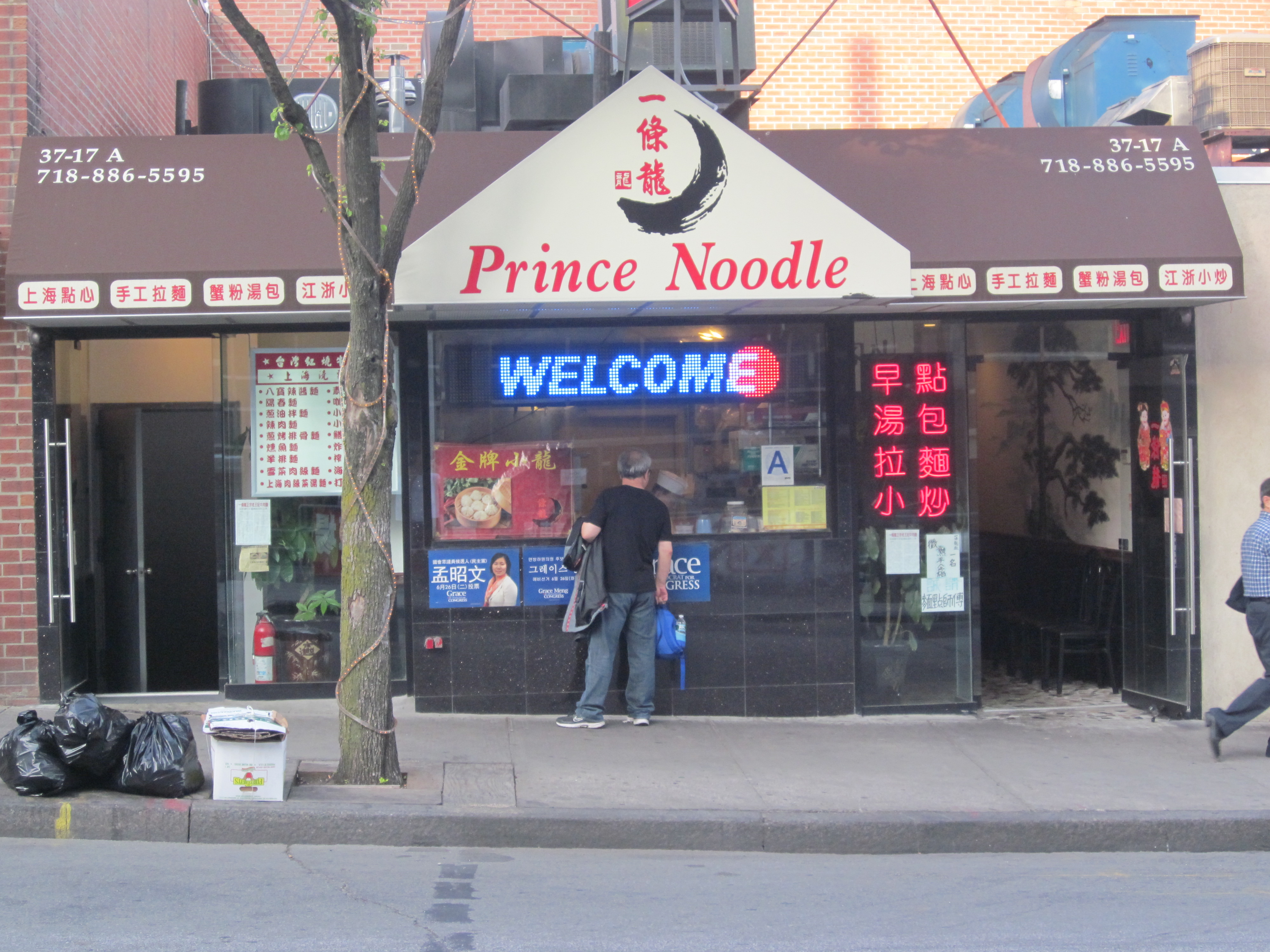
Prince Noodle House
3717 Prince Street
Unit A
Flushing

I’ve gone over the rules of our Chow City group many times in these electronic pages. We look for $20 and under places. We do our best to unearth those that are under the foodie radar, which nowadays is practically impossible. We look for virgin territory in terms of cuisines, but after ten years, the only cuisines we’ve skipped are the big name items (French, German, “American,” nouveau or fusion anything).

But there was one clause that was really never discussed or spelled out in our unwritten rule book. It didn’t have to be; it was taken for granted. That was the concept of waiting in line for a table at a restaurant. It goes against everything we hold sacred when it comes to eating; it’s a shock to our eating sensibilities.

So when Rick suggested a very well documented—at least by foodies—noodles and dumpling place in Flushing called Nan Xiang Dumpling House, I gently pointed out that, from my knowledge of these things, the place has become a “foodie destination.”

Rick understood immediately and, knowing the unwritten (and never mentioned) rule, quickly dismissed his original choice and instead went with an alternate, quite literally, down the road from Nan Xiang, the road in this case being Prince Street, called Prince Noodle House.

Of our group, only Mike from Yonkers, who was called to an urgent co-op board meeting, did not make the trip to bustling Flushing. There was absolutely no wait or line to get into the Prince Noodle House and we were given a big round table next to a large celebratory party of Asians.

One of the reasons Rick decided on, first Nan Xiang Dumpling, and then the Prince Noodle House were the aforementioned dumplings; in particular soup dumplings. He wanted to experience the Shanghai-style dumpling where the soup is “frozen” within the dumpling only to melt inside when steamed. Prince Noodle had them on their menu, here called  “soup buns,” so we ordered the crab meat mini buns and the “special” mini buns for the table.

Crab meat soup buns

While we ate the soup buns, improperly at first and not with the provided spoons, the soup bursting all over our plates, Eugene told us of his trip to Jefferson City, Missouri where he attended a wedding.

“It was ridiculous,” he complained. “The wedding was catered. All they had was Mountain Dew, a keg of beer, and franks and beans. Can you imagine that?”

We couldn’t imagine it especially for a man used to the all you can eat buffets on the cruise ships and all-inclusive resort he regularly frequents.

While Eugene railed about his Jefferson City experience, I peered behind me at the big table. They were given one of those rotating round trays so they could spin it around making sharing easier. How come we didn’t get one of those, I wondered? The food was beginning to assemble on their table and I liked what I saw.

I asked our waiter about a dish they ordered that was a mix of a green, spinach like vegetable combined with what looked like tofu.

The waiter pointed to something on the menu called “malantou (kalimeris indica) w. dried tofu.”

“Indica means cannabis, or marijuana,” Zio offered as if he really knew of such things.

I ordered one for our table along with five spiced beef.

Kalimeris indica, also known as malantou with dried tofu

Served at room temperature, the malantou, vinegary greens mixed with dried shredded tofu, was a refreshing appetizer, though did not induce the melancholic buzz worthy of its name. The five spiced beef, on the other hand, thin slices of roast beef, cured with five spice powder and a sweet soy sauce drizzled over it, also served at room temperature, were addictive in a more familiar way, at least for us, than what Zio had presumed we would experience with the malantou.

Five spiced (roast) beef

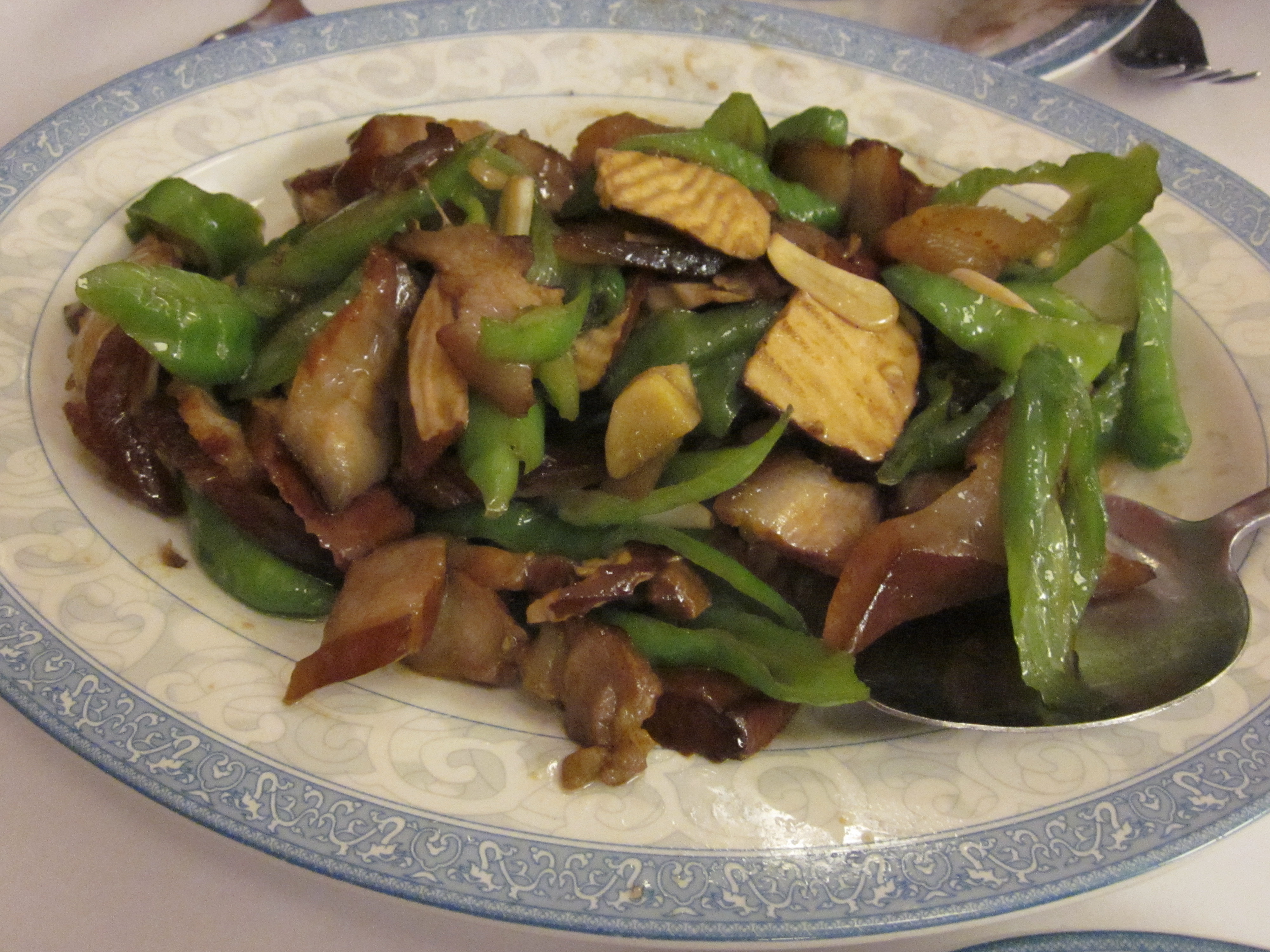
Gerry immediately had his sight set on the “sliced fish swimm hot chili pepper sauce,” that was on the menu, highlighted in red to indicate that it was spicy. No one had any disagreement with his choice or of Rick’s twice sautéed pork belly.

I thought we should at least try some of the noodles at Prince Noodle House and ordered hot and spicy pork noodle soup. I added a rice dish, snow cabbage with rice cake and pork, while Zio studied the menu for one last dish.

The waiter hovered over his shoulder. “I want this,” he said, pointing to something on the menu.

The waiter bent down closer to see what Zio was pointing to.

“You want crap fish?” he said.

“Huh?” Zio immediately got flustered.

“The crap fish?” the waiter said again.

Zio looked at the menu. What he was pointing to read: “spicy bean paste Buffalo crap fish.”

“Yes, I want…number 102,” Zio concurred, indicating the number adjacent to the item where the a and the r had obviously and mistakenly transposed.

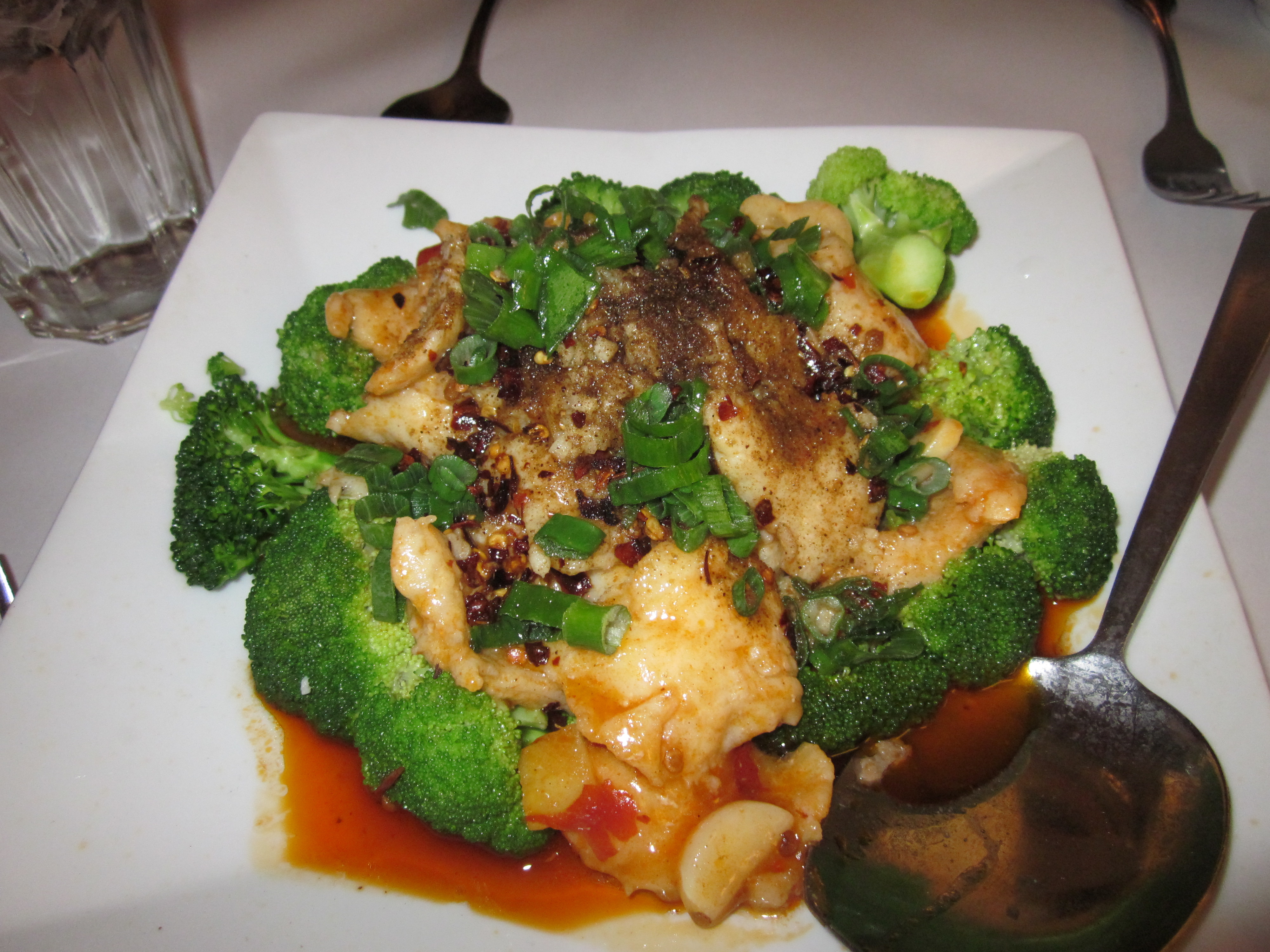
Sliced fish “swimm” in hot chili pepper sauce

First to come out was the family-sized sliced fish that, in an enormous casserole dish, was literally “swimm” in hot chili pepper sauce. A few bites brought tears to Eugene’s eyes, a sheen to Rick’s forehead, and loud honking from Gerry’s prominent, yet distinguished nose.

The noodle soup was equally spicy and the noodles, hand pulled, gelatinous in texture, lived up to its princely reputation.

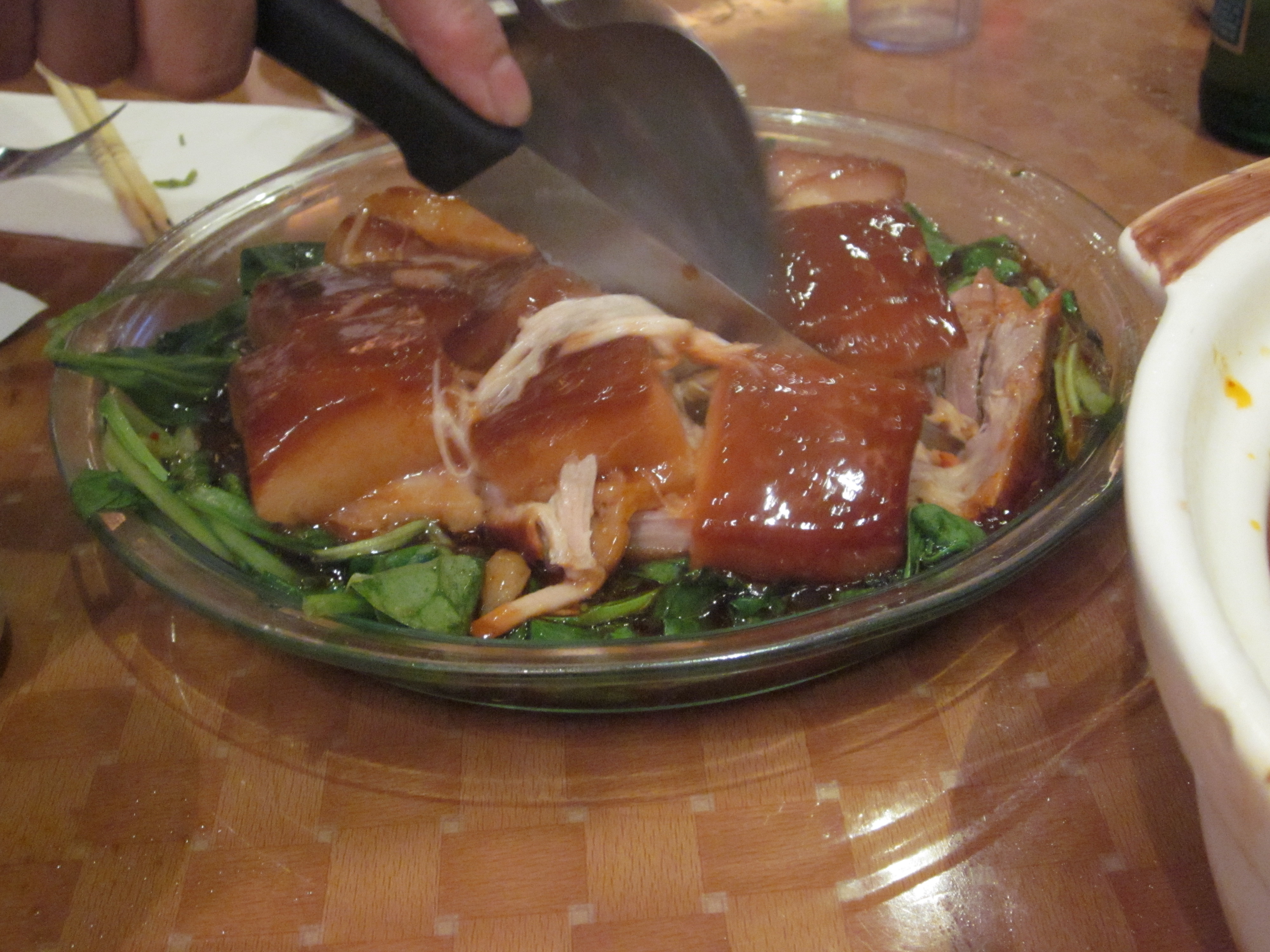
Relief from the heat came with the arrival of the pork belly and the snow cabbage and rice cake. Covered with a one inch layer of fat and glazed to a burnished reddish color, the pork belly was ultra tender; the meat kept moist by its fatty coat and marinated with light soy sauce, sugar and rice wine.

Sauteed pork belly

Last to arrive was the whole carp. Smothered in a bean paste and topped with scallions and ginger, Zio was the first to sample it. He didn’t have much to say as he picked through the many bones. Gerry tried a few bites.

“Hmmm, crap fish has a very unique taste,” he said with a straight face.

There’s crap fish under all that spicy bean paste.

While we polished off almost everything but the unfortunate carp, the dishes on the rotating tray on the table behind us kept piling up. We were done and they were just starting on a huge platter of lobster. Despite having completely stuffed our faces, we gawked enviously as we paraded out of the now fully booked restaurant.

Good thing we didn’t have to wait, I thought to myself as I made my way back to the parking lot where my car was parked. Once inside my car, I stared through the windshield at Prince Street. I noticed a line had formed outside of the Nan Xiang Dumpling House. Maybe the soup dumplings and noodles were better than the stuff we just experienced at Prince Noodle House, but I wasn’t going to wait to find out.

The line for soup dumplings at Nan Xiang

Friends With Frog Benefits

24 Apr

Hunan Manor
339 Lexington Avenue

That a man was outside trying to get passers by to take the menus he was handing out was not a good sign. Still, it was what was on those menus that enticed me to try Hunan Manor. And when I relayed to Gerry some of those menu items: “steamed pork elbow,” “frog in spicy soup,” “cumin flavored beef on toothpics,” fragrant pig ears,” and “numbing—and—hot chicken,” it was very easy to entice him to join me as well.

Without taking a menu from the man outside the restaurant, we went into the generic, harshly lit, restaurant where there were plenty of tables available. In the back a large party shared a big round table. There were bottles on the table; wine, alcohol, soft drinks and they were loudly toasting each other.

Along with the big table in the back, all the patrons were Asian, Chinese I assumed, maybe even Hunanese, but assuming is something I try not to do.

Hunan cuisine explained.

Gerry and I wanted to sample authentic Hunan, as opposed to authentic Szechuan, and after looking at the long menu, the restaurant would have been a natural for our Chow City group. The only problem were the prices; not outrageous by any means, but a bit too high for our miserly standards.

Gerry is a prodigious eater and I certainly can hold my own, but even by extending our gluttony to unheard of limits, the two of us alone couldn’t do the menu justice.

Before we ordered, our waiter asked the obligatory “You like spicy?” question. Once we got that out of the way and affirmed our penchant for unadulterated Hunan, we proceeded to order.

Our first course was a soup to share; the Chinese yam with pork ribs. While we waited, a tiny, Asian woman took the table next to us. She was familiar with the management and spoke fluently to them, not even bothering to look at the menu.

Our soup arrived. We used the provided spoons to sip the clear, yet fragrant broth delicately and then fished out the chunks of pork ribs and tore meat from bone with our teeth.

Pork and yam soup

While we made quick work of the soup, two enormous platters arrived in front of the woman sitting next to us practically obscuring her. One was some sort of meat sautéed with peppers and chilies while the other was pale; tofu, maybe…or something else we knew not what.

We looked at each other and then back at the platters on the table next to ours. Gerry raised his eyebrows at me slyly and then nudged his empty plate a little closer to the platters in front of the woman.

I admit to being a Hunan novice; I had no clue what it was that she was about to dig into. And I also admit to abhorring those who stare longingly at others’ dinners and then obtrude by pointing at it and asking, like I found myself doing: “May I inquire what that is?”

The woman next to us did not share my aversions.   “Frog,” she replied pleasantly, not put off at all by my sorry table manners.

We looked at the other platter in front of her.

“Potatoes,” she said, indicating the pale mound of starch topped with strips of peppers.

Potatoes at a Chinese restaurant? We were now very intrigued and kept staring—longingly at the platters. Gerry pushed his empty plate a little closer to her, hoping that she would pick up on his no longer subtle movements.

Trying to help Gerry out, I forced an idiotic smile and said,. “They certainly give you a lot of food.”

She finally understood and smiled in return. “Yes, I can’t eat it all,” she said. “I’ll bring the rest home to share with my friends.”

His hopes dashed, Gerry inched his plate back in front of him and, thankfully, the smoked preserved pork shoulder with dried tofu we ordered arrived along with a plate of sautéed water spinach and sliced fish, Hunan-style.

Smoked pork with dried tofu

The pork, a combination bacon/belly-like texture with a distinctive smoky flavor meshed well with the tofu while the fish, tender and moist, dusted with dry chilies, had a low key, yet distinctive kick to it, though not as fiery as the type I’ve experienced at various Szechuan restaurants.

Slice fish, Hunan style: note the dried chili pepper sprinkled on top. The dry heat a characteristic of Hunan cooking.

Finally the dark green water spinach; the roots crunchy and bitter and sautéed with garlic rounded out the perfect blend of flavors our three dishes had.

Our waiter brought our check and asked again if we liked hot, Hunan food.

We told him we liked it very much.

He shook his head. “Some don’t like spicy,” he said. “Some run away.”

“They don’t know what they’re missing,” Gerry said, blowing his nose loudly into a napkin as the heat from the food had worked its magic on his sinuses.

As we left the restaurant, I glanced back through the window. I could see the woman who was sitting next to us. She was texting someone on her phone; the mound of food in front of her had barely been touched.

“I wish my friends would share their frogs with me,” I muttered.

“You just don’t have the right friends,” Gerry said. And then we both took menus from the man outside the restaurant and shoved them into our pockets before heading off.

I’ll take one of those.

A C for a Chili Place in Chinatown

6 Mar

Old Sichuan
65 Bayard St
Chinatown

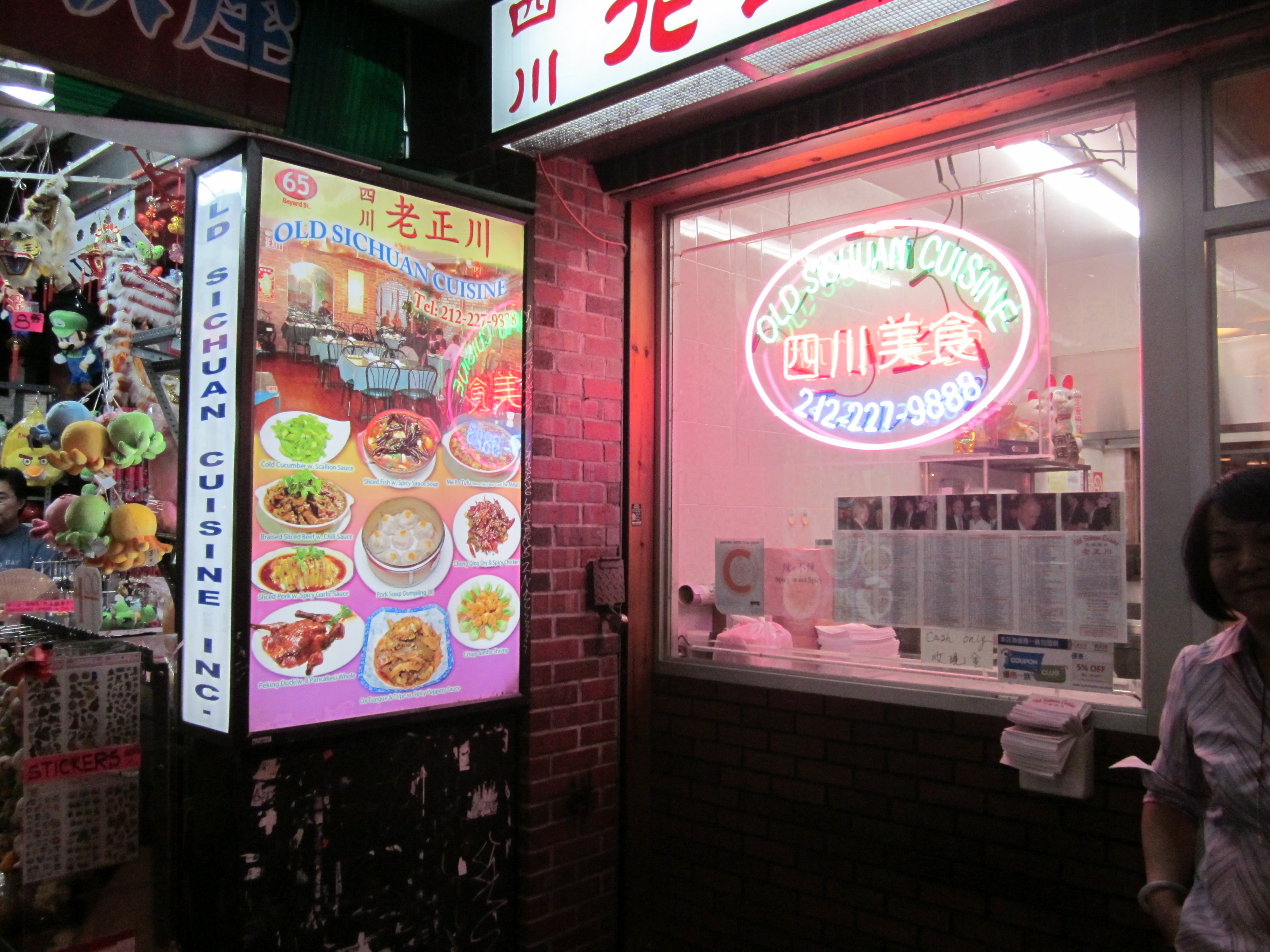
The C grade was prominently displayed on Old Sichuan’s window. There were no apologies and no disclaimers that the C was only “temporary.” When Zio, who chose the restaurant for our group, noticed the grade, he shook his head. “Uh oh, they’re gonna have roaches,” he said with a resigned shrug.

But he really knew better. The C was, for our group, in some ways a badge of honor, rather than a scarlet letter. And the hostess, a very pleasant woman who’s gap-toothed smiled never wavered, showed no remorse, urging Zio and I inside despite our telling her we would wait a few moments for the others to arrive. She stuck with us—proudly pointing out the pictures of some of the dishes on the side of the window, totally oblivious that there was C grade next to them.

Some of Old Sichuan’s choices in pictures…and a C grade.

Zio’s eyes went directly to the picture of the ox tongue and tripe.

“You like spicy?” Our hostess inquired.

“That’s why we are here,” I replied.

“That a cold dish,” she said, referring to the ox tongue and tripe Zio was salivating over. “But spicy. Come in. We have table.”

There was no point in hanging around outside especially since the bags of garbage on the sidewalks of Bayard Street were piled high and more than a little ripe. We went in and were given a round table in the back room.

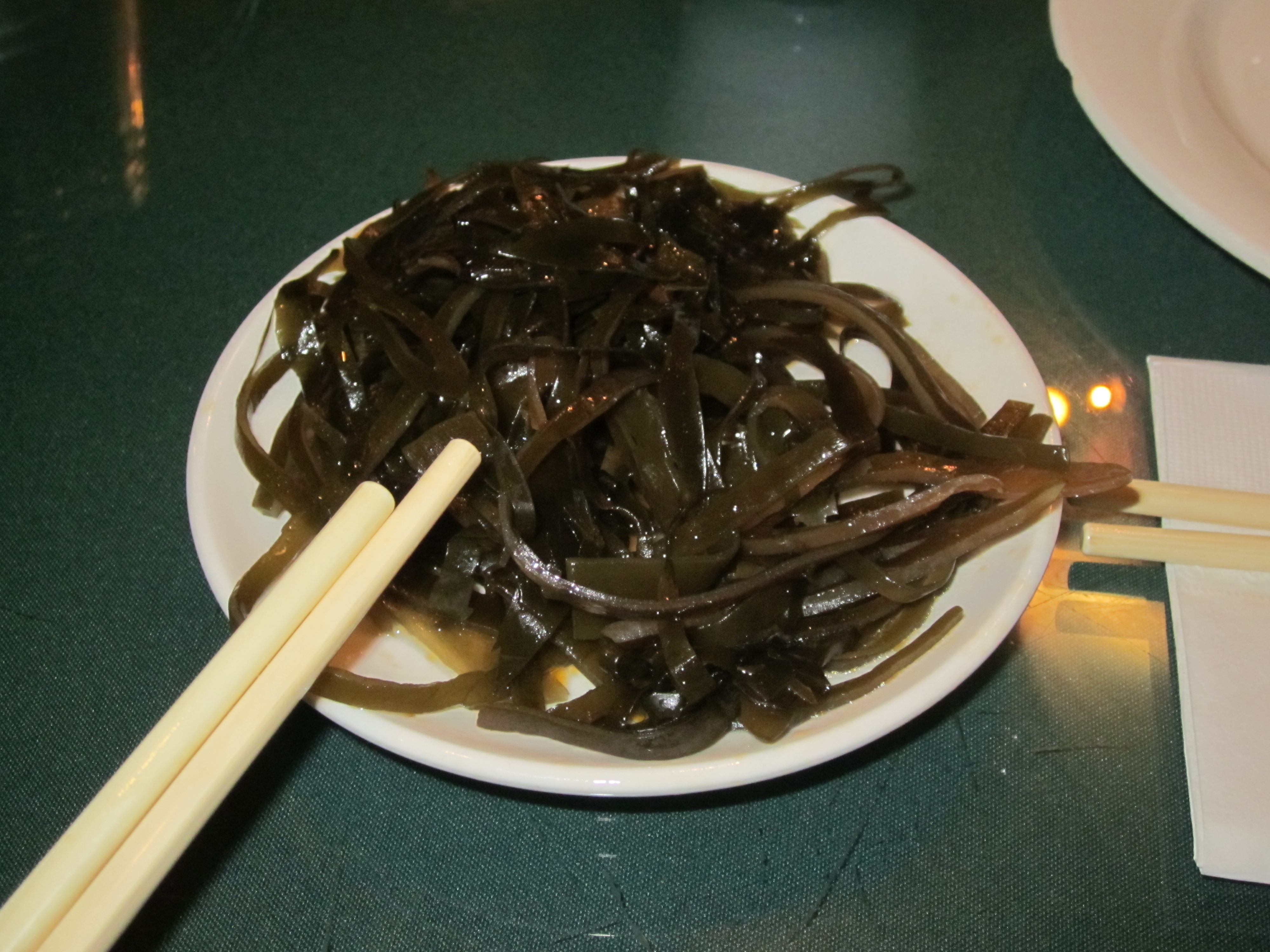
Before Zio could order his obligatory diet Coke (with lemon), the waiter brought us a plate of seaweed along with tea and ice water. Gerry and Rick arrived soon after. Gerry announced that Eugene would be a no-show due to a rare work commitment and that he just got a text from Mike from Yonkers that he would be a half hour late.

Seaweed, compliments of the chef.

While we waited, we put in two orders of Dan Dan Noodles and one of the picturesque, ox tongue and tripe.

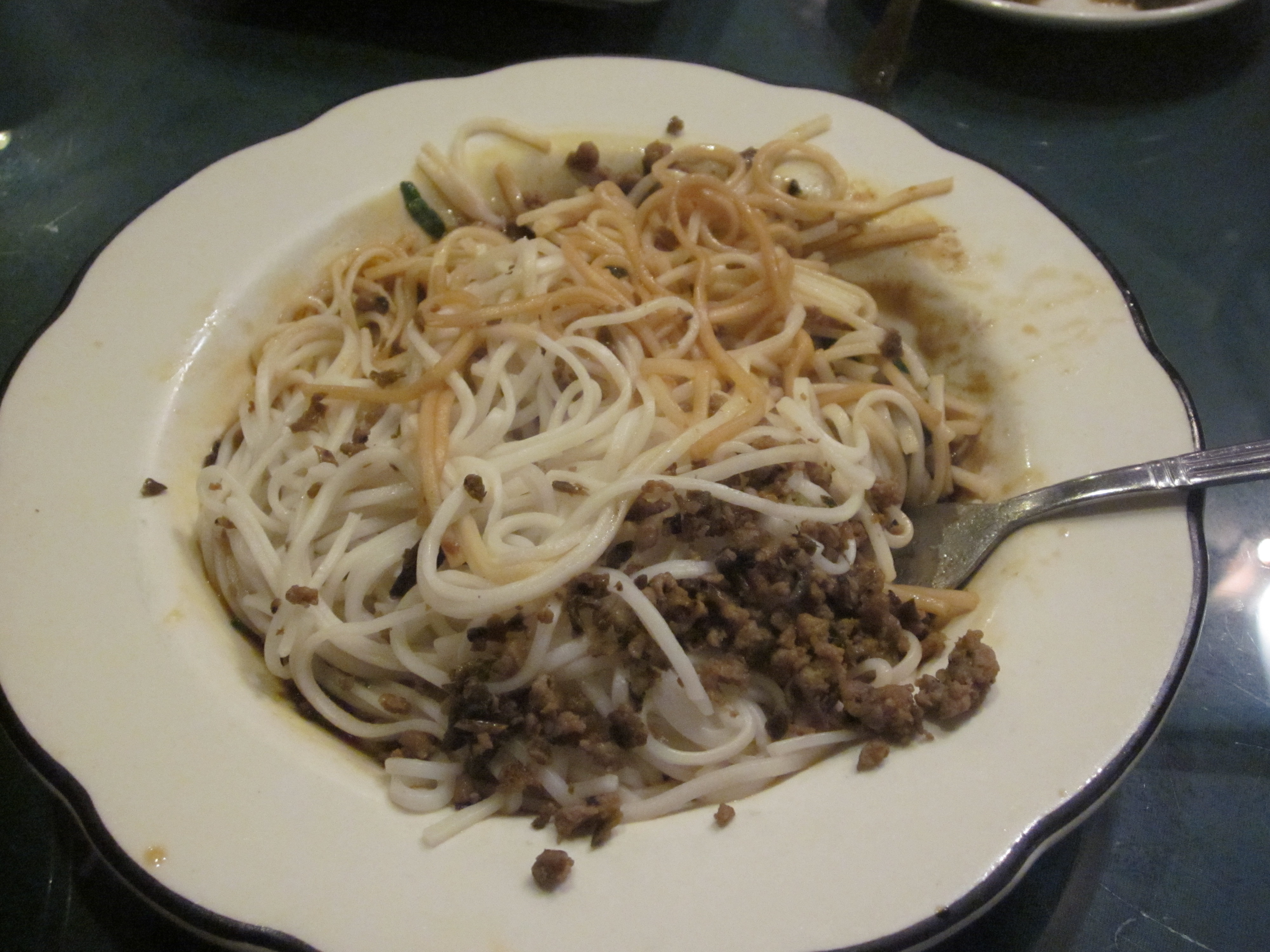
The noodles came out first and if Dan Dan Noodles were a barometer for the quality of the food at a Szechuan restaurant, Old Sichuan was clearly a serious contender for top honors. The noodles were fresh; the chili and minced pork perfectly balanced along with the addition of sautéed greens. The dish was sublime.

Dan Dan noodles

We approached the ox tongue and tripe hesitatingly. Rick was even more apprehensive thinking there might be chopped nuts; cashews, almonds, or walnuts, in the dish. We didn’t want to have to insert Zio’s soda straw as a breathing tube if Rick’s throat constricted due to an allergic reaction to the nuts. Peanuts were apparently okay, and that’s what we believed was in the dish along with chilies and tender slices of ox tongue and tripe. So Rick threw caution to the wind and speared a few slices with his chopstick.

Ox tongue and tripe

Needless to say, he survived which was a good and bad thing. We were happy we didn’t have to resort to a tableside tracheotomy, but that also meant there would be less of the delicious ox tongue and tripe for the rest of us, especially since we thought it would be the right thing to save some for Mike from Yonkers if and when he ever showed up.

Some of Old Sichuan’s specials that day.

And he did, just as we were about to order double cooked pork for him. He had no issue with our choice for him, but I was a little concerned about the baby lamb with green pepper I was considering.

“Is it cruel to eat baby lamb?” I asked our table of self proclaimed food geniuses. No one had an answer either way, so I went ahead and ordered it.

Fish in a little “hot pot.”

Zio wanted fish; he just wasn’t sure which one; the options were plentiful. He finally decided on fish and sour cabbage in a “little hot pot.” Rick splurged and ordered the tea smoked duck, while Gerry deliberated between mushroom with “grandma’s” sauce which would have been worth it for the name alone and our waiter’s recommendation; something called “sautéed sponge gourd.”

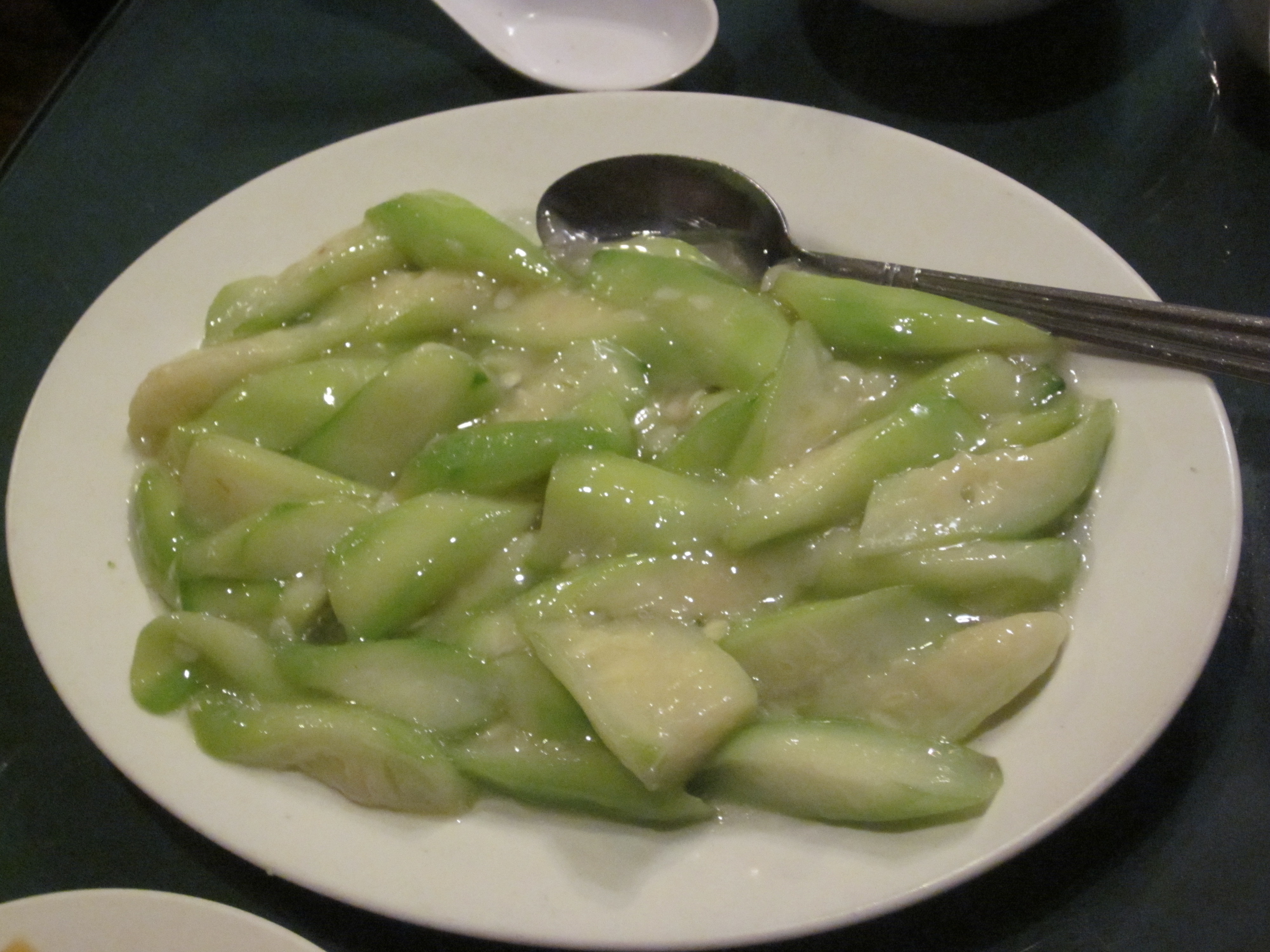
“What is that?” Rick asked when the platter of pale green vegetables arrived.

“Sponge Gourd, Square Pants,” Gerry replied, straight faced.

And, I must confess, they were the best sponge gourd square pants I’ve ever had….and I’ve had them all over town.

Sponge gourd, square pants.

We made quick work of our food; there were no losers among any of our entrees proving that Old Sichuan might be an oldie, but it was certainly a goodie. The only misstep was when we asked for our check.

The final tally was not unexpectedly, considered we all had two beers and that tea smoked duck and Zio’s little hot pot were extravagances for our group, over budget. But what was more disconcerting was when our gap-toothed hostess took our bill before Gerry had contributed his share. He had to make a run to an ATM: cash only at Old Sichuan.

I wondered where she was taking our money and followed her to a table up front where she gave it to a man who had been eating at a table near us. “He pay for you,” she said.

I watched as she gave him our money.

Bewildered now, I stared at the stranger. “You’re paying for us?”

“No,” he said. “Not for you.”

Apparently he wanted to pay for one of his companions before said companion was given the check and insisted on paying. The hostess realized her mistake and laughed.

“But we haven’t got all the money there yet,” I tried to tell her. She just continued to laugh and smile and took our money into the kitchen.

I peered into the kitchen and saw that she, along with our waiter, were counting our money.

I shrugged and went back to our table.

A few moments later, she returned and began counting out our money for us, indicating that there was not enough there.

“Yes, we know,” we said.

Still not sure if she understood, she left the unfulfilled check on the table, smiled, laughed a little, and walked away.

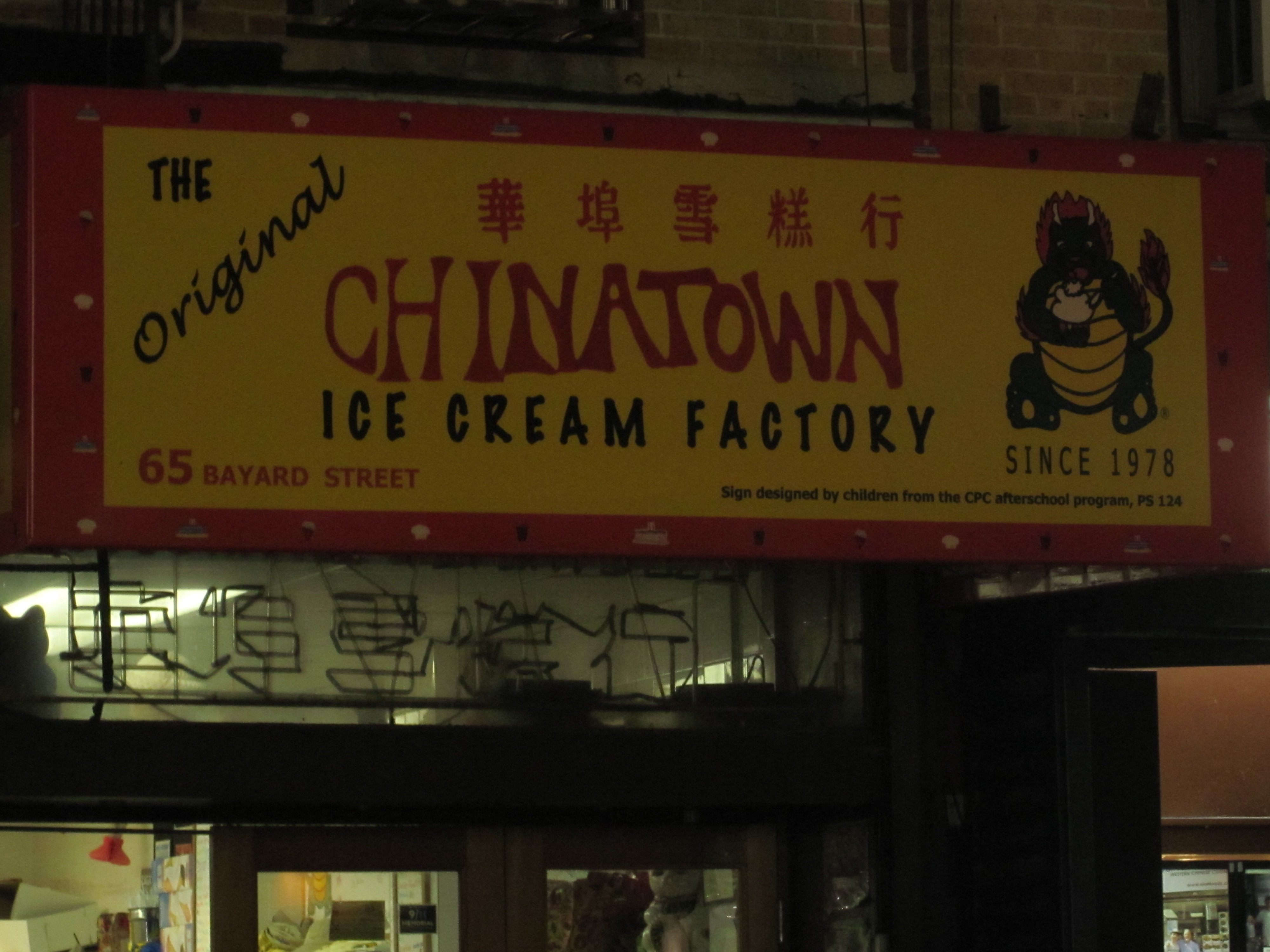
Gerry returned and we finally totaled out the check. We were about to leave when our waiter said not to go just yet. He had something for us. A pancake filled with melted chocolate. They were tiny squares with toothpicks speared in them. I picked one up. The hot chocolate oozed out and blistered my finger. I put it back on its tray. I didn’t really want it. I was saving what room for dessert next door at the Chinatown Ice Cream Factory.

Black sesame ice cream for dessert next door.

Old Sichuan was very good, but its location right next to the Chinatown Ice Cream Factory made it a standout and Gerry, Mike from Yonkers and I took our cones and happily ate them on the sidewalk amongst the piles of garbage bags and the putrid stench wafting from them.

The Place Where They Don’t Count the Shrimp

22 Nov

Sabrosura
1200 Castle Hill Ave
Bronx

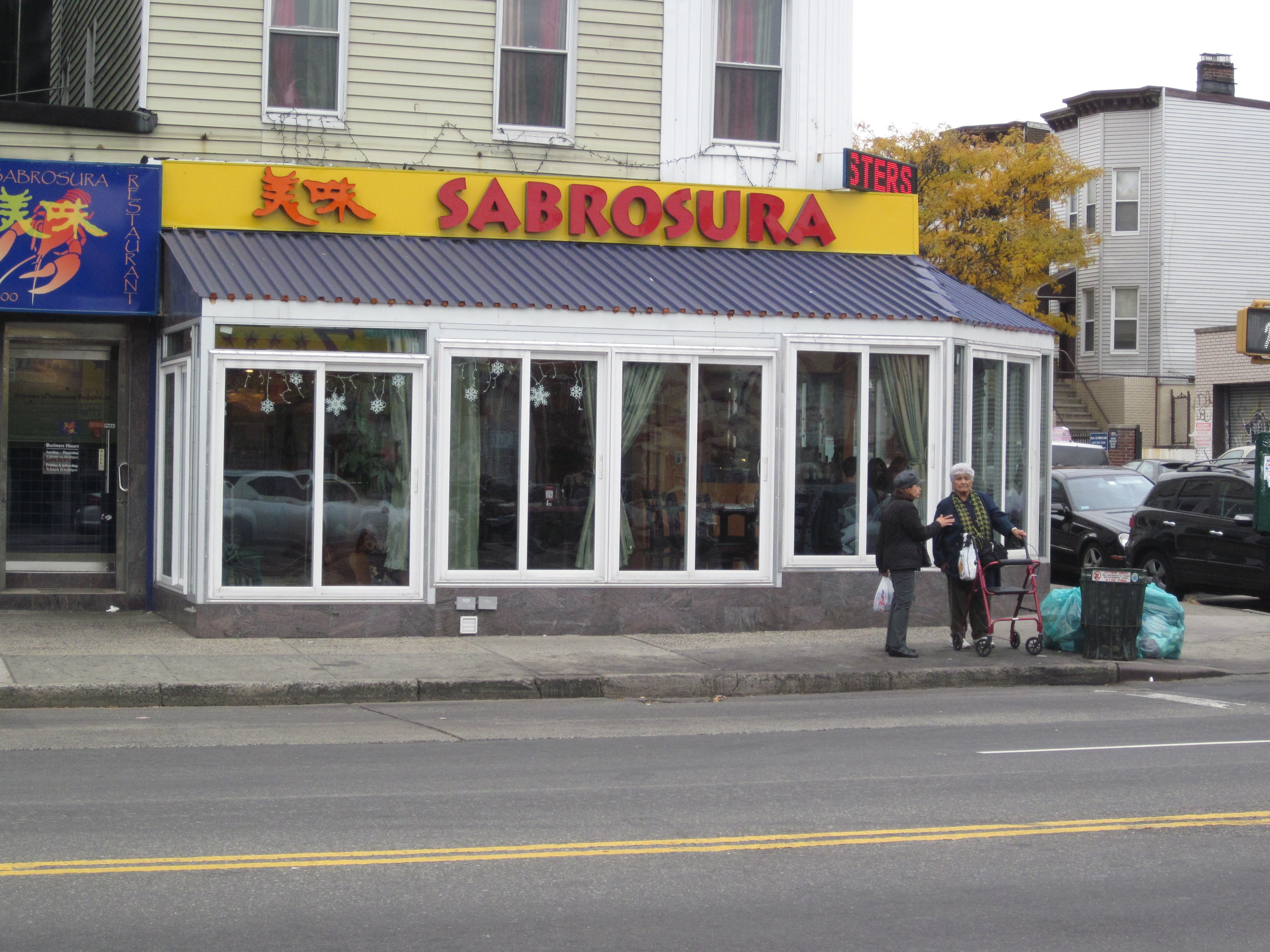
Zio and I were waiting in front of Sabrosura for Gerry, Mike from Yonkers, and Eugene to arrive. The corner restaurant had a no reservations policy and also one where the full party had to arrive before being seated. The latter policy usually reeks of arrogance and over confidence; the restaurant thinking that holding tables with one or two people of a larger party will slow down the turnover.  But despite the policy, Sabrosura showed no signs of pretension or arrogance and when I first entered, the owner, a pleasant man of Chinese heritage, who, I later learned was born and raised in Santo Domingo, took my name and offered me a very small seat near the busy take-out section of the restaurant where I could wait for the others. The night was mild, however, so Zio and I chose to wait outside.

“The food’s the best around here,” said a man who had exited the restaurant behind me and observed my situation. “It’s worth the wait.”

After our last couple of outings; mediocre African in Harlem and tasteless Fujinese in Chinatown where we struggled through webbed duck feet, fish stomach, and a very spiny eel, I thought we needed to get back to basics. And Chino-Latino, the food offered by Sabrosura, was as basic as it got for me.

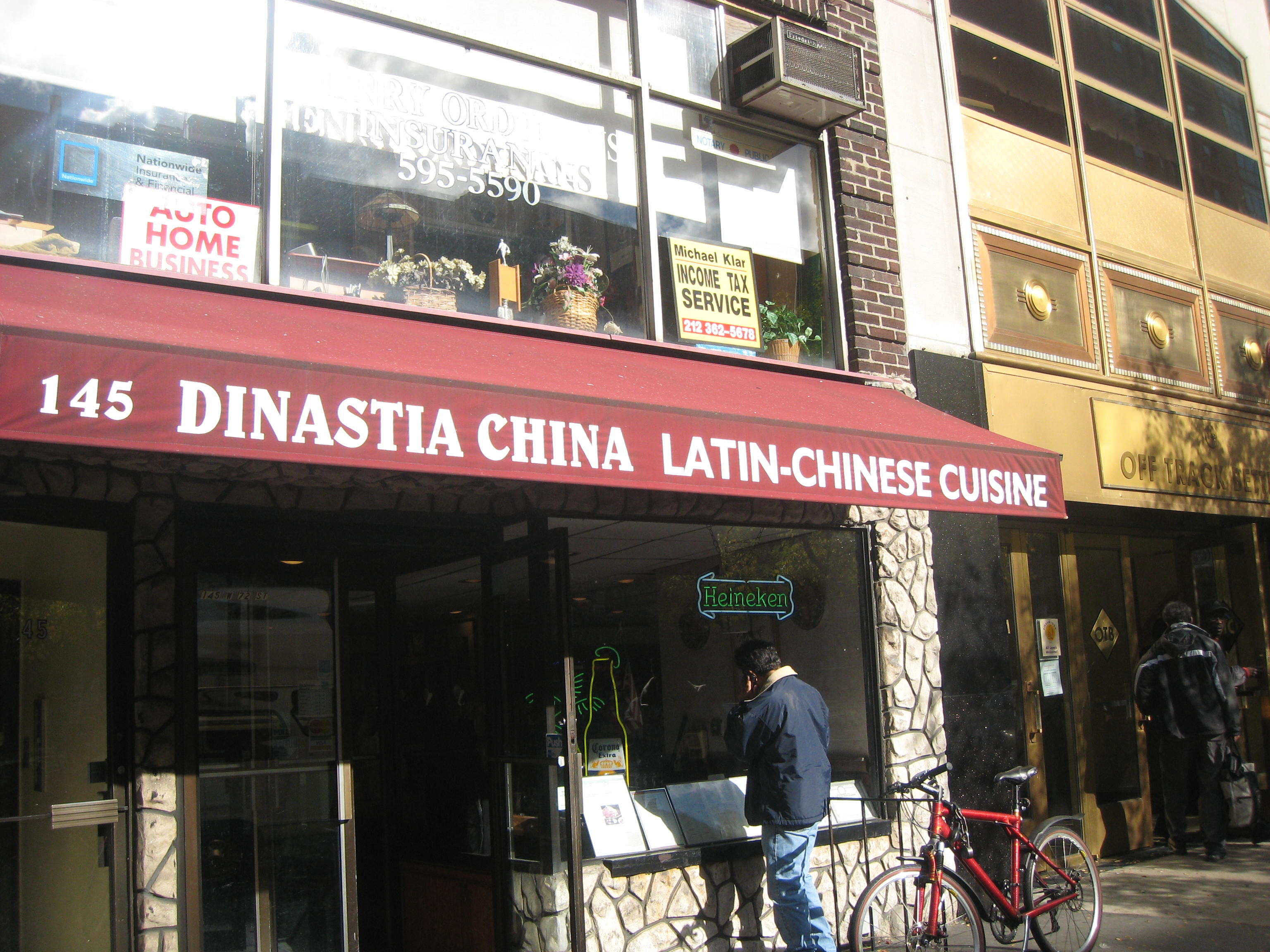
One of the first restaurants I dined in after moving into the city was a dingy place on West 72nd Street called La Dinastia. It served Latino specialties like rice and beans, huge plates of roast chicken with platanos or maduras (green or ripe plantains) ropa vieja (shredded beef), picadillo (spiced ground beef) and fried king fish along with Chinese-American staples; wonton soup, barbecued ribs, lo mein, fried rice, and sweet and sour pork. To me, at the time, it was a revelation. It was cheap. It was hearty. And the restaurant’s total lack of atmosphere perfect fodder to my then creatively downscale brain. Friends I brought to La Dinastia didn’t always agree and it was nicknamed by one as “Dinasty”. But that just spurred my loyalty to the place. Even the presence of a dead cockroach floating in the duck sauce one time I dined there did not sour me on the restaurant. That, in a way, was part of its appeal.

La Dinastia, now known as DInastia China

“They don’t count the shrimp or anything,” the man, who was in his early thirties, burly, wearing a tight sport jacket, neck tie loose and collar half turned up, who told us he was Dominican, added. “The other places around here…they only give you a few shrimps in your asopao. This is the place to come in Castle Hill.”

We didn’t have to prod him for information about Sabrosura or the state of dining on Castle Hill Avenue where Sabrosura was located; it flowed from him…until he got the signal that his take-out order was ready.

We spotted Eugene and Gerry in Eugene’s car looking for a parking spot. Zio and I went in the restaurant, but still they were hesitant to seat us. “Looking for a parking spot? Ha, that’s what they all say.”

Upon quickly glancing at the colorful menu filled with photographs of many of the various dishes, Eugene, obviously still stinging from our last inedible experience blurted; “Finally, there’s something we can eat here.”

And he was right, but the menu was vast and offered a number of combinations, some in triplicate, and even including Chino-Latino “Bento Boxes,” so the dilemma for us was to narrow the options down.

One thing La Dinastia, or most of the Chino-Latino restaurants I ever visited never had was that Puerto Rican/Dominican specialty, a mash of twice fried plantains, pork cracklings and garlic called mofongo. Sabrosura had a number of different types available and, as the menu stated “All mofongos normally include garlic and crispy pork skin; if you don’t want either, just let us know!” That was the kind of place Sabrosura was; anything for their customers. But we most definitely wanted garlic and pork skin with our mofongo and we wanted ours with shrimp. Gerry was concerned that one would not be enough until he saw that size of the bowl that was coming our way. The huge bowl was  a hollowed out mofongo filled with shrimp in a tomato-based gravy and topped with a few slices of avocado.

Chinese Chop Suey Soup

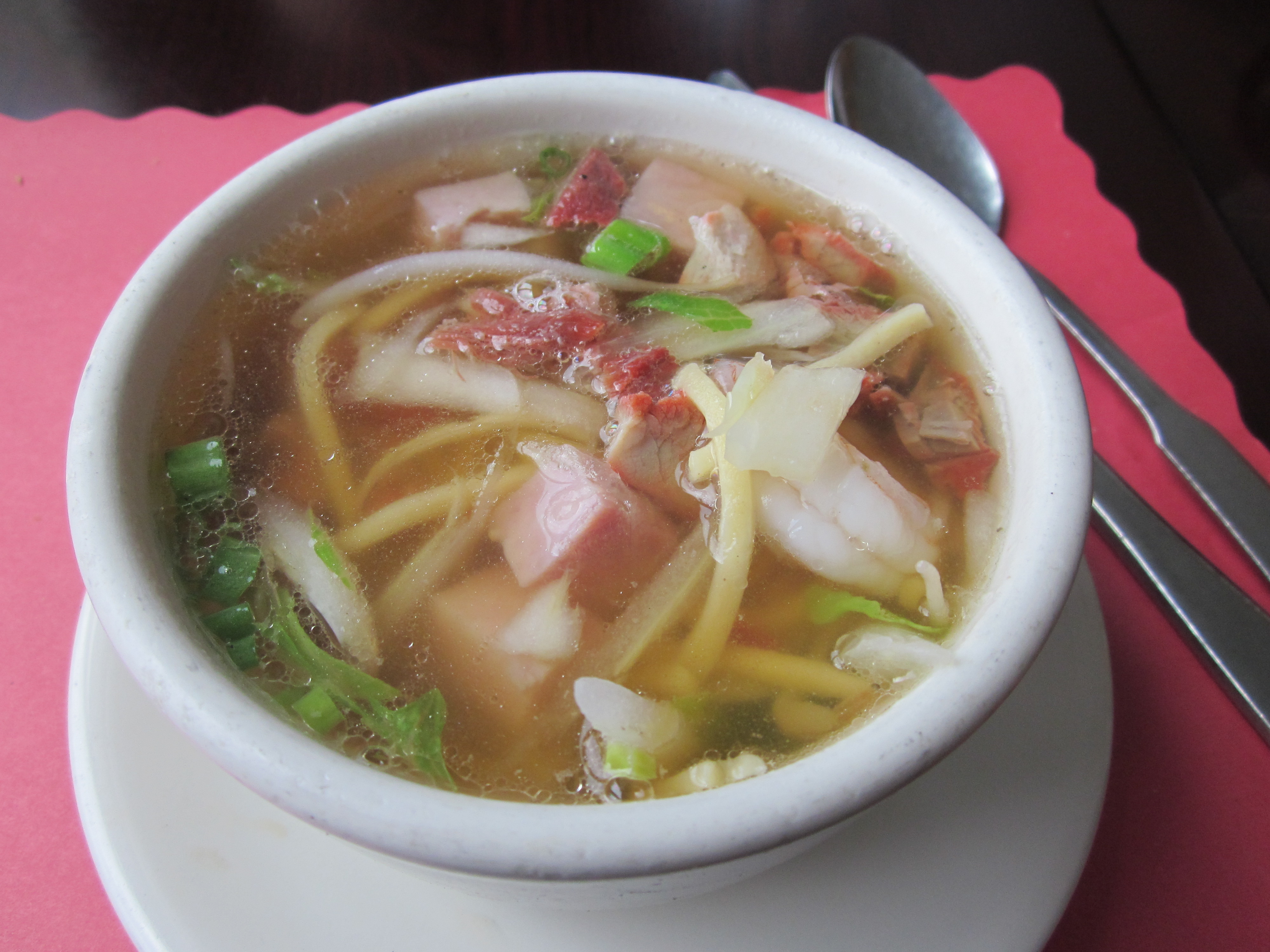
Along with the mofongo to start, I couldn’t resist trying the “Chinese chop suey soup.” My experience at Chino-Latino restaurants was that the soups were actually very good; whether they were wonton, or called “Chinese soup,” or “Special Chinese soup,” they were usually in a light chicken broth, brimming with bok choy, cabbage, bean sprouts, noodles and bits of roast pork, ham, and shrimp. At Sabrosura they didn’t care if they used the very old school word “chop suey” to describe their soup and neither did I. What I tasted was reassuringly familiar and after finishing it, left me, predictably, with a slight MSG buzz.

Bourbon boneless ribs and plantains

The feast proceeded from there. Mike from Yonkers slowly devouring a monstrous platter of broiled fish that looked exactly as it did on the menu. Eugene working his way through a combination called the “Mojito;” roast chicken and boneless bourbon barbecued ribs.  Zio experimenting with a Bento Box of fried fish, pork, and anything else that might immediately stop his heart. Gerry digging through a mound of fried rice topped with shrimp and squid called chofan, and I with my old standby, ropa vieja with yellow rice.  No one complained. No one moaned. Everything was eaten.

“old clothes” with yellow rice

After a sampling of the restaurant’s excellent flan, we staggered out onto Castle Hill Avenue all of us very happy that at Sabrosura, they do not count the shrimp.

F(e)asting on Fuzhou Style Fish Stomach

15 Nov

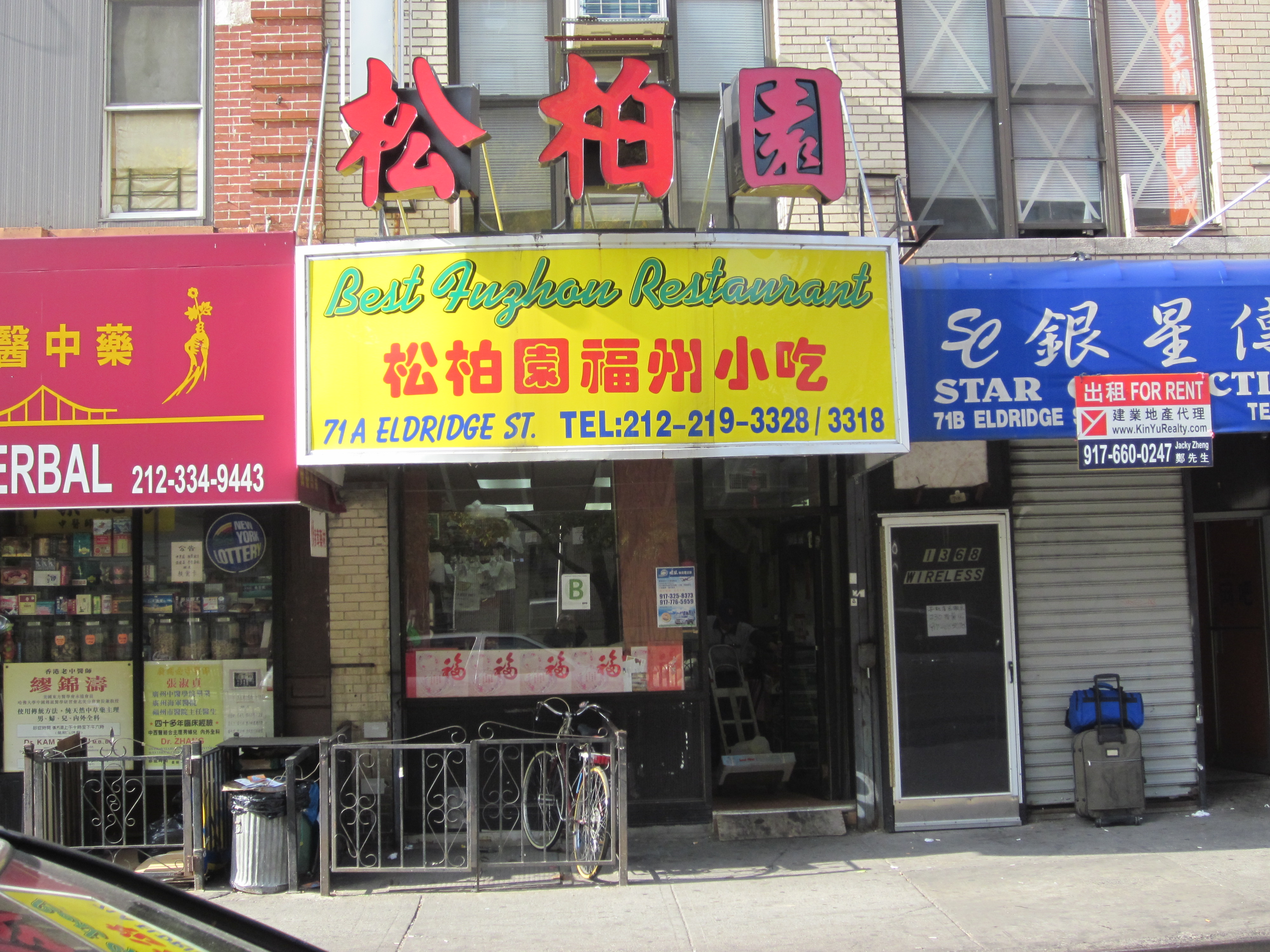
Best Fuzhou Restaurant
71A Eldridge Street
Chinatown

I got the call from Zio a few hours before we were all to meet at Rick’s chosen destination, Best Fuzhou Restaurant. “How you doing,” I asked.

There was a pause, and then Zio replied, “Not good.”

It was his knee, he explained. He did something to it and had to see a doctor in Connecticut the next morning. “I’m not gonna make it tonight,” he said.  I didn’t ask how it happened; I assumed it was in the line of duty. In Zio’s case, that meant possibly squatting in a crawlspace in search of termites or carpenter ants.

It wasn’t until later, after our Best Fuzhou experience that I suspected Zio might have just used the knee as an excuse not to be subjected to what we just were. That maybe he read the Robert Sietsema review of the place from the Village Voice that Rick attached to his email. I didn’t. I never read reviews of restaurants until after I’ve dined there. I didn’t even open up the link. Maybe if I did I would have seen the review’s headline and sub heading “Enjoy the Fish Stomach at Best Fuzhou: A Lower East Side Fujianese also Kindly Peels Your Goose Feet.” That might have at least tipped me off as to what to expect. As it was, I went in pretty much clueless except that I knew we were meeting in Chinatown for a regional variation on Chinese.

Our goose feet were peeled and cooked…I think.

Did Zio know that the aforementioned goose feet were, yes, kindly peeled, but also as inedible as the cow foot he tried to eat at Salimata, our previous restaurant? Did he know that the colorfully named “do do frog’s leg” that caught Rick’s attention on the menu required surgical precision to remove what meat there was on the frog’s skinny legs? Or that the conch that accompanied the goose feet (or web as it was listed on the menu) was as equally tough to eat? I wasn’t sure.  But one had to wonder.

When I arrived at the harsh fluorescently-lit restaurant on the Lower East Side fringe of Chinatown, the Westchester boys, Gerry, Eugene, and Mike from Yonkers had already arrived. I told them the news about Zio and hesitated before sitting while one of the waitresses grabbed a mop and began clearing the table next to ours and the floor around it from spilled, smeared brown sauce, and stray, smashed noodles. Rick showed up soon after and even with just five, the table seemed crammed; Zio’s girth would have severely limited any elbow space between us.

With the many exotic dishes on the menu and Sietsema’s apparently glowing review—the waitress, who spoke almost no English, proudly showed us a copy of it—Best Fuzhou seemed a natural for our group. For his part though, Eugene was immediately skeptical. Maybe the menu was a little too exotic. Studying it carefully and bypassing fish head with bean curd, crispy jelly fish skin, duck kidney with cauliflower, goose intestine with tender leek, stir fried pig stomach and other intriguing options, he finally settled on the safe, hot and spicy fish fillet.

On the other end of the spectrum, for Gerry, the more exotic the better and he gambled on eel with black bean sauce which carried no price, only the dubious “S.P” (Seasonal Price) next to it meaning it would be more expensive than anything else on the menu. To her credit, our waitress, in her struggling English, was able to make clear that the price for the eel in black bean sauce that was evidently in season was $28. Gerry hesitated, but only for a moment, before nodding that it was okay despite overshooting the $20 food limit stated in our very loose food group bylaws.

I tried to find a happy medium; something a bit out of the ordinary, but not a stretch like, do do Frogs legs, Rick’s choice. So I settled on the clams with pan fried noodles. As it turned out, the rice noodles lightly fried and speckled with strips of clam was the only dish we all enthusiastically approved of.

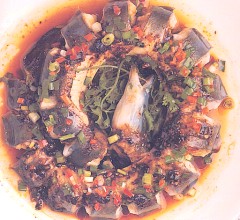
water melon with fish stomach and unidentifiable red stuff

The same couldn’t be said for the Sietsema recommendation, water melon soup with fish stomach, which arrived in a big bowl and was gingerly distributed into little bowls by our waitress who also added dollops of a blood red liquid I assumed was chili oil. After sampling the soup with the mysterious red condiment, there was no spice kick—no discernible taste at all.  Red dye? Fish blood? As I write this I’m still not sure what it was. The clear soup had chunks of water melon, a white, bland vegetable nothing like the watermelon we know surrounded by bits of fish stomach reminiscent to the egg whites floating in the opaque broth. Eugene could only manage a few sips. Only Gerry dared attempt a second bowl. And from there it got worse.

Mike from Yonkers, speaking loudly so he could be heard above the constant parade of big black garbage bags dragged on a noisy dolly through the small restaurant and out to the street, proclaimed to all who might think to listen that he never ordered the goose web. But the proof was on the menu and, unfortunately on our table. Again, it was Gerry who was the only one who could make any headway of the truly impenetrable peeled goose foot. Eugene would not even attempt a nibble and when the do do frogs legs arrived in a thick brown sauce, he picked up the serving spoon, noticed a few mushrooms surrounding the skimpy frogs’ legs and then put the spoon back down with a disgusted grunt. For a man who portends to have a worldly appetite, Eugene has an unusual aversion to mushrooms.

Eel with black bean sauce: (s.p) Good luck.

The final dish to crowd our not very appetizing table was the “seasonal” eel. After clearing a few dishes, the waitress found a space for the platter in the middle of table positioned so the eel’s head and cold, dark beady eyes were staring menacingly at Eugene. A few bites of the tough, bone-riddled eel in black bean sauce were more than enough for me…and everyone else including Gerry. This particular “S.P” delicacy was definitely wasted on us. Thankfully, we filled up on what on the menu were described as oyster pancakes, but more like a slightly salty Chinese version of the deep fried Mexican churro.

“We’re not having dessert are we?” Eugene muttered once the plates were cleared from our table. Maybe Zio, if he was in attendance, would have insisted on trying the Fuzhou style eight treasure rice offered for dessert. For those of us who did attend, however, even eight treasures were not enough to entice us to try anything else Fuzhou style.

Hot Pot Time Machine

4 Aug

Minni’s Shabu Shabu
131-17 38 Avenue
Flushing

It had been almost three months since we last convened and in the midst of deadlines, I never reported on the dinner. The place was called Minni’s Shabu Shabu  (www.minisshabushabu.com) in Flushing, Queens and though my memory of that night has blurred somewhat over the past few months, I do remember that it was very cold and the steaming hot pots offered at Minni’s were a relief. Eugene, going on the advice of a friend, had chosen the brightly lit restaurant where each table had a built-in hot pot filled with broth. There were on/off switches with a temperature control and each of us was given a platter of raw vegetables, two uncooked eggs, some starchy provisions we could not immediately identify, and rice noodles. Apparently, it was up to us to cook the food, but the combination of technical savvy and culinary knowledge of what goes into a shabu shabu (the meal created with the hot pots) was complicated and looking to Eugene, who supposedly researched the place, for any advice was futile.

The waiter who was busy buzzing between tables in the crowded restaurant quickly helped us get started; we had to order a meat or fish to be cooked in the broth along with the accompanying vegetables and noodles. The offerings were plentiful—lamb, pork, beef, clams, lobster, squid, tripe; all of it making it even more confusing. I kept it simple by ordering beef, but the waiter mistakenly thought I wanted the tripe and beef so along with thinly sliced raw round steak, I had a honeycomb of tripe as well which I quickly donated to Zio’s already enormous platter of uncooked shellfish and vegetables.

Ingredients for the hot pot

After dousing the beef into the boiling broth, the red meat immediately turned a sallow gray and tasted as lifeless as it looked. Maybe adding a few of the vegetables would help? I threw some cabbage and the eggs in the broth and then wandered to a buffet where a variety of sauces were available; hot chili sauce, soy, sweet barbecue, a green, coriander sauce, red tofu and countless others. Without any guidance, I began adding a little of all of them. The result was more flavor, but minus any distinction.

The color of…

All of us were pretty much clueless on the art of making shabu shabu with the notable exception of Mike from Yonkers who was deliberately adding ingredients; slowly layering his soup with flavors. Whether it was an act or something he was a natural at, we will never know, but he certainly looked good doing it. So, though most of my broth had evaporated and the ingredients already devoured, I mimicked Mike from Yonkers’ technique, and, surprisingly, the last remnants of the soup was now a hearty, flavorful meal. Next time I visit a shabu shabu place, I’ll be better prepared though, in all honesty, that next time won’t be soon.
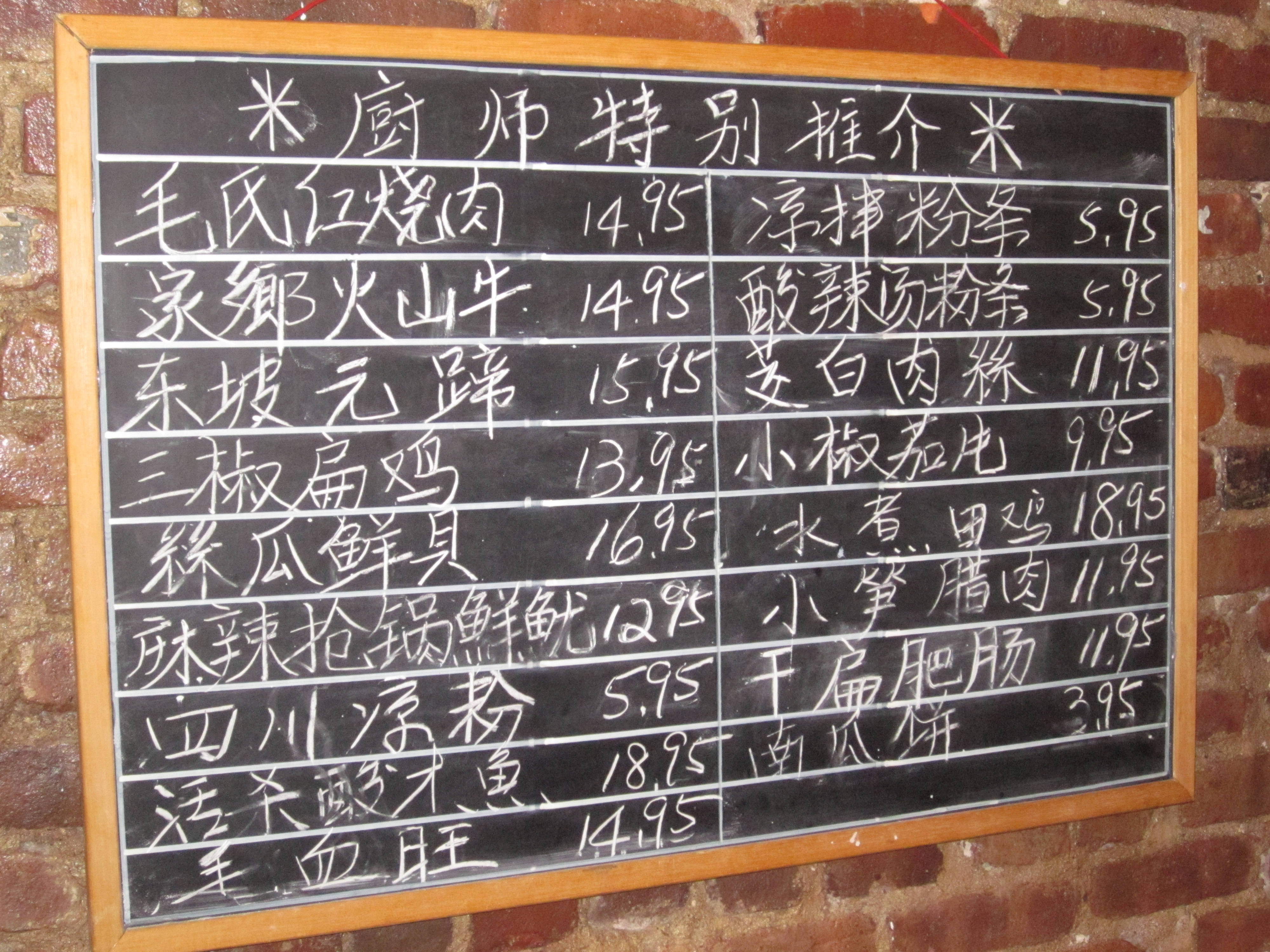
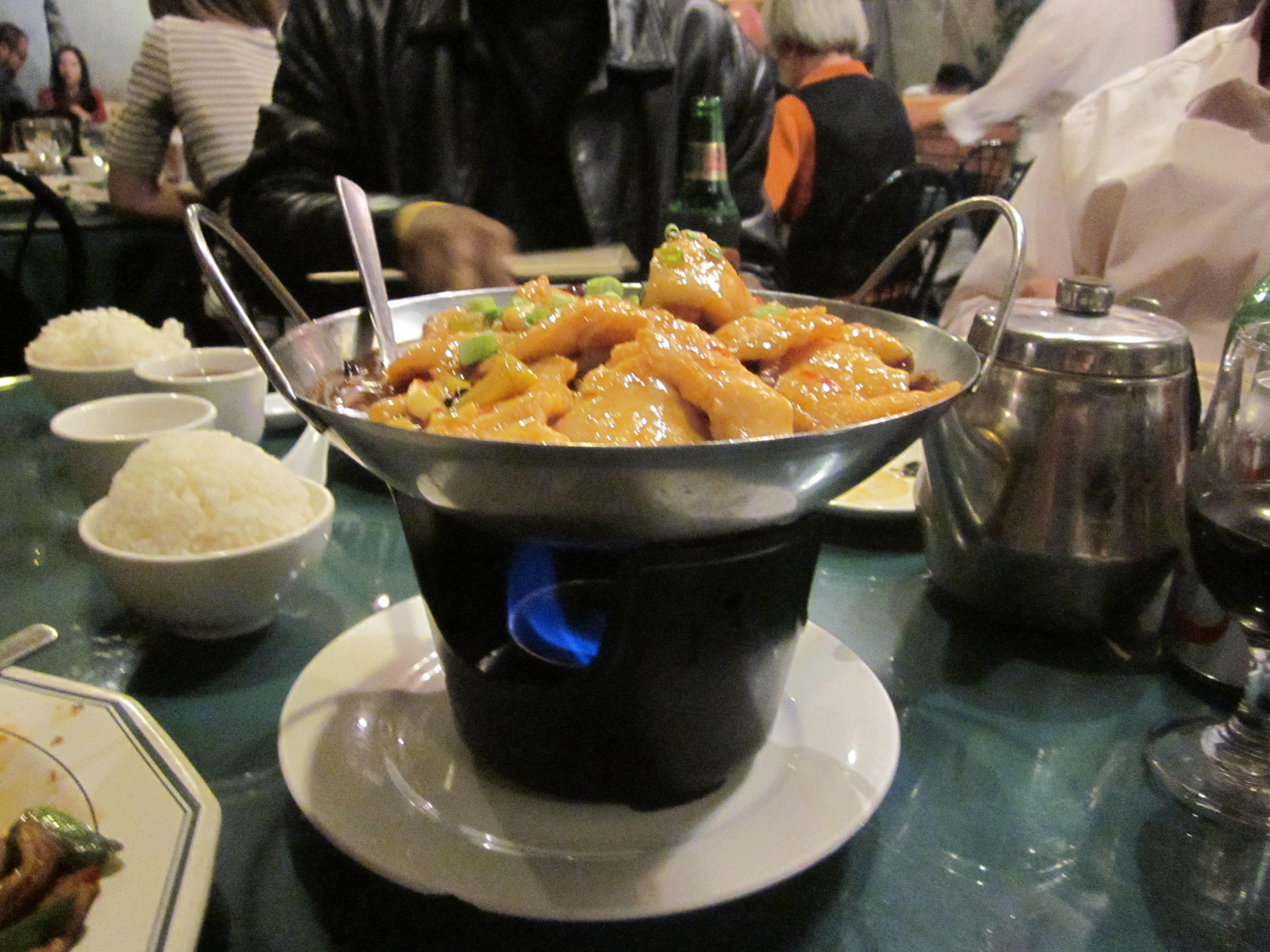
We last visited Minni’s in Flushing in 2008. It still goes strong and now, I believe, deserves a return trip.