What’s with the pig haters?

Why, Mookie, why?

And nothing to eat at Strictly Roots that roots around in the mud?

Now did you have to go and call it swine?
Just remember, it’s the other white meat.
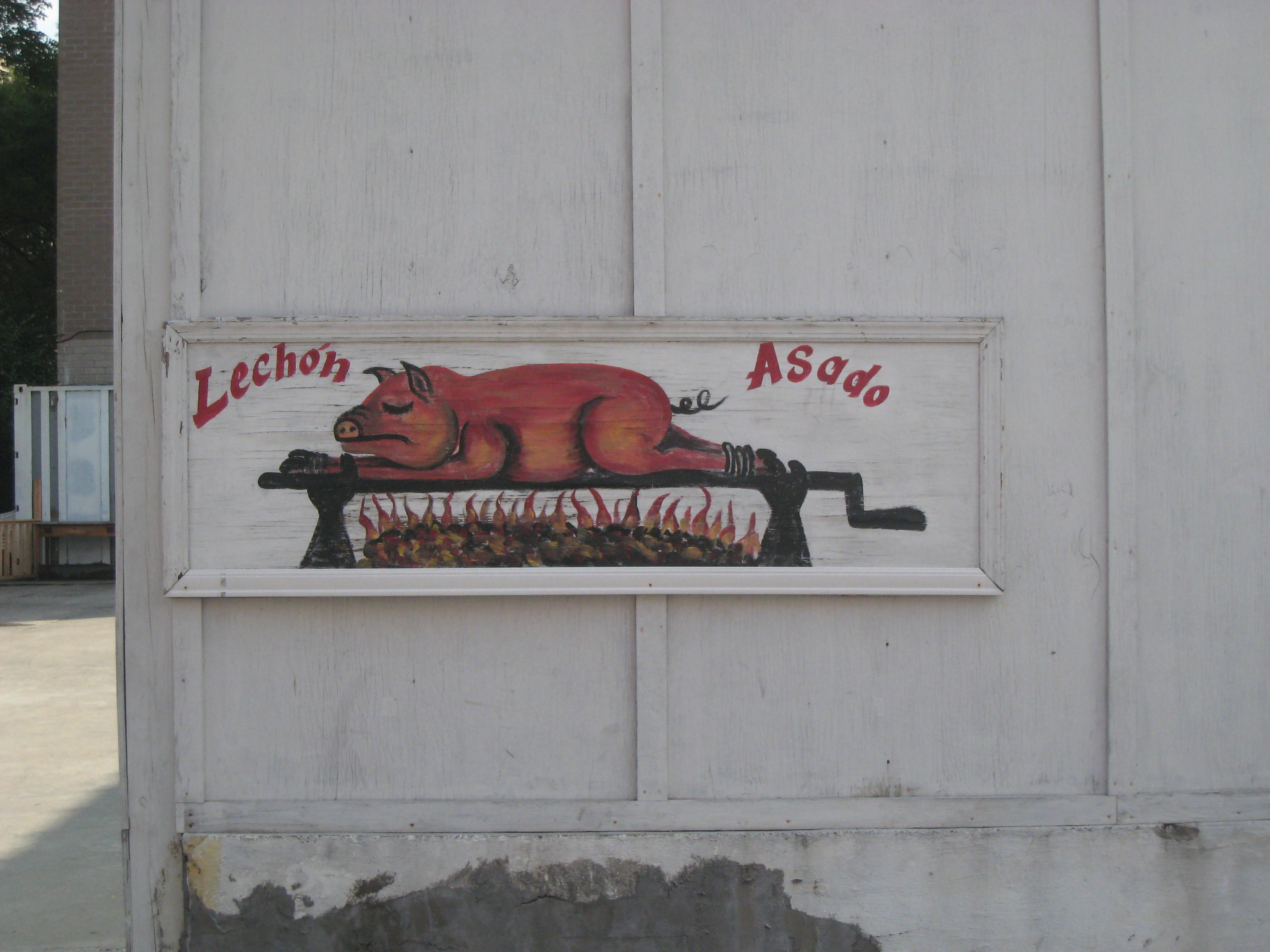
Pigs have feelings too. Be nice.
What’s with the pig haters?
Why, Mookie, why?
And nothing to eat at Strictly Roots that roots around in the mud?
Now did you have to go and call it swine?
Just remember, it’s the other white meat.
Pigs have feelings too. Be nice.
Minang Asli
86-10 Whitney Avenue
Elmhurst

The snowflakes were falling heavily when I exited the Elmhurst Avenue subway station. On the other side of Broadway was Winnie’s Bar while across the street from the station was the Hong Kong Supermarket. It all looked eerily familiar and when I noticed Taste Good restaurant nestled next to the supermarket, it was like déjà vu all over again. I was in the exact same location when we last convened and dined at Taste Good.
As I navigated the dark, snowy streets to our next destination, chosen by Eugene, the Indonesian Minang Asli, I realized that our previous three restaurants were of the Asian bent, including the Malaysian, Taste Good, the Vietnamese Bronx find, World of Taste Seafood, and the Upper East Side fusion of Korean, Japanese, Thai, Chinese, and Vietnamese, Buddha Bbeeq. Not that I was complaining.
Zio was shivering outside the small restaurant when I arrived. Why he was standing outside freezing when there were three very gracious Indonesian women in the otherwise empty restaurant gesturing for him to come in, was beyond me. To escape the cold, I needed no prodding and he followed me in.
A small electric heater struggled to add a little warmth to the chilly, non-descript dining room. We were told we were expected; Eugene had called ahead to reserve a table for what was to be a party of five. Rick had already excused himself on account of a corporate holiday celebration that, incredibly, did not require the guests bring their own bottle. Free food and drinks during these dismal days?* Who could blame him for going with the free stuff despite having to endure the obviously fake giddiness he would most likely encounter?
Zio and I waited for the others to arrive in the cold confines and then, after about fifteen minutes of waiting, Zio blurted, “I’m starving!” We ordered beef stew soup and pempek palembang, also known as deep fried fish cake in a sweet and sour vinegar sauce. Gerry, Eugene, and Mike from Yonkers, who commuted together from Westchester arrived just as one of the three aforementioned waitresses brought soup bowls and what we thought was soup.

Pempek palembang: soup it is not.
In our frozen delirium, not to mention our unabated hunger, we spooned the dish into the bowls and began to eat. I wondered why the soup was cold and then realized that we actually were spooning the fish cakes and sauce into our mouths instead of the soup, which came a few minutes later. Were the three Indonesian women giggling because we had just made fools of ourselves? Maybe so, but our gaffe didn’t faze Zio who continued to slurp at the cold vinegar sauce. I was less concerned about our faux pas when I glanced at Minang Asli’s menu and noticed its proclamation to “leave your manners behind, and eat your heart out.”.
The standard in Indonesian food was set a few years back at nearby Upi Jaya and, despite ultimately developing calluses on our intestinal tracks that have since come in handy when confronting the extreme heat of chili peppers that we so often endure in our adventures, we were initiated to the pleasures of Indonesian cuisine, and most notably, the signature dish, beef rendang. It was the gauge to measure an Indonesian restaurant’s authenticity. Would they prepare the dish in the uncompromising, harshly spiced manner it is meant to be prepared or would they soften the blow; alter it somewhat to appease the Anglo tongue? We unanimously agreed to find out.

Beef rendang: the measuring stick of Indonesian suthenticity.
Maybe it was because my aforementioned intestinal track had been callused, but Minang Asli’s version of beef rendang seemed a tad milder than the one I remembered at Upi Jaya and only for that reason was it a close second to what we experienced years back.
You never quite know Mike from Yonkers’ reasoning, and when he resolutely put the menu down and said, “Gotta have the brains,” meaning the menu option of beef brains stewed in lemongrass flavored coconut milk, we knew better than to dig any deeper into his already complicated psyche.

One brain left
Gerry was disappointed the kale leaves were not available, but settled instead on the jackfruit, a starchy, blander and less juicy or tart version of a pineapple. To please Zio we ordered the whole fried red snapper in a lime and soy marinade and added another Indonesian/Malaysian staple; gado gado, a traditional dish of mixed vegetables in a peanut and sweet soy sauce.
The noodles we ordered, a lo-mein-like dish, was a disappointment but not enough to stop us from cleaning the platter. In fact, all that remained on our table was a solitary beef brain—its creamy consistency an acquired taste that, apparently, most of us, including Mike from Yonkers who ordered it, had not acquired.
No one had entered the restaurant during our meal and the owner/chef, her coat on, thanked us for coming and announced that now that we had finished, she could go home.
The food must have brought out Eugene’s reflective nature when, looking up at the television where Snoopy was decorating his dog house with Christmas lights, he sighed. “Imagine,” he said, “us all alone here in Queens, in this Indonesian restaurant with ‘Charlie Brown’s Christmas’ on the television.”
We didn’t have much to add to his comment so we slowly gathered our coats and headed out into the cold.

Dining entertainment
*This was December, 2008, and just months after the Wall Street meltdown of that year.
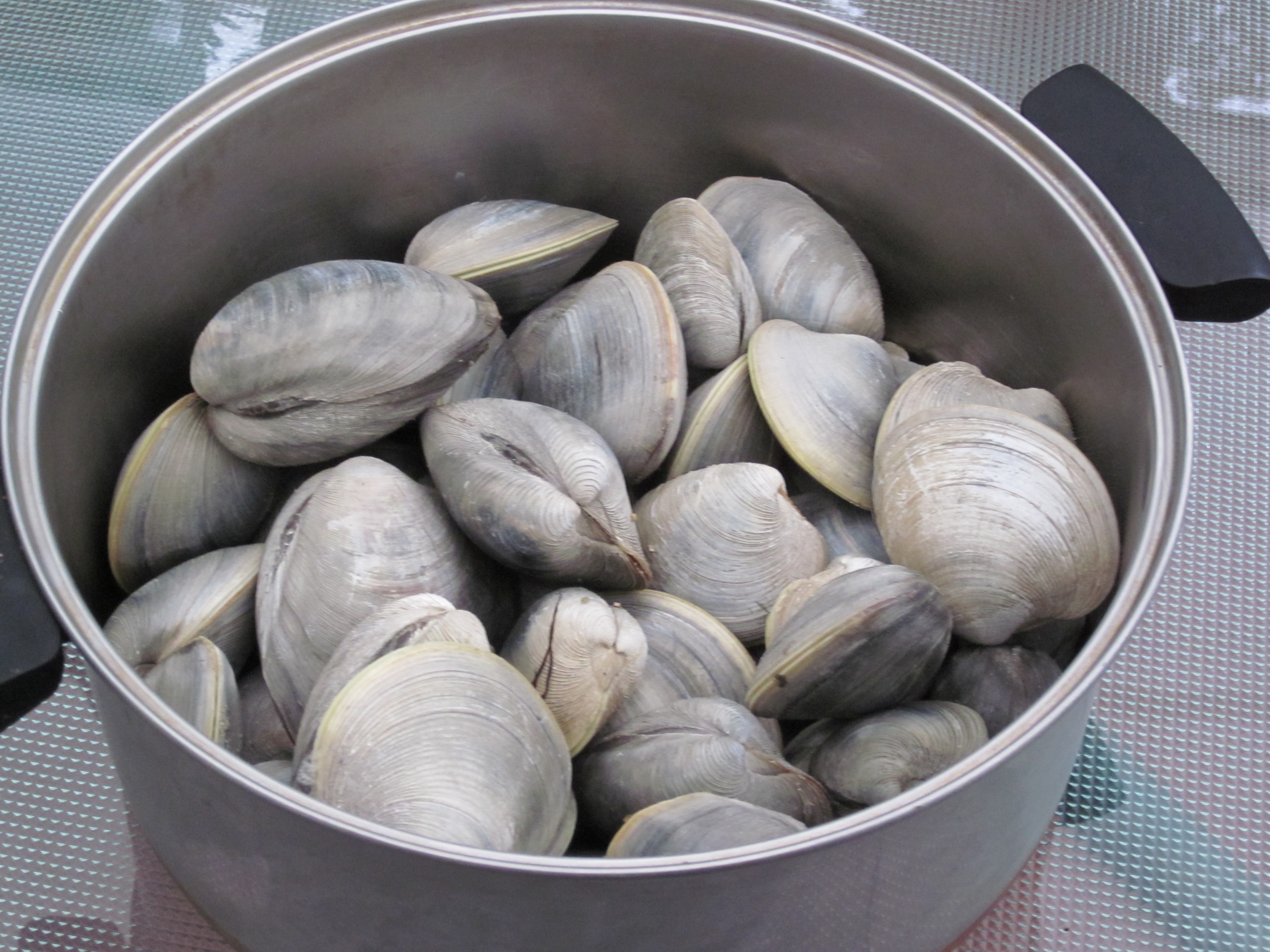
Nauset Beach Clams
Thanks to the hard work of the very generous owner of the 100-year-old house I rent with my family each summer in Cape Cod, a bucket of freshly dug little neck and cherrystone clams was waiting for us when we returned one day from the beach. I could make chowdah, New England-style with potatoes, milk, onions and bacon. I could just open them up and eat them raw. I could steam them and dip them in butter and broth. Or, considering I had several ripe, in season, tomatoes that I wanted to use before they became overripe, I could make linguini with clam sauce, Manhattan-style (meaning a tomato-based sauce).

Local tomatoes
Given the option at a restaurant between red or white clam sauce, I always prefer the latter; the hearty red tomato sauce usually obscuring the distinct flavor of the clams. White clam sauce works for me. The garlic, olive oil, white wine, some red pepper flakes, and then the broth from the just opened clams makes for the perfect complement to either spaghetti or linguini. It’s easy to make and really, the only danger to screwing it up is to overcook the clams.
But with those ripe tomatoes and the bucket of clams, I decided to take a chance and combine the two over linguini.
This is what I used for the sauce:
4 overly ripe fresh, large tomatoes, diced.
20 clams (Cherrystone and Little Necks combined)
3 cloves of garlic
1/4 cup of chopped white onion
2 tbs of chopped basil
1 ½ pounds of linguini
¼ cup of olive oil
½ teaspoon of hot red pepper flakes
I first diced the tomatoes not bothering with skinning or seeding them and put them in a bowl with a few sprinkles of Kosher salt. While the tomatoes macerated, I rinsed the clams in cold water to remove whatever sand was clinging to them. Once cleaned, I put the clams in a big pot adding about an inch of water to steam them.* Covering the pot and turning the fire on high, I steamed the clams just until their shells opened and then put them aside.
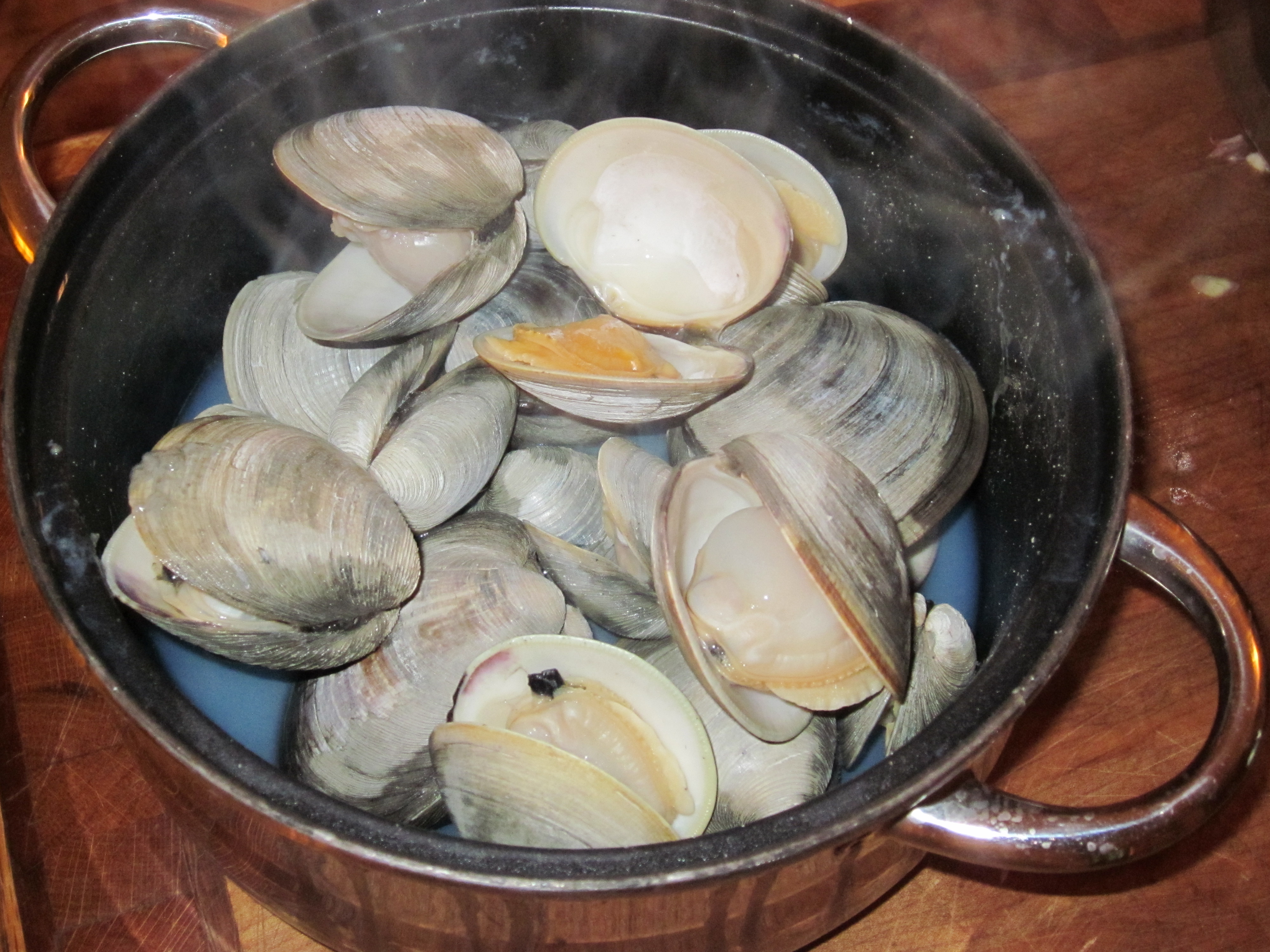
The clams now steamed open.
Using a large skillet, I added the olive oil and softened the onions and garlic sprinkling the red pepper flakes into the pan. When the onions and garlic were cooked, I tossed in the tomatoes adding the broth from the steamed clams and brought it all to a low simmer.

Cooking the tomatoes down
While the tomatoes cooked down, I removed the clams from the shells and roughly chopped them. Chopped clams, in my opinion, should not be uniform in size. I like the surprise of a big, juicy belly along with the tougher tail end of the clam.

The clams chopped.
After chopping the clams, I boiled the water for the linguini. Once the water boiled, I tossed in the pasta, adding salt to the water. Just before the linguini was cooked al dente I folded the chopped clams and the chopped basil into the sauce, keeping it on a fire just hot enough to heat them.
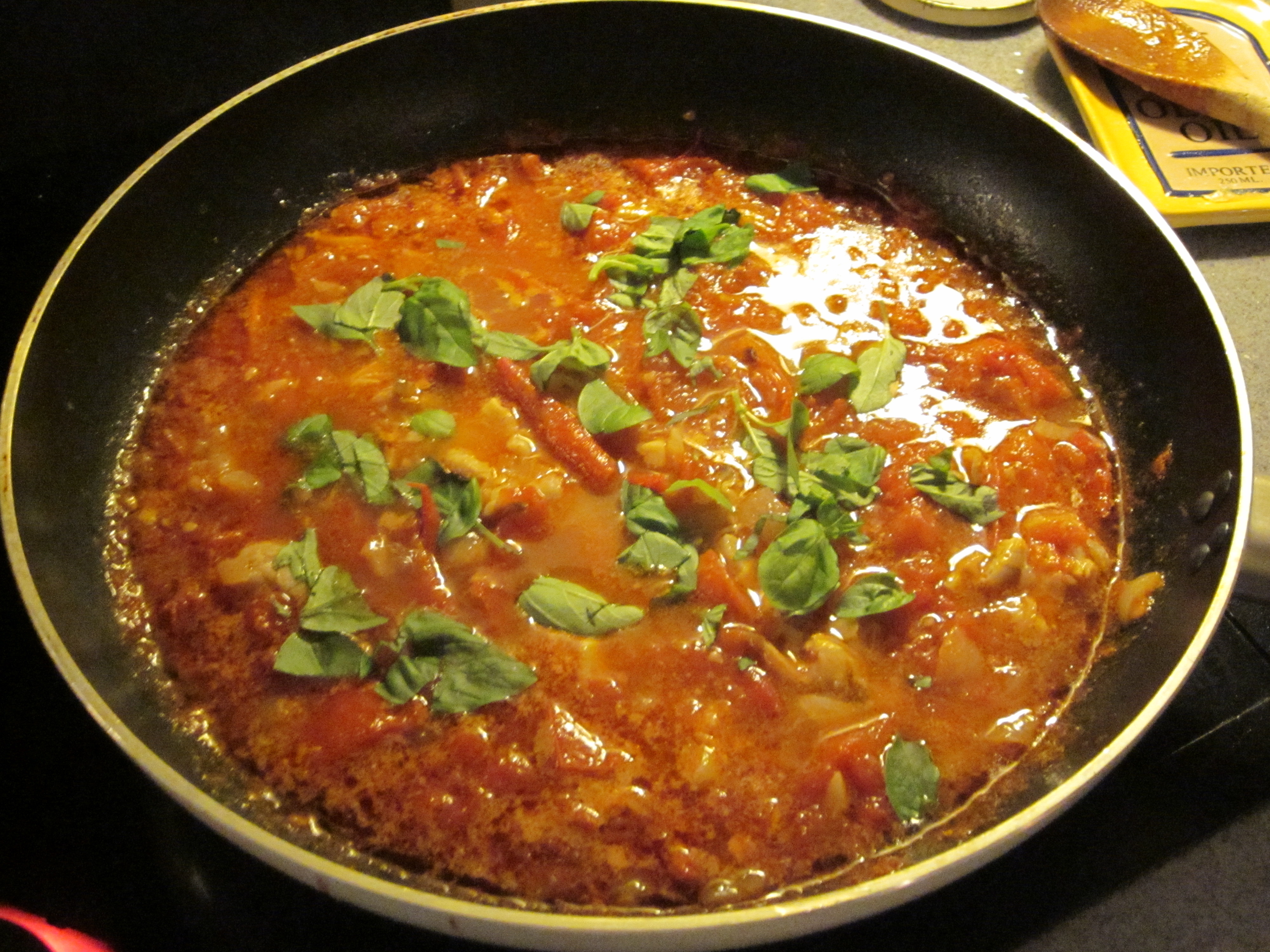
The sauce.
Using tongs, I tossed the linguini in the sauce and then into bowls.
The result was a light, fresh, briny tomato sauce where, in this case, the flavor of the clams and the broth balanced each other perfectly.
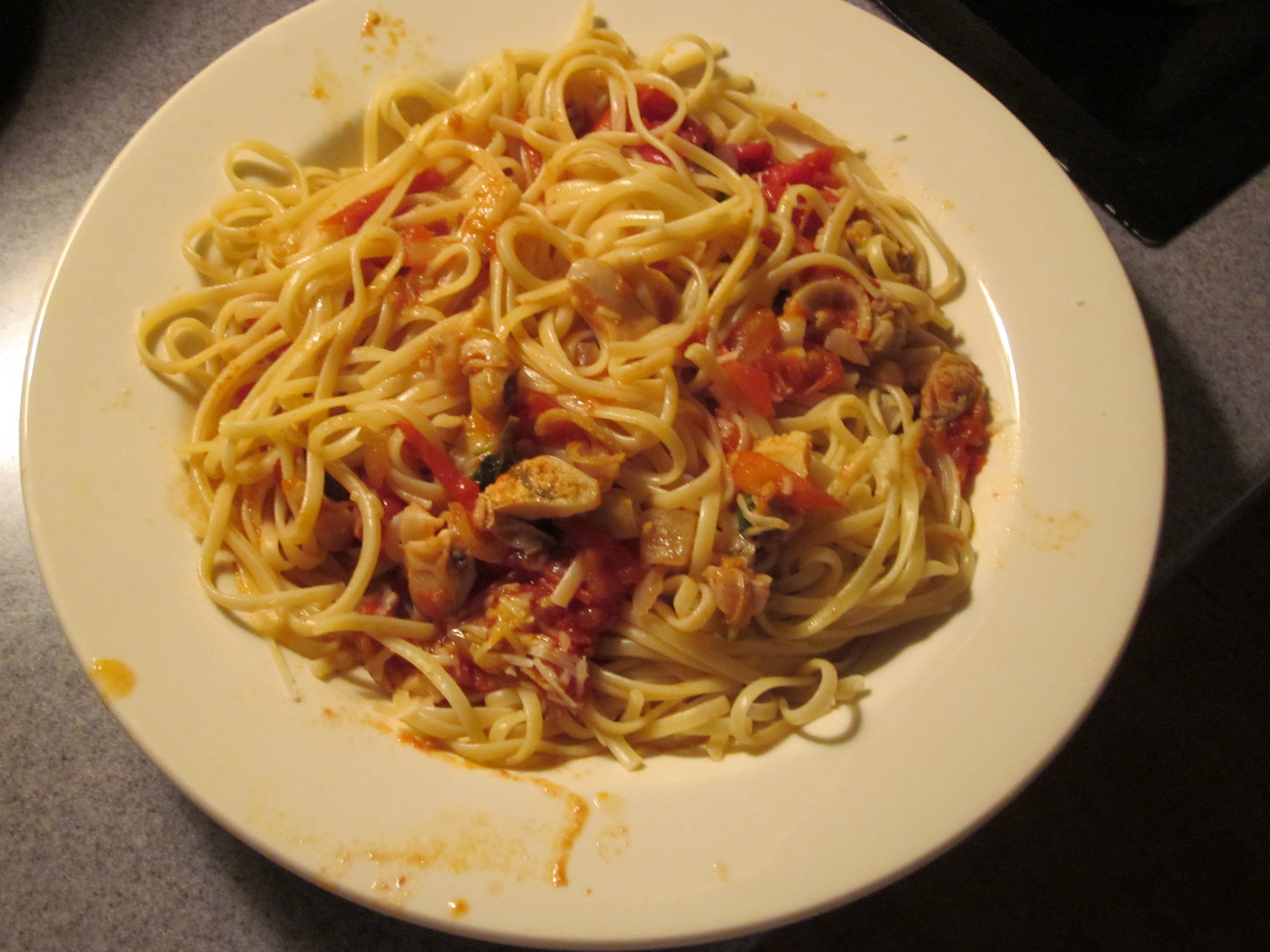
Linguini and Cape Cod Clam sauce: Manhattan-Style: As pretty as it gets after too much “limeade.”
*Before I began preparing the meal, I had told myself to save about a half dozen of the smallest of the little necks to steam open directly in the sauce. The clams in their shells would not only look nice, but because of their size, also remain tender. But while preparing the above dish, I began to consume multiple glasses of limeade spiked with vodka and when it came time to steam the clams, dumped them all into the pot including the few I was hoping to reserve. Once I realized my mistake, it was too late. The little necks were cooked.
World of Taste Seafood and Deli
R.I.P
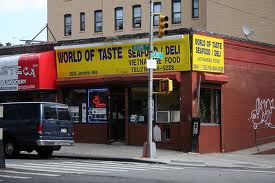
World of Taste Seafood Deli: Circa 2008
After several years now of conducting these eating excursions, most of us in our group understand that it is imperative to always double check on the status of the establishment chosen. And the more obscure it might be, the more diligence required. An African restaurant ballyhooed by the Village Voice in, say February, might no longer exist by July. This time it was my turn to choose our destination and always looking out for the oft-neglected food borough, the Bronx; I did my research and came up with the name of a Vietnamese restaurant situated in an unlikely location on a stretch of Jerome Avenue which runs just below the tracks of the elevated number 4 subway line.
The restaurant was named Phung Hung and, a few days before we were to meet, I called and spoke to someone who seemed to confirm I had found the right place. On the date of our scheduled dinner, I remembered at the last minute to call once more—just to be absolutely sure of its authenticity. This time there was confusion. Was this not, Phung Hung? Had I dialed a wrong number? Whoever answered lost patience with me and hung up. I quickly went onto the computer and typed in the address and found another option; a restaurant called World of Taste Seafood Deli. I called again and was told that the same restaurant was formerly called Phung Hung but its name had been changed. The man I spoke to also told me that he would hold a table for six for “Mr. Brian.”
Seeing the restaurant on the corner of Jerome and 193rd St, I realized why the name was changed. There were photos of fried fish, chicken wings, fries and other fast food Chinese items displayed in the window. It was an appeal to the demographics of the neighborhood to offer what was familiar and safe, but, thankfully, the Vietnamese menu was also available. Gerry and Mike from Yonkers had already arrived and seated at a small round table in the stifling, Vietnam-like climate of the restaurant where a ceiling fan and an enormous window air conditioner cooled only those in their immediate vicinity.
Jerome Avenue
Gerry had a six-pack of beer in a brown paper bag and, at first, was brusquely told he couldn’t bring it into the restaurant. A moment later one of the proprietors, a woman of color who seemed out of place working in an Asian restaurant, asked Gerry if he “talked to David earlier.” Gerry, understanding that it was I who must have spoken to David, who, we learned, was the person I contacted on the phone making the reservation for “Mr. Brian” nodded and, immediately, was granted permission to bring and drink the beer, as long as it was in a paper cup. Apparently “Mr. Brian” carries some serious influence.
Eugene was a late scratch and Zio and Rick were on their way. While we waited, I noticed that most of the cooking in the open kitchen was done by two tiny elderly Vietnamese women. The possibilities of what was to be created in the kitchen by their experienced and no doubt skilled and comforting hands immediately excited me. The anticipation along with the heat combined to form a growing sheen of perspiration around my face and neck. The proprietor, who mentioned she was David’s partner, must have noticed and offered us a table directly in front of the huge, loud air conditioner.
Zio, a dreamy, whimsical smile on his face, walked in just as we moved. Before even sitting down, he announced that he grew up in the surrounding Kingsbridge neighborhood. Glancing around the restaurant but not really looking at anything, he began: “My grandfather had a fruit stand a few blocks up. . .there was a diner right over there on the corner. . .my father used to send money to relatives in Italy. . .” and on and on the reminiscing went. It took a jolt from the Vietnamese iced coffee he ordered, sweetened liberally with condensed milk, to revive him from his stupor and begin concentrating on the present business of stuffing his face.
As we expected, Rick was lagging behind; this time caught in Yankee Stadium traffic. We knew the scenario and began ordering with the assurance that Rick would be grateful with the scraps from our first course. We started with three “banh mi,” Vietnamese sandwiches served in a fresh loaf of French bread. The sandwiches were individual-sized but big enough to share knowing that there would be more. . .much more to come. The three sandwiches arrived looking like they belonged on the cover of Saveur, a glossy food magazine I used to scribble for. The three were banh mi xi mai, a Vietnamese meatball hero smothered in a bright red chili sauce, mi thit heo nuong, stuffed with grilled pork, pate, with sprigs of cilantro and cucumber peeking out, and the phung hung, looking like a traditional hero with cold cuts of ham, ground pork, and pate, but with the added zest of cilantro, chilies and soy sauce. The only complaint about the banh mi came from Zio who lamely claimed he could not negotiate breaking the phung hung version into sharable pieces without obliterating the beautifully prepared sandwich. But it was accomplished and though difficult, we were able to save a few samples for Rick who had just arrived.
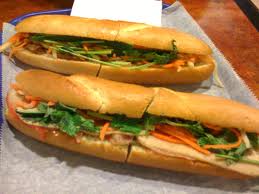
Beautiful Banh Mi
Though not much deters us from over indulging on our food adventures, that there was nothing over six dollars on the menu made it practically impossible for us to resist what was to be a very public display of gluttony. We circled numbers that corresponded to the items on the menu and I brought it up to the proprietor who made it clear that she wanted me to read off the items by the number not by the Vietnamese name. There was number 25, country style beef cubes sautéed with scallion and onions, number 16, spring rolls with grilled pork and vegetables piled on rice vermicelli, number 30, shrimp with string beans, scallions and onion in a satea sauce, number 10, seafood with rice noodles soup, 35, beef noodle soup Hue style, and number 33, sautéed mixed vegetables. Once she wrote all the numbers down, needing two pages of her small pad to do so, she began barking out the numbers to the two Vietnamese women who immediately got to work.

Seafood noodle soup
“You know, they filmed Marty around here with Ernest Borgnine,” Zio blurted over the noise of the air conditioner.
Rick looked at him and as if on cue, shouted back, “You’re just a fat, little man. A fat, ugly man.”
Zio concurred: “I’m ugly! I’m ugly! I’m ugly!”

What do you wanna do tonight? I dunno. What do you wanna do?
The screen test ended when the parade of platters began arriving and even with two round tables pushed together, there was barely enough room to hold them all. So impressive was the display that it drew a comment from two diners who had come in after playing basketball at nearby St. James Park, the man shaking his head in awe while his female companion gazed incredulously. “With all that food, I was saying you all must be food critics,” the male basketball player said.
I waved his assertion off. “No, being critical about food just gets in the way of our eating,” I replied.
And there wasn’t much to be critical about at World of Taste Seafood Deli. If you wanted to be picky, the sautéed dishes; the vegetables and shrimp were nothing out of the ordinary, but maybe that was because we had become jaded after the remarkable banh mi, the spicy, beef noodle soup, and the seafood with rice noodles. Closing time was 8:30 and the staff was cleaning up while we were still picking through the remains of our feast. As they were leaving with their take out order, the basketball players glanced one last time at the devastation we created on our combined two tables and shook their heads in awe.
It hadn’t gotten any cooler once we vacated the World of Taste Seafood. Zio got that gaze on his face again and pointed to the train tracks above us. “Martin Sheen and Tony Musante—you know the movie. . .**“ But before Zio could finish telling us about the movie, the uptown number 4 train rumbling above us cut him off.

Sheen and Musante frolicking on the subway in the Bronx.
*World of Taste Seafood Deli sadly closed in 2009. Soon after, Pho Mien Tay, another Vietnamese restaurant opened in the same spot, but was short-lived followed by Pho Saigon #1, which also did not last. Across the street is another Vietnamese restaurant, called Com Tam Ninh Kieu that has survived the turmoil at 2614 Jerome Avenue that specializes in Pho but without its quirky charms or the magnificent banh mi. Now, at 2614 Jerome there is a nail supply store with signs in Vietnamese.
**The title of the movie Zio was reminiscing about can be found in the title of this post.

World of Taste Seafood Deli: Circa 2011
Treichville
R.I.P
The path to Treichville was a circuitous one. Originally Rick’s pick and scheduled a month earlier, Rick chose the much anticipated Rudar Social Club in Astoria, but the date coincided with the closing of his newly acquired money pit in Atlantic Highlands. At first Rick did not think this would be a conflict; that the closing would be over before our dinner and it was, but seriously challenging his loyalty to his brothers in gluttony, he decided instead to take his lawyer out for a drink. That, coupled with Zio being stricken with a stomach virus so potent that just the thought of Croatian cuisine made him retch, led to us cancelling at the last minute. It took a month to reschedule and again, the Rudar Social Club was Rick’s choice, but this time thoughtfully, giving us a week’s notice, cancelled.

A restaurant posing as a car service
This time, instead of rescheduling, we shifted the choice to Mike from Yonkers, who was next in line. The short notice sent him into a minor panic and he quickly decided on African place in Fort Greene, Brooklyn. The problem, Eugene immediately pointed out via email, was that the place had closed several months earlier. After a few days, a replacement was chosen, a soul food joint in the heart of the trendy East Village, but after deliberating with an anonymous member of our group, Mike from Yonkers determined that the soul joint didn’t fit our criteria. For some reason, and after several years with our group, Mike was still struggling to comprehend our guidelines, loose as they are. But with a little counseling, again from the same anonymous source, he finally came up with another Treichville. The Treichville we were visiting was not the one in the heart of Cote d’Ivoire, but in East Harlem, just a few steps from legendary Patsy’s Pizzeria.
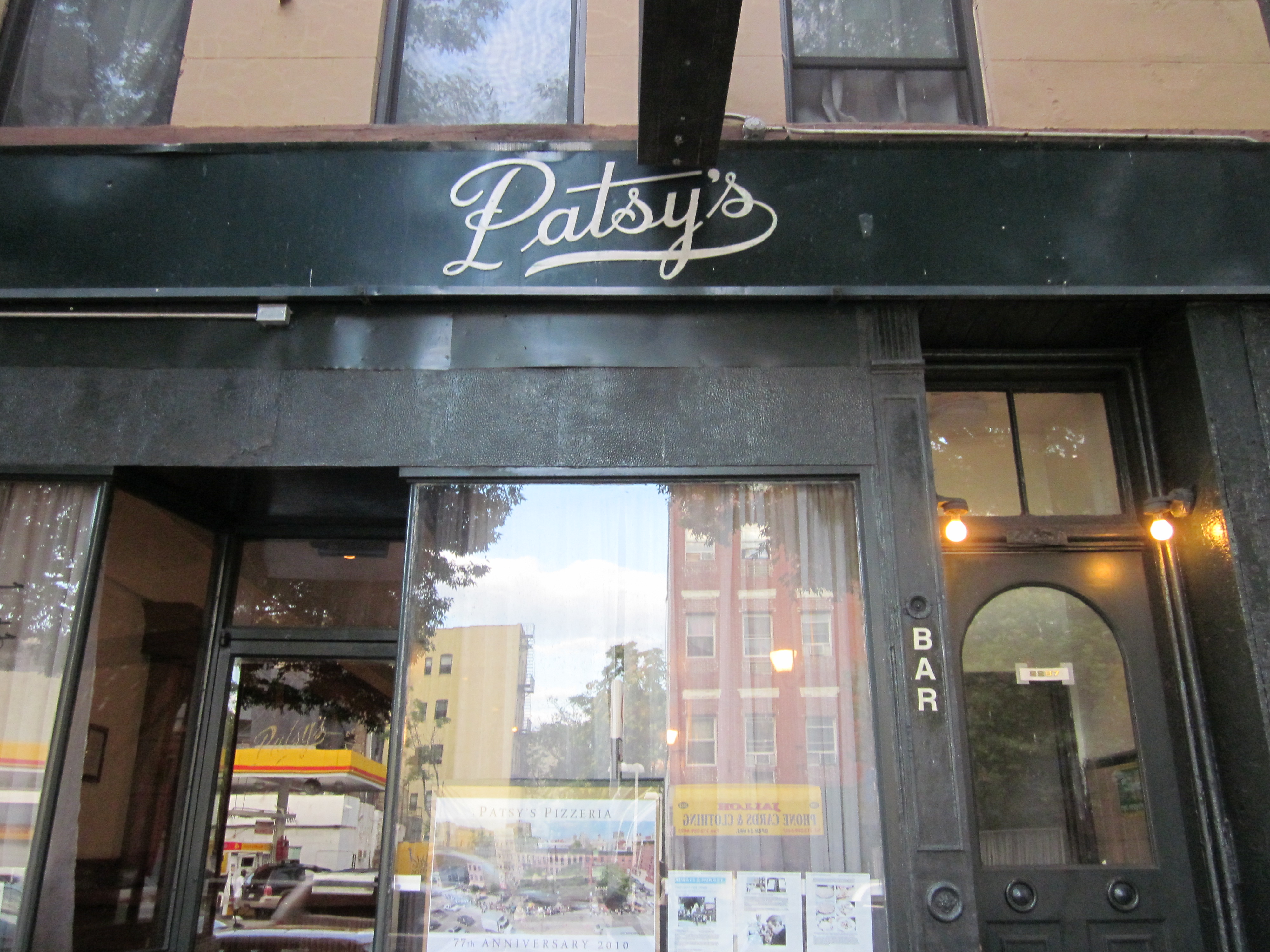
Temptation around the corner.
From the outside on a block on east 118th Street, Treichville looked more like a car service operation than a restaurant. The only hint was the subtle sign above the door with the restaurant’s name and the proclamation of African cuisine. The windows were barred and a neon sign behind them flashed “Open 24 Hours.” I arrived early and hungry and Patsy’s was a serious temptation, but I thought it best to display some willpower. Soon the others arrived and we piled into the tight, low-ceilinged quarters where we were the only diners. The specialty here was West African, specifically the Ivory Coast, and the menu printed in both English and French. Drinks were the usual, ginger beer or sorrel, both homemade and satisfying. But it was the soups on the menu that interested us the most, particularly the pepe (pepper) soup; a combination of crab, cow feet, lamb, and tripe. The host/waiter announced that the pepe was not quite ready yet, but after nudging him wavered and said he would bring out soups for all. While he was at it, we asked for a sampling of Treichville’s specialties—kind of the poor man’s version of a “chef’s tasting menu.” He gladly obliged.
The five of us were first served huge bowls of soup with Eugene, Mike from Yonkers, and Gerry getting the pepe while Zio and I were given chicken soup. Noticing immediately that Zio and I were slighted, our host brought out two more bowls of the pepe. I took a few spoonfuls of the chicken soup, which was more like a stew, enough to gush appreciatively over it and then offered it to the others for tastings while I sampled the pepe, which was not quite what was described in the menu—there was no meat, just fish, crab, mussels, and shrimp—more like a bouillabaisse with the sub-tropical addition of a whole, scotch bonnet chili pepper which Eugene ate inducing a bout of spasmodic hiccupping. Following Eugene’s lead and not knowing the pepper was a spicy garnish and not for eating, Mike from Yonker’s ate his and soon a fine sheen of sweat had formed on his forehead.
Meanwhile, despite my warnings to Zio to just taste both of the soups and not try to finish them all, I noticed the bones of the chicken from his soup picked clean and lined up neatly against the side of his now empty bowl and that he was busy extracting a piece of meat from a slender crab claw that was in his fish soup. When I warned him again, he threw up his hands defiantly. “What do you want me to do? I can’t just leave it!” he said.
Once the soup was cleared, we were all given salads with homemade vinaigrette which helped take down the heat from the soups. Following the salad, two platters of whole fish appeared; one, according to our host was grilled, the other fried, though I could tell no difference. Both were doused in a room temperature onion/mustard sauce and served with a mashed-like condiment of cassava and plantain called foutou. The procession continued with a platter of lamb shank, beef, and grilled chicken, all covered with the same onion/mustard concoction. With the addition of platters each of couscous, cassava, and white rice, our combined tables were overflowing.
The fish, whether grilled or fried, was perfectly moist and tender while the lamb shank, more than enough even for our colossal appetites. The beef and chicken were both fine, but really just pure excess at this point and after a few bites of the fish, I heard Zio groan repeatedly. “I can’t,” he stammered, “No more.” And so, for the first time in our long history of dinners together, Zio was done. He was not alone. We were all pretty much done—the Treichville “chef’s tasting menu” just too much for us. So finally, with Treichville, despite the roundabout way he got to it, Mike from Yonkers nailed the concept of our group and deserved the accolades we heaped upon him at dinner’s end.
*Hoping to return to Treichville a few months ago, I came across thie signs, in duplicate, plastered underneath Treichville’s security gate and on its door.

I would have settled for a “C” grade, but this…
They say it’s so hot out you can fry an egg on a city sidewalk. I tried, but not on a sidewalk. My egg frying experiment was on my roof. I used two methods; both fuel efficient. Method one was placing a frying pan on the roof and letting the100 degree temperature heat it up.

Method One: Note the slightly cooked egg whites on the edge
I also tried cooking an egg the old fashioned way; directly on the roof’s surface.

Eggs the old fashioned way: fried directly on the rooftop surface.
Though it was 100 degrees plus on this day, these eggs had no choice but to be slow-cooked.

Method one: 20 minutes later.
The sun was definitely cooking the egg, but unless you like your eggs very rare, it was not quite done yet.

Old fashioned eggs 20 minutes later
And after another 15 minutes.

Cooked, but…

I forgot to grease the “sidewalk.”
After scraping both out of pan and off the roof, respectively, this is what I got.

Unless you have too much time on your hands or are working on your summer in the city survival skills, I do not recommend frying an egg on a sidewalk or on a rooftop. However, method one could work if the pan is properly greased and allowed at least an hour in 100 plus degree sun before cracking the egg into it.
Frankfurters on the Grill
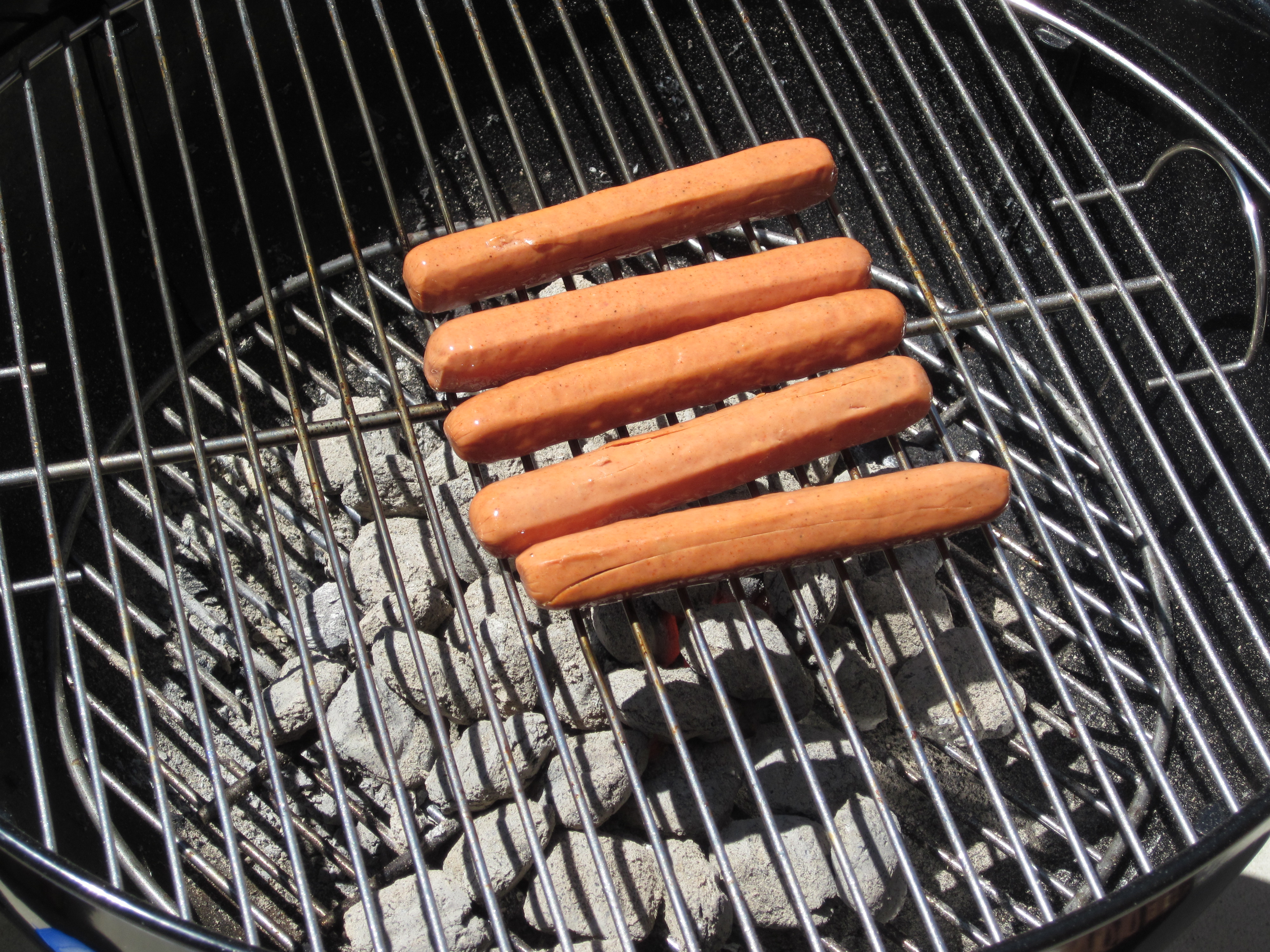
Utensils
Charcoal grill
Chimney starter
Charcoal briquettes
Paper
Matches
Tongs
Ingredients
Frankfurters (Look for all beef with natural casing)
Hot dog buns (American style, top loaders preferred. I will not hold it against anyone if they favor the New England Style even though they were constructed more for lobster meat than a frankfurter)
Mustard (My personal favorite is a spicy, deli-style mustard, but if the bright yellow stuff works for you, who am I to say no?)
Relish (Sweet, emerald green or India)
Ketchup (only if there will be persons under 12 at your Fourth of July barbecue. Proof of age required.)
Butter
Chopped white onions, sauerkraut, chili, or anything else you want on your frankfurter is optional.
Fire Preparation
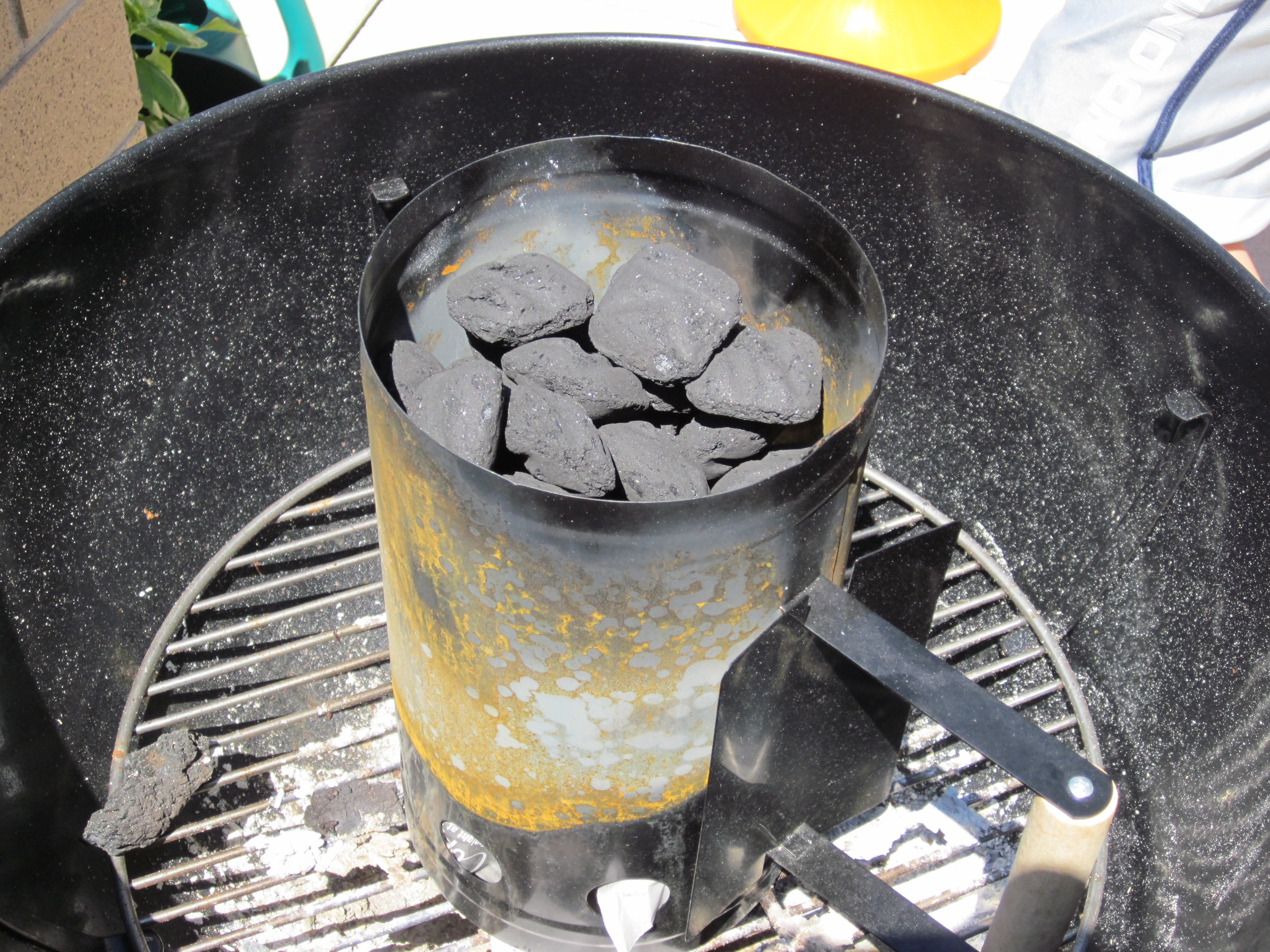
Charcoal in chimney starter
Fill chimney starter with charcoal briquettes
Put one piece of newspaper below, light with match and let charcoal burn unto white and glowing.

Charcoal smoking
Pour hot briquettes into the grill, cover with grate.
Frankfurter Preparation
Slice frankfurters lengthwise with a sharp knife.

Slicing frankfurters
Bun Preparation
Open buns and spread butter on each side.

American Style Buns
Condiment Preparation
Assemble mustard, relish, ketchup and any other condiments you might want.

The Frankfurter Trinity
Place frankfurters on the hot grill, turning frequently with the tongs until the skin splits, bubbles and the sausage’s juices are revealed. They are now done, but if you prefer a dark char on the meat, cook as long as you like.
In the meantime, flatten the buns on the fringe of the grill, away from the direct heat. Watch carefully to make sure they do not burn. Take them off when they are toasted lightly brown.
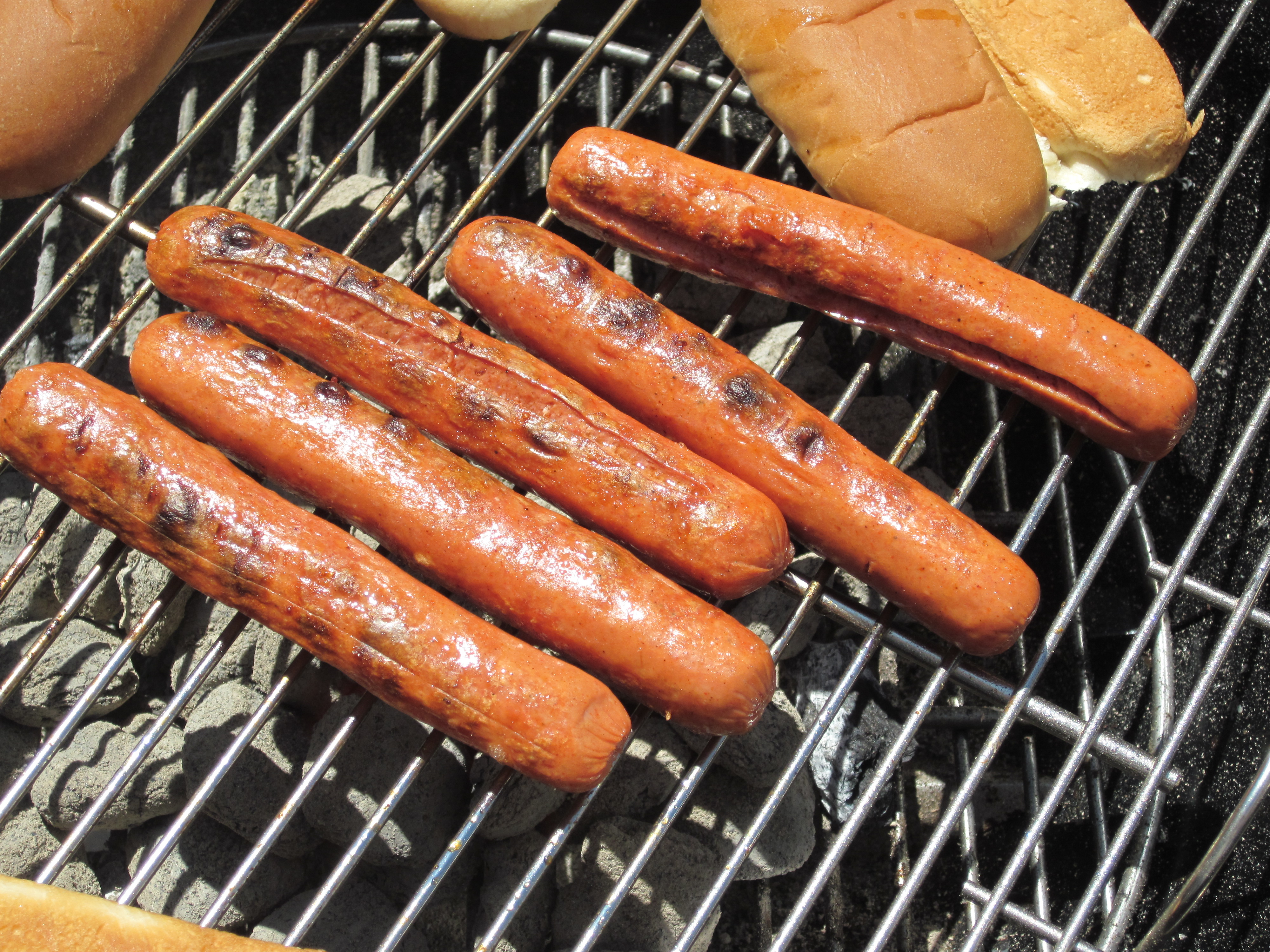
Frankfurters lightly charred, buns toasting on the fire’s fringe.

Perfectly toasted buns

The dressed frankfurter
Place frankfurter in the roll, apply the condiments of choice, and enjoy.

A youngster enjoying his frank (with ketchup).
I consider myself a pizza aficionado (or should I say snob) and have sampled many of the legends. For old school, brick oven, coal fired style I’ve been to original John’s on Bleecker Street, Grimaldi’s just over the Brooklyn Bridge, Patsy’s in East Harlem, Lombardi’s in SoHo, and the original Totonno’s in Coney Island. I’ve experienced the pleasures of the perfect New York “regular” slice at Joe’s on Bleecker. For Sicilian slices, there wasn’t much better than Sal’s in Mamaroneck. Back in my college days, I often ditched dorm dinner to drive over an hour for the clam pie at Frank Pepe’s in New Haven or a meatball “apizza” from Zuppardi’s in nearby West Haven. But I had never been to the much celebrated Di Fara’s Pizzeria in Midwood, Brooklyn.
The crowds waiting to eat at Di Fara’s were as legendary as the pizza. Di Fara’s definitely took planning; open for lunch from 12 until 4:30 and then closed until 6 made the timing tough. Do you get there before 6 and hang out outside waiting for it to open? Do you time it so you arrive after the first wave has ordered? Or do you make Di Fara’s an afternoon- long lunch break? It all seemed too complicated until, finally, Gerry and I ventured to Midwood 2007; leaving in the late afternoon hoping to arrive just as Di Fara’s opened for dinner. It just so happened that our group was scheduled to convene the following night at a traditional, not so celebrated place. What follows below is part one of what turned out to be an eating doubleheader.

Di Fara Pizza
1424 Avenue J
Midwood, Brooklyn
Gerry and I knew it would be a challenge. Zio couldn’t do it; the termites were beginning their early spring spawn and his talents were needed elsewhere. Mike from Yonkers claimed other commitments such as a job. Eugene claimed other commitments such as working out, if that can possibly be believed. Rick was a Di Fara veteran and a hard working executive; consecutive eating orgies might appear to be frivolous. That left only Gerry and I. We were braced for back to back expeditions to the outer boroughs and the culinary pleasures they promised starting with a long anticipated trip to the much hyped Di Fara Pizza followed by a trip to Queens and a Japanese place picked by Eugene called Yamakaze.
Normally we wouldn’t consider a food destination if we classified it “much hyped,” but for Di Fara’s we were willing to make an exception. Yes, the pizzeria had been ballyhooed in all the local publications, many claiming it to be the best pizza in the city. And after making the trek, finding it surrounded by Kosher bakeries and grocery stores on Avenue J in the heart of Jewish-orthodox Midwood, Brooklyn; the exterior non-descript, the interior cramped, the few tables either occupied or empty but with bits of congealed cheese, olive oil, sauce, and crust from possibly a generation of diners still on the tables, the walls, where the paint wasn’t peeling or crumbling, covered with accolades from all the usual suspects: New York Magazine, Time Out New York, Newsday, the Daily News, the Times, along with a photo of Di Fara proprietor and master pizza maker Dominic DeMarco and his daughter with Rob Reiner, and a framed, and very apt quote credited to Mohandas Gandhi: “There is more to life than increasing its speed.”
Gerry and I both were prepared for a wait. We knew Dominic DeMarco took pride in making every pizza himself and his way, which was, so we heard, painstakingly methodical. There is no defined ordering system at Di Fara. When we walked in there were a number of people scattered around the counter. Was there a line to order? I asked but all I got in return were bemused smiles and shrugs. I took that to mean that there wasn’t. But when Dominic’s daughter, who was the old man’s only help that evening, actually asked us what we wanted, we knew we had to be ready with a quick answer. That didn’t leave any time to peruse the options so Gerry and I went with the easiest; a regular “round” pie and two slices of “square.” And to our surprise, there were actually two hot square slices available as well as a just vacated, oil-streaked, tomato sauce-stained table. The slices would work as the perfect appetizer as we waited for our pie.
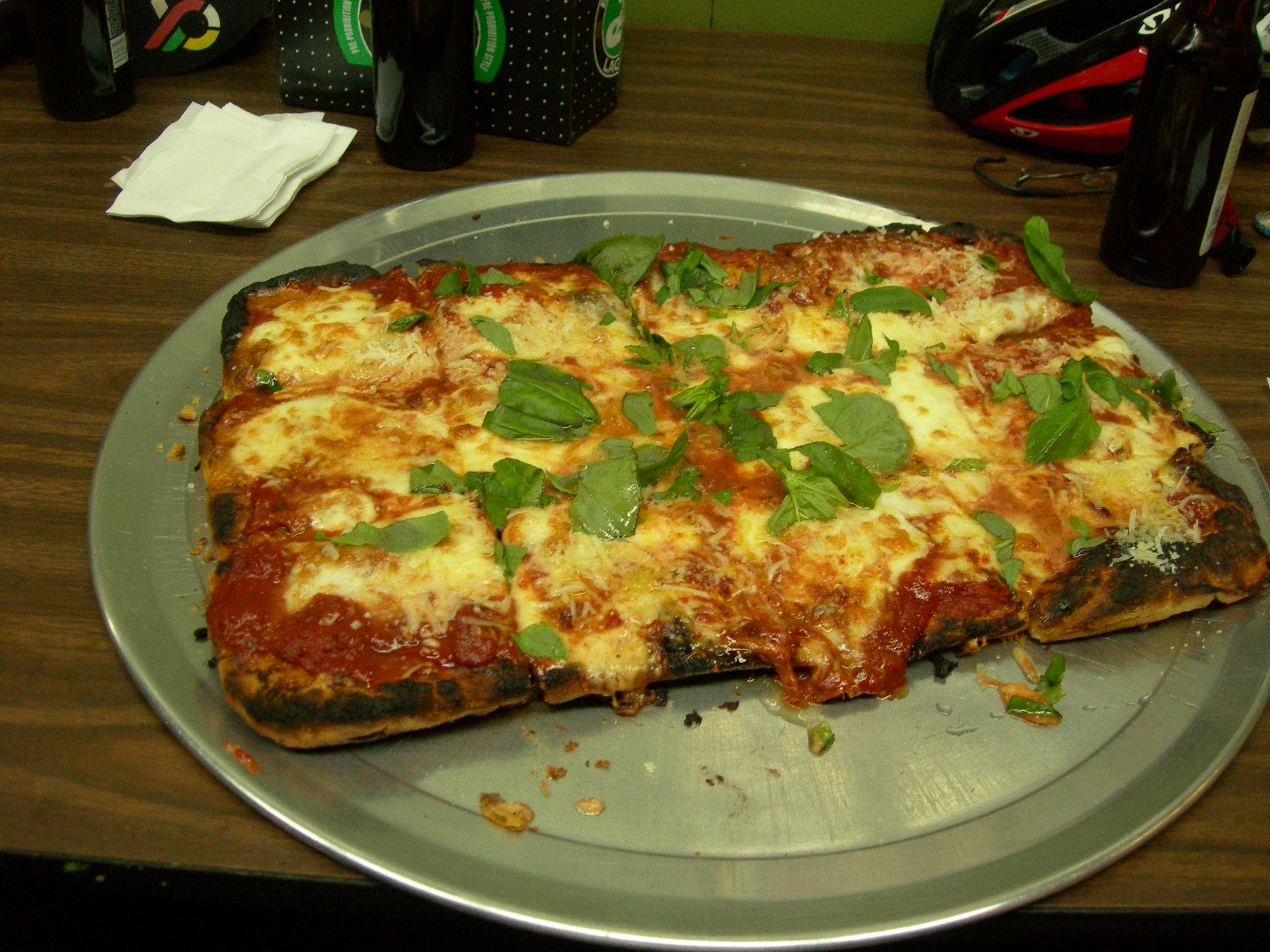
Square Pie
A stack of empty boxes that held cans of San Marzano tomatoes was piled next to the counter which I quickly attributed to the robust sauce on our “square” slices. When lifting the slice the olive oil slid gracefully over the cheese while the crust, cooked not in a wood burning brick oven and despite being saturated by the oil, retained a crunchy, almost fried-like texture. Before even tasting the slice, Gerry, reflexively, added granulated garlic which he almost immediately regretted; the addition totally superfluous.
So we devoured our slices and then began to wait. We had no idea who might have ordered before or after us. People began to fill the small confines, gathering around the counter. DeMarco’s daughter had disappeared into the back; presumably to prepare additional ingredients like sausage, pepperoni, onions, and mushrooms. When she returned, she didn’t immediately go to the counter to take orders but went about her business oblivious of the hordes that were forming. I went out and bought a few beers for the wait and bagels from one of the kosher bakeries for the next morning’s breakfast. A half hour went by. A group of high school students who were there before us were still waiting for their pie. A man sitting and staring at the counter expectantly, also ahead of us, would occasionally get up, take a look at what was going on behind the counter only to return to his seat and resume his staring. The area around the counter was now three deep. Some were waiting for orders, others waiting to put in an order whenever the daughter got around to asking.
Our appetizer, the square slices, instead of holding off our appetites, increased it. We were ravenous. The daughter noticed us and checked her pad; she confirmed that our order had been placed. “Just a few more ahead of you,” she said. That was reassuring.
Forty five minutes had passed. Our beers were gone. I was contemplating the bag of bagels. The high school kids finally got their pizza; we watched as Dominic, a bit stooped, accompanied the pie to the counter, hand grated parmesan cheese from a huge wedge and sprinkled it on the pie, added a slather of olive oil from an old fashioned spouted tin and then brought over a bunch of basil and using scissors, clipped a few leaves onto the pie. Gerry and I eyed the pizza as the kids began to eat. The man waiting next to us got up, made his way to the counter and tried to peer over it. Dominic noticed and nodded. The man acknowledged the nod. Progress. The next pizza out was his.
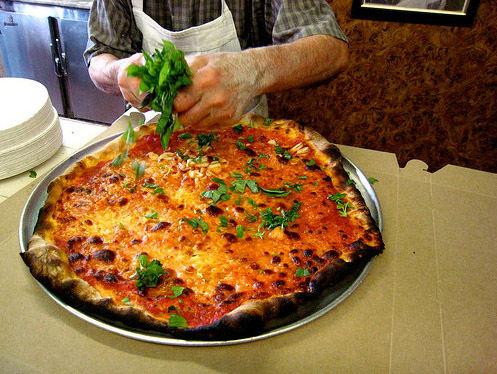
The hands of DeMarco at work.
We were close. We had been waiting just over an hour when we got the nod from Dominic. Gerry got up and let Dominic prepare the pie the Di Fara way; a sprinkling of grated cheese, a few swirls of olive oil, and then the freshly scissor-cut basil. Gerry brought the pie to the table. We waited just a few moments for it to cool down while admiring its aesthetic perfection and then, despite hungry, envious eyes upon us, began to deliberately consume it, slice by slice, finishing in less than a quarter of the time of our wait for it to arrive.
It was large pie and despite its somewhat delicate crust, still heartier than the thin, coal-fueled oven pies from say, Patsy’s in Harlem or Totonno’s in Coney Island. which made finishing it in its entirety an accomplishment or a blatant display of gluttony, depending on your point of view. Gerry and I certainly believed it was the former. What was the point in taking a slice or two home? We could have been generous and shared a last slice with one of the many now waiting anxiously for DeMarco to make their pizza. But then who knew when we would ever return to Midwood and subject ourselves to the bitter and the sweet of Di Fara Pizza? The pizza was extraordinary, but was it worth the long, confusing wait within Di Fara’s dingy, cramped confines. Di Fara’s requires work; you have to plan your visit, trying your best to avoid prime times, but, in a strange way, maybe the extra effort enhances the flavor and overall dining experience. Maybe Di Fara’s pizza would not taste so special if it were more accessible? If nothing else, it was something to think about on the long ride home.
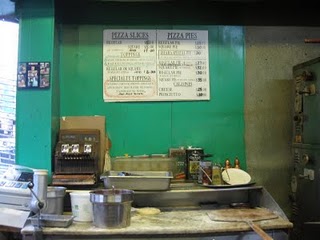
Where the man works.
Since our visit in 2007, Gerry has returned to Di Fara’s several times, but I’ve never been back. Again, it’s the planning thing; I just haven’t cleared the afternoon/evening to make the trek. And Di Fara’s is seemingly recession-proof; in 2009 they upped their slice to a whopping $5. But Di Fara’s is unique; the pizza cannot really be replicated. Or so I thought? According to Di Fara’s website; www.difara.com, there is the sobering news that there will be a Di Fara’s debuting this summer in, where else, Las Vegas. The only good news about that is that the time it takes to get to Midwood from where I live in Manhattan along with the requisite hour plus wait for a pie, it actually might be faster to get a Vegas Di Fara slice into my mouth than a Brooklyn slice.
Welcome back to this month’s installment of Name That Place. I know I’ve been tough on all of you in the previous challenges I’ve presented in this little Fried Neck Bones game we play. So tough that I’ve stumped the masses the previous two times. This time, however, in identifying the joint in question, I will offer multiple images that should serve as hints. There might even be a subtle hint or two amongst the prose here as well.
If you have lived in New York for at least a few years, I would think you would know the place I am hoping you will name. Many have passed through its narrow doors. It’s not an exotic, out of the way place. It’s not hidden in a fringe neighborhood (if such a thing exists in New York anymore). And the food is meant to satisfy almost anyone’s dietary requirements. And at that, I think I’ve said enough. Now let’s let the images speak for themselves.

“Celebrities” are honored to have their photos on display here.

Here is a small sampling of what you might find when flipping through this establishment’s generous menu.

This place was one of the original to have an “open kitchen.” And here the flame is always burning.

Yet contradictions abound here adding to its unique allure.

How many restaurants offer Muscle Milk and Red Bull along with red and white wine from their own barrel?
There they are: five images from the place I am confident you will name. When you identify the place, add it into the comments section below. Look for the answer right here at Fried Neck Bones…and Some Home Fries on Monday.

Salute Kosher Restaurant
63-42 108 Street
Forest Hills
“Time is flying! You’re getting older, but you don’t feel you’ve accomplished anything with your life.” Those were the opening lines to Everything is Possible, a pamphlet based on the teachings of Rabbi Nachman of Breslov that I was handed at the conclusion of our dinner at Salute Kosher Restaurant. The Hasid who fittingly choose that particular pamphlet for me was genial despite our initial reservations about accepting his pamphlets. He remained genial as he took our “tax deductible” contribution to Breslov City in the Galilee in return for the pamphlets. It was the least we could do after our feast of countless inexpensive shish kebabs at this self proclaimed, Uzbek-style restaurant.

Salute Kosher was Eugene ’s second choice. La Kasbah, a Moroccan restaurant in Astoria , was his first, but the phone at the restaurant was no longer in service meaning the restaurant was most likely out of business, so the ever-diligent Eugene steered us to the Forest Hills section of Queens to Salute. Just as the cuisine of Tibet intrigued him enough to choose it in his last pick, the food from Uzbekistan now, for some reason known only to Eugene, piqued his interest.
Suspicious eyes greeted Zio as he was the first to enter the restaurant. The regulars in this Uzbek-Russian enclave of Queens must have wondered what to make of the rotund stranger. The glares were too unsettling for Zio and he decided to wait for the rest of us outside the restaurant. Once Eugene announced his presence inside, however, the guarded looks eased. With his Sicilian-swarthy countenance, Eugene could pass for a Moroccan, not to mention an Uzbek. But when he opened his mouth, and despite reciting the one word of Russian he did know, it was obvious he was anything but an Uzbek. What he couldn’t express to the English-struggling waitress, he compensated by raising his voice until it was booming within the busy restaurant causing more than a few disturbing glances our way. He finally explained to the waitress that we were there to sample a good portion of the extensive menu. After that, language was no longer an issue.
Though Mike from Yonkers had been excused, Rick, whose presence was in doubt, showed up just in time to sample the home made babaganush served with “national” bread. What distinguishes Turkish babaganush from, say, Egyptian, or Greek? The differences are subtle, and Salute’s Uzbek version had an intense creaminess that put it high on the world wide babaganoush meter. We followed that up with a platter of assorted smoked fish. The cured fish were salty and tough enough to survive the harsh winters of Uzbekistan. And I’m only assuming that Uzbekistan has harsh winters.

Our final appetizer was the Uzbek mantu, homemade meat dumplings whose gaminess, after the strong flavor of the fish, I, much to Zio’s horror, just could not tolerate. Even a swill from the Russian beer we were drinking could not extinguish the taste. Thankfully the parade of shish kebabs soon followed. We tried the lamb, the lamb ribs, the lula (ground seasoned lamb), the chicken with bones kebab, and the beef kebab (special cut). But this wasn’t enough for Gerry and Zio, who, in their gluttony, insisted we order another round of lula, chicken (with bones) and, because it was special cut, more beef. Now picked clean of their meat, the sharp-edged skewers on our table were piled dangerously high. Our waitress arrived soon and, without comment, cleared the cutlass-like utensils before Zio could use one to clean his teeth with.
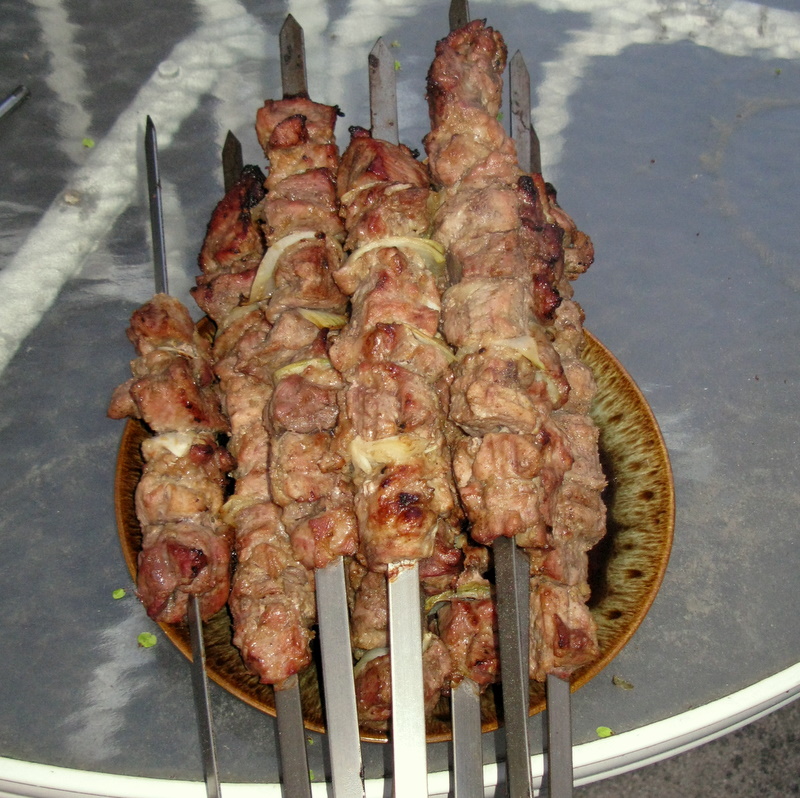
Assortment of kebabs.
As we pondered dessert, a honey-noodle pudding in a box from the grocery store next door, the Hasid entered and despite our initial protestations passed out appropriate pamphlets to all of us. Flipping through “Everything is Possible” I noticed that, according to Rabbi Nachman, the drives—sexual, monetary, pride, eating, and drinking are “water-based” but can be controlled by giving your life back to “G-d.” I’m not sure if it was the forlorn look of the noodle pudding in a box or the words of Rabbi Nachman, that helped me decline dessert, but whatever it was, I made sure I stopped at the grocery store next door for a bottle of water for the ride back home.

 Fried Neck Bones...and some home fries